
The Hadean Earth: Origins of Plate Tectonics
Prologue: The Molten Genesis
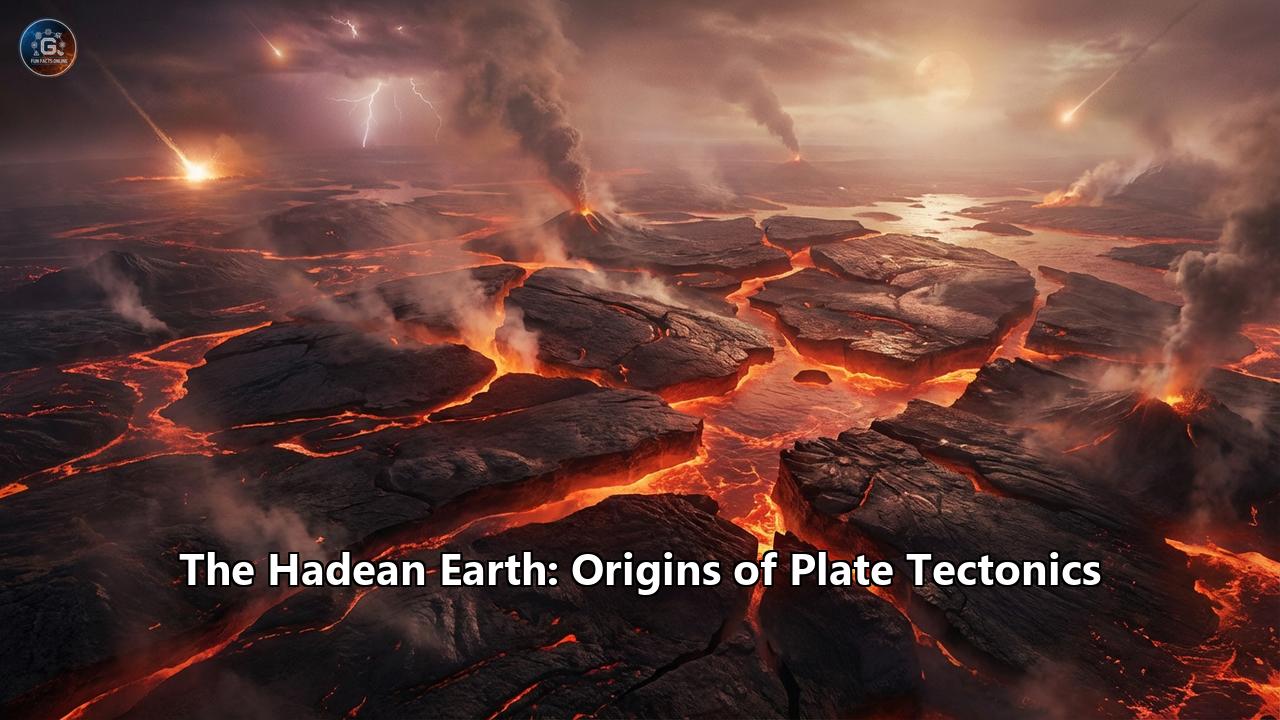
Four and a half billion years ago, the Earth was not the blue marble we know today. It was a sphere of fire and fury, a nascent world born from the violent collisions of the protoplanetary disk. This was the Hadean Eon—named after Hades, the Greek god of the underworld—and for good reason. The surface was a roiling ocean of magma, the sky a choking haze of vaporized rock and primordial gases, and the only light came from the glow of molten lava and the relentless bombardment of asteroids.
Yet, within this hellscape lay the seeds of the most unique and defining feature of our planet: plate tectonics. Unlike any other known world in the solar system, Earth’s surface is a dynamic puzzle of moving plates that constantly recycle the crust, regulate the climate, and build the continents. Without plate tectonics, Earth might have ended up as a scorched wasteland like Venus or a frozen desert like Mars.
The story of how this planetary engine began is one of the greatest detective stories in science. It is a tale woven from microscopic crystals of zircon, computer simulations of planetary interiors, and the study of distant moons and planets. It is the story of how the Hadean Earth transformed from a magma ocean into a habitable world, setting the stage for the emergence of life itself.
Chapter 1: The Magma Ocean and the First Crust
The Aftermath of Theia
The Hadean began with a cataclysm. A Mars-sized protoplanet, often named Theia, collided with the proto-Earth. The energy released was unimaginable, melting the Earth’s mantle and ejecting a ring of debris that would eventually coalesce into the Moon. This event reset the geological clock. The Earth became a global magma ocean, a sea of molten silicate rock thousands of kilometers deep.
As this magma ocean cooled, it began to differentiate. Heavy elements like iron and nickel sank to the core, while lighter silicates floated to the surface. But how did this molten surface solidify into a crust? And was that crust a rigid, immobile shell, or something more dynamic?
The Zircon Paradox
For decades, geologists believed the Hadean Earth was a dehydrated, molten wasteland for its first 500 million years. This view was shattered by the discovery of tiny time capsules: zircons. In the Jack Hills of Western Australia, scientists found zircon crystals dating back to 4.4 billion years ago—mere moments after the Earth formed in geological time.
These zircons told a shocking story. Their chemical signature (specifically, their oxygen isotopes) suggested they formed in the presence of liquid water. This implied that the Earth had cooled rapidly, forming a solid crust and perhaps even oceans as early as 150 million years after its formation.
But the existence of a solid crust does not mean plate tectonics. The crust could have been a "stagnant lid"—a single, unbroken shell covering the entire planet, much like the crust of Mars today. The debate over whether this early crust was mobile or stagnant is the central conflict in understanding Hadean geodynamics.
Chapter 2: The Stagnant Lid vs. The Mobile Lid
The Stagnant Lid Hypothesis
In the standard model of planetary evolution, young rocky planets are hot. You might assume that a hotter interior means more vigorous plate tectonics, but the physics of rocks suggests the opposite. A hotter mantle creates more melt, which leaves behind a dry, stiff residue. Furthermore, without water to lubricate the fault lines, the lithosphere (the rigid outer layer) becomes incredibly strong.
Under these conditions, the crust locks up. Convection currents still swirl in the mantle below, but they cannot break the lid above. Instead, heat builds up until it erupts in massive volcanic outpourings, or "overturns," where the entire crust might founder and sink in a catastrophic global event. This "stagnant lid" regime is what we see on Venus, where the surface is relatively young (about 500 million years old) but shows no sign of a global network of moving plates.
The Heat-Pipe Earth
If the Earth didn't have plates, how did it lose its immense internal heat? A compelling hypothesis is "heat-pipe tectonics," a mechanism we observe today on Jupiter’s moon, Io. On Io, volcanic eruptions are so frequent that they continuously bury the surface under new layers of lava. The older, cold crust is pushed downward not by subduction, but by the sheer weight of the new lava on top.
A heat-pipe Earth would have been a world of constant, violent volcanism. Thousands of volcanoes would puncture the crust, venting heat directly from the mantle. As lava flowed out, the crust would thicken and sink vertically. This mechanism could explain how the Earth cooled efficiently without needing plate tectonics.
Evidence for Early Mobility
However, the Jack Hills zircons present a problem for the stagnant lid and heat-pipe models. Some of these zircons contain inclusions of minerals that typically form under high pressure but relatively low temperatures—conditions found today only in subduction zones, where cold oceanic crust is dragged deep into the hot mantle.
Furthermore, the chemical composition of these ancient crystals resembles that of granites—rocks that, on modern Earth, are formed almost exclusively above subduction zones. This has led some researchers to propose that "proto-plate tectonics" or "mobile lid" tectonics began much earlier than previously thought, perhaps as early as 4.2 to 4.4 billion years ago.
Chapter 3: Igniting the Engine—How Subduction Began
Initiating a subduction zone is the hardest problem in geodynamics. It requires breaking a solid, cold rock layer (the lithosphere) and forcing it to bend and sink into the mantle. Today, old oceanic plates sink because they are cold and dense, but on a young, hot Earth, the plates might have been too buoyant to sink on their own. So, what started the engine?
Mechanism 1: Plume-Induced Subduction
The Hadean mantle was hotter and more vigorous than today's. It likely generated massive "mantle plumes"—mushroom-shaped upwellings of hot rock from the core-mantle boundary. When a super-plume hits the base of the lithosphere, it weakens it. The crust above bulges, cracks, and spreads.
Computer models show that if a plume is strong enough, it can break the stagnant lid. As the plume material spreads out, it can push the older, colder crust at the edges down into the mantle, forcing a slab to sink. This "plume-induced subduction" creates a localized subduction zone. It might not have been a global network yet, but rather a patchy system of sinking plates triggered by rising plumes.
Mechanism 2: The Cosmic Hammer (Impact Tectonics)
The Hadean was also the era of the Late Heavy Bombardment. The solar system was still cleaning up the debris of its formation, and Earth was pummeled by asteroids and comets.
A massive impactor—say, 500 kilometers wide—would punch a hole through the crust and into the mantle. This wouldn't just make a crater; it would instantaneously weaken the lithosphere and create a massive melt pool. The surrounding cold crust, now unstable, could slump into the hole, starting a subduction-like process. Some models suggest that the "subduction" we see evidence of in Hadean zircons wasn't continuous plate tectonics, but episodic subduction triggered by these giant impacts.
Mechanism 3: Water Weakening
This is perhaps the most critical factor. Water is the lubricant of plate tectonics. It enters the crystal lattice of minerals like olivine and weakens them, lowering the "yield strength" of the rock. Without water, the Earth's crust would be too strong to break.
The early formation of oceans (as proven by the zircons) meant that water could hydrate the oceanic crust. As this hydrated crust got buried (perhaps by heat-pipe volcanism), it released water into the mantle, lowering its viscosity and making it easier for the crust to slide and bend. This feedback loop—water weakening the rocks, allowing subduction, which carries more water into the mantle—may have been the tipping point that allowed Earth to transition from a stagnant lid to a mobile one.
Chapter 4: The Hadean Landscape
To visualize the Hadean Earth during this transition, we must discard our modern sensibilities.
The Sky: The atmosphere was dominated by carbon dioxide, nitrogen, and water vapor. There was no free oxygen, so the sky was not blue. Instead, it was likely a hazy, reddish-orange, similar to Titan, due to hydrocarbon smog or simply the scattering of light through a dense, dusty atmosphere. The Oceans: The oceans were not blue. Rich in dissolved iron (which had not yet oxidized into rust), the Hadean seas would have appeared green or perhaps dark purple if early halophilic microbes were present. The Land: There were no green continents. The land consisted of black basaltic volcanic islands and perhaps small "proto-continents" of grey granite. These landmasses were barren, stark, and constantly reshaped by volcanism and impacts. The Sounds: It was a noisy world. The constant rumble of volcanoes, the hiss of escaping steam, the crash of meteorite impacts, and the howling winds of a dense, turbulent atmosphere would have created a cacophony of geological violence.Chapter 5: The Origin of Life Connection
The origins of plate tectonics are inextricably linked to the origins of life. The "Warm Little Pond" theory of Darwin has largely been supplanted or supplemented by the "Hydrothermal Vent" hypothesis.
Alkaline Vents
Deep in the Hadean oceans, seawater seeped into the fractured crust. It was heated by magma and reacted with the ultramafic rocks (peridotite), a process called serpentinization. This reaction released hydrogen gas and created highly alkaline fluids.
When these hot, alkaline fluids vented back into the cool, slightly acidic, iron-rich Hadean ocean, they precipitated porous chimneys of carbonate and silica. These chimneys were natural electrochemical reactors. The gradients of pH and temperature across the chimney walls provided energy—analogous to the proton gradients that drive ATP synthesis in living cells today.
Plate tectonics (or at least active volcanism and crustal cracking) was essential to keep these vents active. It provided the fresh rock and the heat source. Without the geological recycling of the crust, the chemical gradients needed for life might have faded away.
Nutrient Supply
Furthermore, subduction and volcanism bring essential nutrients like phosphorus, sulfur, and transition metals from the mantle to the surface. A stagnant lid planet locks these nutrients away in its interior. A mobile lid planet constantly exhumes them, dusting the oceans with the fertilizers of life. It is no coincidence that life likely emerged on the only planet with active tectonics.
Chapter 6: The Transition to the Archean
As the Hadean Eon gave way to the Archean (around 4.0 billion years ago), the Earth’s tectonic engine stabilized. The mantle cooled slightly, the lithosphere thickened just enough to become negatively buoyant (denser than the mantle), and the sporadic, impact-driven or plume-driven subduction coalesced into a self-sustaining global network.
The continents began to grow. The subduction of hydrated oceanic crust led to the production of vast amounts of tonic, trondhjemitic, and granodioritic (TTG) magmas—the precursors to modern continental crust. These distinct "cratons" floated on the mantle like rafts, eventually colliding to form the first supercontinents.
This transition marked the end of the "hellish" Hadean and the beginning of the familiar geologic cycles. The carbon-silicate cycle established itself, with plate tectonics acting as a planetary thermostat. Volcanoes pumped CO2 out, and the weathering of new silicate rocks drew it down, preventing the Earth from freezing over or boiling away.
Epilogue: The Unique Earth
Why did Earth develop plate tectonics while its neighbors did not?
- Venus: Likely too hot. The water evaporated, leaving a dry, stiff crust that couldn't break. It remains in a stagnant/episodic lid regime.
- Mars: Too small. It cooled too fast, its lithosphere became too thick and rigid to bend, freezing its tectonics in place billions of years ago.
- Earth: The "Goldilocks" planet. It was large enough to retain its internal heat and water, but cool enough for the lithosphere to be dense and subductable.
The story of the Hadean is the story of how our planet avoided the fates of its siblings. It is a story of a violent beginning that forged a delicate balance—a balance that allowed the crust to move, the oceans to cycle, and life to emerge from the fire and water.
While we may never stand on the shores of the Hadean ocean or watch the orange sun set over a black volcanic range, we see the legacy of that time every day. We see it in the mountains raised by colliding plates, in the air we breathe regulated by tectonic cycles, and in the very ground beneath our feet, which is slowly, inexorably, on the move. The Hadean was not just a chaotic prologue; it was the crucible in which the modern Earth was cast.
Reference:
- https://en.wikipedia.org/wiki/Hadean
- https://www.hou.usra.edu/meetings/lpsc2023/pdf/2723.pdf
- https://www.researchgate.net/publication/320025242_Impact-driven_subduction_on_the_Hadean_Earth
- https://www.futurity.org/heat-pipe-earth-plate-tectonics-1753492/
- https://en.wikipedia.org/wiki/Heat-pipe_tectonics