
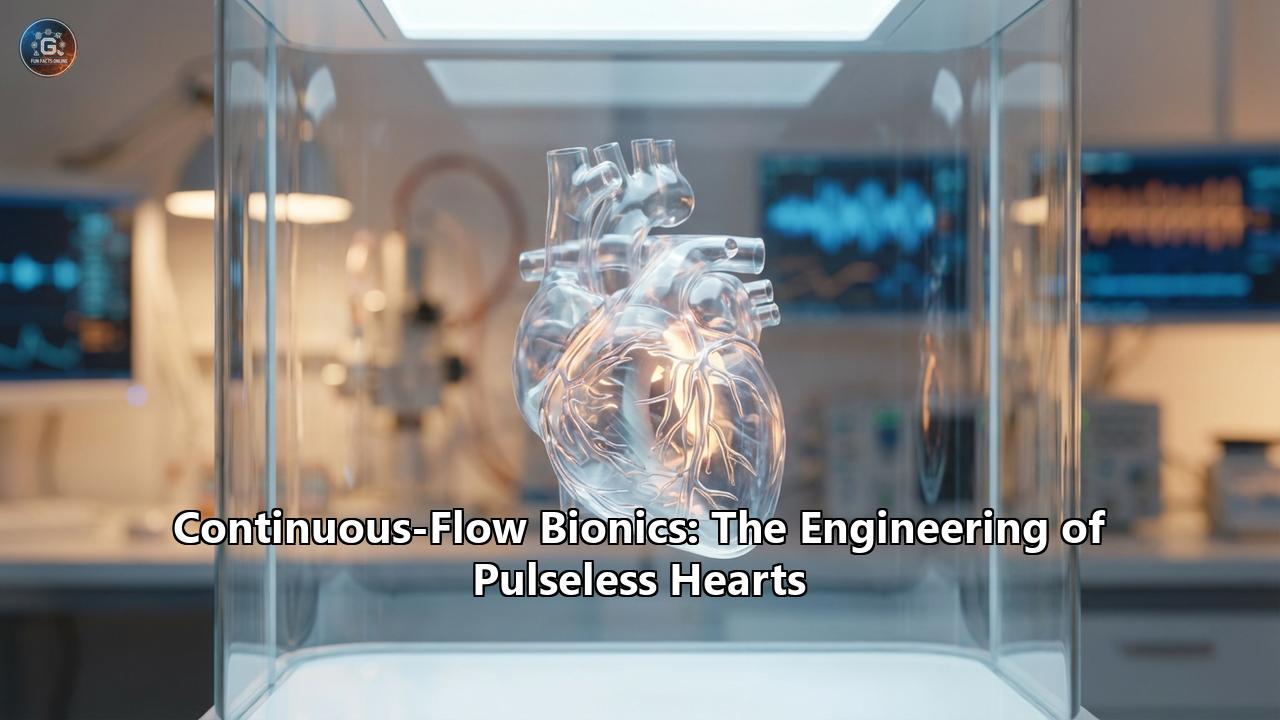
For millennia, the heartbeat has been the universal signifier of life. The rhythmic thumping in the chest—the systole and diastole that drive blood through miles of vessels—has been romanticized in literature, measured in medicine, and accepted as an absolute biological necessity. To check for life is to check for a pulse. Yet, at the bleeding edge of cardiovascular engineering, a radical paradigm shift is rewriting the rules of physiology. In the realm of continuous-flow bionics, the most advanced artificial hearts in the world do not beat. They whir.
The concept of a pulseless human, sustained by a continuously spinning rotor suspended in a magnetic field, bridges the disciplines of fluid dynamics, aerospace engineering, and cardiothoracic surgery. This transition from biomimetic, pulsatile artificial hearts to continuous-flow rotary pumps marks one of the most significant leaps in the history of medical technology. By abandoning millions of years of evolutionary design in favor of industrial efficiency, engineers are creating durable, life-sustaining machines that could ultimately render end-stage heart failure a manageable, mechanical problem rather than a terminal diagnosis.
The Mechanical Heartbreak: The Flaws of Biomimicry
To understand why the future of the artificial heart is pulseless, one must examine the failures of the past. The quest for a total artificial heart (TAH) began in earnest in the mid-20th century, driven by the ambition to replicate the natural heart’s function. Early pioneers assumed that to replace the heart, one had to copy its mechanics. This approach, known as biomimicry, resulted in volume-displacement pumps: machines equipped with flexible polyurethane diaphragms, artificial valves, and pneumatic drivers designed to inflate and deflate, mimicking the biological squeeze.
The most famous of these early devices, the Jarvik-7, achieved historical notoriety in 1982 when it was implanted into Barney Clark. Its descendant, the SynCardia temporary Total Artificial Heart, remains the only FDA-approved TAH in use today. While these devices have successfully bridged hundreds of patients to transplantation, they are fundamentally limited by their reliance on pulsatile mechanics.
The human heart beats approximately 100,000 times a day, or 35 million times a year. In biological tissue, cells constantly regenerate and repair themselves to withstand this relentless mechanical stress. Synthetic materials, however, do not heal. A mechanical diaphragm flexing 35 million times a year is subjected to immense material fatigue, making long-term durability a nearly insurmountable engineering challenge. Furthermore, these displacement pumps are loud, bulky, and require multiple artificial valves, which are prone to structural failure and blood clotting. Their sheer size precludes them from being implanted in many women and children. Most critically, they require external pneumatic compressors to drive air through thick hoses that exit the patient's abdomen, tethering patients to cumbersome machinery and creating a permanent gateway for severe, life-threatening infections.
Faced with the seemingly impossible task of building a machine that could flex billions of times over a patient's lifespan without breaking, engineers asked a revolutionary question: Is the pulse actually necessary, or is it merely an artifact of biological tissue?
In nature, the pulse exists because cardiac muscle must contract and relax to fill with blood. But in the world of mechanical engineering, the most efficient way to move fluid is not with a flexing sack, but with a spinning propeller.
The Rotary Revolution: When Spinning Replaces Beating
The shift toward continuous flow began not with total artificial hearts, but with Left Ventricular Assist Devices (LVADs). Developed to support a failing native heart rather than replace it entirely, the first generation of LVADs were also pulsatile, bulky, and prone to mechanical breakdown. However, in the late 1990s and early 2000s, engineers introduced continuous-flow LVADs. These devices utilized high-speed rotary impellers—similar to the turbines in a jet engine or the water pumps in a submarine—to propel blood from the failing left ventricle continuously into the aorta.
When patients were fitted with these continuous-flow LVADs, an extraordinary physiological phenomenon emerged. Because the pump was pushing blood continuously, it began to drown out the weak, natural pulse of the failing heart. Medical professionals found themselves standing over living, talking, breathing patients who had no palpable pulse and a flatline on a traditional blood pressure monitor.
The realization that human organs could perfuse, filter, and function perfectly well without pulsatile blood pressure opened the door to a new era of bionics. If a continuous-flow pump could support half the heart, could two continuous-flow pumps replace the entire organ?
Pioneers of the Pulseless Frontier: The Texas Heart Institute
The concept of a fully continuous-flow total artificial heart found its earliest and most aggressive champions at the Texas Heart Institute (THI) in Houston, a legendary epicenter of cardiovascular innovation. Here, cardiothoracic surgeon Dr. O.H. "Bud" Frazier, alongside Dr. William E. Cohn—a prolific medical inventor with more than 90 patents—began an ambitious series of experiments.
Dr. Cohn and Dr. Frazier theorized that two continuous-flow rotary pumps could be stitched together to serve as a complete artificial heart. To prove it, they began testing in animal models, excising the beating hearts of calves and replacing them with twin rotary pumps. The calves recovered, stood up, ate, and walked on treadmills with entirely continuous, pulseless blood flow. In 2011, this foundational research reached a historic milestone. Dr. Cohn and Dr. Frazier successfully implanted the world's first continuous-flow, pulseless total heart replacement into a human patient, Craig Lewis, whose native heart was ravaged by amyloidosis. Though the patient eventually passed away from his underlying systemic disease, the operation proved unequivocally that a human could live, wake up, and communicate without a pulse.
However, duct-taping two separate LVADs together was not a sustainable, permanent solution for the broader population. The human circulatory system is immensely complex; the systemic circulation (the body) operates at high pressure, while the pulmonary circulation (the lungs) operates at much lower pressure. Balancing the outputs of two separate, independent rotary pumps in real-time proved computationally and hemodynamically treacherous. What was needed was a single, unified device built from the ground up to handle both circulations simultaneously.
The Magic of MagLev and Fluid Dynamics
The greatest enemy of any rotary pump is friction. Early continuous-flow devices utilized mechanical bearings to keep the spinning rotor in place. While effective for short periods, blood is a delicate and unforgiving biological fluid. When blood comes into contact with the heat generated by mechanical friction, or when it enters the tiny microscopic crevices around a physical bearing, it invariably forms dangerous clots (thrombosis). Conversely, if the spinning blades of the rotor strike the blood too violently, they shear and destroy red blood cells (hemolysis).
To solve this, biomedical engineers turned to magnetic levitation (MagLev)—the exact same physical principles used to float high-speed bullet trains above their tracks.
By embedding electromagnets into the titanium housing of an artificial heart, engineers could suspend the rotor in mid-air (or rather, mid-blood). A magnetically levitated rotor floats frictionless within the pump cavity. Because there are no mechanical bearings, there is no heat generation, no physical wear and tear, and crucially, wide "blood gaps" can be engineered around the rotor. Blood can flow freely over, under, and around the spinning mechanism, aggressively washing the surfaces to eliminate the stagnant zones where clots typically form.
This MagLev technology represents the pinnacle of current continuous-flow bionics. It guarantees unprecedented durability. Without mechanical friction, a magnetically levitated titanium rotor can theoretically spin uninterrupted for decades, outlasting the biological lifespan of the patient.
The Anatomy of the BiVACOR Total Artificial Heart
The culmination of decades of research into continuous-flow, MagLev technology is materialized in the BiVACOR Total Artificial Heart. Invented by biomedical engineer Dr. Daniel Timms and championed clinically by Dr. William Cohn at THI, the BiVACOR TAH is a masterclass in elegant, simplified engineering.
Rather than utilizing two separate pumps to manage the lungs and the body, the BiVACOR TAH features a unique, brilliantly compact design: a single moving part. It utilizes a centrally located, magnetically suspended double-sided centrifugal rotor. On one side of the rotor, smaller vanes propel blood to the low-pressure pulmonary system; on the flip side, larger vanes propel blood to the high-pressure systemic circulation.
Because both the left and right impellers are attached to the same spinning hub, the device operates with a single motor, dramatically reducing its size, weight, and power consumption. Constructed from biocompatible, corrosion-resistant titanium, the entire device is roughly the size of a fist, making it suitable for a vast majority of adults, including women and smaller men who were excluded by the massive sizes of older pneumatic hearts.
Despite its diminutive size, the BiVACOR is remarkably powerful. Spinning at several thousand revolutions per minute, it is capable of pumping over 12 liters of blood per minute—enough cardiac output to sustain an adult male engaged in strenuous physical exercise.
On July 9, 2024, the field of cardiovascular bionics achieved a monumental breakthrough. The Texas Heart Institute and BiVACOR announced the successful first-in-human implantation of the BiVACOR TAH as part of a U.S. FDA Early Feasibility Study. This historic operation proved the viability of a dual-sided, single-rotor MagLev artificial heart, marking the beginning of the end for the bulky, pulsatile hearts of the 20th century.
The Cleveland Clinic CFTAH: A Divergent Engineering Path
While BiVACOR utilizes active electromagnetic levitation, another prominent continuous-flow device under development offers a different engineering philosophy. The Cleveland Clinic Continuous-Flow Total Artificial Heart (CFTAH) has been iterating on its own unique pulseless design.
Like the BiVACOR, the CFTAH utilizes a single continuous-flow pump assembly with centrifugal impellers on both ends to manage both the left and right circulations. However, its method of rotor suspension is distinct. Rather than relying entirely on complex electronic sensors and active electromagnetism to keep the rotor perfectly centered, the CFTAH utilizes a combination of passive magnetic forces and a blood-lubricated hydrodynamic journal bearing. The rotor is designed to move axially and radially until it finds a natural, balanced position where magnetic and fluid dynamic forces achieve equilibrium.
This approach aims to provide passive, inherent hydraulic flow and pressure regulation, theoretically reducing the complexity of the internal electronics. Long-term animal trials using the CFTAH have demonstrated excellent biocompatibility and systemic performance, though engineers have had to continuously refine the design of the right impeller and the pump housing using complex Computational Fluid Dynamics (CFD) to prevent varying degrees of thrombus from forming during explant studies. The iterative improvements of devices like the CFTAH highlight the incredible precision required to balance flow dynamics, rotor geometry, and hematological health.
The Blood Barrier: Hemocompatibility and Shear Stress
Engineering a machine to pump fluid is straightforward; engineering a machine to pump blood is one of the most difficult challenges in modern science. Blood is a living, complex tissue, filled with delicate cellular structures and an incredibly sophisticated biochemical cascade designed to clot the moment it detects foreign material or abnormal flow patterns.
The success of any continuous-flow bionic heart hinges entirely on its "hemocompatibility". When blood passes through a high-speed rotary pump, it experiences non-physiologic shear stress. If the shear stress is too high, it rips open the membranes of erythrocytes (red blood cells), spilling free hemoglobin into the plasma—a toxic condition known as hemolysis. Furthermore, elevated shear forces can mechanically uncoil and degrade von Willebrand factor (vWF), a crucial protein responsible for blood coagulation, leading to acquired von Willebrand syndrome and dangerous internal bleeding.
Engineers combat these issues using advanced Computational Fluid Dynamics to optimize the precise angle, pitch, and curvature of the titanium impeller blades. The goal is to ensure a smooth, laminar flow of blood, avoiding turbulence and high-velocity jets. In vitro testing of the BiVACOR TAH, for instance, circulated cattle blood for hours against physiological pressures to measure these exact metrics. The normalized indices of hemolysis and the degradation of vWF multimers were shown to be remarkably similar to clinically approved, highly successful reference pumps (like the CentriMag), proving that continuous-flow rotary systems can achieve exceptional hemocompatibility.
The Physiology of Pulselessness: How the Body Adapts
The human body's ability to adapt to a pulseless existence is a marvel of biological resilience, but it is not without its physiological enigmas. The arterial pulse is not just a mechanical wave; it acts as a signaling mechanism for the endothelium—the inner lining of the blood vessels. The pulsatile shear stress on endothelial cells triggers the release of nitric oxide, a powerful vasodilator that helps regulate blood pressure and vascular health.
When a patient transitions to continuous flow, the sudden lack of pulsatility causes the vascular tree to initially stiffen. The kidneys, which rely on pulsatile pressure to optimize glomerular filtration, must recalibrate their renin-angiotensin-aldosterone systems. Yet, clinical data from thousands of continuous-flow LVAD patients have demonstrated that the human body compensates. The organs adapt to the steady, non-pulsatile perfusion, and systemic function is maintained.
Interestingly, despite the shift away from biomimicry, modern bionic hearts have a trick up their sleeve to satisfy the body's latent desire for a pulse. While the pump operates continuously, the advanced controllers managing MagLev systems like the BiVACOR can artificially simulate pulsatile outflow. By rapidly modulating the rotor's rotational speed—revving it up and slowing it down once per second—the magnetic levitation system can create an "artificial pulse". This modulation can help wash out the pump chambers to prevent clotting and provide the native vascular system with the pulse-pressure waves it evolved to expect, bridging the gap between continuous flow efficiency and biological signaling.
The Algorithmic Heart: Smart Controllers and Metabolic Demand
A biological heart is governed by the autonomic nervous system. When a person stands up, exercises, or experiences stress, adrenaline and neural signals instantly command the heart to beat faster and pump harder. An artificial heart made of titanium has no nerves. How does it know when the body needs more blood?
In early continuous-flow devices, the speed of the pump was manually set by a clinician. A patient operating at a fixed 5,000 RPM would have enough blood flow to walk comfortably but might find themselves gasping for breath if they attempted to climb a steep flight of stairs, as their mechanical heart could not ramp up its output.
The future of continuous-flow bionics lies in the algorithmic heart—smart controllers that act as a digital autonomic nervous system. The magnetic levitation systems in devices like BiVACOR act not only as bearings but as highly sensitive pressure gauges. By continuously monitoring the electrical current required to keep the rotor suspended and spinning, the device’s microprocessors can instantly calculate the resistance and pressure of the patient's circulatory system thousands of times per second.
If a patient begins to exercise, their blood vessels dilate to deliver oxygen to the muscles, causing systemic vascular resistance to drop. The smart controller detects this sudden drop in pressure and automatically increases the RPM of the magnetic rotor, dynamically ramping up the cardiac output from 5 liters per minute to 10 or 12 liters per minute without the patient ever having to press a button. This self-regulating, autonomous physiological response is what transforms a simple rotary pump into a truly bionic organ.
Severing the Tether: Power and Autonomy
If there is a remaining Achilles heel in the realm of mechanical circulatory support, it is the driveline. For a continuous-flow artificial heart to spin, it requires a constant, uninterrupted supply of electricity. Currently, this power is delivered via a percutaneous driveline—a specialized cable that physically exits the patient's body, typically through the abdomen, and connects to an external controller and battery pack worn in a bag or a vest.
This permanent breach in the skin is a major vulnerability, serving as a conduit for severe bacterial infections. Driveline infections are one of the leading causes of morbidity and mortality in patients with long-term mechanical circulatory support. To make the continuous-flow total artificial heart a true "destination therapy" (a permanent alternative to biological heart transplantation), the tether must be severed.
The frontier of this effort is Transcutaneous Energy Transfer Systems (TETS). TETS utilizes electromagnetic induction to transmit electrical power across the intact skin, identical in principle to the wireless charging of a modern smartphone but on a much more powerful and critical scale. In a fully implantable system, an internal battery and a receiving coil are surgically placed under the patient’s skin. The patient wears an external transmitting coil over the implant site. Power passes invisibly through the skin, running the artificial heart and keeping the internal battery topped off.
Should the patient wish to shower or swim, they can remove the external transmitter and rely entirely on the internal battery for several hours. By completely closing the skin, TETS eliminates the driveline infection risk, fundamentally altering the psychology and physiology of living with a bionic heart. Unencumbered by wires, a patient with a continuous-flow total artificial heart could achieve a quality of life virtually indistinguishable from a healthy biological human.
The Philosophical and Clinical Horizon
The engineering of pulseless hearts forces us to confront deep philosophical questions about the nature of human life. For generations, the absence of a pulse was the clinical definition of death. Today, a person can sit across from you, engaging in animated conversation, breathing, thinking, and feeling, while inside their chest, a titanium rotor hums in perfect, continuous silence.
The profound success of continuous-flow bionics—spearheaded by visionaries at the Texas Heart Institute, the Cleveland Clinic, and innovative firms like BiVACOR—signals an impending revolution in cardiovascular medicine. Heart failure remains a leading cause of death globally, and the demand for biological donor hearts will forever outpace the supply. The continuous-flow total artificial heart promises a reality where donor shortages are irrelevant.
Because devices like the BiVACOR TAH utilize non-contact magnetic suspension and have no points of mechanical wear, their operational lifespan is practically limitless. They are immune to the rejection that plagues biological heart transplants, require no immunosuppressive drugs, and are compact enough to be stockpiled on hospital shelves, ready for immediate implantation.
As these devices move from Early Feasibility Studies to broader clinical trials, the medical community is preparing for a world where end-stage biventricular heart failure is no longer a death sentence, but an engineering challenge that has been definitively solved. The transition from biomimetic beating machines to continuous-flow, magnetically levitated rotors is a testament to the power of human ingenuity. By letting go of the biological past and discarding the pulse, science has discovered how to keep the human machine running indefinitely. The future of the heart, it turns out, is a quiet, continuous, and unyielding whir.
Reference:
- https://eureka.patsnap.com/blog/bivacor-total-artificial-heart/
- https://www.facs.org/for-medical-professionals/news-publications/news-and-articles/bulletin/2026/march-2026-volume-111-issue-3/with-real-momentum-total-artificial-heart-technology-faces-defining-chapter/
- https://www.texasheart.org/people/william-e-cohn/
- https://www.tmc.edu/leader/billy-cohn-m-d/
- https://www.texasheart.org/the-texas-heart-institute-implants-bivacor-total-artificial-heart/
- https://bivacor.com/
- https://pmc.ncbi.nlm.nih.gov/articles/PMC8934311/
- https://www.ovid.com/jnls/asaiojournal/abstract/10.1097/mat.0000000000002076~cleveland-clinic-continuous-flow-total-artificial-heart?redirectionsource=fulltextview
- https://pmc.ncbi.nlm.nih.gov/articles/PMC12954472/
- https://www.researchgate.net/figure/The-Continuous-Flow-Total-Artificial-Heart-shown-as-a-schematic-A-and-ex-vivo-B_fig12_51776386
- https://pubmed.ncbi.nlm.nih.gov/40960057/
- https://tollbit.houstonchronicle.com/news/houston-texas/health/article/texas-heart-institute-announces-groundbreaking-19596234.php