
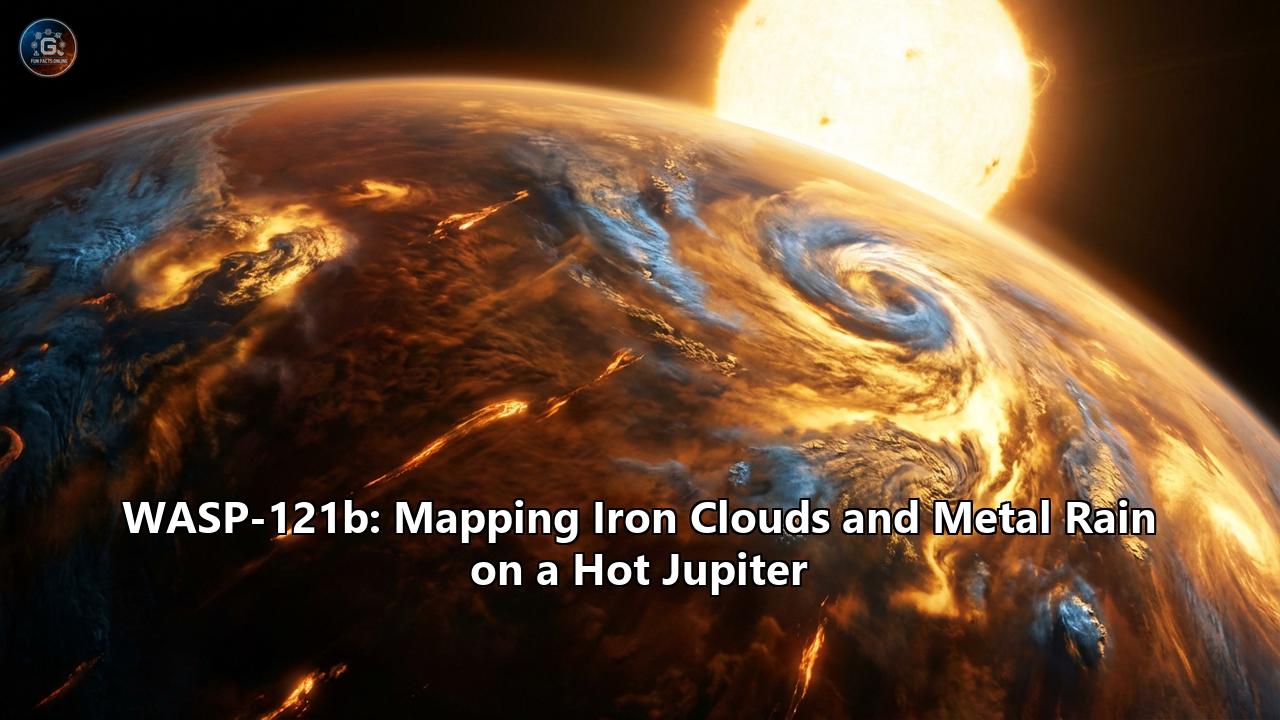
The universe, in its infinite sprawl, has a way of mocking our terrestrial expectations. For centuries, we looked to the planets of our own solar system—the rusted deserts of Mars, the crushing pressures of Jupiter, the methane hazes of Titan—and believed we understood the boundaries of planetary weather. We thought of rain as water, of clouds as vapor, and of storms as swirls of gas and lightning. But 855 light-years away, in the constellation Puppis, a world known as WASP-121b is rewriting the textbooks of atmospheric physics, offering a vision of hell so exotic it defies the imagination of the most daring science fiction writers.
This is a world where the day is hot enough to vaporize metal, where the night is cool enough to condense it into clouds, and where the rain that falls is made of liquid gems. It is a "Hot Jupiter," a gas giant hugging its parent star in a gravitational embrace so tight that it is on the brink of being torn apart.
WASP-121b is not just another data point in the growing catalog of exoplanets; it is a laboratory of extremes. It challenges our understanding of how atmospheres behave under intense radiation and offers a glimpse into the violent, beautiful, and terrifying possibilities of galaxy formation. This is the story of the heavy metal planet, the iron skies, and the sapphire rain.
I. The Architecture of an Inferno: What is WASP-121b?
To understand the weather of WASP-121b, one must first understand its geography—or rather, its cosmography. Discovered in 2015 by the WASP (Wide Angle Search for Planets) consortium, this planet is an "ultra-hot Jupiter." It is a gas giant with a mass about 1.2 times that of Jupiter and a radius nearly twice as large. This "puffiness" is a direct result of the intense heat it endures, which causes its atmosphere to expand outward, untethered by the cooling that compresses planets like our own Jupiter.
The planet orbits an F-type star, WASP-121, which is brighter and hotter than our Sun. But the defining feature of this system is the proximity. WASP-121b orbits its star at a distance of just 0.025 AU (Astronomical Units). To put that in perspective, Mercury, the scorched innermost planet of our solar system, orbits at about 0.4 AU. WASP-121b is nearly roughly 15 times closer to its star than Mercury is to the Sun.
This proximity has profound consequences. The planet completes a full orbit in just 30.6 hours. A year on WASP-121b passes in little more than an Earth day. The gravitational forces at play here are immense. The star's gravity pulls on the planet so hard that it has been deformed from a sphere into an egg shape, a prolate spheroid pointed constantly at the fiery heart of its solar system.
This tidal interaction has resulted in "tidal locking." Just as our Moon always shows the same face to Earth, WASP-121b is forever fixed with one side facing its star. One hemisphere exists in a perpetual, blinding day; the other lies in an eternal, starless night. It is this permanent dichotomy—the split between the oven and the freezer—that drives the planet’s ferocious, heavy-metal weather.
II. The Dayside: A Furnace of Atomic Destruction
Imagine a sky that doesn't just burn; it disintegrates matter. On the permanent dayside of WASP-121b, the sub-stellar point (the point directly beneath the star) reaches temperatures soaring above 3,000 degrees Celsius (5,400 degrees Fahrenheit).
On Earth, heat facilitates life. On WASP-121b, heat destroys structure. The atmosphere on the dayside is so incredibly hot that molecules cannot hold themselves together. Water vapor, a robust molecule that defines habitable worlds, is ripped apart here. The thermal energy is so high that the bonds between hydrogen and oxygen snap, leaving a soup of atomic hydrogen and oxygen (along with a hydroxide radical, OH). This is a process known as thermal dissociation.
If you were to float in the upper atmosphere of the dayside (protected by an impossible heat shield), you would not see clouds. The heat is too intense for anything to condense. Instead, the sky would likely glow with the blinding light of the star and the thermal emission of the gas itself. It is a clear sky, but "clear" in the most menacing sense. The atmosphere is filled with metals like iron, magnesium, chromium, and vanadium—but they are not solid. They are gases.
Spectroscopic analysis using the Hubble Space Telescope and later the James Webb Space Telescope (JWST) has detected these heavy metals floating in the upper atmosphere. On Earth, iron is the material of anvils and skyscrapers, solid and unyielding. On WASP-121b’s dayside, iron is a vapor, drifting on winds that move faster than the speed of sound.
This atomic soup, however, does not stay put. The planet is a dynamic system, and the incredible heat of the dayside creates a pressure differential that drives global winds. The atmosphere expands on the hot side and rushes toward the cool side, creating a supersonic jet stream that circles the planet's equator. This wind is the conveyor belt that powers the planet's exotic cycle.
III. The Nightside: Where Iron Condenses and Rubies Rain
As the supersonic winds carry the superheated gas across the terminator—the twilight line dividing day from night—the conditions change dramatically.
The nightside of WASP-121b is, relatively speaking, a freezer. While the dayside roasts at 3,000°C, the nightside plunges to a "frigid" 1,500°C (2,700°F). While 1,500 degrees is still hot enough to melt lead, aluminum, and even gold on Earth, the drop in temperature is cataclysmic for the atmosphere of WASP-121b.
It is here, in the eternal dark, that the chemistry of the planet becomes truly alien.
1. The Return of WaterFirst, the water cycle attempts to repair itself. The atomic hydrogen and oxygen that were torn apart on the dayside cool down enough to recombine. The bonds snap back into place, forming water vapor again. This creates a strange, asymmetric water cycle: water is destroyed on one side of the planet and resurrected on the other.
2. The Iron CloudsMore visually spectacular is the fate of the metals. As the iron, magnesium, and chromium vapors cross into the night, they hit the temperature cliff. They cool below their condensation points. Just as water vapor on Earth cools to form cumulus clouds of liquid droplets, the iron vapor on WASP-121b condenses into clouds of liquid metal.
Imagine looking up at a night sky not filled with stars, but obscured by shifting, heavy layers of metallic fog. These clouds would reflect the thermal glow of the planet below, perhaps shimmering with a dark, reddish hue. They are vast banks of iron and magnesium aerosols, drifting through the dark hemisphere.
3. The Gemstone RainBut the strangest phenomenon involves a metal that was conspicuously missing from the upper atmosphere in early observations: aluminum. When astronomers looked for aluminum signatures on the dayside, they found surprisingly little. The leading theory is that the aluminum has condensed and sunk into the deeper layers of the atmosphere on the nightside.
When aluminum condenses in the presence of oxygen, it forms a mineral known as corundum (Al₂O₃). On Earth, corundum is a dull, hard mineral used in sandpaper. But when you add trace impurities to it, it becomes something else entirely. Add a little chromium, and corundum becomes a ruby. Add traces of iron or titanium, and it becomes a sapphire.
Because WASP-121b’s atmosphere is rich in these specific impurities—chromium, iron, titanium, vanadium—the "rain" that precipitates from these corundum clouds is likely composed of liquid rubies and sapphires.
Driven by gravity, these droplets of liquid gem and molten metal fall from the upper atmosphere toward the deeper, higher-pressure layers of the gas giant. It is a precipitation cycle of unimaginable value and violence. The "rain" never hits a solid surface, for there is no ground on a hot Jupiter. Instead, the droplets fall until they reach depths where the temperature rises again, or until they are swept up by vertical currents and dragged back toward the dayside.
IV. The Great Recycling: The Global Circuit
The weather of WASP-121b is a loop. The metal clouds and gemstone rain of the nightside do not stay there forever. The equatorial jet stream, screaming eastward at speeds of up to 5 kilometers per second (over 11,000 miles per hour), eventually carries this material back across the morning terminator and into the view of the star.
As the liquid iron clouds and corundum droplets cross back into the dayside, they are slammed by the stellar radiation. The temperature spikes instantly. The clouds flash-boil. The liquid iron vaporizes back into gas. The rubies and sapphires disintegrate, their molecules ripping apart into constituent atoms of aluminum and oxygen.
The sky clears, returning to the transparent, scorching haze of the dayside, ready to begin the cycle all over again.
This is a weather system of phase changes not of water, but of the periodic table’s heavy hitters. It is a global engine that processes metal through states of matter we rarely see outside of industrial smelters, powered solely by the relentless irradiation of the parent star.
V. Recent Discoveries: The Helium Tails and the Escaping Atmosphere
The story of WASP-121b has evolved significantly with the advent of the James Webb Space Telescope (JWST) and advanced ground-based observations from facilities like the Very Large Telescope (VLT) in Chile.
In the mid-2020s, researchers utilizing these new tools began to uncover even more dynamic behaviors. One of the most striking discoveries is that WASP-121b is not just enduring its star’s heat; it is slowly dying from it.
The intense ultraviolet light from the star heats the upper atmosphere so much that gas atoms gain enough kinetic energy to escape the planet's gravitational pull. WASP-121b is literally evaporating.
The Helium TailsUsing high-resolution spectroscopy, astronomers detected helium atoms escaping the planet. But they aren't just drifting away in a sphere; they are being sculpted. The pressure from the stellar wind (the stream of particles from the star) pushes the escaping gas into a long tail trailing behind the planet, much like a comet.
Even more recently, observations have hinted at a "leading tail" as well, creating a complex geometry of escaping gas. This helium, along with hydrogen and heavier metals like iron and magnesium, is bleeding into space at a rate of millions of tons per second. While the planet is massive enough to survive this for billions of years, it is effectively shrinking, shedding its envelope into the void.
The Magnetic MysteryThe shape of this escaping atmosphere has sparked intense debate about the planet's magnetic field. On Earth, our magnetic field protects our atmosphere from being stripped away by the solar wind. The shape of WASP-121b's outflow suggests it might have a weak magnetic field, or perhaps a complex interaction where the ionized metals in the atmosphere create their own localized magnetic environments. Mapping these magnetic structures is the new frontier of exoplanet research.
VI. How We Know: The Art of Exoplanet Cartography
How do we know any of this? We have never taken a picture of WASP-121b that shows more than a single pixel of light. The planet is too far away and too close to its blindingly bright star to be resolved directly by telescopes.
The detailed picture we have of WASP-121b comes from spectroscopy, specifically "transmission spectroscopy" and "emission spectroscopy" (phase curves).
1. Transmission Spectroscopy (The Transit)When WASP-121b passes in front of its star (a transit), some of the starlight filters through the edges of the planet's atmosphere on its way to Earth. The atoms and molecules in the atmosphere absorb specific wavelengths of light, leaving dark "fingerprints" in the star's spectrum. By analyzing which colors are missing, astronomers can identify the chemical composition.
- "Missing" water wavelengths? Water vapor is present.
- "Missing" iron wavelengths? Iron gas is floating there.
As the planet orbits the star, it shows us different phases, just like the Moon. By measuring the total infrared light coming from the system over a full 30-hour orbit, astronomers can separate the light of the star from the light of the planet.
- When the planet is behind the star (secondary eclipse), we see only the star. This gives us a baseline.
- Just before it goes behind the star, we see the planet's full dayside. The brightness tells us the dayside temperature.
- When the planet is in front of the star, we see its nightside. The dimness tells us the nightside temperature.
By mapping the brightness changes throughout the orbit, scientists built a "thermal map" of the planet. They noticed that the hottest point on the planet wasn't directly under the star, but shifted to the east. This "hotspot offset" was the smoking gun for the massive equatorial winds, proving that heat was being physically blown downwind before it could radiate away.
3. High-Resolution Doppler SpectroscopyThis is the technique that confirmed the rain. By looking at the Doppler shift of the light—how the wavelengths stretch or compress as gas moves toward or away from us—astronomers could measure the speed of the wind. But they also noticed that certain chemical signals (like iron) disappeared on the nightside and reappeared on the dayside. The only physical explanation for the disappearance of a gas signal in a cold region is condensation: the gas turned into liquid clouds and dropped out of sight.
VII. A Mirror to Our Origins
Why does WASP-121b matter? It is a world hostile to life as we know it. It will never be a destination for colonization. It is a world of death.
However, WASP-121b is crucial for understanding planetary formation.
- Migration Theory: Planets like this shouldn't exist where they do. Gas giants form in the cold outer reaches of a solar system (like Jupiter). For WASP-121b to be where it is, it must have migrated inward, drifting through the solar system and disrupting everything in its path. Studying it tells us about the chaotic youth of planetary systems.
- Atmospheric Extremes: By testing our climate models on WASP-121b, we stress-test our physics. If our models can accurately predict the weather on a world with iron clouds, we can be more confident when we use them to look for subtle signs of life on more Earth-like worlds in the future.
VIII. Conclusion: The Heavy Metal World
WASP-121b stands as a testament to the diversity of the cosmos. It reminds us that the conditions we consider "normal"—liquid water, silicate rocks, nitrogen skies—are just one setting on the universe's vast mixing board.
Out there in the dark of the Puppis constellation, a jewel-toned storm is raging. Clouds of iron are gathering in the twilight. Winds of supersonic fury are carrying the vapor of molten metal into the dawn. And in the deep, crushing dark of the nightside, it is raining rubies.
As we continue to peer into the universe with instruments like the James Webb Space Telescope and the upcoming European Extremely Large Telescope, WASP-121b will remain a touchstone—a benchmark for the extreme, the exotic, and the impossible made real. It is a planet that forces us to look up and wonder not just if we are alone, but what other fantastical weathers await us in the billions of worlds yet to be mapped.
Reference:
- https://www.techexplorist.com/exotic-water-cycle-metal-clouds-discovered-jupiter-exoplanet/44916/
- https://mashable.com/article/space-planet-metal-clouds-cosmos
- https://scitechdaily.com/from-metal-rain-to-roaring-jet-streams-the-first-3d-look-at-an-alien-atmosphere/
- https://science.nasa.gov/exoplanet-catalog/wasp-121-b/
- https://www.astronomy.com/observing/the-alien-weather-of-wasp-121-b/
- https://astrobiology.com/2024/01/hubble-observes-the-atmosphere-of-exoplanet-wasp-121-b-changing-over-3-years.html
- https://www.techexplorist.com/astronomers-webb-telescope-study-wasp-121b/99636/
- https://wasp-planets.net/tag/wasp-121b/
- https://www.sciencedaily.com/releases/2026/01/260120000311.htm
- https://scitechdaily.com/james-webb-reveals-a-scorching-exoplanet-bleeding-into-space/