
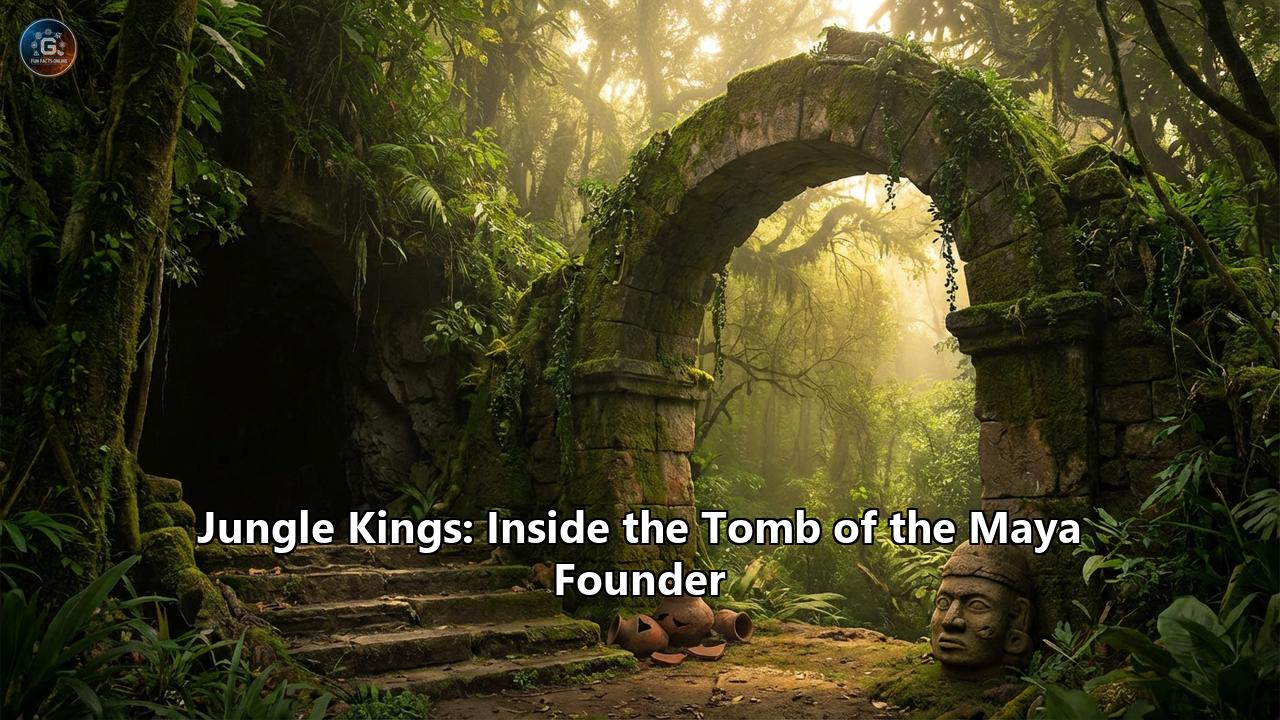
The jungle does not give up its secrets easily. For centuries, the dense canopy of the Honduran rainforest shrouded the ruins of Copan, a city of stone that once commanded the southern frontier of the Maya world. When explorers John Lloyd Stephens and Frederick Catherwood first hacked their way through the vines in 1839, they found a "shattered capital" of incomprehensible beauty—stelae carved with the faces of forgotten kings, pyramids strangled by ceiba roots, and a hieroglyphic stairway that whispered of a history lost to time.
For over a century, these stone faces remained silent. We knew they were kings, but we did not know their names, their stories, or where they came from. They were ghosts in the mist, their lives obscured by the very collapse that brought their civilization to its knees in the 9th century.
That changed in the late 20th century, not through the hacking of machetes, but through the delicate scrape of trowels and the daring excavation of tunnels deep beneath the earth. There, in the cool, stale air inside the heart of a pyramid, archaeologists came face to face with the man who started it all: K'inich Yax K'uk' Mo', the Sun-Eyed Radiant First Quetzal Macaw.
This is the story of that discovery—a journey 1,600 years into the past to uncover the "Stranger King" who walked out of the west to build a dynasty, and the scientific detective work that finally opened the doors to his tomb.
Part I: The Layered Mountain
To understand the discovery of the founder, one must first understand how the Maya built their world. In the modern mind, a building is a static object; we build it, use it, and eventually demolish it. To the Maya, a sacred location was a living thing, a nexus of power that could not simply be moved. When a king died or a new calendar cycle began, they did not tear down their temples. Instead, they performed a ritual "termination," carefully de-sanctifying the structure, and then built a new, larger pyramid directly on top of the old one.
Over four centuries, the Acropolis of Copan grew like an onion, layer upon layer of stone skins, each concealing the history of the one before. The final skin, the one visible to tourists today, is known as Structure 10L-16 (or simply Temple 16). It is a massive, imposing pyramid that dominates the West Court, the highest point in the city's royal complex.
For decades, archaeologists suspected that Temple 16 held the key to Copan’s history. In the 1980s and 90s, the Copan Acropolis Archaeological Project (PAAC), led by William Fash and Ricardo Agurcia Fasquelle, decided to do something audacious. Rather than stripping away the outer layers—which would destroy the final phase of the temple—they would mine into the mountain. They dug narrow, claustrophobic tunnels through the rubble fill, navigating the perilous darkness to find the earlier temples hidden within.
What they found in 1989 changed Maya archaeology forever.
The Red Queen of Temples: Rosalila
As Ricardo Agurcia tunneled through the dark, damp fill of Temple 16, his light caught a flash of color: a vibrant, blood-red stucco. It wasn't just a fragment. As he cleared the debris, a face emerged—a terrifying, beautiful mask of a sun god with bird wings.
He had discovered Rosalila.
Unlike most earlier temples, which the Maya partially destroyed before building over, Rosalila was found perfectly intact. The Maya had treated this building with such reverence that they had carefully packed it in white plaster before burying it, preserving its intricate moldings and brilliant paint as if it had been built yesterday.
Rosalila was a masterpiece of Early Classic art, dating to approximately 571 AD. Its façade was a billboard of sacred power, screaming the identity of the king it venerated. The central sun god masks were flanked by the wings of a macaw and the feathers of a quetzal. In the Maya language, "Sun" is K'inich, "Quetzal" is K'uk', and "Macaw" is Mo'. The building literally spelled out the name of the dynastic founder: K'inich Yax K'uk' Mo'.
Agurcia realized that Rosalila was a shrine dedicated to the founder cult. But if Rosalila was the shrine, where was the man himself? The existence of such a venerated temple suggested that the founder’s physical remains might be close—perhaps directly beneath.
Part II: The Descent into the Underworld
While Agurcia focused on the preservation of Rosalila, a team from the University of Pennsylvania, led by Robert Sharer and David Sedat, took on the task of going deeper. They were looking for the "root" of the Acropolis, the very first building on the site.
The tunneling was grueling. The air was thick with dust and humidity; the spaces were tight. As they dug beneath Rosalila, they moved back in time, century by century.
The Margarita Tomb: The Lady in Red
In 1993, just below the level of Rosalila, the team hit a massive masonry offering chamber. Inside, the wealth was staggering. They found thousands of jade beads, carved shell ear ornaments, and mercury—a rare and toxic substance associated with the underworld.
The occupant of this tomb was covered in cinnabar, a red mercuric sulfide powder that the Maya used to symbolize blood and the life force of the soul. The skeleton was stained so deeply that she was dubbed "The Lady in Red."
Who was she? The richness of her burial rivaled any king's. But osteological analysis proved the skeleton was female, a woman in her 50s. The location was telling. She was buried in a structure named Margarita, which featured the same intertwined Quetzal-Macaw iconography as Rosalila.
Among the treasures in her tomb was a vessel that would become an icon of Mesoamerican art: The Dazzler Pot.
This ceramic masterpiece was not Maya in style. It was a tripod vessel painted in the distinct, bright frescoes of Teotihuacan, the great imperial metropolis in distant central Mexico, over 1,000 miles away. The pot depicted a temple in the talud-tablero architectural style of Teotihuacan. Inside the temple sat a figure wearing the "goggle-eyes" of the Mexican rain god Tlaloc, looking out.
The leading theory was electric: This woman was likely the wife of the founder. If K'inich Yax K'uk' Mo' was the Stranger King who arrived from the west, this woman was the local matriarch, the daughter of the previous ruling family who married the invader to legitimize his dynasty. Her bloodline, combined with his military prowess, created the royal line of Copan.
But the founder himself was still missing.
The Hunal Tomb
Sharer and Sedat pushed deeper. In 1995, they reached bedrock. There, at the very center of the axis that ran up through Margarita, Rosalila, and Temple 16, they found a modest, low-lying platform.
It was named Hunal.
The architecture of Hunal was shocking. It was not built in the local Copan style, nor the Petén style of the Maya lowlands. It was built in the talud-tablero style—the signature architectural fingerprint of Teotihuacan. It was a piece of central Mexico transplanted into the Honduran jungle.
Inside the Hunal platform, they found a vaulted crypt. The capstones were carefully lifted, revealing a stone slab. Beneath the slab lay the crumbling remains of a man.
He was old, perhaps in his 60s. His skeleton told a story of a violent life. His right arm had been broken and healed poorly, leaving it withered—a "parry fracture" consistent with deflecting a blow from a club. His shoulder cracked, his skull scarred. This was a warrior.
On his chest lay a jade pectoral. But the "smoking gun" was on his head. He had been buried with a headdress made of shell and jade, featuring the unmistakable "goggles" of the Teotihuacan war god.
The team had found him. This was K'inich Yax K'uk' Mo'.
Part III: The Stranger King
The discovery of the Hunal tomb confirmed what epigraphers—the code-breakers of Maya hieroglyphs—had only recently deciphered.
For years, scholars like David Stuart and Linda Schele had been decoding the inscriptions on Altar Q, the stone block at the base of Temple 16. The altar tells a specific story. It records a date: September 5, 426 AD. On this day, the text says, K'inich Yax K'uk' Mo' "took the K'awiil" (the scepter of kingship) at a place called the Wiite' Naah—the "Root House."
Three days later, he "arrived."
For a long time, this was dismissed as myth. But the strontium isotope analysis of the Hunal skeleton provided hard scientific proof. Strontium isotopes, absorbed into tooth enamel during childhood from local water and food, act as a geographic fingerprint.
The analysis revealed that the King in the Hunal tomb was not from Copan. He was a foreigner.
However, the twist was that he wasn't from Teotihuacan either. His chemical signature matched the Tikal region in the northern Petén jungle of Guatemala. This aligned with a broader historical theory: The "New Order."
In 378 AD, decades before Copan's founding, a warlord named Siyaj K'ak' ("Fire is Born") arrived in Tikal. He was an emissary from Teotihuacan, and his arrival coincided with the death of the Tikal king and the installation of a new, Teotihuacan-aligned dynasty.
Yax K'uk' Mo' appears to have been a part of this wave of imperial expansion. He was likely a Maya lord from the Petén who adopted the potent imagery and military backing of Teotihuacan—the "Rome" of ancient Mesoamerica—to conquer the frontier city of Copan. He was a Stranger King, an outsider who marched into the valley, displayed the symbols of a distant, exotic superpower (the goggle eyes, the talud-tablero architecture), and established a new order.
Part IV: The Dynasty's Architecture
The excavation of Temple 16 revealed more than just a tomb; it revealed the biography of a dynasty obsessed with its creator.
- Hunal (c. 427 AD): The founder's tomb. A foreign, Mexican-style building for a foreign king.
- Yehnal (c. 440 AD): Built by the founder's son, Ruler 2 (Popol Hol). This temple covered Hunal. It featured massive red masks of the Sun God, but in a distinct Maya style. This was a statement: The foreigner had become the ancestor. The son was blending his father's exotic power with local tradition.
- Margarita (c. 450 AD): Also built by Ruler 2 to house his mother, the Lady in Red. This temple was a dazzling display of color and iconography, intertwining the Quetzal and Macaw, cementing the parents as the dual progenitors of the line.
- Rosalila (c. 571 AD): Built by Ruler 10. By this time, Yax K'uk' Mo' had been apotheosized. He was no longer just a grandfather; he was a god. The temple was a "mountain of creation," preserved intact to keep the conduit to the divine ancestor open.
- Temple 16 (c. 775 AD): The final shell. Built by Yax Pasaj, the 16th and final ruler.
Part V: The End of the Line
The tragedy of Copan is written in the relationship between the first king and the last.
By 776 AD, Copan was in trouble. Overpopulation, deforestation, and environmental degradation were starving the city. The king, Yax Pasaj, was struggling to maintain authority.
In a desperate bid to save his kingdom, Yax Pasaj returned to the source. He built the final version of Temple 16. At its base, he placed Altar Q.
The altar is a square stone table. On its sides, 16 figures are carved—the 16 kings of the dynasty. They sit in chronological order, passing the torch of leadership from one to the next. On the front of the altar, the First King, K'inich Yax K'uk' Mo', hands the scepter of power directly to the Last King, Yax Pasaj.
It was a piece of political propaganda. Yax Pasaj was saying, “My power comes directly from him. I am the heir of the Sun King.”
He even drilled a vertical tube from the floor of the temple summit down into the older temples below, a spiritual umbilical cord meant to channel the power of the ancient bones into his failing reign.
It didn't work. Within a few decades of completing the temple, the dynasty collapsed. The palaces were abandoned, and the jungle began to reclaim the city. The tomb of the founder, meant to be the eternal battery powering the kingdom, became a forgotten crypt.
Conclusion: The King Found
The discovery of the Hunal tomb is one of the greatest triumphs of modern archaeology. It did not just provide gold or jade; it provided truth. It turned a mythical name from a stone carving into a flesh-and-blood man—a man who suffered broken bones, who traveled thousands of miles, and who forged a kingdom that lasted four centuries.
Today, visitors to Copan can walk through the tunnels. They can stand in the humid darkness, looking up at the terrifying red masks of Rosalila and the plaster walls of Margarita. They are standing inside the family album of the Maya, staring into the face of a history that was very nearly lost to the roots of the jungle.
K'inich Yax K'uk' Mo' is no longer a ghost. He is the Radiant First Quetzal Macaw, and he has returned to speak to us from the tomb.
Reference:
- https://goggleman.wordpress.com/2013/02/20/143/
- https://www.moontravelguides.com/travel/arts-culture/exploring-the-ruins-of-copan/
- https://ahutnick.github.io/copanaltarqkings/structure-16/
- https://en.wikipedia.org/wiki/Cop%C3%A1n
- https://www.mesoweb.com/publications/PMP2/PMP2s.pdf
- https://www.ancient-origins.net/ancient-places-americas/rosalila-temple-0013402
- https://maya.nmai.si.edu/gallery/copan
- https://michaelharrison.org.uk/category/maya-ruinas/honduras/
- http://www.the-silk-route.co.uk/hondurasCopan.htm
- https://www.pbs.org/wgbh/nova/transcripts/2804maya.html
- https://ahutnick.github.io/copanaltarqkings/yax-kuk-mo/
- https://www.penn.museum/sites/expedition/tunneling-into-the-heart-of-the-copan-acropolis/
- https://ahutnick.github.io/copanaltarqkings/motmot-marker/