
For seventy years, the history of computing has been a history of cooling. From the cavernous, air-conditioned halls of the ENIAC to the liquid-cooled overclocking rigs of modern gamers, heat has been the enemy. It is the chaotic waste product of computation, the entropy tax levied by thermodynamics on our desire to process information. We treat it as an exhaust fume, something to be wicked away, fanned out, and dissipated into the ether. The "Thermal Wall"—the point where chips generate more heat than can be effectively removed—has been the primary barrier halting the exponential rise of clock speeds since the mid-2000s.
But what if this perspective is fundamentally wrong? What if heat isn't just the exhaust of computation, but the fuel? What if, instead of fighting the thermal chaos, we could harness it, discipline it, and make it calculate?
This is the promise of Thermal Computing, or phononics. It is a paradigm shift that reimagines the fundamental carrier of information. Instead of electrons rushing through a channel, thermal computing uses phonons—quanta of vibrational energy—to transmit, switch, and process data. In this new world, silicon does not just survive heat; it thinks with it.
Part I: The Physics of the Whispering Lattice
To understand how a rock can calculate using heat, we must first abandon our macroscopic intuition of temperature. To a human, heat is a sensation. To a physicist, heat is motion. But at the atomic scale, in a rigid crystal like silicon, heat is not random jiggling; it is a symphony of waves.
1.1 Enter the Phonon
When you heat one end of a silicon bar, atoms vibrate. Because they are bonded to their neighbors, these vibrations propagate through the lattice like a ripple through a pond. Quantum mechanics tells us that these vibrational waves are quantized. Just as light consists of particles called photons, sound and heat consist of particles called phonons.
Phonons are the elemental units of heat. They carry energy, momentum, and, crucially for our purposes, information. In a standard electronic chip, phonons are the "noise" that scatters electrons, increasing resistance and causing overheating. In a thermal computer, phonons are the signal.
1.2 The Spectrum of Heat
Not all phonons are created equal. They exist in a spectrum, much like the colors of light:
- Acoustic Phonons: These are low-frequency, long-wavelength vibrations. They carry sound and the bulk of thermal energy. They travel at the speed of sound in the material (in silicon, roughly 8,430 meters per second).
- Optical Phonons: These are high-frequency vibrations where adjacent atoms in the lattice move in opposite directions. They interact heavily with light and electrons but struggle to transport heat over long distances.
The magic of thermal computing lies in coherent phonon transport. In a chaotic material (like glass), phonons scatter off defects immediately, resulting in diffusive heat flow—the slow, spreading warmth we are used to. But in a perfect crystal of silicon, or a carefully engineered nanostructure, phonons can travel ballistically, like bullets. If we can control these "heat bullets," guiding them down specific paths and gating their flow, we can build a computer.
Part II: The Building Blocks of a Thermal Computer
A computer requires three fundamental components: a way to move information (wires), a way to switch it (transistors), and a way to store it (memory). In the electronic world, these are copper traces, MOSFETs, and capacitors. In the phononic world, we have invented thermal equivalents.
2.1 The Thermal Wire: Silicon Nanowires
Bulk silicon is a good conductor of heat, but it is an indiscriminate one. Heat flows in all directions. To create a "thermal wire," we must confine the phonons. This is achieved using Silicon Nanowires (SiNWs).
When a silicon wire is shrunk to a diameter of less than 100 nanometers, strange things happen. The boundaries of the wire become so close that they interfere with the phonon wavelengths. We can engineer the roughness of the wire's surface to scatter high-frequency phonons while allowing specific low-frequency modes to pass through unhindered. This acts as a waveguide for heat.
Recent advancements have taken this further with Isotope Engineering. Natural silicon is a mix of isotopes (mostly Si-28, with some Si-29 and Si-30). These heavier atoms act as speed bumps for phonons. By purifying silicon to 99.9% Si-28, researchers have created "super-highways" for heat, increasing thermal conductivity by 10-15% and allowing for sharper signal transmission.
2.2 The Holy Grail: The Thermal Transistor
For decades, the "thermal transistor" was a theoretical dream. A transistor needs to be able to switch a large flow of something (current/heat) using a small control signal.
In late 2023, a team at UCLA achieved a historic breakthrough: the first stable, fully solid-state Thermal Transistor.
- The Mechanism: Unlike previous attempts that used liquid electrolytes (too slow/messy), this device uses an electric field to control atomic bonding. It relies on a thin film of molecules at an interface. When an electric field is applied (the "gate"), it stiffens or softens the chemical bonds between the molecules.
- The Result: Stiff bonds transfer heat efficiently; soft bonds block it. This allows the device to switch heat flow on and off at speeds exceeding 1 megahertz (1 million times per second).
- The Gain: Crucially, it demonstrated gain. A small amount of electrical energy could control a massive flux of thermal energy. This is the definition of a transistor.
This invention proved that we can manipulate heat with the same precision as electricity. We can now build "AND" gates and "OR" gates where "hot" is 1 and "cold" is 0.
2.3 Thermal Diodes: The One-Way Street
Electricity flows easily in one direction through a diode and is blocked in the other. Heat usually flows symmetrically—hot to cold, regardless of direction. Breaking this symmetry is essential for logic.
Thermal diodes are built using nonlinear lattices. By joining two materials with different responses to temperature (e.g., a carbon nanotube loaded with heavy molecules on one end), we create a scenario where vibrational matches occur in one direction but mismatches occur in the reverse.
- Forward Bias: The vibrational spectra of the two materials overlap. Phonons tunnel through resonance. Heat flows.
- Reverse Bias: The spectra mismatch. Phonons reflect. Heat is blocked.
These diodes prevent "back-flow" of information in a thermal circuit, ensuring that the calculation moves forward from input to output.
Part III: The Architecture of Heat
So, we have the parts. What does a thermal computer look like? It doesn't look like a standard Intel CPU. It looks like a metamaterial.
3.1 Phononic Crystals
Imagine a block of silicon drilled with a periodic array of nanoscale holes. This is a Phononic Crystal. Just as the periodic atoms in a crystal create "band gaps" for electrons (ranges of energy where electrons cannot exist), these periodic holes create "phononic band gaps."
Frequencies of heat that fall within this gap cannot propagate through the material. They are perfectly reflected. By selectively removing holes to create a path, we can build a waveguide within the crystal. This allows us to "draw" circuits for heat. We can bend heat around corners, split a heat beam into two, or focus it to a point.
3.2 Logic Gates
- The Thermal AND Gate: Two input waveguides meet at a junction. If only one sends a heat pulse, the energy dissipates into the lattice. If both send pulses simultaneously, the non-linear interaction amplifies the wave, allowing it to cross a threshold and travel down the output line.
- The Thermal NOT Gate: A control heat flow disrupts the main signal flow through destructive interference or by altering the material properties (like the UCLA transistor) to block the path.
3.3 Thermal Memory
Memory requires hysteresis—the system must "remember" its state. Thermal memory devices utilize Phase Change Materials (PCMs), like Vanadium Dioxide ($VO_2$).
- At low temperatures, $VO_2$ is an insulator for both heat and electricity.
- Above a critical temperature ($67^\circ C$), it snaps into a metallic state with high conductivity.
- By maintaining the material near this transition point, a small pulse of heat can flip it between "insulating" (0) and "conducting" (1). The state persists as long as the ambient bias is held, effectively storing a thermal bit.
Part IV: Thermodynamic Computing & Inverse Design
While we can build Boolean logic (1s and 0s) with heat, mimicking electronic computers is not necessarily the best use of phononics. Heat is inherently stochastic (noisy). Why fight the noise?
Thermodynamic Computing is a sub-field that embraces the chaos. Instead of forcing heat to be a precise digital bit, we use the natural tendency of systems to seek thermal equilibrium to solve complex problems.4.1 Calculating with Equilibrium
Many mathematical problems, such as optimization or matrix inversion, can be mapped onto physical systems.
- Imagine a landscape of peaks and valleys. finding the lowest point (optimization) is hard for a digital computer—it has to check every spot.
- A thermodynamic computer simply lets "heat" flow. The system naturally settles into the lowest energy state (the valley) on its own. The "answer" is the final state of the material.
4.2 The MIT Matrix Solver
In recent years (leading up to 2026), researchers at MIT utilized Inverse Design to create thermal accelerators. They didn't manually place holes in silicon. They used AI to simulate billions of random patterns, looking for a structure that processed heat in a specific way.
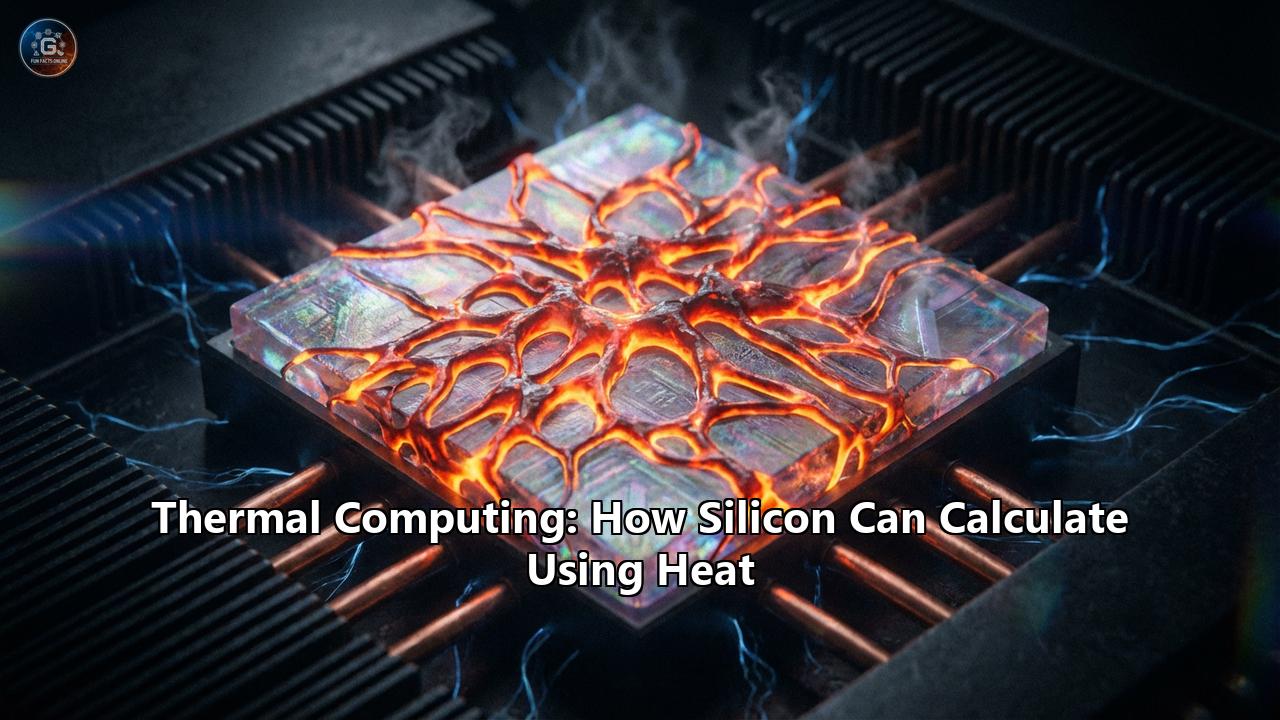
The result was a complex, organic-looking web of silicon. When heat was applied to the inputs (representing a vector of numbers), the temperature distribution at the outputs perfectly represented the result of a matrix multiplication.
This passive device computes using waste heat. It draws no electrical power for the calculation itself. It simply scavenges the heat generated by a neighboring electronic CPU and performs useful math with it.
Part V: Why Do We Need This?
Electronic computers are faster. Electrons travel at nearly the speed of light; phonons travel at the speed of sound. A thermal computer will never run 'Crysis' at 500 FPS. So, why bother?
5.1 The Harsh Environment Frontier
Electronics are fragile.
- Space: On the surface of Venus ($460^\circ C$), silicon electronics fry instantly. The bandgap collapses, and the semiconductor becomes a conductor.
- Deep Earth: Sensors in geothermal wells or oil drilling face similar fates.
- Nuclear Reactors: High radiation scrambles electronic charge.
Thermal computers love heat. A phononic computer designed to operate at $500^\circ C$ doesn't just survive; it thrives. The high ambient temperature provides the "bias" current. For a rover on Venus, a thermal computer is the only viable brain. It requires no cooling and no heavy shielding.
5.2 The "Zero-Power" Coprocessor
Data centers currently consume 2-3% of the world's electricity, mostly for cooling.
Imagine a hybrid chip. The electronic core does the heavy, fast logic. It generates heat.
Instead of blowing that heat away with a fan, it is funneled into a phononic coprocessor layer. This layer performs background tasks—encryption checking, system monitoring, or neural network weighting—using the waste energy.
It is the ultimate recycling: turning the entropy of the primary processor into the computational work of the secondary one.
5.3 Stealth and Security
Electronic devices emit electromagnetic radiation (EMR). A radio receiver can detect a computer running from a distance.
Thermal computers are electronically silent. They emit no radio waves, only a faint, chaotic heat signature that is indistinguishable from natural background radiation. This makes them ideal for secure, un-hackable hardware keys or stealth military logic controllers.
Part VI: The Challenges of the Phonon
Despite the promise, the road to a thermal Pentium is steep.
- Speed: The speed of sound in silicon is ~8 km/s. The speed of light is 300,000 km/s. Thermal logic will always be kilohertz or megahertz, not gigahertz. It is suited for parallel processing, not serial speed.
- Leakage: Heat is harder to insulate than electricity. A vacuum is the only perfect insulator. In a solid chip, phonons tend to leak into the substrate. Maintaining signal integrity over long distances is difficult.
- Interface Resistance: Every time heat moves from one material to another (Kapitza resistance), it scatters. Building complex, multi-material devices introduces loss at every junction.
Part VII: The Future—The Hybrid Era
We are standing at the dawn of the Hybrid Era. The future is not about replacing electronics with phononics, but marrying them.
We are moving toward Thermo-Electronic Systems-on-Chip (TESoC).
- Layer 1: High-speed Graphene/Silicon electronics for rapid decision making.
- Layer 2: Phononic interconnects that manage the heat flow, directing it away from hotspots dynamically (active cooling).
- Layer 3: A thermodynamic computing mesh that scavenges the waste heat to perform stochastic AI training or cryptographic hashing.
In this future, the "Thermal Wall" is no longer a barrier. It is a resource. We are teaching silicon to translate the language of heat, turning the random vibrations of atoms into the orderly logic of intelligence. We are finally listening to the whispering lattice.
Deep Dive: The Science of Silicon-28
To truly appreciate the engineering feats involved, one must look at the material science of Silicon-28.
Standard silicon is "dirty" with isotopes. About 92% is Si-28, but 4.7% is Si-29 and 3.1% is Si-30. To a phonon, these heavier atoms are boulders in the road. They cause scattering.
In the 2020s, the production of highly enriched Si-28 (99.99%) became feasible.
- Thermal Conductivity: Jumps from 150 W/mK to over 250 W/mK at room temperature.
- Coherence Length: Phonons can travel micrometers without scattering, enabling "ballistic" logic gates that were previously impossible.
This material innovation is the substrate upon which the thermal computing revolution is being printed.
Deep Dive: Landauer’s Principle and the limit of Efficiency
Rolf Landauer proved in 1961 that erasing a bit of information releases a minimum amount of heat ($k_B T \ln 2$). This is the fundamental link between information and thermodynamics.
Electronic computers are millions of times less efficient than this limit. They burn energy just to hold a 1 or a 0.
Thermal computers operate much closer to this limit. In "reversible logic" thermal gates, where information is not erased but redistributed, we approach the theoretical minimum of energy consumption. We are not just building a new computer; we are building a machine that respects the fundamental laws of the universe.
Conclusion
Thermal computing is more than a novelty; it is a necessity born of physical limits. As transistors shrink to the atomic scale, the distinction between an electron's path and an atom's vibration blurs. We have reached the end of the era where we can ignore the heat. By embracing phononics, we are entering a new age where the fire of computation effectively cools itself, and the very vibrations of matter become the thoughts of the machine.
Reference:
- https://www.techbriefs.com/component/content/article/46057-new-silicon-nanowires-could-speed-up-computer-processors
- https://pubs.aip.org/aip/adv/article/5/5/053101/977817/Preface-to-Special-Topic-Phononics-controlling
- https://pubs.aip.org/aip/jap/article/102/10/104303/392228/Phonon-spectrum-and-specific-heat-of-silicon
- https://nanowires.berkeley.edu/wp-content/uploads/2015/04/nl5b00495.pdf
- https://physicsworld.com/a/thermal-transistor-could-cool-down-computer-chips/
- https://scispace.com/papers/thermal-logic-gates-computation-with-phonons-4ydrpv3zvg
- https://arxiv.org/abs/0709.0032
- https://ar5iv.labs.arxiv.org/html/0709.0032
- https://pressemitteilungen.pr.uni-halle.de/index.php?modus=pmanzeige&pm_id=5666
- https://www.youtube.com/watch?v=IojIck4HXJw
- https://news.mit.edu/2026/mit-engineers-design-structures-compute-with-heat-0129
- https://www.allaboutcircuits.com/news/ucla-creates-first-stable-fully-solid-state-thermal-transistor/
- https://arxiv.org/pdf/2506.10876
- https://en.wikipedia.org/wiki/Landauer%27s_principle