
The modern technological renaissance—spanning the proliferation of electric vehicles, the expansion of wind energy, and the miniaturization of consumer electronics—rests on a remarkably fragile foundation: rare-earth elements (REEs). Lanthanides like neodymium, dysprosium, and terbium, alongside transition metals like scandium and yttrium, are the undisputed champions of materials science. They possess f-orbital electrons that grant them unparalleled magnetic anisotropy, and when alloyed, they create structural metals with extraordinary strength-to-weight ratios.
However, this reliance on rare earths has triggered a silent crisis. The extraction and refinement of these elements are notoriously destructive to the environment, often generating radioactive byproducts and toxic runoff. Furthermore, the global supply chain is heavily monopolized, leading to extreme price volatility and geopolitical tension. As the world hurtles toward a decarbonized green economy, demand for these elements is projected to outstrip supply by tens of thousands of tons within the next decade.
To circumvent this impending bottleneck, materials scientists are looking away from the exotic and turning their attention toward the abundant. The solution to the rare-earth crisis may not lie in discovering new elements, but in fundamentally reimagining one of the most common metals on Earth: aluminum. Through the cutting-edge science of crystal lattice manipulation, researchers are unlocking advanced aluminum allotropes—radically new structural forms of the metal that exhibit properties historically reserved for rare earths.
The Alchemy of Allotropes
To understand the promise of advanced aluminum, one must first understand the concept of allotropy. Allotropes are different structural forms of the same chemical element. The classic example is carbon: depending on how its atoms are arranged, carbon can manifest as soft, opaque graphite, or as ultra-hard, transparent diamond. The chemical ingredient is identical; the atomic geometry dictates the physical reality.
Standard aluminum, the metal used in soda cans and airplane fuselages, exists in a Face-Centered Cubic (FCC) crystal lattice. In this configuration, the atoms are densely packed, giving standard aluminum its characteristic density of 2.70 g/cm³, its high electrical and thermal conductivity, and its reliable malleability. It is a highly stable, predictable, and somewhat chemically "orthodox" metal.
But what happens if we force aluminum atoms out of their comfortable FCC arrangement? By subjecting the metal to extreme pressures, rapid temperature quenching, or by building it atom-by-atom on constrained substrates, scientists can trap aluminum in metastable states—allotropes with entirely different physical, electronic, and magnetic properties. This is where the ordinary becomes extraordinary.
Supertetrahedral Aluminum: The Metal That Floats
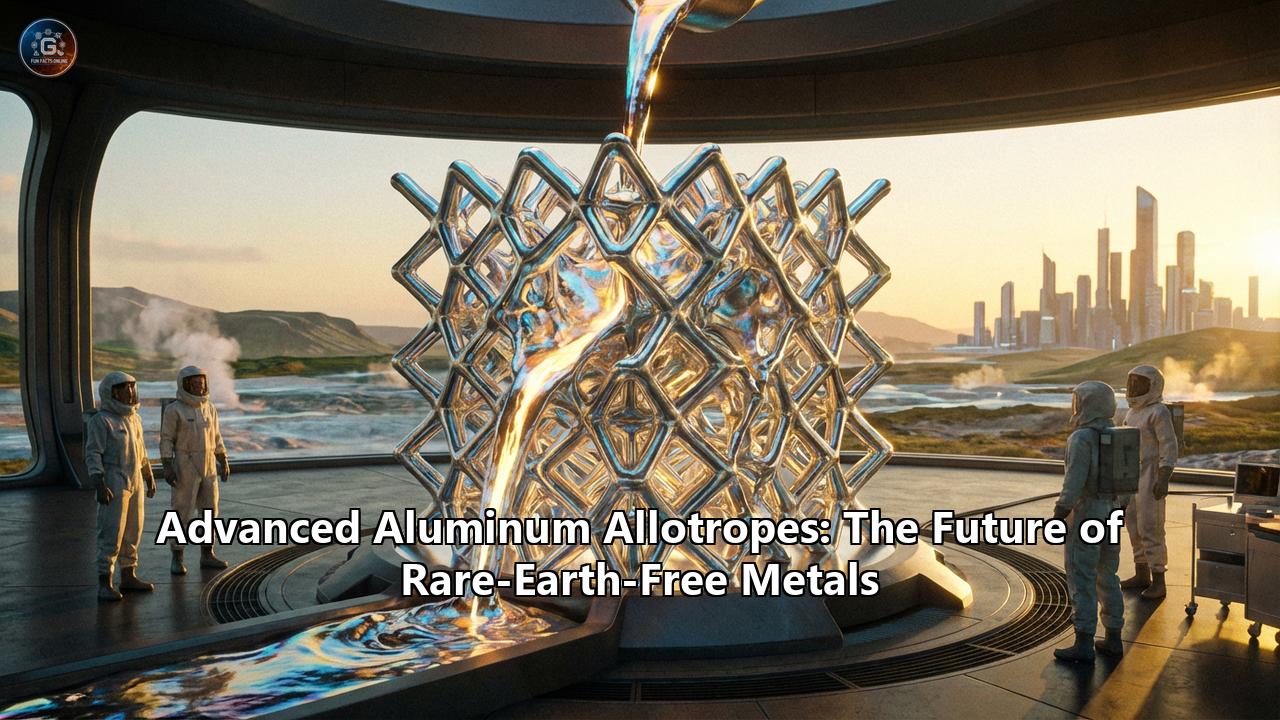
One of the most profound breakthroughs in allotropic engineering is the computational discovery of supertetrahedral aluminum. Designed using advanced density functional theory (DFT) calculations, this metastable phase completely abandons the traditional dense packing of metals.
Instead of individual atoms sitting in a grid, supertetrahedral aluminum is composed of "superatoms"—clusters of four aluminum atoms bonded together into an Al₄ tetrahedron. These tetrahedra are then arranged into a complex three-dimensional diamond-like lattice, effectively replacing the carbon atoms of a diamond structure with entire aluminum clusters.
The physical ramifications of this geometry are staggering. The vast amount of empty space (voids) within this diamond-like lattice results in a material with a density of just 0.61 g/cm³. To put this in perspective, the density of water is 1.0 g/cm³, meaning this crystalline solid metal is so incredibly light that it would effortlessly float on water.
Historically, achieving ultra-lightweight metallic structures required alloying aluminum with highly reactive and expensive elements like lithium, or utilizing costly rare-earth elements like scandium to maintain strength at low weights. Supertetrahedral aluminum bypasses this need entirely. It achieves its extreme lightweighting not through chemical dilution, but through structural architecture. Furthermore, quantum chemical modeling indicates that this allotrope is highly plastic and behaves as a semimetal, opening the door for its use in highly specialized aerospace components, deep-sea buoyancy technologies, and advanced flex-electronics.
Unlocking the Impossible: Magnetic Aluminum
Perhaps the most aggressively pursued holy grail in materials science is the rare-earth-free permanent magnet. Today, high-performance electric motors and wind turbine generators rely almost exclusively on Neodymium-Iron-Boron (NdFeB) magnets, which boast unmatched magnetic strength. Normal aluminum is strictly paramagnetic; it does not hold a magnetic field. Its three valence electrons form a delocalized "sea" rather than remaining strictly localized to provide the unpaired spins necessary for ferromagnetism.
However, allotropic manipulation and controlled nanoscale phase shifts are proving that aluminum can be the key to unlocking powerful magnetism without rare earths.
The secret lies in altering the atomic spacing. When aluminum is alloyed with manganese, and the crystalline structure is precisely controlled, the material forms what is known as the τ-phase (tau-phase) MnAl. This involves forcing the metal into an L1₀ face-centered tetragonal structure. In this distorted allotropic lattice, the aluminum atoms act as "spacers," stretching the crystal lattice just enough to force the manganese atoms into a ferromagnetic alignment.
This L1₀ chemically ordered structure yields high magnetocrystalline anisotropy—the exact property that makes rare-earth magnets so powerful. While MnAl magnets were heavily researched in the late 20th century before being overshadowed by neodymium, modern computational materials science is revitalizing them. By introducing nanostructuring techniques such as severe mechanical milling, rapid melt-spinning, and carbon doping (creating MnAlC), scientists are dramatically increasing the coercivity (resistance to demagnetization) of these alloys.
Furthermore, aluminum's role in the historic AlNiCo (Aluminum-Nickel-Cobalt) magnets is being re-evaluated. AlNiCo possesses an exceptionally high Curie temperature (up to 1000 °C), making it vastly superior to neodymium in extreme-heat environments like aerospace generators, but it traditionally suffered from low coercivity. By applying modern allotropic engineering to the aluminum matrix within AlNiCo, researchers are working to pin magnetic domains more effectively, striving to create a high-heat, high-strength magnet entirely free of dysprosium and neodymium.
Structural Superiority: Erasing the Need for Scandium
In the aerospace and defense sectors, aluminum-scandium alloys represent the pinnacle of structural materials. Adding just a fraction of a percent of scandium to aluminum creates nanoscale L1₂-ordered Al₃Sc precipitates. These microscopic structures lock the grain boundaries of the metal in place, resulting in an alloy that is incredibly strong, highly weldable, and resistant to recrystallization at high temperatures. The problem? Scandium is notoriously rare, difficult to refine, and prohibitively expensive.
The future of high-strength, rare-earth-free metals relies on mimicking the structural effects of scandium using abundant elements and allotropic phase manipulation. Instead of relying on exotic elements to form strengthening precipitates, metallurgists are engineering complex stacking faults and localized allotropic zones within the aluminum matrix using elements like zinc, calcium, and manganese.
By subjecting dilute aluminum and magnesium alloys to specific thermomechanical processing (such as peak-aging followed by rapid cooling), scientists can force the formation of highly stable, non-FCC nanoscale precipitates. These localized structures behave identically to scandium precipitates—acting as roadblocks to dislocation movements within the metal's crystal lattice. This phase-engineering yields aluminum and magnesium alloys with aerospace-grade yield strength and high ductility, utilizing only elements that are universally abundant and remarkably inexpensive.
Furthermore, research into aluminum-cerium alloys provides a fascinating bridge. While cerium is technically a rare earth, it is vastly overabundant—often treated as waste during the mining of high-value neodymium. Advanced Al-Ce alloys form stable intermetallic structures that thrive at temperatures exceeding 300ºC, replacing the need for heavier cast irons or exotic titanium alloys in combustion engines and high-stress thermal environments. By turning the structure of aluminum into a host for the most abundant, otherwise discarded minerals, we alleviate the pressure on the critical REE market.
The Quantum Horizon: Semimetals and Isotopes
The push to redefine aluminum extends down to the very core of the atom. Recent breakthroughs in nuclear physics have demonstrated just how extreme the manipulation of this element can get. In 2025, physicists at the Fragment Separator facility in Germany successfully observed Aluminum-20, an incredibly rare and unstable isotope with seven fewer neutrons than standard stable aluminum.
Lying far beyond the proton drip line, Aluminum-20 unravels through a dramatic, never-before-seen triple-proton decay chain. While an unstable isotope is not an allotrope, its discovery highlights a broader scientific reality: our understanding of the fundamental limits of the aluminum atom—from its nucleus to its electron shells—is undergoing a rapid evolution.
This deep atomic understanding is directly fueling the development of electronic aluminum allotropes. By tweaking the crystal structure, we can alter aluminum's bandgap. In its standard FCC form, aluminum is a brilliant conductor. But in computationally predicted allotropic forms (like the supertetrahedral diamond lattice), it shifts into a semimetal. This opens the door to rare-earth-free optoelectronics, specialized sensors, and advanced plasmonics. Standard aluminum interacts strongly with ultraviolet light, but altering its geometry allows researchers to tune its plasmonic resonance into the visible and infrared spectrums, potentially replacing scarce elements like indium and gallium in advanced display technologies and solar cells.
Forging the Future: Synthesis and Manufacturing
The theoretical existence of advanced aluminum allotropes is established, but trapping the metal in these high-energy, metastable states for mass commercialization is the ultimate engineering hurdle. Because these structures are not the element's natural resting state at room temperature, synthesizing them requires "tricking" thermodynamics.
- High-Pressure, High-Temperature (HPHT) Synthesis: By squeezing aluminum inside diamond anvil cells at pressures mimicking the Earth's mantle, atoms are forced into tighter, unnatural configurations, such as Body-Centered Cubic (BCC) or Hexagonal Close-Packed (HCP) phases. The challenge is preserving these structures when the pressure is removed.
- Rapid Quenching and Melt-Spinning: By cooling molten metal alloys at rates exceeding a million degrees per second, atoms do not have time to settle into their natural FCC grid. This freezes the material into amorphous (metallic glass) or complex non-equilibrium crystalline structures.
- Molecular Beam Epitaxy (MBE): This technique involves vaporizing aluminum and depositing it atom-by-atom onto a substrate crystal with a different lattice spacing. The aluminum is forced to match the underlying substrate, straining its atomic bonds and growing artificially stabilized allotropic thin films.
- Machine Learning and Inverse Design: Instead of trial and error, scientists are now using AI-driven computational models to define the exact magnetic or structural properties they want. The AI then works backward, calculating the required crystal lattice and the specific temperature-pressure pathway required to synthesize it.
The Dawn of the Engineered Aluminum Age
The geopolitical and environmental ramifications of this materials science revolution cannot be overstated. By shifting our reliance from the chemical rarity of the lanthanide series to the structural engineering of aluminum—the third most abundant element in the Earth's crust—we are moving from a resource-constrained paradigm to an intellect-driven one.
We can bypass the devastating ecological toll of rare-earth mining, strip away the vulnerabilities of monopolized global supply chains, and build next-generation technologies using a metal that is fundamentally cheap and 100% recyclable.
The transition from standard FCC aluminum to advanced, functional allotropes represents a turning point in metallurgy. Through supertetrahedral geometric clustering, L1₀ phase magnetic manipulation, and nanoscale precipitate engineering, aluminum is stepping out of the shadow of its rare-earth superiors. We are no longer limited by what the Earth provides in scarce quantities; we are limited only by our ability to rearrange the fundamental geometry of what is already abundantly in our hands.
Reference:
- https://physicsworld.com/a/powering-the-green-economy-the-quest-for-magnets-without-rare-earths/
- https://ceramics.org/ceramic-tech-today/aluminum-cerium-alloy-has-potential-to-jump-start-rare-earth-production-in-the-us/
- https://www.oreateai.com/blog/the-many-faces-of-an-element-understanding-allotropes/b9c215bf9412fb01a9508d55b5727feb
- https://www.scribd.com/presentation/964634059/ALUMINUM
- https://pubs.acs.org/doi/10.1021/acs.jpcc.7b07565
- https://www.edgetechree.com/rare-earth-alloys/
- https://sdmmagnets.com/rare-earth-free-magnets/
- https://www.researchgate.net/publication/325548594_Rare-earth-free_high_energy_product_manganese-based_magnetic_materials
- https://digitalcommons.unl.edu/cgi/viewcontent.cgi?article=1435&context=mechengfacpub
- https://www.cjcmotor.com/solution/free-permanent-magnet-new-magnetic-materials
- https://pmc.ncbi.nlm.nih.gov/articles/PMC7522977/
- https://www.researchgate.net/publication/344423578_Rare-earth-_and_aluminum-free_high_strength_dilute_magnesium_alloy_for_Biomedical_Applications
- https://www.sci.news/physics/aluminum-20-14087.html
- https://scitechdaily.com/aluminium-20-the-self-destructing-atom-scientists-never-saw-coming/
- https://aerospaceamerica.aiaa.org/departments/creating-alternatives-to-rare-earth-alloys/