
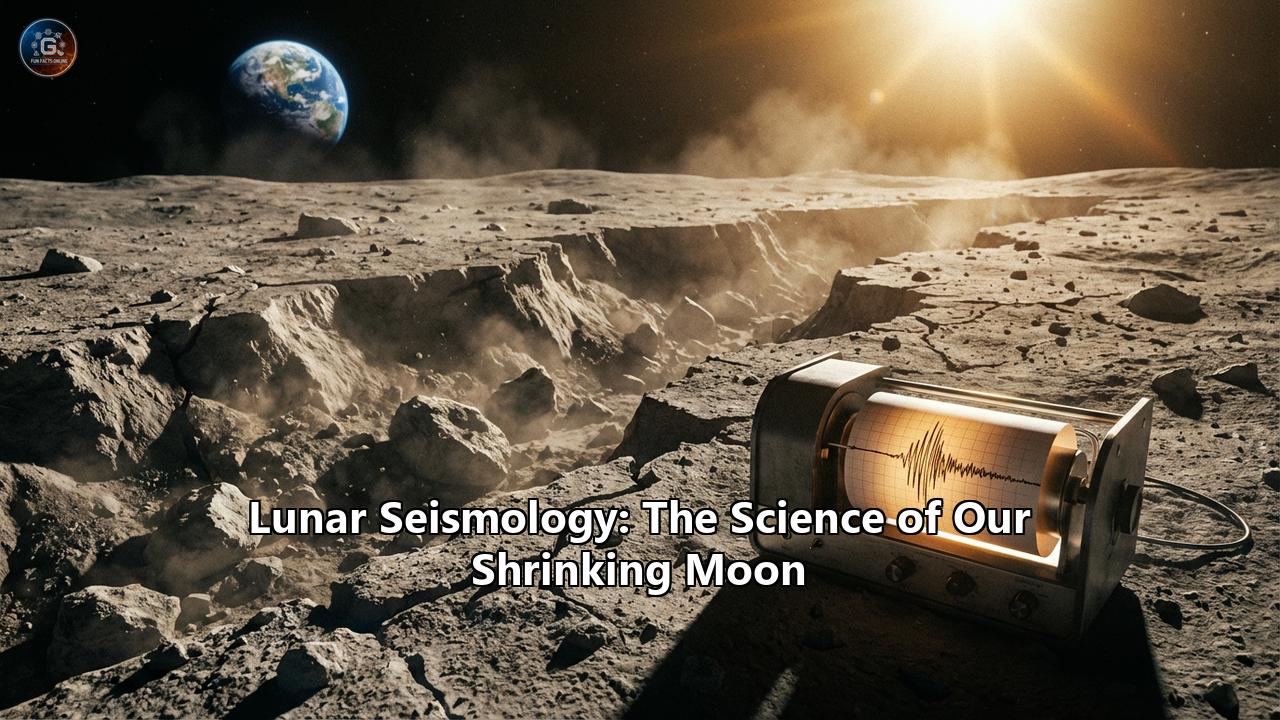
When you look up at the night sky, the Moon appears as a silent, unchanging sentinel. Its cratered face, locked in a permanent gaze with our planet, gives the illusion of a geologically dead world—a cosmic museum where the footprints of Apollo astronauts sit undisturbed in the vacuum of space. But beneath that still, gray dust, a violent and dynamic geological drama is unfolding. The Moon is not a dead rock; it is a living, shrinking, and quaking world.
Welcome to the fascinating field of lunar seismology, a branch of planetary science that has profoundly shifted our understanding of our nearest celestial neighbor. Through a combination of half-century-old data, cutting-edge orbital imagery, and advanced modern computing, scientists have discovered that the Moon’s interior is actively cooling and contracting. As it shrinks, its brittle crust buckles and cracks, triggering "moonquakes" powerful enough to pose serious hazards to future human exploration.
The Legacy of the Apollo Passive Seismic Experiment
To understand the shrinking Moon, we must first look back to the Apollo era. When astronauts first walked on the lunar surface, they were venturing onto a world whose interior was a complete mystery. Was it solid all the way through? Did it have a molten core? Did it experience tectonic activity like Earth?
To answer these questions, Apollo 11 astronaut Buzz Aldrin deployed the first lunar seismometer in 1969, powered by two panels of solar cells. This instrument was the vanguard of the Apollo Passive Seismic Network, a series of advanced sensors placed by the crews of Apollo 11, 12, 14, 15, and 16. The later stations were equipped with radioactive thermal generators, allowing them to survive the brutal, two-week-long lunar nights and transmit continuous data back to Earth until the network was officially decommissioned in 1977.
For eight years, these instruments listened to the heartbeat of the Moon. What they recorded shocked planetary scientists: the Moon was vibrating with activity. Initially, researchers parsing the data by hand with pen and paper identified around 13,000 seismic events. Decades later, with the help of modern algorithms and artificial intelligence, scientists like Keisuke Onodera from the University of Tokyo re-analyzed the Apollo short-period seismic data and uncovered 22,000 previously overlooked moonquakes.
By studying how seismic waves travel through the lunar interior, scientists were able to classify moonquakes into four distinct categories:
1. Deep Moonquakes:The most common type of lunar seismic event, deep moonquakes, originate between 700 and 1,200 kilometers below the surface—about halfway to the Moon's center. These are not caused by the Moon's own internal heat, but rather by the Earth. Just as the Moon's gravity pulls on Earth's oceans to create tides, Earth's massive gravitational field constantly stretches and squeezes the Moon. This tidal stress causes deep, rhythmic fractures. Deep moonquakes often occur in concentrated "nests" and peak in frequency depending on the Moon's orbital position relative to Earth.
2. Meteoroid Impacts:The Moon lacks a thick atmosphere to burn up incoming space debris. As a result, it acts as a giant acoustic detector for the solar system. The Apollo seismometers recorded more than 1,700 impacts from meteoroids striking the lunar surface, sending shockwaves rippling through the crust.
3. Thermal Moonquakes:The lunar surface experiences some of the most extreme temperature swings in the solar system, plunging to -250°F (-150°C) during the lunar night and baking at 250°F (120°C) under the harsh daytime sun. This rapid heating and cooling causes the lunar crust and the loose surface rock (regolith) to physically expand and contract. These microscopic movements generate thousands of tiny, shallow tremors every lunar morning and evening.
4. Shallow Moonquakes:While deep and thermal moonquakes are relatively weak, shallow moonquakes are the true monsters of the lunar underworld. Originating within the top 200 kilometers of the crust, these tectonic events are incredibly powerful. Out of the original catalog of seismic events, 28 were identified as shallow moonquakes, registering up to a staggering 5.5 on the Richter scale. On Earth, a 5.5 magnitude earthquake is enough to damage buildings. On the Moon, the effects are even more dramatic due to the unique nature of lunar geology.
The Ringing Bell: Why Moonquakes Are So Destructive
If you experience a magnitude 5.5 earthquake on Earth, the intense shaking usually lasts for only a few seconds to a minute. The Earth's crust is fractured into tectonic plates, saturated with water, and highly weathered. These features act like a geological sponge, rapidly absorbing and dampening seismic energy.
The Moon, however, is bone-dry, highly fractured from billions of years of asteroid impacts, and relatively cold in its upper layers. When a shallow moonquake strikes, the seismic waves do not dissipate. Instead, they bounce around continuously within the brittle crust. Scientists famously describe the Moon as "ringing like a bell." Lunar seismic energy can take anywhere from half an hour to several hours to completely dissipate, with the most intense, violent shaking lasting for over 10 minutes.
For a human outpost or a fragile spacecraft resting on the lunar surface, 10 to 30 minutes of continuous, high-amplitude shaking is a catastrophic hazard. But what exactly is causing these powerful shallow moonquakes if the Moon lacks moving tectonic plates? The answer lies in the slow, inevitable cooling of the lunar core.
The Science of the Shrinking Moon
To understand the origin of shallow moonquakes, scientists had to look at the Moon on a global scale. The Moon formed approximately 4.5 billion years ago in a chaotic environment of intense cosmic bombardment and radioactive decay, which left it as a molten, glowing sphere of magma. Over billions of years, the Moon has been slowly radiating that primordial heat out into the freezing vacuum of space.
As the Moon's interior cools, it physically contracts. To visualize this process, scientists often use the analogy of a grape drying into a raisin. As the fleshy interior of the grape shrinks, the outer skin must buckle and fold to accommodate the reduced volume. The Moon undergoes the exact same process. However, unlike the flexible skin of a grape, the Moon's outer crust is incredibly rigid and brittle. As the volume of the Moon's interior decreases, the solid crust is forced to compress. Eventually, the stress becomes too great, and the crust breaks.
This breaking forms what geologists call "thrust faults," where one section of the lunar crust is pushed violently up and over an adjacent section. These geological fractures manifest on the surface as cliff-like stair-steps known as lobate scarps.
Scientists estimate that over the last several hundred million years—a blink of an eye in geological time—this contraction has caused the Moon to shrink by about 150 feet (50 meters) in diameter.
For a long time, researchers believed these lobate scarps were ancient relics of the Moon's distant past. That changed with the launch of NASA's Lunar Reconnaissance Orbiter (LRO). Equipped with the incredibly powerful Lunar Reconnaissance Orbiter Camera (LROC), the LRO has mapped the lunar surface in unprecedented high resolution. The images beamed back revealed a vast, global network of thousands of relatively small, pristine thrust faults.
The visual evidence was striking: these lobate scarps looked remarkably "young." They crosscut small impact craters that would have otherwise been erased by the slow churn of micrometeoroid impacts, and they featured bright, unweathered regolith, suggesting recent geological movement.
The definitive proof came when Dr. Thomas Watters, a senior scientist emeritus at the Smithsonian’s National Air and Space Museum, combined the new LRO imagery with the old Apollo seismic data. By using a specialized algorithm designed to relocate the epicenters of the shallow moonquakes recorded in the 1970s, Watters and his team discovered a smoking gun: the epicenters of the strongest shallow moonquakes perfectly aligned with the young lobate scarps mapped by the LRO. Furthermore, many of these quakes occurred when the Moon was at apogee (its farthest point from Earth in its orbit), a time when tidal stress is added to the global contraction stress, making fault slips highly likely.
The conclusion was undeniable. The lobate scarps are not ancient fossils; they are active fault lines. The Moon is actively shrinking today, and the scraping, thrusting crust is the engine driving the powerful shallow moonquakes.
Further expanding on this, recent research by Cole Nypaver and Tom Watters mapped another class of tectonic features known as small mare ridges (SMRs). While lobate scarps were mostly found in the lighter lunar highlands, over 1,100 previously unrecognized SMRs were identified in the dark basaltic plains of the lunar maria. These ridges share an average age of about 100 to 120 million years with the lobate scarps, proving that the entire global surface of the Moon—from the highlands to the maria—is buckling under the pressure of its shrinking interior.
The South Pole Danger Zone: Implications for Artemis
This paradigm shift in lunar geology has arrived at a critical moment in human history. NASA’s ambitious Artemis program aims to return humans to the Moon for the first time since 1972, with the ultimate goal of establishing a permanent, sustainable human presence.
Unlike the Apollo missions, which landed in the relatively flat, equatorial regions of the Moon, Artemis targets the lunar South Pole. This region is of immense strategic value because its deep, permanently shadowed craters act as cold traps, harboring billions of years' worth of frozen water ice. This ice can be mined to provide drinking water, breathable oxygen, and even liquid hydrogen and oxygen for rocket fuel.
However, the quest for lunar water brings astronauts directly into a seismic danger zone.
By meticulously mapping the lunar South Pole, researchers have discovered a dense cluster of lobate scarps crisscrossing the very areas NASA has selected as candidate landing sites for the Artemis III crewed mission. For example, the de Gerlache Rim 2, a prime candidate landing region, contains a young thrust-fault scarp that orbital models suggest is highly active. In fact, the epicenter of one of the most violent shallow moonquakes ever recorded by the Apollo network was relocated to within 60 kilometers of the lunar South Pole, encompassing several proposed Artemis landing zones.
The hazard here is twofold. First is the direct threat of the moonquake itself. A magnitude 5.5 quake lasting for hours could severely damage rigid lunar habitats, crack the foundations of launch pads, or disrupt sensitive life-support machinery. As Renee Weber, a planetary scientist at NASA's Marshall Space Flight Center, notes, understanding this seismic hazard is absolutely vital to the survival of future lunar outposts.
The second, and perhaps more terrifying hazard, is landslides. The lunar South Pole is defined by its rugged, extreme topography, with craters like Shackleton featuring incredibly steep, plunging slopes. The surface of these slopes is covered in regolith—a loose, dry, frictionless layer of fractured rock and dust.
Computer models evaluating the slope stability in the South Polar region have yielded alarming results. Even light to moderate seismic shaking from a distant lobate scarp slip could be enough to destabilize the regolith on these steep crater walls. If an astronaut, a lunar rover, or a mining habitat were positioned inside one of the permanently shadowed regions when a shallow moonquake strikes, they could be buried by a silent, cascading avalanche of lunar dust and rock.
"We hope to sound a cautionary note: that the Moon is a seismically active body and that there is a potential hazard to long-term settlements, if they are located too close to a young fault," Watters warns. Future mission planners must now treat the Moon not just as an exploration destination, but as an active seismic construction site. Structural engineering for lunar habitats will require flexible foundations, shock absorbers, and rigorous hazard zoning to ensure that multimillion-dollar infrastructure isn't built directly atop an active thrust fault.
The Future of Lunar Seismology
Despite the incredible discoveries derived from the Apollo network and the Lunar Reconnaissance Orbiter, our seismic map of the Moon is still woefully incomplete. The Apollo seismometers were entirely localized to the nearside equatorial region of the Moon. We have virtually zero direct seismic data from the lunar farside or the extreme polar regions.
To safely establish a permanent lunar economy, a new era of lunar seismology is dawning. NASA and international space agencies are actively developing next-generation instruments to deploy a global lunar geophysical network.
One of the most highly anticipated missions is the Farside Seismic Suite (FSS). Scheduled to fly on a commercial lunar lander, the FSS will place the first highly sensitive broadband and short-period seismometers on the far side of the Moon. Protected from the extreme temperature swings by advanced thermal shielding, these instruments will survive the lunar night and peek deep into the Moon's core, helping to map the global distribution of tectonic stress.
Furthermore, future Artemis astronauts will likely be tasked with deploying vast arrays of modern seismic sensors across the South Pole. These new networks will monitor the thermal cracking of the regolith, listen for the distant thud of meteoroid impacts, and serve as an early warning system for the violent shifting of the shrinking lunar crust.
For thousands of years, humanity has looked at the Moon and seen a symbol of quiet permanence. Today, thanks to the persistent curiosity of planetary seismologists, we know the truth. Our Moon is a dynamic, contracting world, groaning and fracturing under the weight of its own cooling heart. As we prepare to leave our footprints in the lunar dust once again, we do so with a newfound respect for the ground beneath our boots. Exploring the Moon will not just be a matter of conquering the vacuum of space, but mastering the tremors of a shrinking world.
Reference:
- https://science.nasa.gov/moon/moonquakes/
- https://www.earthscope.org/news/whats-inside-the-moon-seismology-can-show-us/
- https://www.researchgate.net/publication/223618353_New_identification_of_deep_moonquakes_in_the_Apollo_lunar_seismic_data
- https://www.smithsonianmag.com/science-nature/thousands-of-moonquakes-some-of-them-threatening-discovered-in-old-apollo-era-data-180984822/
- https://www.hou.usra.edu/meetings/lpsc2024/pdf/1616.pdf
- https://www.space.com/moonquakes-artemis-3-hazards
- https://earthsky.org/space/shrinking-moon-moonquakes-faults-wrinkles/
- https://www.nasa.gov/solar-system/moon/shrinking-moon-causing-moonquakes-and-faults-near-lunar-south-pole/
- https://airandspace.si.edu/newsroom/press-releases/shrinking-moon-causes-temblors-and-faults-lunar-south-polar-region
- https://eos.org/articles/the-quaking-shrinking-moon
- https://www.sciencedaily.com/releases/2026/02/260218031532.htm
- https://www.skyatnightmagazine.com/news/moonquakes-artemis-iii-landing-sites
- https://physicsworld.com/a/moonquakes-and-landslides-make-the-lunar-south-pole-unstable/
- https://earthsky.org/space/moon-is-shrinking-moonquakes-faults/