
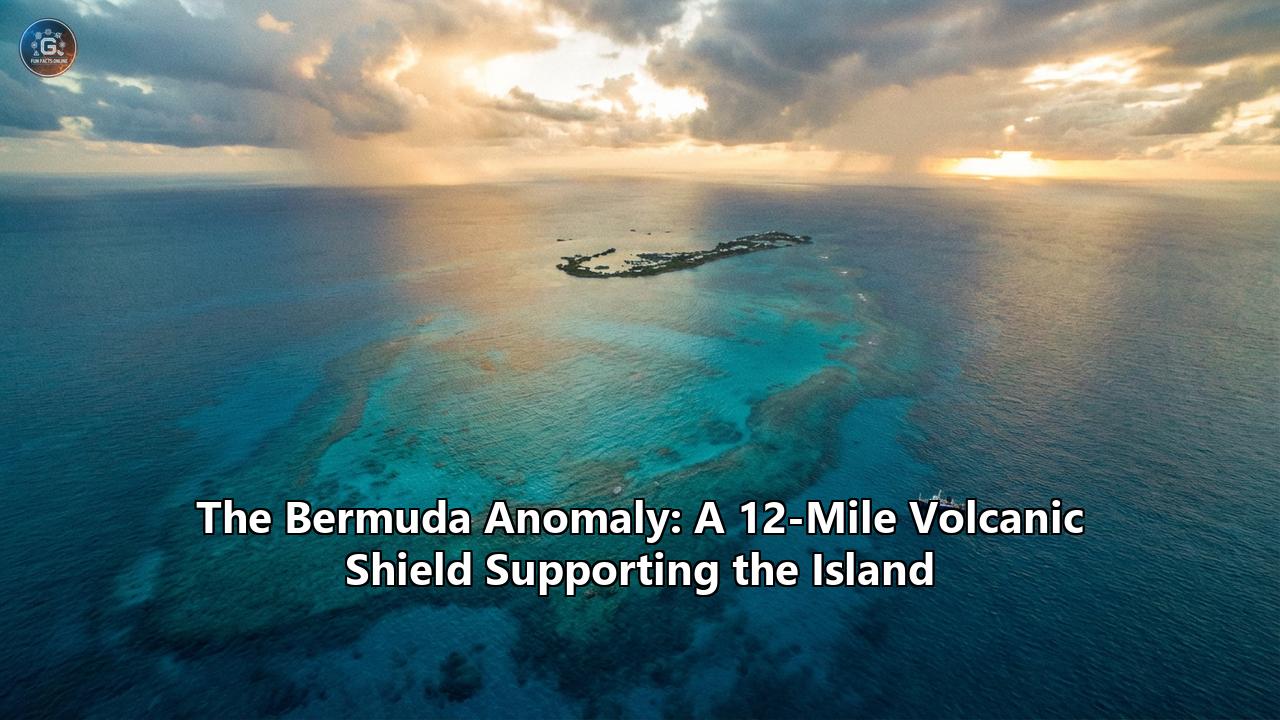
In a groundbreaking geological revelation that has sent shockwaves through the scientific community this week, researchers have identified a massive, previously unknown structure supporting the island: a 12-mile-thick volcanic shield—a colossal "raft" of frozen magma that defies standard geological models. This discovery, combined with evidence that Bermuda’s lavas originated from the mantle’s chaotic "Transition Zone," suggests that the island is not just a tourist paradise, but a rare portal into the deepest, most volatile layers of our planet.
Part I: The Impossible Island
To understand the magnitude of this discovery, one must first understand why Bermuda shouldn’t exist—or at least, why it shouldn’t look the way it does.
Most oceanic islands, like Hawaii or Iceland, follow a predictable geological script. They are typically formed by "hotspots"—plumes of scorching magma rising from deep within the Earth to puncture the tectonic plate moving above. As the plate drifts, the hotspot punches a new hole, creating a chain of volcanoes that eventually erode and sink back under the waves as they cool and become denser. This process, known as thermal subsidence, dictates that old volcanoes should sink.
Bermuda is an extinct volcano, having last erupted about 30 million years ago. By all conventional laws of geophysics, it should have long since eroded and subsided deep below the sea surface, becoming a "guyot" (a flat-topped seamount). Yet, it remains defiantly buoyant, rising some 15,000 feet from the ocean floor to kiss the surface.
For decades, geologists called this the "Bermuda Rise"—a broad, gentle swelling of the seafloor surrounding the island. But they couldn't explain what was holding it up. The gravity signals were wrong. The heat flow data didn't match a standard hotspot. The island was a geological ghost, floating where it should have sunk.
Now, we know why.
Part II: The 12-Mile Shield
The mystery began to unravel thanks to a new study led by seismologists utilizing cutting-edge imaging technology to "X-ray" the Earth beneath the Atlantic. What they found was not a simple magma chamber or a standard volcanic root, but a monstrous layer of extrusive rock unique to this region.
The "Raft" AnomalyBeneath the visible limestone cap and the ancient volcanic pedestal of Bermuda lies a distinct geological layer approximately 12.4 miles (20 kilometers) thick. To put this in perspective, the average oceanic crust is only about 3 to 4 miles thick. This newly discovered layer acts as a gigantic, buoyant life preserver, a "raft" of frozen, crystalline rock that has thickened the crust to continental proportions.
This structure is formed from a specific type of magmatic intrusion. Approximately 30 million years ago, during Bermuda's final and most violent volcanic phase, magma didn't just erupt onto the surface; it injected itself laterally into the crust, inflating it like a water balloon. This process, known as underplating, added massive volume to the plate without adding enough density to sink it.
The result is a shield of rock so vast and thick that it fundamentally altered the local gravity field. It is this 12-mile-thick fortification that counteracts the natural sinking of the ocean floor, keeping Bermuda propped up above the waves for millions of years longer than nature usually allows.
Part III: The Transition Zone—A Voice from the Deep
If the 12-mile shield is the structure that holds Bermuda up, the material it is made of is the story. And that story begins not in the upper crust, but in a hellish, high-pressure realm known as the Mantle Transition Zone.
In 2019, a precursor study led by petrologist Dr. Esteban Gazel (Cornell University) and Dr. Sarah Mazza (University of Münster) analyzed core samples drilled from Bermuda deep in the 1970s. These cores, which had been gathering dust in storage, turned out to contain the "Rosetta Stone" of Atlantic geology.
The Water-Rich CrystalWhen the team analyzed the chemical fingerprints of the Bermuda lava, they found something impossible. The rocks contained isotopes of lead and carbon that didn't match the upper mantle (where normal lava comes from). Instead, they matched the chemical signature of the Transition Zone—a layer of the Earth situated between 250 and 400 miles (410–660 km) deep.
This zone is a geochemical dumping ground. For billions of years, subducting tectonic plates have dived into the Earth, carrying with them water, carbon dioxide, and ocean sediments. These slabs eventually stall in the Transition Zone, melting into a volatile, crystal-rich "slush."
The Bermuda samples contained crystals of titanium-augite and other water-bearing minerals, indicating that the magma held as much water as some subduction zones—despite being nowhere near a trench. This confirmed a radical theory: Bermuda was formed by a "belch" from the deep Earth. A disturbance in the Transition Zone, likely caused by the shifting of ancient slab remnants from the supercontinent Pangea, sent a pulse of this volatile, water-rich magma shooting upward.
The silica-poor, carbon-rich magma:Because this magma came from such a chemically distinct depth, it was silica-poor but rich in carbon dioxide and volatiles. This unique chemistry is what allowed the magma to be so buoyant and eruptive, likely contributing to the rapid formation of the massive 12-mile shield. It wasn't just molten rock; it was a high-pressure injection of deep-Earth material that froze in place.
Part IV: Rewriting the Textbooks
The combination of these two discoveries—the deep-mantle origin and the massive crustal shield—paints a picture of a geological event unlike any other known on Earth.
- A New Type of Volcano: We can no longer classify volcanoes simply as "plate boundary" or "hotspot." Bermuda represents a third category: a Mid-Plate Transition Zone Volcano. It proves that the Earth’s mantle is not a stagnant conveyor belt but a dynamic, churning system capable of launching material from its deepest reservoirs directly to the surface.
- The Stability of Intraplate Ocean Islands: The 12-mile shield explains why some islands persist while others vanish. It suggests that underplating—the thickening of the crust from below—plays a far more critical role in the topography of our planet than previously thought.
- Global Carbon Cycle: The high carbon content of the Bermuda lavas implies that these deep-earth eruptions might be significant, overlooked drivers of Earth's ancient climate. When Bermuda formed, it may have released vast quantities of deep-mantle CO2 into the atmosphere, potentially influencing the global cooling trends of the Oligocene epoch.
Part V: The Real Mystery of the Triangle
For decades, the "Bermuda Triangle" has been a fixture of pop culture, blamed on everything from aliens to Atlantean crystals. The irony is that the scientific reality is far stranger than the fiction.
The "force" emanating from Bermuda isn't magnetic magic; it is gravity. The 12-mile-thick rock layer creates a positive gravity anomaly, a subtle distortion in the Earth’s gravitational field that satellites can detect. While this doesn't crash planes, it does mess with our understanding of the seafloor.
Furthermore, the magnetic minerals frozen within this massive shield have locked in the orientation of the Earth’s magnetic field from 30 million years ago. This creates a complex local magnetic signature—not one that spins compasses wildly, but one that tells the history of a planet in motion.
The "Bermuda Anomaly" is not a danger to travelers, but a gift to science. It is a window into the "deep water cycle" of the Earth, proving that the oceans we sail upon are intimately connected to vast reservoirs of water and crystal trapped hundreds of miles beneath our feet.
Conclusion: The Sentinel of the Atlantic
As tourists lounge on the pink sands of Horseshoe Bay, they are unknowingly sunbathing on top of a geological miracle. Beneath their towels lies a 150-foot limestone cap. Beneath that, the eroded stump of a 30-million-year-old volcano. And supporting it all, hidden in the crushing depths, is that 12-mile-thick shield—a silent, frozen leviathan that refuses to let the island die.
The discovery of the Bermuda Shield is a reminder that even in the 21st century, our planet has not run out of surprises. We have mapped the surface of Mars more precisely than the interior of our own home. But piece by piece, rock by rock, anomalies like Bermuda are helping us build a map of the underworld, revealing a planet that is more dynamic, more volatile, and more interconnected than we ever dared to imagine.
Bermuda is no longer just an island. It is a monument to the deep Earth.
Reference:
- https://www.newsweek.com/bermuda-new-type-volcano-never-seen-earth-1427180
- https://www.livescience.com/planet-earth/geology/giant-structure-discovered-deep-beneath-bermuda-is-unlike-anything-else-on-earth
- https://news.cornell.edu/stories/2019/05/earths-deep-mantle-scientists-discover-new-way-volcanoes-form
- https://www.labroots.com/trending/earth-and-the-environment/14766/scientists-discover-volcanoes-form
- https://bermudageology.com/the-bermuda-volcanic-seamount/
- https://www.livescience.com/65528-mysterious-way-volcanoes-can-form.html
- https://www.sciencealert.com/geologists-have-just-discovered-a-new-way-volcanoes-can-form
- https://en.wikipedia.org/wiki/Bermuda_Pedestal
- https://www.uni-muenster.de/news/view.php?cmdid=10271&lang=en
- https://science.nasa.gov/earth/earth-observatory/bermuda-7397/