
Look at your hand. At a glance, it is skin, bone, and blood. But zoom in past the cells, past the DNA helices, to the atomic level, and you will find a collection of ancient travelers. The carbon that builds the backbone of your genetic code, the oxygen powering your every breath, and the nitrogen that knits together your amino acids—none of these existed when the universe began.
For the first few minutes after the Big Bang, the cosmos was a simple, sterile soup of hydrogen, helium, and a dash of lithium. It was a universe without chemistry, without biology, and without the possibility of life. To create the complexity we see today, the universe needed alchemy. It needed forges capable of crushing atoms together to create something new. It needed stars.
While violent supernovae often steal the spotlight with their explosive brilliance, they are not the sole authors of our existence. There is a quieter, slower, and more prolific creator in the galaxy: the Red Giant. These bloated, dying stars are the great cosmic gardeners, gently seeding the universe with the specific ingredients necessary for life. This is the story of how they do it, and how you are the direct result of their final, fiery breaths.
Part I: The Awakening of a Giant
To understand how a Red Giant creates the building blocks of life, we must first understand what it is. A Red Giant is not a different species of star; it is a phase—a retirement plan for stars like our Sun.
For billions of years, a star lives on the "Main Sequence," existing in a delicate state of hydrostatic equilibrium. Gravity tries to crush the star inward, while the explosive force of nuclear fusion in the core pushes outward. It is a perfect stalemate. In the core, hydrogen atoms are smashed together to form helium, releasing energy in the process. This energy is the light we see and the heat we feel.
But eventually, the fuel runs out.
When a star of intermediate mass (roughly 0.8 to 8 times the mass of our Sun) exhausts the hydrogen in its core, the stalemate breaks. Without the outward pressure of fusion, gravity wins, and the core collapses. This collapse increases the pressure and temperature dramatically. Meanwhile, the outer layers of the star, reacting to the intense heat radiating from the compressing core, do something counterintuitive: they expand.
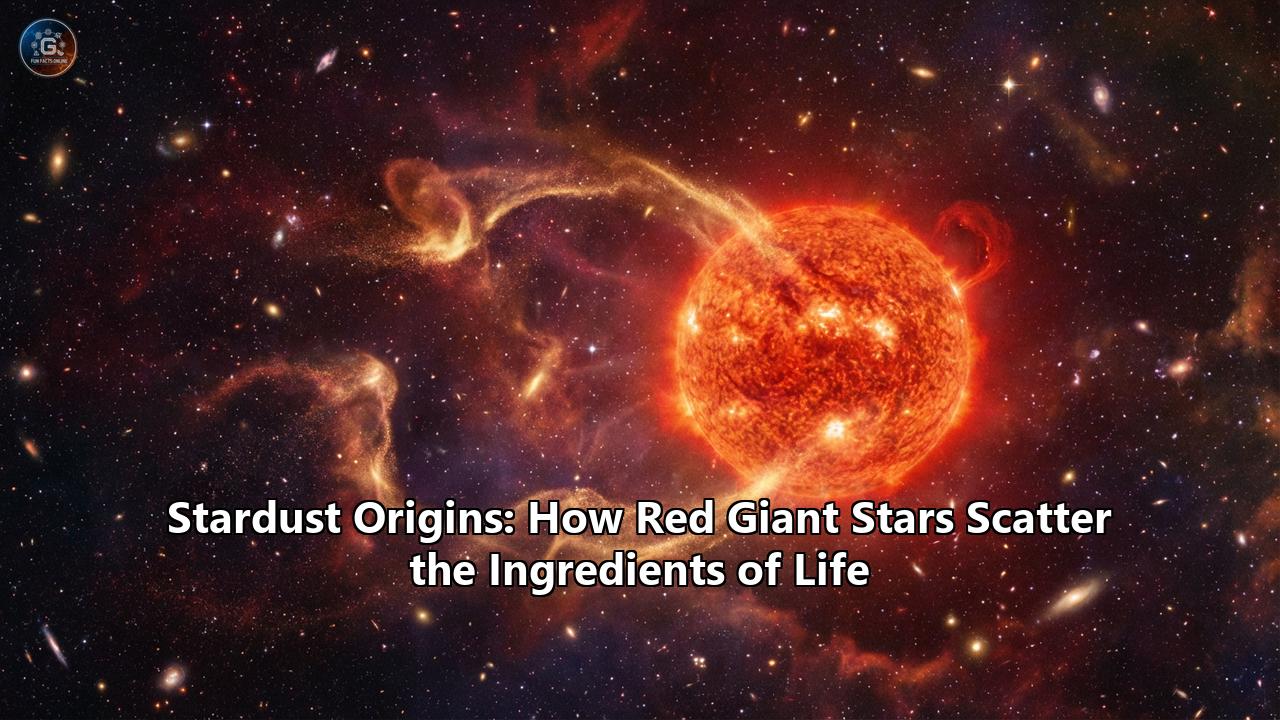
The star balloons outward, swelling to hundreds of times its original size. If our Sun were to turn into a Red Giant today, it would swallow Mercury and Venus, and its outer atmosphere would lick at the surface of Earth. As the gas expands, it cools, shifting the star’s color from a blinding white-yellow to a glowing, ember-red.
The star has become a Red Giant. But the real magic is happening deep inside, hidden from view.
Part II: The Alchemist’s Furnace
Inside the collapsed core of the Red Giant, temperatures reach over 100 million degrees Kelvin. This hellish environment is hot enough to wake a sleeping giant: Helium.
In a main-sequence star, helium is just an inert waste product, the "ash" of hydrogen fusion. But in the crushed core of a Red Giant, helium becomes the new fuel. Through a reaction known as the Triple-Alpha Process, three helium nuclei (alpha particles) collide and fuse to form a single nucleus of Carbon-12.
This is a pivotal moment in the history of the universe. Carbon is the scaffolding of life. Its unique ability to form four stable chemical bonds allows for the complex chains and rings that make up organic chemistry. Every protein, every sugar, every lipid in your body is anchored by carbon atoms that were likely forged in this specific phase of a dying star’s life.
But the alchemy doesn't stop there. As the star evolves into the Asymptotic Giant Branch (AGB) phase, the fusion layers become unstable. The star begins to pulse, like a dying heartbeat. These pulses, or "thermal flashes," drive convection currents that reach deep into the star's interior.
This is where the S-Process (Slow Neutron Capture) begins.
Unlike the rapid, chaotic fusion of a supernova (the R-Process), the S-Process is a slow, methodical method of building heavy elements. Free neutrons, released by side reactions in the helium-burning shell, drift through the core. Every so often, an atomic nucleus captures one of these neutrons. If the new nucleus is stable, it waits for another. If it’s unstable, it decays into a proton, transforming the atom into a completely new element, one step higher on the periodic table.
Over thousands of years, this slow assembly line produces elements heavier than iron, including:
- Strontium: Used by marine life to build exoskeletons.
- Barium: A heavy element often used in medical imaging today.
- Technetium: A radioactive element that played a key role in the history of astronomy.
Perhaps most importantly for us, these stars are the primary factories for Nitrogen. While massive stars produce most of the oxygen, and supernovae produce the iron in our blood, it is the intermediate-mass Red Giants that churn out the bulk of the nitrogen in the universe. Nitrogen is a critical component of amino acids (the building blocks of proteins) and nucleic acids (DNA and RNA). Without the nitrogen produced in the belly of Red Giants, the genetic code of life simply could not be written.
Part III: The Great Scattering
It is one thing to create these elements; it is another to get them out of the star and into the universe where they can form planets and people. If the elements stayed locked in the core, the star would simply die as a white dwarf, taking its treasure to the grave.
Red Giants, however, are generous givers.
The "Dredge-Up"
As the star undergoes its thermal pulses, massive convection currents churn the star's layers like a pot of boiling oatmeal. These currents scoop up the newly minted carbon, nitrogen, and s-process elements from the deep interior and transport them to the surface. Astronomers call this a "dredge-up."
Once at the surface, these elements cool. The carbon atoms can bond together to form microscopic grains of graphite and diamond, while other elements form silicates. This is literally "stardust"—tiny, solid particles forming in the atmosphere of a star.
The Stellar Wind Mystery
For decades, the prevailing theory was that this dust drove the star's mass loss. The idea was simple: light exerts pressure. The intense radiation from the star pushes against the dust grains, and as the dust is blown outward, it drags the gas along with it, creating a "stellar wind" that strips the star of its outer layers.
However, recent discoveries have complicated this picture. A groundbreaking 2024 study of the star R Doradus revealed that dust grains might not be close enough to the star to drive the wind alone. This suggests that other mechanisms—perhaps magnetic fields or pulsations similar to sound waves—are helping to launch this material into the cosmos.
Regardless of the exact mechanism, the result is the same: the Red Giant gently sheds its outer layers over millions of years. It exhales its atmosphere, enriched with carbon, nitrogen, and oxygen, into the surrounding void.
The Planetary Nebula
The finale of this process is one of the most beautiful sights in the universe: a Planetary Nebula. (The name is a misnomer; it has nothing to do with planets, but 18th-century astronomers thought they looked like round planetary disks).
As the Red Giant sheds its last layers, the hot, exposed core (now a White Dwarf) floods the surrounding gas with ultraviolet light. The gas glows in vibrant neons—greens from oxygen, reds from hydrogen and nitrogen. The Helix Nebula and the Ring Nebula are famous examples of these cosmic tombstones, marking the site where a star died and bequeathed its elements to the galaxy.
Part IV: The Smoking Gun—Technetium
For a long time, the idea that stars created elements was just a theory. In the early 20th century, many scientists believed the elements were primordial, existing since the beginning of time.
The proof that stars were active factories came in 1952, thanks to an astronomer named Paul Merrill.
Merrill was studying the light spectra of S-type Red Giant stars when he noticed the spectral signature of an element called Technetium. This was shocking. Technetium is an unstable, radioactive element with a half-life of only about 4 million years—a blink of an eye in cosmic time.
If Technetium had been present when the star was born billions of years ago, it would have decayed into nothing long ago. The only explanation for seeing it in the atmosphere of an old Red Giant was that the star was making it right now.
This discovery was the "smoking gun" for stellar nucleosynthesis. It proved that stars are not just static balls of gas, but active nuclear reactors changing the chemical composition of the universe in real-time. This paved the way for the legendary B2FH paper (named after authors Burbidge, Burbidge, Fowler, and Hoyle) in 1957, which mapped out exactly how stars forge the elements.
Part V: Meeting the Giants
When you look up at the night sky, you can see these factories at work with your naked eye.
- Betelgeuse (Orion): The most famous Red Supergiant. It is so large that if placed in our solar system, it would extend past Jupiter. It is currently shedding massive amounts of material and dimming unpredictably as it burps out clouds of dust that obscure its light.
- Aldebaran (Taurus): The glowing "Eye of the Bull." An orange giant 44 times the size of the Sun, currently fusing helium into carbon.
- Mira (Cetus): The "Wonderful" star. Mira is a variable star that pulsates wildly, changing its brightness by a factor of a thousand. It is hurtling through space so fast that it leaves a comet-like tail of shed material 13 light-years long—a trail of life-giving ingredients sown across the galaxy.
- Arcturus (Boötes): An ancient orange giant passing through our stellar neighborhood. It is one of the brightest stars in the northern sky and a future preview of what our Sun might look like (though slightly more massive).
- La Superba (Canes Venatici): One of the reddest stars in the sky. It is a "Carbon Star," a rare class of Red Giant where the dredge-up has brought so much carbon to the surface that it chokes the atmosphere with soot, blocking blue light and letting only deep red filter through.
Part VI: From Stardust to Flesh
The cycle completes in the Interstellar Medium (ISM). The winds from these giants mix with the explosion debris of supernovae. The carbon dust, the nitrogen gas, and the oxygen float in the void for millions of years.
Eventually, a shockwave—perhaps from a passing spiral arm or a nearby supernova—compresses a cloud of this enriched gas. Gravity takes hold, and the cloud collapses to form a new star and a disk of planets.
4.5 billion years ago, this happened to our solar nebula. The carbon atoms in that cloud, forged in the heart of a long-dead Red Giant, clumped together to form organic molecules on a cooling rock called Earth. The nitrogen gas became trapped in the atmosphere and eventually fixed into the soil.
When you eat a plant, or an animal that ate a plant, you are ingesting atoms that were dredged up from the core of a dying star.
- The Nitrogen in your DNA? A gift from a Red Giant.
- The Carbon in your cells? Forged in the triple-alpha process of a dying star.
- The Oxygen you breathe? Likely from a massive star, but enriched by the giants.
- The Iron in your blood? The violent legacy of a supernova.
We are, quite literally, a patchwork of cosmic history.
Conclusion: The Quiet Legacy
Supernovae are the rock stars of the universe—flashy, violent, and impossible to ignore. But the Red Giants are the patient artisans. They spend millions of years carefully fusing helium, brewing the complex chemistry of carbon and nitrogen, and gently scattering it into the void.
Without their slow, steady labor, the universe might be filled with iron and hydrogen, but it would lack the organic complexity required for life. We exist because generations of giants lived, aged, and died, scattering their ashes into the cosmos—ashes that would one day wake up, look at the stars, and wonder where they came from.
Reference:
- https://scitechdaily.com/astronomers-overturn-decades-old-theory-about-how-stars-spread-lifes-ingredients/
- http://lifeng.lamost.org/courses/Hongkong/Hongkong_En/lecture/ch16/ch16.html
- https://armaghplanet.com/aldebaran-red-giant-at-the-eye-of-the-bull.html
- https://www.youtube.com/watch?v=FqPL_0lGjYs
- https://science.nasa.gov/universe/stars/
- https://spmiasacademy.com/general-knowledge/mira-variable-star/
- https://sites.ualberta.ca/~pogosyan/teaching/ASTRO_122/lect17/lecture17.html
- https://en.wikipedia.org/wiki/Aldebaran
- https://starwalk.space/en/news/aldebaran-star
- https://en.wikipedia.org/wiki/Technetium_star
- http://large.stanford.edu/courses/2011/ph241/hamman1/
- https://grokipedia.com/page/B2FH_paper
- https://www.forbes.com/sites/startswithabang/2017/04/18/60-years-of-starstuff-how-humanity-discovered-where-our-elements-come-from/
- https://en.wikipedia.org/wiki/B2FH_paper
- https://earthsky.org/brightest-stars/mira-quite-wonderful/
- https://www.almanac.com/arcturus-star
- https://www.universetoday.com/articles/seeing-the-red-of-la-superba-a-magnificent-springtime-carbon-star
- https://imagine.gsfc.nasa.gov/educators/lessons/xray_spectra/background-elements.html