
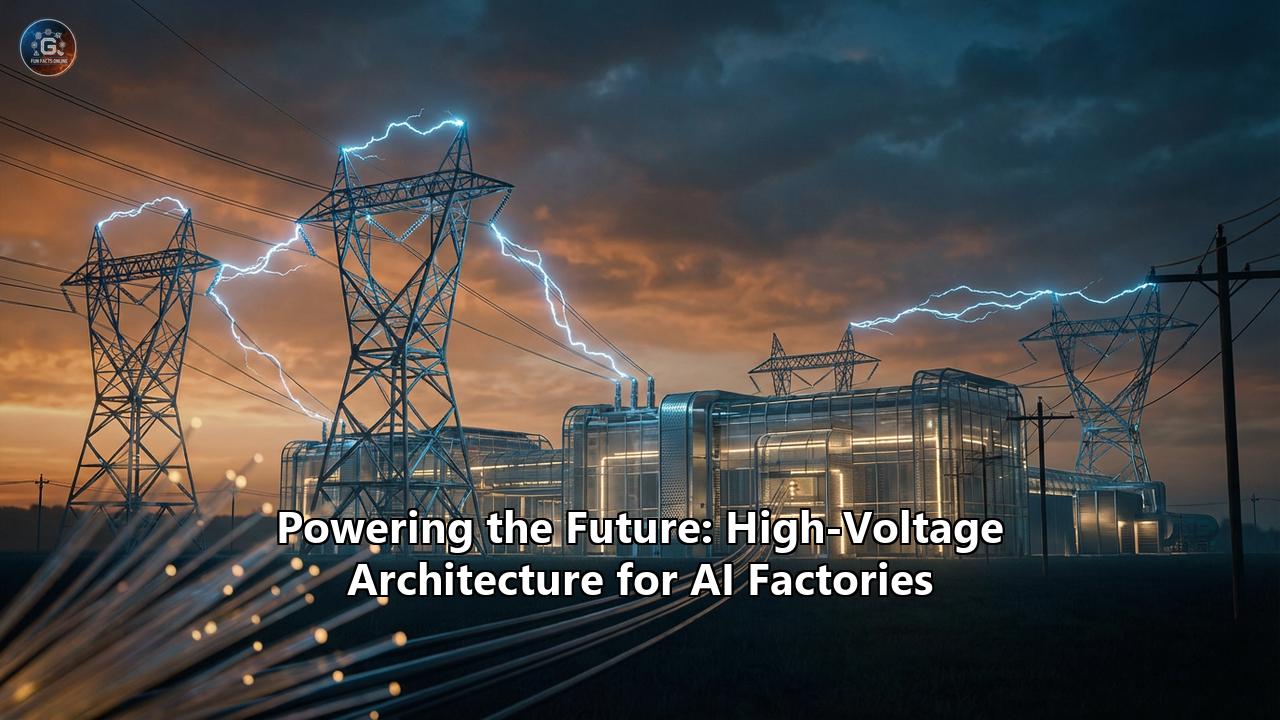
The data center is dead. Long live the AI Factory.
For decades, the digital world was powered by a predictable, steady hum. Rows of servers, largely idle, sipped power from a grid designed for consistency. But the generative AI revolution has shattered this paradigm. We are no longer building mere storage facilities for digital files; we are constructing industrial-scale power plants of intelligence—massive, throbbing engines of computation that demand energy not in kilowatts, but in megawatts and gigawatts.
As AI models race toward trillion-parameter complexity, the physical infrastructure supporting them is hitting a hard wall. The laws of physics—specifically Ohm’s Law—have become the primary adversary of the modern data center architect. The traditional 12V and 480V AC power distribution systems that served the internet era are buckling under the weight of accelerated computing. Cables are becoming too thick to manage, heat is becoming impossible to extract, and efficiency losses are bleeding millions of dollars in wasted energy.
The solution lies in a radical re-imagining of the electrical backbone: a shift to High-Voltage Architecture. From 800V DC distribution backbones to 48V direct-to-chip delivery, this new electrical standard is not just an upgrade; it is the prerequisite for the future of artificial intelligence.
The Physics of the Problem: The 12V Trap
To understand why high voltage is inevitable, one must first understand the "current" crisis. In electrical engineering, power ($P$) is the product of voltage ($V$) and current ($I$). To deliver more power to a chip, you can either increase the current or increase the voltage.
For years, standard servers operated comfortably on 12V power shelves. A standard rack might consume 5kW to 10kW. At 12V, delivering 10kW requires about 833 Amps of current. This was manageable with standard copper busbars.
However, a modern NVIDIA NVL72 rack—a single cluster of Blackwell GPUs acting as one supercomputer—can consume 120kW or more. To deliver 120kW at 12V, you would need to push 10,000 Amps of current.
This is physically impossible for a standard server rack.
- Resistive Losses ($I^2R$): Power loss in a conductor increases with the square of the current. Increasing current by 10x increases resistive heat losses by 100x. At 10,000 Amps, the copper busbars would essentially become electric heaters, melting components and wasting vast amounts of energy before it even reached the GPU.
- The Copper Crisis: To handle that current without melting, the copper conductors would need to be massive—weighing hundreds of kilograms per rack. In a gigawatt-scale facility, the cost and weight of this copper become prohibitive.
The only way out of this trap is to raise the voltage. By moving from 12V to 48V, or from 415V AC to 800V DC, we can drastically lower the current, reducing heat, saving copper, and fitting the massive power of an AI factory into a feasible physical footprint.
The New Blueprint: 800V DC Architecture
The industry, led by heavyweights like NVIDIA, Eaton, and the Open Compute Project (OCP), is coalescing around a new standard for the "AI Factory": 800V DC.
This is not a random number. It mirrors the revolution happening in the Electric Vehicle (EV) industry, where 800V architectures allow for faster charging and lighter wiring. In the data center, an 800V DC backbone offers a "superhighway" for electrons that bypasses the inefficient stop-and-go traffic of traditional AC distribution.
Why DC? The End of Conversions
Traditional data centers are plagued by conversion steps. Power comes from the grid (AC), gets stepped down (AC), converted to DC for batteries (AC-DC), back to AC for the UPS (DC-AC), then distributed to the rack (AC), and finally converted back to DC for the server (AC-DC).
Every conversion step bleeds efficiency—typically 2-5% is lost as heat. In a 100MW facility, a 5% loss is 5 megawatts of wasted power—enough to power 4,000 homes—just vanished as heat that must then be cooled (costing even more energy).
The 800V DC native architecture simplifies this radically:
- Grid to Edge: Medium Voltage AC (e.g., 13.8kV or 34.5kV) enters the facility.
- Rectification: Large, industrial-grade Solid State Transformers (SSTs) convert this directly to 800V DC at the facility edge.
- The DC Busway: A streamlined 800V DC busway runs through the data hall, connecting directly to the racks.
- No UPS Room: Instead of a massive centralized UPS room, battery storage is integrated directly onto the 800V bus or into "sidecar" battery racks. This reduces stranding capacity and eliminates redundant conversion hardware.
NVIDIA’s reference designs for its next-generation "Kyber" racks utilize this 800V DC input. By eliminating the AC switchgear and Power Distribution Units (PDUs) inside the rack, they free up precious "white space" for compute and cooling.
The Grid-to-Chip Journey: A Technical Walkthrough
Let’s trace the path of an electron in this modern AI Factory to see how high-voltage architecture changes the game.
Stage 1: The Medium Voltage Handshake (13.8kV - 34.5kV)
The journey begins at the utility substation. AI Factories are so large they often require their own dedicated substations. Here, the focus is on Grid-interactive technologies. Using smart switchgear, the facility doesn't just draw power; it communicates with the grid, potentially using its internal battery reserves to smooth out demand peaks—a critical feature when AI training jobs can cause sudden, massive load spikes (transients) of 50MW in milliseconds.
Stage 2: The 800V DC Backbone
Instead of stepping down to 480V AC, the power is rectified to 800V DC.
- Technology: Silicon Carbide (SiC) modules are the heroes here. These wide-bandgap semiconductors can handle high voltages with incredibly low switching losses, making the AC-to-DC conversion over 98% efficient.
- Distribution: Overhead busways (rigid bars of aluminum or copper) carry this 800V current above the server rows. Busways are superior to cables here because they are rigid, offer better airflow (less cable clutter), and can be tapped into anywhere along the row, offering modular flexibility.
Stage 3: The Rack Power Shelf (800V -> 48V)
Inside the rack, we encounter the Power Shelf. In the new architecture, this shelf takes the 800V DC input and steps it down to 48V DC.
- Why 48V? 48V is the new "safe" low voltage. It is low enough to be safe for handling (Safety Extra Low Voltage - SELV) but high enough to be 16x more efficient than 12V.
- Efficiency: Modern GaN (Gallium Nitride) transistors allow these converters to run at ultra-high frequencies (>1 MHz), shrinking the size of transformers and capacitors. This means the power shelf takes up less vertical space (U space) in the rack, leaving more room for GPUs.
Stage 4: The Last Inch (48V -> <1V)
The final leg is the most critical: the "Last Inch" from the motherboard to the GPU silicon. The GPU needs roughly 0.8V to 1V to operate, but it needs it at thousands of Amps.
- The Problem: If you converted to 1V at the edge of the motherboard, the resistance of the traces on the board itself would cause massive voltage droop (VDroop) before the power reached the chip.
- The Solution: Vertical Power Delivery (VPD). Companies like Vicor and MPS have pioneered Power-on-Package technology. They bring 48V directly onto the underside of the GPU substrate. A tiny, incredibly dense current multiplier module converts 48V to 1V millimeters away from the transistor. This "vertical" stack eliminates motherboard losses effectively to zero, allowing the GPU to drink as much power as it needs instantly.
Strategic Imperative: Sustainability & The "Copper Crisis"
The move to high voltage isn't just about performance; it's an environmental imperative.
1. The Copper EquationA 1 gigawatt AI campus built with traditional 480V/12V architecture would require copper cabling weighing as much as the Statue of Liberty. By switching to 800V DC, the current drops, and the required conductor cross-section shrinks by roughly 45%.
This is a massive reduction in Scope 3 carbon emissions (embedded carbon) associated with mining, refining, and transporting copper. It also significantly lowers the structural load on building floors.
2. CUE: Carbon Usage EffectivenessWe are moving beyond PUE (Power Usage Effectiveness) to CUE (Carbon Usage Effectiveness). High-voltage architectures enable easier integration of renewable energy. Solar panels and wind turbines generate DC power natively. Connecting a solar farm directly to an 800V DC data center bus eliminates the wasteful DC->AC->DC conversions required to connect renewables to a traditional grid-tied facility.
3. Liquid Cooling SynergyHigh-voltage systems are denser. Density creates heat. This necessitates a marriage between electrical and mechanical engineering. The new 800V busbars and power shelves are often liquid-cooled. Cold plates circulate dielectric fluid or water directly over the GaN/SiC power FETs. This captures nearly 100% of the heat rejection into water loops, which can then be reused for district heating, further improving the facility's sustainability profile.
The Road Ahead: Greenfield vs. Brownfield
For CIOs and Infrastructure leaders, the path forward involves a bifurcation of strategy:
- Greenfield (New Builds): The "AI Factory" standard is clear. Design for Medium Voltage (MV) to the row or 800V DC. Plan for liquid cooling loops in every rack. Do not build a legacy 480V AC floor if you intend to deploy MW-scale clusters. The ROI on efficiency gains alone will pay for the new equipment within years.
- Brownfield (Retrofits): For existing data centers, the 48V rack is the bridge. You may not be able to rip out the facility-level 480V AC distribution, but you can deploy racks that convert AC to 48V DC locally. This allows you to host high-density OCP-compliant servers without rebuilding the entire power plant. However, you will be limited by the physical capacity of your cabling and cooling.
Conclusion
We are witnessing the industrial revolution of the digital age. The "AI Factory" is a machine that turns electricity into intelligence. Like any industrial machine, its efficiency depends on its power source.
The high-voltage architecture—spanning 800V DC facility backbones, 48V rack standards, and direct-to-chip vertical power—is the gearbox that allows this machine to run. It solves the physics of megawatt-scale density, alleviates the material scarcity of copper, and opens the door to a greener, grid-interactive future.
For the data center industry, the message is clear: Voltage up, or power down. The future belongs to the high-voltage architecture.
Reference:
- https://convergedigest.com/the-megawatt-shift-nvidias-800-vdc-strategy/
- https://www.techpowerup.com/341843/nvidia-moves-to-800-volt-dc-power-infrastructure-to-drive-gigawatt-scale-ai
- https://developer.nvidia.com/blog/building-the-800-vdc-ecosystem-for-efficient-scalable-ai-factories/
- https://navitassemi.com/wp-content/uploads/2025/10/Redefining-Data-Center-Power-GaN-and-SiC-Technologies-for-Next-Gen-800-VDC-Infrastructure.pdf
- https://en.eeworld.com.cn/mp/EEWorld/a399816.jspx
- https://www.innoscience.com/site/details/1024
- https://www.hardfindelec.com/a/113037.html
- https://developer.nvidia.com/blog/nvidia-800-v-hvdc-architecture-will-power-the-next-generation-of-ai-factories/
- https://www.youtube.com/watch?v=-oyqIunZE-g
- https://fuspan.com/why-is-busbar-preferred-over-cable-for-power-distribution/
- https://www.opencompute.org/documents/dcf-sustainability-metrics-final-r3-docx-pdf