
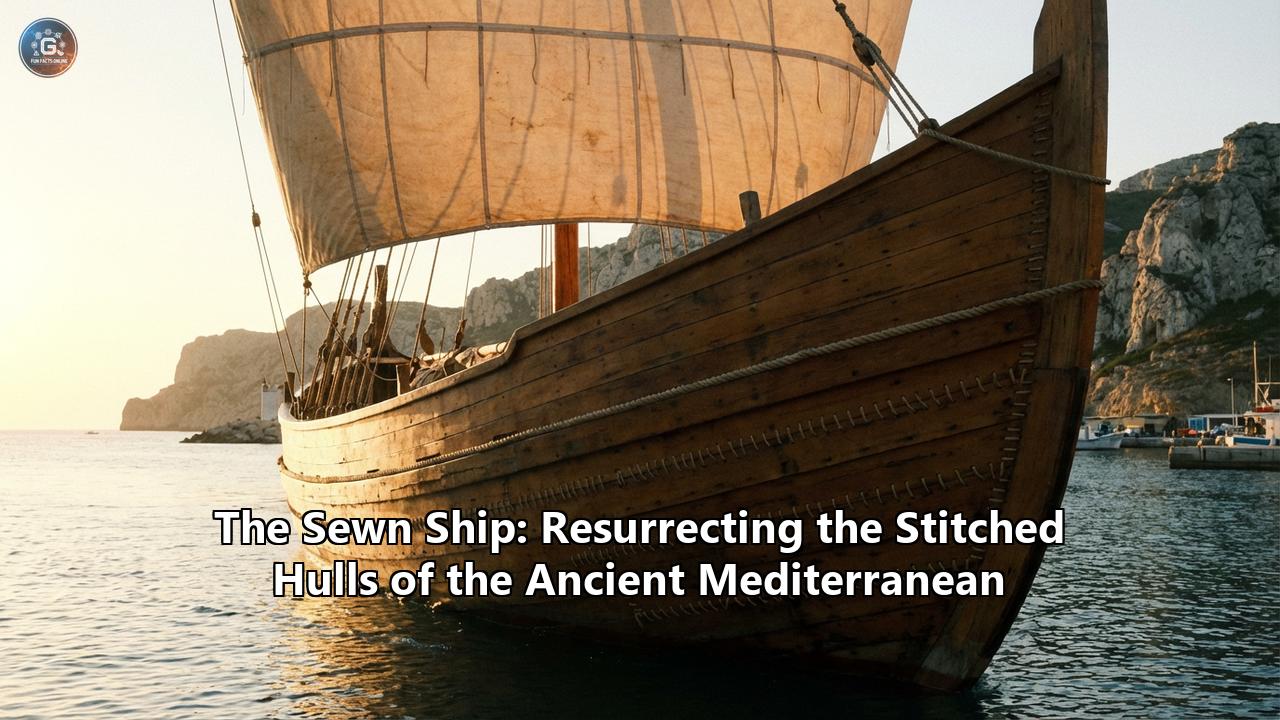
The Aegean sunlight catches the surface of the water, not on the sleek, seamless fiberglass of a modern yacht, but on something far more organic. It is a vessel that breathes. As the waves slap against the hull, there is no rigid shudder of iron or bolted timber. Instead, the boat groans—a soft, rhythmic creaking of wood rubbing against wood, held together not by nails, but by thread.
This is the sound of the ancient Mediterranean. For thousands of years, before the ring of the iron hammer defined the shipyard, the sea was conquered by needle and twine. From the coasts of Istria to the harbors of Marseille, ancient shipwrights literally sewed their vessels together, stitching planks of pine and elm with cords of linen, esparto grass, and roots. It was a technology of remarkable resilience and flexibility, one that allowed the first great maritime civilizations to spread their nets of trade and war across the known world.
For centuries, this tradition was lost to the deep, forgotten by history books that favored the bronze rams of triremes and the massive grain freighters of Rome. But in the last few decades, the mud of the Mediterranean floor has begun to give up its secrets. Through spectacular archaeological discoveries like the Zambratija boat in Croatia and the Jules Verne 9 in France, and the daring experimental archaeology projects that have resurrected them, we are finally relearning the lost art of the sewn ship.
Part I: The Discovery in the Mud
The story of the sewn ship’s resurrection begins not in a library, but in a shallow bay in the northern Adriatic. In 2008, local fishermen in the Bay of Zambratija, Croatia, reported strange timbers protruding from the seabed. The site was shallow, only a few meters deep, and vulnerable to the shifting sands and modern boat traffic. When archaeologists from the Archaeological Museum of Istria and the French CNRS (Centre national de la recherche scientifique) descended to investigate, they found something that defied the standard timeline of Mediterranean shipbuilding.
They uncovered a hull that was roughly 12 meters long, built from elm, alder, and fir. But it was the fastenings that took their breath away. There were no metal nails. There were no deep, locking mortise-and-tenon joints that characterized Greek and Roman ships. Instead, the planks were lashed together with vegetal ropes threaded through oblique holes.
Radiocarbon dating stunned the team: the wood dated to between the 12th and 10th centuries BC. This was the late Bronze Age, the era of the Trojan War and the mysterious Sea Peoples. The Zambratija boat was identified as the oldest fully sewn boat ever found in the Mediterranean. It was a "missing link," a survivor from an era when the peoples of the Adriatic—the Histri and Liburnians—were mastering the sea with technologies that seemed primitive to modern eyes but were sophisticated in their execution.
The "Shell-First" Enigma
To understand why the discovery of a sewn boat is so significant, one must understand how ancient ships were built. If you were to visit a wooden boatyard today, you would see the "skeleton-first" method: the keel is laid, the ribs (frames) are erected, and then the planks are bent and nailed onto this skeleton. The internal frame provides the strength.
The ancients did it backward. They built "shell-first."
In this mindset, the watertight skin of the boat was the primary structure. The shipwright would lay the keel and then painstakingly attach the planks to the keel and to each other, building up the sides of the ship shell-like, piece by piece. Only after this shell was complete would they insert the framing timbers for reinforcement.
In the classic Greek and Roman periods, this shell was created using mortise-and-tenon joints—thousands of wooden slots and tabs locked with pegs. But the Zambratija find, and others like it, proved that before the mortise-and-tenon took over, the shell was created by sewing.
Part II: The Anatomy of a Stitch
How do you sew a 10-ton wooden vessel so that it doesn't leak? The sheer audacity of the engineering is difficult to grasp until you look at the microscopic details.
The "stitch" was not a crude looping of rope. It was a complex system designed to tighten under pressure and protect the cordage from the chafing of the sea.
1. The Tetrahedral Recess
The first step was preparation. On the inside of the plank, the shipwright would carve out a tetrahedral recess—a triangular, pyramid-shaped divot. This wasn't just for aesthetics; it allowed the rope to sit flush with the wood, preventing it from being worn down by the cargo or the crew's feet.
2. The Oblique Channel
Using a bow drill or an auger, the builder would then bore a hole from this recess diagonally outwards, exiting through the edge of the plank. Crucially, the hole did not go all the way through to the outside of the hull. It stayed inside the thickness of the wood. This meant the stitching was largely protected from the external water and rocks.
3. The Wadding
Before the sewing began, a watertight seal had to be created between the planks. Shipwrights would place a wadding pad—often a roll of fabric, moss, or vegetal fiber soaked in pitch—along the seam. When the planks were drawn together, this wadding would be compressed, acting like a gasket.
4. The Stitching
Then came the labor. Using long wooden needles, the builders would thread cords of linen, esparto grass, or Spanish broom through the oblique channels. The stitching pattern was often an "X" shape (cross-stitch) or a simple spiral, passing over the wadding pad on the inside.
5. The Locking Peg
Once the stitch was pulled tight—likely by a team of workers using levers to tension the rope—a small tapered wooden peg (a treenail) was hammered into the hole. This peg locked the rope in place, ensuring that if the cord snapped at one point, the whole seam wouldn't unzip.
The result was a hull that was remarkably flexible. Unlike a rigid nailed ship, a sewn boat could flex and twist with the waves. In the choppy, unpredictable waters of the Aegean or the Adriatic, this "elasticity" was a survival feature, allowing the boat to absorb the shock of the sea rather than crack against it.
Part III: The Golden Age of the Stitched Hull
While the Zambratija boat is the oldest, it was the discovery of two shipwrecks in Marseille, France, that brought the "golden age" of this technology into focus.
In 1993, during excavations for a parking garage at Place Jules-Verne, archaeologists stumbled upon the ancient harbor of Massalia (Marseille), the Greek colony founded around 600 BC. Buried in the sediment were two vessels: Jules Verne 7 and Jules Verne 9.
Jules Verne 9 (dating to the late 6th century BC) was a revelation. It was a coral-fishing boat, about 9 meters long, and it was fully sewn. The preservation was exquisite. Archaeologists could see the pitch still clinging to the linen threads. It showed that the Greek colonists of Massalia, bringing their Phocaean traditions from the Aegean, were using sewn technology for their workhorses.Nearby lay Jules Verne 7, a slightly larger vessel. This boat told a different story—the story of transition. Its lower hull was sewn, but its upper strakes were fastened with mortise-and-tenon joints. It was a hybrid, a technological mutant caught between the old world of lashing and the new world of locking wood.
Other wrecks across the Mediterranean flesh out this picture:
- The Giglio Wreck (c. 600 BC): Found off the Tuscan island of Giglio, this Etruscan or Greek vessel used a "laced" construction known as the GBG technique. It was a merchant ship, laden with amphorae, proving that sewn ships weren't just small fishing boats—they were the heavy haulers of Archaic trade.
- The Bon Porté Wreck (c. 525 BC): Discovered near Saint-Tropez, this 10-meter vessel was sewn with vegetal ropes and helped confirm that this technique was widespread across the Ligurian Sea.
These boats were the trucks of the Archaic period. They carried the wine, the olive oil, and the ceramics that fueled the economies of the burgeoning city-states.
Part IV: The Great Transition
If sewn boats were flexible, strong, and capable, why did they disappear? By the Classical period (5th-4th century BC), the great navies of Athens and the merchant fleets of Rome had largely abandoned sewing in favor of the locked mortise-and-tenon.
The answer lies in the changing demands of maritime history: Scale, Maintenance, and War.
The Maintenance Nightmare
Experimental archaeology has revealed the Achilles' heel of the sewn boat: maintenance. The replica of the Jules Verne 9 boat, named Gyptis, revealed that sewing a hull is incredibly labor-intensive. It took the modern team approximately 15 hours to sew just one meter of planking.
Furthermore, natural fiber ropes rot. A sewn boat required constant vigilance. Every winter, the hull likely had to be hauled out, the pitch scraped off, and the fraying stitches inspected or replaced. If the stitches loosened, the boat would become "hogged" or misshapen.
The Need for Speed and Ramming
The geopolitical landscape changed. The rise of the trireme and the quinquereme meant that ships were no longer just transport; they were missiles. A warship designed to ram an enemy vessel at 10 knots needed a hull of extreme rigidity. A sewn hull, with its inherent flexibility, might absorb the shock of a ramming impact too well—or worse, the shock might shear the stitches, causing the attacker to disintegrate along with its victim.
The mortise-and-tenon joint created a "monocoque" structure—a single, solid wooden shell that was incredibly stiff. It turned the boat into a battering ram.
The Ma'agan Michael Ship: The Pivot Point
The Ma'agan Michael ship, discovered off the coast of Israel and dating to around 400 BC, serves as the perfect example of this completed transition. It was still built "shell-first," respecting the ancient sequence. However, its planks were fastened almost entirely with locked mortise-and-tenon joints. It represents the maturity of the new technology—a vessel that retained the hydrodynamic elegance of the shell concept but ditched the high-maintenance sewing for the durability of oak pegs.
Part V: The Survivors in the Shallows
However, technology rarely dies completely; it retreats into niches. While the deep-sea grain ships and warships adopted the new joinery, the sewn boat found a sanctuary where it remained superior: the Adriatic lagoons.
In the shallow, muddy waters of the Po Delta and the Venetian lagoon, a rigid, deep-keeled ship was a liability. The locals needed flat-bottomed barges that could slide over sandbanks and withstand the stresses of beaching.
Here, the "Romano-Paduan" tradition kept the needle alive. Wrecks like the Comacchio (late 1st century BC) show that even at the height of the Roman Empire, shipwrights were still sewing the bottoms of their large barges, while using mortise-and-tenon for the sides. The flexibility of the sewn bottom allowed these barges to "breathe" as they settled onto riverbanks during low tide, where a rigid hull might have snapped its keel.
This tradition persisted for centuries. The Cervia shipwreck, dating to the 6th-7th century AD, shows that long after Rome fell, the people of the upper Adriatic were still stitching their ships, a direct lineage stretching back to the Bronze Age Zambratija boat.
Part VI: Resurrecting the Gyptis
Archaeology can only tell us what a boat looked like when it died. To understand how it lived, you have to build one.
In 2013, the Centre Camille Jullian in Marseille embarked on an ambitious project: to build a full-scale sailing replica of the Jules Verne 9. They named her Gyptis, after the legendary Ligurian princess who married the Greek founder of Marseille.
The project was a lesson in humility. The team decided to use tools and techniques as close to the original as possible (with the concession of electric drills to bore the thousands of holes required, simply to finish within a human lifespan).
The Build
The team found that the sewing process was a rhythmic, exhausting dance. Two people were needed for every stitch—one inside the hull, one outside—passing the needle back and forth, tightening the cord with levers, and hammering in the locking pegs. They consumed kilometers of linen thread and massive amounts of pine pitch.
The Sea Trials
When Gyptis finally hit the water, she silenced the skeptics. She was not a leaky, fragile basket. She was light.
The mortise-and-tenon ships of later eras were heavy, laden with thousands of oak tenons. Gyptis, held together by air and string, floated high on the water. Under sail, she was fast and responsive. The flexibility of the hull, which engineers feared would be a weakness, proved to be a strength in the chop of the Mediterranean. The boat moved with the water.
The crew described the sensation of sailing her as distinct from modern wooden boats. There was a liveliness to the hull. However, they also learned the cost. The boat required constant care. After every season, she had to be hauled out and re-coated. It became clear why the ancients eventually traded the high-performance, high-maintenance sewn hull for the "set it and forget it" durability of tenons.
Conclusion: From Vines to Victory
The story of the sewn ship is a reminder that technological progress is not a straight line from "primitive" to "advanced." The sewn boats of the ancient Mediterranean were not crude rafts; they were sophisticated machines perfectly adapted to their time and environment.
They were the vessels that carried the heroes of the Odyssey (indeed, Homer describes Odysseus building a raft by "boring through" planks and fitting them together, a description that has divided scholars between sewing and mortise-and-tenon). They were the ships that founded Marseille and opened the trade routes of the Adriatic.
Today, thanks to the waterlogged timbers of Zambratija and the living planks of the Gyptis, we can hear that sound again: the soft, rhythmic groan of a ship stitched to the sea, reminding us that sometimes, the strongest bond is the one that knows how to bend.
Reference:
- https://www.researchgate.net/publication/331018044_Ancient_Mediterranean_Sewn-Boat_Traditions
- https://en.wikipedia.org/wiki/Phoenician_joint
- https://en.wikipedia.org/wiki/Sewn_boat
- https://www.phoenicia.rocks/blog/the-journey-of-shipbuilding-joints-from-sewing-to-tenon-and-pin
- https://www.ancientportsantiques.com/wp-content/uploads/Documents/ETUDESarchivees/Navires/Documents/Pomey2012-ShipHulls.pdf
- https://www.ancientportsantiques.com/wp-content/uploads/Documents/ETUDESarchivees/Navires/Documents/Pomey2019-SewnShips.pdf
- https://engnovate.com/ielts-reading-tests/cambridge-ielts-16-academic-reading-test-3/