
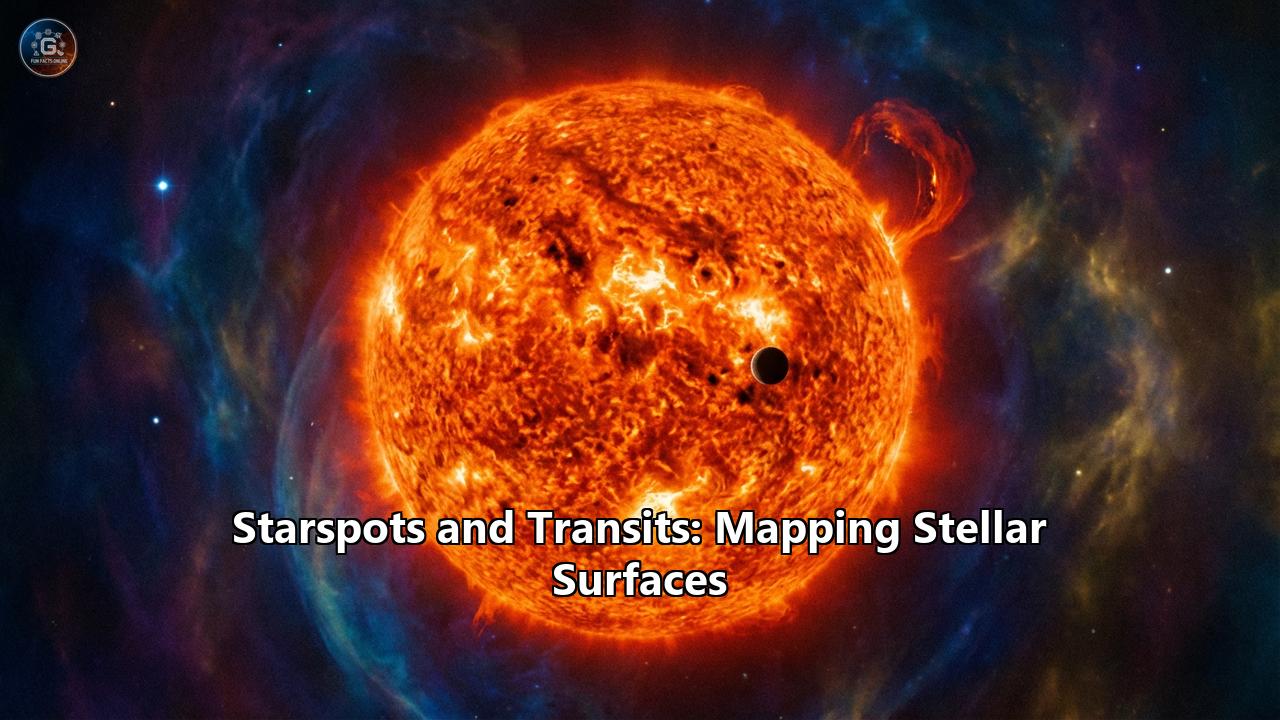
The surface of a star is a turbulent, dynamic landscape, a roiling ocean of plasma governed by forces that dwarf anything found on Earth. For centuries, the only star whose surface we could resolve in any detail was our own Sun. We watched sunspots migrate across its face, tracing the invisible hand of its magnetic field, and from these observations, we built our first understanding of stellar dynamos. But the billions of other stars in our galaxy remained unresolved points of light—featureless, uniform, and distant.
That era of ignorance is ending. A quiet revolution is taking place in astrophysics, driven not by building larger telescopes to "zoom in" on stars, but by a clever exploitation of geometry and luck. By watching exoplanets—planets orbiting other stars—pass in front of their hosts, astronomers have found a way to scan stellar surfaces with exquisite precision. These "transits" act as a natural sliding slit-scanner, revealing the location, size, and temperature of starspots, measuring the star’s hidden rotation, and even unlocking the secrets of magnetic dynamos in stars entirely unlike our Sun.
This technique, known variously as spot transit mapping or eclipse mapping, has transformed exoplanets from mere objects of discovery into powerful probes of stellar astrophysics. It has revealed stars with "giant polar spots" that defy solar physics, mapped "butterfly diagrams" on distant dwarfs, and uncovered the bizarre geometry of tilted planetary systems. This is the story of how we are mapping the impossible—painting portraits of stellar surfaces light-years away, one shadow at a time.
The Broken Mirror: Why We Need to Map Stars
To understand why mapping stellar surfaces is so critical, we must first understand the "stellar activity problem." For decades, models of stellar evolution and exoplanet atmospheres assumed stars were simple, uniform spheres of gas. This "lightbulb approximation" works well for basic calculations, but it fails spectacularly when we look closer.
Real stars are magnetically active. They have starspots—regions where intense magnetic field bundles pierce the photosphere, suppressing convection. Because the hot plasma from the interior cannot rise as effectively in these regions, they cool down, appearing darker than the surrounding surface. On the Sun, these spots are small, rarely covering more than a fraction of a percent of the surface. But on younger, more active stars, starspots can be monstrous, covering 10%, 20%, or even 50% of the star’s face.
These spots are not just blemishes; they are physical laboratories. They tell us about the star’s dynamo—the internal engine that generates its magnetic field. In the Sun, the dynamo is thought to operate at the "tachocline," the boundary between the radiative core and the convective outer envelope. But what happens in small red dwarf stars (M-dwarfs) that are fully convective and have no tachocline? How do they generate their massive flares and magnetic fields? The answer lies in the distribution of their spots.
Furthermore, starspots are the bane of exoplanet hunters. When a planet transits a star, we measure the dip in light to determine the planet's size. If the planet crosses a bright patch (a facula) or a dark patch (a spot), that measurement is distorted. If we try to analyze the planet's atmosphere by looking at the light filtering through it (transmission spectroscopy), unmapped starspots can mimic the signal of water vapor or scattering clouds, leading to false detections.
To find Earth 2.0, and to understand the magnetic engines of the universe, we must map these spots. And since we cannot resolve the stellar disk directly, we use the planets themselves as our cartographers.
The Mechanism: The Planet as a Probe
The principle of transit mapping is elegant in its simplicity. Imagine a spotlight shining on a wall. If you pass your hand in front of it, you cast a shadow. If the spotlight is perfectly uniform, your shadow is a constant darkness. But if the spotlight has a dirty smudge on the lens, and your hand passes over that smudge, the shadow you cast changes.
When an exoplanet transits its host star, it blocks a tiny fraction of the star's light, typically 0.01% to 1%. This creates a U-shaped dip in the "light curve"—the graph of brightness over time.
- The Spotless Star: If the star is uniform, the bottom of the "U" is flat or gently curved due to limb darkening (the star being dimmer at the edges).
- The Spot Crossing: If the planet passes over a dark starspot, it is temporarily blocking less light than it was a moment before (because it is blocking a region that was already dark). This causes a small, upward "bump" or spike in the bottom of the light curve.
This spot-crossing event is the "fingerprint" of the spot. Its properties tell us everything:
- Timing: The moment the bump occurs tells us the longitude of the spot on the star.
- Duration: How long the bump lasts tells us the physical size of the spot.
- Amplitude: The height of the bump tells us the contrast (temperature difference) of the spot relative to the rest of the star.
By observing multiple transits, we can watch these bumps migrate. If the star rotates, the spot will be in a different position during the next transit. If the bump moves slightly to the left or right in successive transits, we can calculate the star’s rotation period with incredible precision. If the shape of the bump changes, we are witnessing the evolution (birth and decay) of the magnetic field itself.
The Toolkit: From Simple Models to "Starry"
In the early days of exoplanet science, starspots were treated as "red noise"—nuisances to be averaged out. But as data quality improved with space telescopes like CoRoT, Kepler, and TESS, astronomers realized these "noise" features were actually signals.
The Geometric Approach
Early mapping efforts used simple geometric models. They assumed the star was a circle and the spot was a smaller dark circle. Algorithms would "slide" the planet across the model and adjust the spot's position until the model matched the data. This worked for single, large spots, but failed for complex active regions.
Doppler Imaging vs. Transit Mapping
Before transits, the primary method for mapping stars was Doppler Imaging. This technique relies on the fact that a rotating star has one side moving toward us (blueshifted) and one side moving away (redshifted). A spot on the approaching side creates a distortion in the blueshifted part of the star's spectral lines.
- Limitation: Doppler imaging only works for fast rotators. If a star spins slowly, the Doppler broadening is too small to resolve features.
- Advantage of Transits: Transit mapping works regardless of rotation speed. It provides a spatial resolution defined by the size of the planet, not the speed of the star. For a "hot Jupiter" planet, the resolution is exquisite, allowing us to resolve features just a few degrees across.
The "Starry" Revolution
The modern era of mapping is defined by sophisticated software like starry, developed by astrophysicist Rodrigo Luger and colleagues. Instead of moving circles around a grid, starry uses spherical harmonics—a mathematical language that describes patterns on a sphere (similar to how Fourier transforms describe waves).
This approach allows for an "analytic" solution. It means the computer doesn't have to "guess and check" millions of times; it can calculate the exact light curve for any surface map instantly. This speed allows astronomers to run thousands of simulations, determining not just the "best fit" map, but the probability of different map configurations.
Recently, researchers led by Sabina Sagynbayeva extended this with the StarryStarryProcess. This technique addresses a subtle bias: standard models often assume the unspotted surface is perfectly uniform. The StarryStarryProcess treats the surface as a collection of related pixels, allowing for a more realistic, "spotty" background. This tool was instrumental in one of the most shocking discoveries in the field: the polar spots of TOI-3884b.
Case Study I: The "Wild Angle" of TOI-3884b
If there is a "hero system" for transit mapping, it is TOI-3884b. This system, located about 140 light-years away in the constellation Virgo, consists of a "super-Neptune" planet orbiting a small M-dwarf star.
In 2025, a team led by researchers from the Astrobiology Center in Tokyo and utilizing the MuSCAT3 and MuSCAT4 multicolor cameras on the Las Cumbres Observatory network, turned their gaze to this system. The light curves were bizarre. Every time the planet transited, there was a massive, persistent "bump" in the data.
The Giant Polar Spot
Conventional wisdom says spots should be near the equator, like on the Sun. But the modeling of TOI-3884b revealed something startling: the star possessed a giant polar spot—a massive cool region covering the star’s pole.
But here was the puzzle: usually, polar spots are found on stars that rotate incredibly fast (locking the magnetic field to the pole). TOI-3884 is a slow rotator, spinning once every 11 days. This contradicted standard dynamo theories. The detection of this spot challenged the idea that slow-spinning M-dwarfs should have solar-like, distributed spots.
The 62-Degree Misalignment
The spot mapping unlocked a second secret. By tracking how the planet crossed the spot in different colors (g, r, i, z bands), the team could reconstruct the 3D geometry of the system. They found that the planet does not orbit around the star's equator. Instead, its orbit is tilted at a "wild angle" of 62 degrees relative to the star’s spin axis.
The planet is effectively orbiting "over the top" of the star, repeatedly crossing the polar spot. This specific geometry suggests a violent history—perhaps a gravitational scattering event with another massive planet in the past that kicked TOI-3884b into this extreme orbit. Without spot mapping, this dynamic history would have remained invisible.
Case Study II: The Butterfly of HAT-P-11
While TOI-3884b showed us the poles, the system HAT-P-11 gave us a glimpse of a stellar cycle in action. HAT-P-11b is a Neptune-sized planet orbiting a K-dwarf star. Using four years of data from the Kepler Space Telescope, astronomers detected hundreds of spot-crossing events.
On the Sun, spots don't appear randomly. Over the 11-year solar cycle, they start at mid-latitudes and migrate toward the equator, creating a pattern called the "Butterfly Diagram." Astronomers had dreamed of seeing this on another star.
HAT-P-11 delivered. Because the planet orbits at a high inclination (nearly 90 degrees to the star's equator), it acts as a scanner that cuts across almost all latitudes.
- The Discovery: By mapping the recurrence of spots, researchers identified "active latitudes." They found that spots were concentrated in two specific bands on either side of the equator, just like the Sun.
- The Implication: This confirmed that K-dwarfs (slightly smaller than the Sun) operate a solar-like interface dynamo, distinct from the fully convective M-dwarfs. It was the first time a "butterfly" pattern had been robustly inferred for a star other than the Sun using transits.
Furthermore, HAT-P-11b is a benchmark for atmospheric studies. When water vapor was detected in its atmosphere, the team had to be extremely careful. Unocculted starspots can introduce a spectral slope that mimics water absorption. By using the transit map to correct for the spots, they confirmed the water detection was real—a triumph of combining surface mapping with atmospheric chemistry.
Case Study III: The Forbidden Zone of CoRoT-2b
One of the earliest successes of this field came from the CoRoT mission (Convection, Rotation and planetary Transits). The target was CoRoT-2b, a hot Jupiter orbiting a young, extremely active G-star.
The light curve of CoRoT-2b was a mess of bumps and wiggles. It looked like a seismometer during an earthquake. But within that chaos was order.
- Differential Rotation: By tracking individual spots as they were eclipsed by the planet, astronomers measured the rotation period of the star at different latitudes. They found that the equator spun faster than the poles, a phenomenon known as differential rotation.
- The Spotless Equator: Strangely, the mapping revealed a "forbidden zone" right at the equator that was relatively free of spots. This gap is reminiscent of "coronal holes" on the Sun, regions where magnetic field lines open up into space.
- Synchronicity: The analysis suggested a coupling between the planet and the star. The magnetic interaction between the massive, close-in Jupiter and the host star might be altering the star’s surface activity, potentially "locking" certain magnetic features to the planet's orbital phase.
The Physics of the Invisible: M-Dwarf Dynamos
The findings from these systems are forcing a rewrite of stellar physics textbooks, particularly for M-dwarfs.
Stars like the Sun have a "tachocline"—a shear layer where the radiative core rubs against the convective envelope. This friction is the generator for the magnetic field (the $\alpha-\Omega$ dynamo).
Red dwarfs (mass < 0.35 Solar masses) are fully convective. They have no radiative core, and thus no tachocline. Theory predicted they should have a "distributed dynamo" that produces small-scale, chaotic fields spread evenly over the star.
The Paradox:Observations, including the mapping of TOI-3884b and magnetic field saturation data, show that these stars can have massive, organized, stable polar spots. This indicates a strong dipolar field, not a chaotic multipolar one.
The transit maps are providing the crucial data points to solve this paradox. They suggest that in the regime of rapid rotation (or even moderate rotation for M-dwarfs), the convective turbulence organizes itself into large-scale structures without needing a tachocline. The "saturation" of activity seen in X-ray data (where stars stop getting brighter in X-rays no matter how fast they spin) correlates with the appearance of these giant spot structures, suggesting the dynamo hits a "max capacity" limited by the star's energy budget.
The Future: TESS, PLATO, and Ariel
We are currently in the "Golden Age" of transit mapping, but the "Platinum Age" is approaching.
1. TESS (Transiting Exoplanet Survey Satellite):Currently active, TESS is finding thousands of planets around bright, nearby stars. While its observation baseline is short (27 days per sector), its targets are bright enough for ground-based follow-up (like the MuSCAT observations of TOI-3884b). TESS is building the catalog of "mappable" stars.
2. JWST (James Webb Space Telescope):JWST offers infrared sensitivity. Starspots have different contrasts in infrared vs. visible light (they are less dark in IR). By observing transits with JWST, we can measure the temperature of the spots with unprecedented accuracy. This resolves the degeneracy between a "small, very cold spot" and a "large, slightly cool spot."
3. PLATO (Planetary Transits and Oscillations of stars):Launching soon by the ESA, PLATO is designed to stare at stars for years, like Kepler, but for brighter stars like TESS. This is the holy grail for stellar mapping.
- Long Duration: We will be able to watch spots evolve over their entire lifetimes, measuring the decay rates of magnetic fields.
- Seismology: PLATO will also measure "starquakes" (asteroseismology). Combining internal sound-wave maps with surface spot maps will link the interior dynamo directly to the surface manifestation.
Ariel’s primary goal is atmospheric characterization. However, to get the atmosphere right, it must account for spots. The mission pipeline is incorporating advanced spot-modeling tools (like Starry) as a fundamental step. Ariel will likely produce the largest database of stellar surface maps as a "byproduct" of its planet survey.
Conclusion: The Shadows of Knowledge
For most of human history, the stars were immutable, perfect spheres. Even with the advent of the telescope, they remained unresolved points. It is a profound irony that the way to see the surface of a star is to block its light.
By interpreting the shadows cast by exoplanets, we have gained a superpower: the ability to resolve features on objects millions of kilometers away, situated dozens of light-years from Earth. We have found that our Sun is just one flavor of magnetic activity, and that the galaxy is populated by stars with polar caps of magnetism, equators of calm, and magnetic cycles that mirror and mock our own.
As we refine these maps with tools like starry and telescopes like PLATO, we are doing more than just drawing maps; we are peering into the hearts of stars, watching the dynamo turn, and understanding the turbulent, magnetic environment in which worlds—and perhaps life—are born. The shadow of a planet is not an absence of light; it is a revelation.
Reference:
- https://www.youtube.com/watch?v=9xvH4hq7EZQ
- https://www.youtube.com/watch?v=mhwpb7bI-B8
- https://svs.gsfc.nasa.gov/14883/
- https://science.nasa.gov/missions/tess/astronomers-map-stellar-polka-dots-using-nasas-tess-kepler/
- https://www.space.com/astronomy/exoplanets/how-scientists-are-using-exoplanets-to-map-out-polka-dots-on-stars
- https://www.researchgate.net/publication/359477909_Longitudinally_Modulated_Dynamo_Action_in_Simulated_M-dwarf_Stars
- https://arxiv.org/abs/2202.02869
- https://pmc.ncbi.nlm.nih.gov/articles/PMC6956918/
- https://www.cfht.hawaii.edu/Instruments/Spectroscopy/Espadons/www.ast.obs-mip.fr/users/donati/dynamo.html
- https://arxiv.org/abs/1607.07870