
The history of human nutrition and material science has effectively been a history of extraction. For millennia, if we wanted leather, we raised a cow. If we needed insulin, we harvested pancreases from slaughtered pigs. If we desired the binding properties of egg whites for baking, we relied on chickens. In this traditional paradigm, the organism was the black box—a complex, inefficient, and ethically fraught biological factory that we could breed but never truly optimize.
We are now standing at the precipice of a fundamental inversion of this model. We are moving from an era of extraction to an era of creation. This shift is being driven by the convergence of two distinct but increasingly intertwined fields: precision fermentation and artificial intelligence. This is not merely about making "fake meat" or cheaper cheese; it is about the digitization of biology. It is the dawn of algorithmic fermentation, where the metabolic pathways of microscopic organisms are tuned with the same precision as a computer chip, and where functional proteins are designed not by evolution’s blind trial-and-error, but by the predictive foresight of deep learning models.
Part I: The Molecule’s Journey – A Digital-to-Biological Odyssey
To understand the profundity of this shift, we must look beyond the buzzwords and trace the life cycle of a single protein in this new bio-economy. Let us imagine a novel enzyme designed to break down plastic waste, or perhaps a hyper-stable casein protein for a lactose-free cheese that melts perfectly. In the old world, discovering such a protein would take decades of bioprospecting. Today, it begins with a prompt.
Step 1: The HallucinationThe journey starts in silicon. Using generative AI models similar to the large language models (LLMs) that power ChatGPT, scientists can now "speak" the language of proteins. Proteins are essentially strings of amino acids, and their function is determined by how these strings fold into three-dimensional shapes.
Tools like DeepMind’s AlphaFold and the University of Washington’s RoseTTAFold have solved the "protein folding problem," allowing researchers to predict a protein's shape from its sequence. But the newest frontier is de novo design—literally "from new." Instead of asking an AI to predict the shape of an existing protein, scientists use diffusion models (the same tech behind AI art generators like Midjourney) to hallucinate entirely new protein structures that have never existed in nature.
For our hypothetical plastic-eating enzyme, the AI explores a vast latent space of chemical possibilities, generating millions of candidate backbone structures. It then uses "inverse folding" algorithms like ProteinMPNN to calculate the exact amino acid sequence required to create that structure. In a matter of hours, a single GPU can do what millions of years of evolution failed to accomplish: design a catalyst purpose-built for a modern problem.
Step 2: The Genetic UploadOnce the digital sequence is finalized, it must be translated into biological reality. This is where synthetic biology takes the baton. The AI-generated amino acid sequence is converted into a DNA sequence, optimized for a specific host organism—typically a yeast like Komagataella phaffii or a fungus like Trichoderma reesei.
This isn't a simple copy-paste. The AI must optimize the "codons"—the DNA words—to match the host’s preferred dialect, ensuring high yields. This digital DNA code is sent to a DNA printer, synthesized chemically, and then inserted into the host microbe using CRISPR-Cas9 gene editing. The result is a "cell factory": a yeast cell that has been hacked to prioritize the production of our novel protein above its own survival instincts.
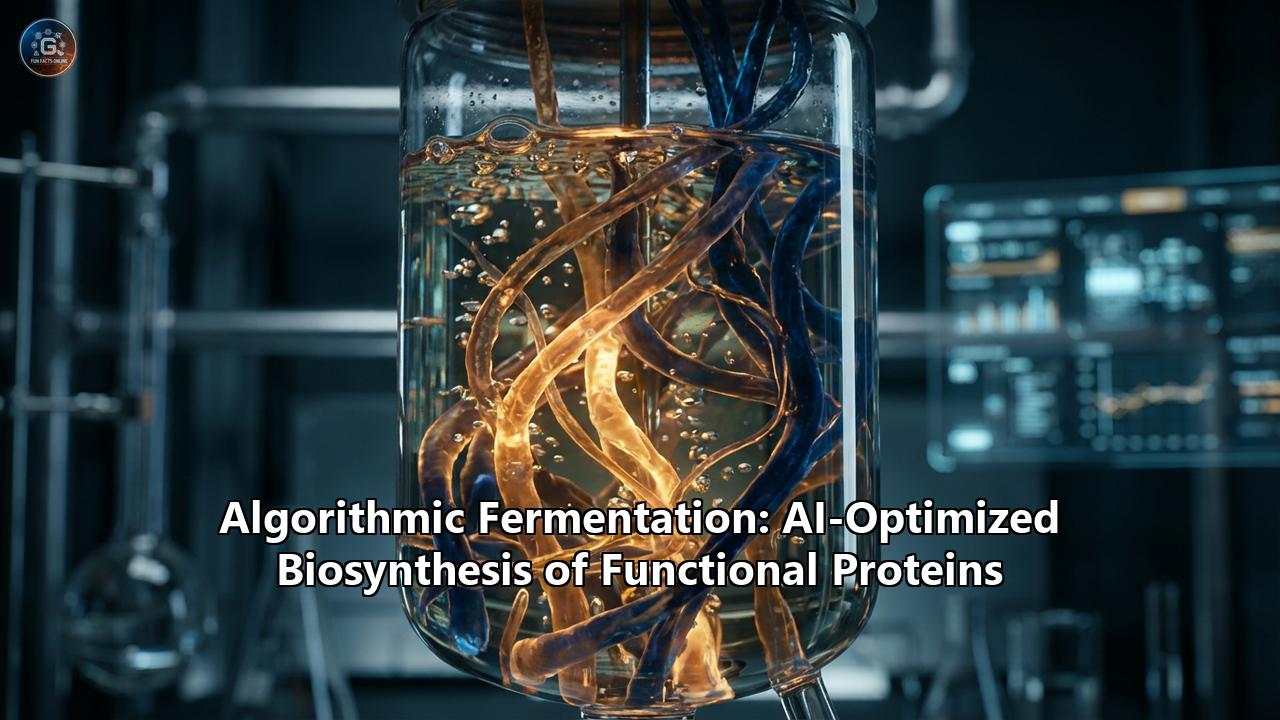
Step 3: The Digital TwinThe engineered microbe is moved to a bioreactor—a steel tank where the fermentation happens. But this is not your grandfather’s brewery. Modern precision fermentation is overseen by "Digital Twins."
A Digital Twin is a virtual replica of the fermentation process that runs in parallel to the physical tank. Sensors inside the real reactor stream real-time data—pH, dissolved oxygen, temperature, metabolic waste—to the Digital Twin. Machine learning algorithms analyze this stream, predicting how the microbes will behave hours in the future.
If the AI predicts a drop in productivity due to a slight shift in acidity, it autonomously adjusts the feed rate of sugar or alkali in the physical tank before the problem actually occurs. This "predictive control" can reduce batch failures by up to 60% and slash energy consumption, a critical factor in making these products cost-competitive with traditional agriculture.
Step 4: Harvest and PurificationFinally, the fermentation broth—a soup of yeast cells and our target protein—is processed. The cells are separated, and the protein is purified. Because the target protein was designed by AI to be hyper-stable or easily separable, the downstream processing costs are often lower than with natural proteins. The result is a pure, functional white powder: a plastic-eating enzyme or a cheese-making casein, born of code and built by biology.
Part II: The Economic Singularity – The "Post-Cow" Economy
The implications of this technology extend far beyond the laboratory. We are witnessing a restructuring of the global food and materials economy. The most significant barrier to the adoption of fermentation-derived proteins has always been cost. A cow is, admittedly, a very efficient bioreactor: it eats free grass and produces complex proteins. Beating that efficiency with steel tanks and electricity is difficult.
However, the "Techno-Economic" landscape is shifting rapidly.
The 90% Cost ReductionRecent analysis from 2025 suggests that optimized facilities, driven by AI process control and higher-yield strains, are approaching a 90% reduction in production costs compared to early 2020s pilots. We are seeing unit costs for precision-fermented dairy proteins projected to hit the $8–$13 per kg range. This is the "parity point"—the moment when it becomes economically irrational for a food giant not to use the fermented option.
Consider the case of industrial enzymes. Companies like Ainnocence have reported a 10,000x reduction in the computational cost of protein design. By bypassing expensive wet-lab trial-and-error with "zero-shot" AI predictions (where the AI gets it right the first time), the R&D overhead for new biological products is collapsing.
Investment ResilienceWhile the broader "food tech" and "plant-based" investment sectors cooled significantly in 2023 and 2024, precision fermentation has remained a bright spot. In the first quarter of 2025 alone, fermentation startups defied the downturn, capturing nearly half of all funding in the alternative protein sector.
Investors are realizing that this is not a consumer fad like a veggie burger; it is a B2B infrastructure play. Companies like Liberation Labs and Synonym are building the "server farms" of biology—massive contract manufacturing facilities that will allow any startup with a DNA sequence to scale production without building their own factory. This "Biomanufacturing-as-a-Service" model is the biological equivalent of Amazon Web Services (AWS), and it promises to unleash a cambrian explosion of independent protein companies.
Part III: The Regulatory Frontier – 2025 and Beyond
Technology moves fast; bureaucracy moves slow. Yet, in the last 18 months, the regulatory dam has begun to break, signaling a global acceptance of algorithmic fermentation.
The FDA’s "No Questions"In September 2025, a landmark moment occurred when the French startup Verley (formerly Bon Vivant) received a "No Questions" letter from the US FDA for its precision-fermented beta-lactoglobulin (a major whey protein). This effectively grants the product GRAS (Generally Recognized As Safe) status, clearing the path for mass-market commercialization in the US.
This was not an isolated event. The FDA has been processing a backlog of GRAS notifications, with companies like Vivici and Remilk also securing regulatory wins. The "Better FDA Act 2025," a bill proposed in the US Senate, aims to make this GRAS notification mandatory rather than voluntary—a move that, while adding a compliance step, ultimately legitimizes the industry and removes the stigma of "self-regulation."
Europe’s AwakeningThe European Union, historically cautious/hostile toward GMOs (which precision fermentation technically utilizes, though the final product contains no genetic material), is showing signs of FOMO (Fear Of Missing Out). The Netherlands, arguably the global heart of ag-tech, broke rank in late 2025 to become the first EU nation to allow pre-approval tastings of fermentation-derived novel foods.
This "Code of Practice" allows companies to test their AI-designed proteins with real consumers years before official EU approval. It is a tacit admission that Europe cannot afford to let the US and Singapore dominate the future of food.
The Singapore SandboxMeanwhile, Singapore continues to operate as the world’s regulatory laboratory. The passage of the "Food Safety and Security Bill" in January 2025 formalized the category of "defined foods," creating a streamlined, predictable pathway for high-tech proteins. By treating food security as a matter of national defense, Singapore has created a regulatory environment where AI-driven food safety assessments are welcomed rather than feared.
Part IV: Hyper-Personalization – Food as Software
Perhaps the most sci-fi application of algorithmic fermentation lies in its convergence with personalized medicine. We are moving toward a future of "Hyper-Personalized Nutrition," where the feedback loop between our biology and our food is closed by AI.
The "Jane" ScenarioImagine a consumer, Jane, in the year 2030. She wears a biosensor that tracks her glucose spikes, cortisol levels, and specific amino acid deficiencies. She also submits a monthly microbiome sample.
An AI model, trained on vast datasets like NHANES but fine-tuned to Jane’s unique physiology, detects that she is deficient in a specific branched-chain amino acid and that her gut lacks the enzymes to properly digest gluten.
Instead of buying a generic multivitamin, Jane’s subscription service sends a request to a local fermentation hub (or perhaps a countertop appliance). There, a specific strain of yeast is induced to produce a custom protein blend rich in the missing amino acids, along with a specific enzyme to aid her digestion. The product is fermented, purified, and delivered to her door as a personalized morning shake.
This is not hypothetical. Research published in 2025 regarding LLMs (like Mistral 7B) analyzing dietary constraints has already demonstrated 91% accuracy in interpreting free-text dietary needs. When combined with the "programmability" of fermentation, food becomes software: versioned, updated, and patched to fix bugs in our human operating system.
Part V: The Challenges – The "Black Box" and the Energy Bill
Despite the optimism, the road to an algorithmic bio-future is paved with significant hurdles.
The Black Box ProblemAI models like AlphaFold are often "black boxes." We know that they work, but we don't always know why. When an AI designs a protein that looks nothing like anything found in nature, safety becomes a complex question. How do you prove a protein is non-allergenic if it has no biological precedent? This "interpretability gap" poses a challenge for regulators who are used to comparing new foods to existing ones.
The Carbon Cost of ComputeTraining the massive models required for protein design is energy-intensive. A single training run for a state-of-the-art model can emit as much carbon as five cars do in their lifetimes. Furthermore, while fermentation is more land-efficient than cattle farming, it is energy-hungry. Bioreactors require constant temperature control and aeration. If the electricity grid powering these "cell factories" is dirty, the environmental gains of animal-free protein are diminished.
Data ScarcityWhile we have billions of protein sequences, we have relatively little data on how those proteins actually behave in a fermenter. We lack the "functional labels"—data that says "this sequence produced high yield at 30°C but failed at 32°C." This data is proprietary, locked away in the servers of private biotech firms. Breaking these data silos without compromising IP is the next great challenge for the industry.
Part VI: Conclusion – The Cambrian Explosion of Design
We are leaving the Neolithic era of biology—where we domesticated plants and animals—and entering the Paleotechnic era, where we domesticate the molecule itself.
Algorithmic fermentation represents a fundamental decoupling of nutrition from agriculture. It promises a world where we can produce the key nutrients of milk without the cow, the whites of eggs without the chicken, and entirely new proteins that evolution never had the time to invent.
It is a future where a famine in one part of the world doesn't wait for a harvest season to be solved, but can be addressed by beaming a DNA sequence to a solar-powered fermentation farm. It is a future where our food is as smart as our phones, and where the boundary between the digital code of silicon and the genetic code of carbon is finally, irrevocably, erased.
Reference:
- https://www.greenqueen.com.hk/precision-fermentation-netherlands-food-tasting-approval/
- https://www.khlaw.com/insights/singapore-revises-food-labeling-rules-and-refines-food-regulatory-framework
- https://www.food-safety.com/articles/10276-singapore-food-agency-updates-industry-guidance-on-safety-assessment-of-novel-foods
- https://plantbasednews.org/news/alternative-protein/precision-fermented-dairy-proteins-approval-fda/
- https://www.greenqueen.com.hk/singapore-food-safety-bill-novel-protein-lab-grown-meat/