
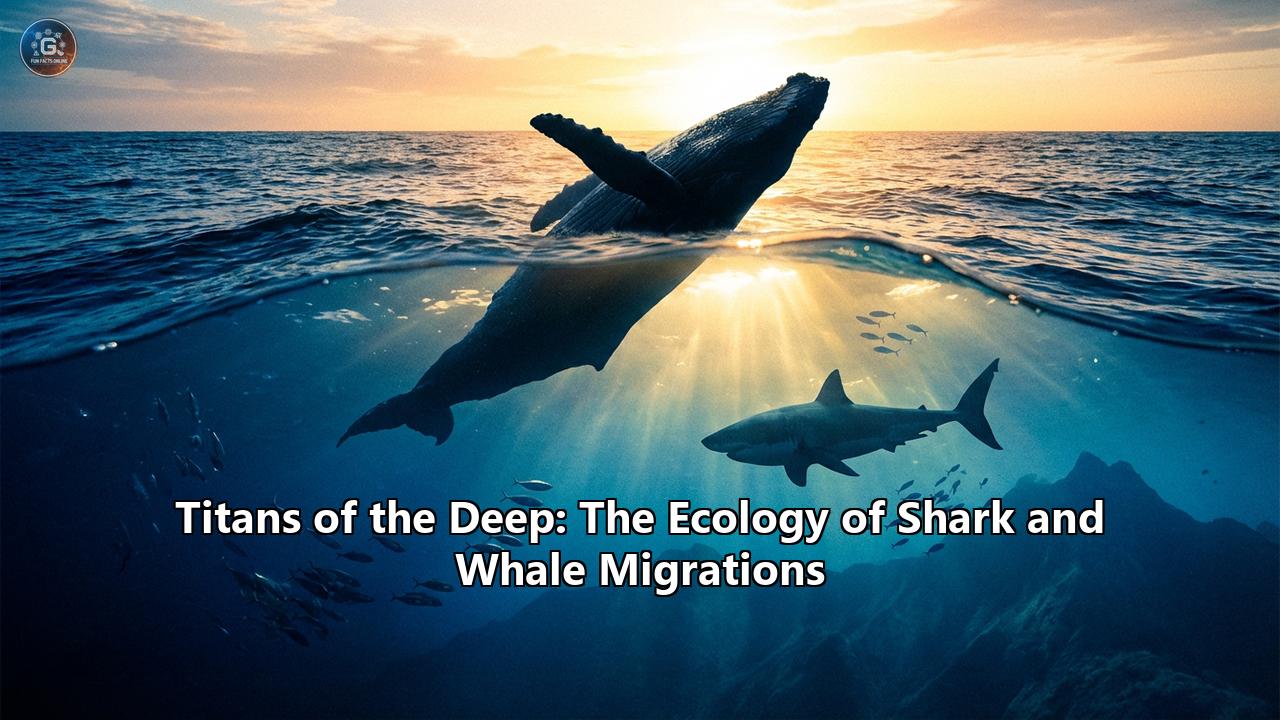
The open ocean is a realm of blue infinity, a desert of waves that stretches beyond the horizon. Yet, beneath this seemingly featureless surface lies a dynamic, pulsating network of highways, rest stops, and hunting grounds invisible to the human eye. Here, the true titans of the deep—the great whales and the apex sharks—undertake journeys of epic scale, navigating thousands of miles with a precision that rivals modern GPS. These are not merely movements from point A to point B; they are energetic odysseys that weave together the physics of the ocean, the biology of survival, and the ancient rhythms of the planet.
This article explores the ecology of these titanic migrations, delving into the physiological marvels that allow air-breathing mammals to plunge into the crushing abyss and cold-blooded fish to heat their bodies for the chase. We will traverse the "White Shark Café," decode the magnetic maps of the bonnethead, and listen to the cultural songs that guide humpbacks across the South Pacific. This is the story of the Titans of the Deep.
Part I: The Architects of Migration
Migration is often described as a seasonal movement between breeding and feeding grounds, but for the ocean's megafauna, it is a life-long state of being. The scale of these movements redefines our understanding of biological borders.
The Humpback Highway: Culture in Motion
Among the baleen whales, the humpback (Megaptera novaeangliae) is the supreme traveler. Populations in the Southern Hemisphere undertake an annual pilgrimage from the freezing, krill-rich waters of Antarctica to the warm, nutrient-poor lagoons of the tropics to breed. But recent research has revealed that these are not just instinctual drives; they are culturally transmitted routes.
In the South Pacific, the "Humpback Highway" runs past the Kermadec Islands and New Zealand. Research from the University of Auckland and the "Blue Corridors" project has shown that these routes are matriarchal. A calf learns the route by swimming in the slipstream of its mother. This cultural transmission extends to their acoustic behavior. Male humpbacks share a complex, evolving "song" that changes annually. In a phenomenon known as "cultural revolution," a new song from a western population (e.g., eastern Australia) can sweep across the ocean, being adopted by populations in French Polynesia within a single season. This acoustic connectivity suggests that migration routes are also corridors of information exchange, where distinct populations meet, mix, and share the latest "hits."
The Sperm Whale: A Tale of Two Sexes
The sperm whale (Physeter macrocephalus) presents a radically different migratory strategy, defined by sexual segregation. Female sperm whales are the "homebodies" of the species, though "home" covers vast swathes of tropical and subtropical waters. They live in tight-knit, matrilineal family units that remain in warmer waters year-round to raise calves.
The males, however, are the true nomads. As they mature, they leave the matriarchal pods and head for the high latitudes—the icy waters of the Arctic and Antarctic. Here, in the nutrient-rich cold, they gorge on deep-sea squid, growing to immense sizes. A fully grown bull sperm whale is a solitary titan, patrolling the polar edges until the urge to breed drives him back to the tropics. This migration is not annual but sporadic, driven by energetic reserves. A male may spend years in the Arctic before making the long journey south to rove between groups of females, acting as a genetic bridge between distant oceans.
The White Shark Café: An Oceanic Enigma
For decades, the great white shark (Carcharodon carcharias) was viewed as a coastal predator, patrolling seal colonies in California, South Africa, and Australia. Satellite tagging has shattered this view. We now know that adult white sharks in the Northeast Pacific undertake a massive offshore migration, leaving the seal-rich coast to spend months in a region halfway between Baja California and Hawaii.
Known as the "White Shark Café," this area was once thought to be an oceanic desert. Why would top predators leave a buffet of seals for the open ocean? Recent expeditions, including those using deep-diving autonomous vehicles, have revealed that the Café is teeming with life in the mesopelagic zone (the "twilight zone"), between 200 and 1,000 meters deep. The sharks are not just loitering; they are diving. Data from pop-up satellite tags show males engaging in "Rapid Oscillatory Diving" (ROD), plunging hundreds of times a day to depths of 450 meters or more. While the exact purpose remains debated—ranging from feeding on spawning squid to mating rituals—the Café demonstrates that white sharks are true pelagic explorers, relying on deep-sea resources to sustain their massive bulk during trans-oceanic crossings.
Whale Sharks: The Constellation Travelers
The largest fish in the sea, the whale shark (Rhincodon typus), follows a different beat. Their migrations are not strictly north-south but are driven by pulses of productivity. They are "boom-bust" travelers, moving between "stepping stones" of food availability.
In the Gulf of Mexico, they gather to feed on tuna spawn. In Western Australia’s Ningaloo Reef, they arrive for the coral spawning. But in between these coastal aggregations, they traverse thousands of miles of open ocean. Recent tracking data suggests they use bathymetric features—seamounts, canyons, and ridges—as navigational waypoints. These geological structures interrupt ocean currents, creating upwellings of nutrient-rich water that support plankton blooms. By hopping from seamount to seamount, whale sharks can cross oligotrophic (nutrient-poor) oceans without starving. Furthermore, they have been observed associating with artificial structures like oil platforms, which act as artificial reefs, suggesting an adaptability to the changing seascape of the Anthropocene.
Part II: Physiology of the Abyss
To migrate is to move, but to migrate in the ocean is to endure. The deep sea presents three killers: crushing pressure, freezing cold, and suffocating lack of oxygen. The way sharks and whales have independently solved these problems is a masterclass in convergent evolution.
The Oxygen Bankers: Hemoglobin and Myoglobin
For a sperm whale or a Cuvier’s beaked whale, the primary constraint is the breath-hold. To dive to 2,000 meters—a common depth for foraging sperm whales—they must store massive amounts of oxygen. They do not do this in their lungs. In fact, deep-diving whales exhale before they dive to reduce buoyancy and prevent the bends (decompression sickness).
Instead, they are "muscle-based" oxygen stores. Their blood has a hematocrit (red blood cell count) far higher than terrestrial mammals, packed with hemoglobin. More importantly, their muscles are almost black with myoglobin, a protein that binds oxygen. A sperm whale's muscle can store ten times more oxygen than a human's. When they dive, they initiate the "mammalian dive reflex": their heart rate slows (bradycardia) to as few as 4-10 beats per minute, and blood is shunted away from non-essential organs (like the stomach and kidneys) to the brain and heart. They become, in essence, a heart-lung-brain machine operating in slow motion.
The Spermaceti Organ: A Biological Submarine
The sperm whale’s boxy head contains the spermaceti organ, a tank holding up to 1,900 liters of liquid wax. For centuries, whalers sought this oil for lamps, but for the whale, it is a buoyancy control device.
One leading hypothesis suggests that by regulating blood flow around the organ, the whale can control the temperature of the wax. To dive, the whale circulates cold water through its nasal passages, cooling the wax. As the wax cools, it crystallizes and becomes denser, pulling the whale down with minimal swimming effort. To ascend, warm blood flushes the organ, melting the wax, increasing buoyancy, and assisting the whale's rise. This "variable ballast" system allows the sperm whale to hang motionless in the abyss, listening for squid, conserving precious oxygen that would otherwise be wasted on swimming against positive buoyancy.
Shark Endothermy: Burning Bright in the Cold
Most fish are ectothermic (cold-blooded), their body temperature matching the surrounding water. This is a death sentence in the deep, cold ocean, where metabolic processes slow down, making a predator sluggish. The "Mackerel Sharks" (Lamnidae)—including the great white, shortfin mako, and salmon shark—have evolved a solution: regional endothermy.
These sharks possess a rete mirabile ("wonderful net"), a complex web of veins and arteries. Cold, oxygenated blood from the gills runs alongside warm, deoxygenated blood from the working muscles. The heat is transferred from the warm blood to the cold blood before it reaches the core, retaining body heat. A great white shark can maintain its stomach, eyes, and brain up to 14°C (25°F) warmer than the surrounding water. This "warm-bloodedness" is the key to their migration. It allows them to hunt in the freezing waters of the mesopelagic zone and digest food rapidly, fueling their high-speed journeys.
Gigantothermy and the Blue-Shifted Eye
Whale sharks are not endothermic in the same way, but they utilize "gigantothermy." Their sheer size—up to 18 meters and 40 tons—provides a high thermal inertia. They warm up at the surface and then dive deep to feed. Their massive bodies lose heat very slowly, allowing them to forage in the cold deep for extended periods before returning to the surface to "recharge" their thermal batteries.
A 2023 study revealed another adaptation: whale shark rhodopsin (a visual pigment) is "blue-shifted." In the deep ocean, red light is absorbed first, leaving only blue light. The whale shark’s vision has genetically mutated to be hyper-sensitive to this blue spectrum, allowing them to see in the dim twilight of the mesopelagic zone, a crucial adaptation for finding plankton clouds or navigating by faint light cues at depth.
Part III: Navigation – The Unseen Maps
How does a shark find a specific café in the middle of the Pacific? How does a whale return to the exact same fjord in Norway after a 5,000-mile loop?
The Magnetic Sense
Sharks are famous for their ampullae of Lorenzini, jelly-filled pores that detect electrical fields. But their navigation relies on a broader sense: magnetoreception. Research published in Current Biology (2021) on bonnethead sharks proved they use the Earth's magnetic field as a map. When placed in a tank with a magnetic field simulating a location hundreds of miles south of their home, the sharks oriented north.
It is highly probable that great whites and whale sharks possess this same "internal GPS." They likely read the magnetic intensity and inclination angle of the Earth's field to determine their latitude. This allows great whites to swim in remarkably straight lines across the open ocean, correcting their course despite currents and storms.
Seamounts and Acoustic Landscapes
For whales, the ocean is primarily an acoustic environment. Low-frequency calls from blue and fin whales can travel hundreds of miles. It is hypothesized that they use "acoustic landmarks"—the way sound reflects off seamounts, continental shelves, and canyons—to build a mental map of the ocean floor.
Migrating humpbacks and sperm whales often congregate around seamounts. These underwater mountains are not just feeding stops; they have distinct magnetic signatures (due to volcanic rock) and create unique current patterns. They serve as multi-sensory waypoints. For a whale shark, a seamount is a cafeteria; for a hammerhead, it is a magnetic beacon; for a humpback, it is a stage for a song.
Part IV: Titans Clashing and Coexisting
Migration forces interaction. When the paths of these giants cross, the results can be violent, cooperative, or strangely commensal.
Predation in the Open Ocean
The ocean is not a peaceful place. The primary natural predator of the humpback whale is the killer whale (orca). Orcas target calves during the migration, particularly at "choke points" like Unimak Pass in the Aleutians or the coastal waters of Western Australia.
However, interactions between large sharks and whales are more complex. Great white sharks are known to scavenge on whale carcasses (whale falls), which provide an essential energy burst for their migrations. But they also actively hunt weak or young cetaceans. In South Africa, the disappearance of great whites from False Bay has been linked to the arrival of distinct orca pods that hunt sharks for their livers. This "fear ecology" has restructured the entire ecosystem: with the great whites gone, smaller predators like sevengill sharks have moved in, only to be eaten by the orcas themselves.
The Cleaning Stations
Not all interactions are hostile. Whale sharks, despite their size, are often plagued by parasites. They have been observed performing "hanging" behaviors, stalling vertically in the water column while schools of smaller fish—and even other shark species like silky sharks—rub against their rough skin. In the Galapagos, this cleaning behavior creates temporary, multi-species aggregations, a moving ecosystem centered around the giant body of the whale shark.
Shared Dining in the Twilight Zone
The most profound interaction is the silent sharing of the mesopelagic zone. Recent data shows that great whites, whale sharks, sperm whales, and beaked whales all rely heavily on the Deep Scattering Layer (DSL)—a massive biomass of lanternfish, squid, and jelly-like organisms that migrates vertically each day.
While they may not compete directly—sperm whales take the giant squid, white sharks take the mid-sized predators, whale sharks filter the soup of life—they are all tethered to the productivity of this deep, dark layer. It is the engine that fuels their migrations. The "White Shark Café" is essentially a shared dining room where these distinct evolutionary lineages converge on the same deep-sea buffet.
Part V: The Future of Migration
The ocean is changing faster than at any time in the last 50 million years. For species that rely on ancient, predictable cycles, the Anthropocene presents an existential challenge.
Climate Change and Range Shifts
As the oceans warm, the thermal map of the world is being redrawn. Great white sharks in California have shifted their nursery range north by over 600km into Monterey Bay, waters that were previously too cold. This range expansion brings them into conflict with established sea otter populations, causing a crash in otter numbers.
For whales, the threat is "mismatch." Humpback migration is timed to coincide with the bloom of krill in the polar regions. As sea ice melts earlier, the krill bloom shifts. If the whales arrive too late, they miss the feast. Energetic models suggest that a mismatch of just a few weeks can be devastating for a pregnant female that has fasted for months.
The Blue Corridors
Conservation is moving from protecting static "spots" to protecting "corridors." The "Blue Corridors" initiative by WWF and scientific partners maps the superhighways of whales to overlay them with shipping lanes and fishing grounds. The goal is mobile conservation: slowing ships down when whales are present and creating dynamic Marine Protected Areas (MPAs) that move with the animals.
Technological Frontiers: eDNA and AI
We are entering a golden age of tracking. We no longer need to physically tag every animal. Environmental DNA (eDNA) allows scientists to scoop a cup of water from the ocean and tell which titans have passed through recently. Combined with Artificial Intelligence (AI) that can identify individual whale tails or shark fins from satellite imagery, we are building a real-time air traffic control system for the ocean.
In the end, the migrations of sharks and whales are more than just biological phenomena; they are the heartbeat of the ocean. They circulate nutrients from the depths to the surface, from the poles to the tropics. They connect the world in a web of movement. To protect them, we must understand not just where they go, but how they survive the journey—mastering the cold, the dark, and the deep.
Deep Dive: The Physiological Marvels of the Titans
To truly appreciate the ecology of these migrations, one must look under the hood. The physiological adaptations that allow these animals to perform their migratory feats are nothing short of biological engineering miracles.
1. The Compressible Thorax and Lung Collapse
When a human diver descends, the air in their lungs is compressed. If they go deep enough, the pressure can cause the lungs to rupture or nitrogen to dissolve into the blood, leading to the bends upon ascent. Whales have solved this by evolving a rib cage that is not rigid but flexible.
- Mechanism: As a sperm whale dives past 100 meters, its rib cage folds inwards. The lungs collapse completely, forcing the air into the reinforced trachea where gas exchange stops.
- The Benefit: By stopping gas exchange, the whale prevents nitrogen from entering the bloodstream. This makes them immune to nitrogen narcosis and decompression sickness. They are essentially diving on a "single breath" stored in their muscles, not their lungs.
- Comparison: Great white sharks do not have lungs, so they don't face the crushing of air spaces. However, they rely on a massive, oily liver (making up to 25% of their body weight) for buoyancy. The lipids in the liver are less dense than seawater, providing lift without the risk of compression that a gas bladder would have.
2. Regional Endothermy: The Ferrari Engine
The rete mirabile in lamnid sharks is an evolutionary masterpiece of heat exchange.
- Counter-Current Exchange: In the shark's swimming muscles, the veins carrying warm blood generated by muscle movement run parallel to the arteries carrying cold, oxygenated blood from the gills.
- Heat Transfer: The heat naturally diffuses from the warm veins to the cold arteries before the heat is lost to the outside water.
- The Result: The shark's core remains warm. This warmth increases the rate of muscle contraction (power output) and speeds up digestion. A cold shark would take days to digest a seal; a warm great white can process the energy quickly and get back to hunting. This high metabolic rate is what allows them to traverse the nutrient-poor open ocean—they can travel faster and more efficiently than their cold-blooded cousins.
3. The Visual Paradox: Seeing in the Dark
The "twilight zone" (200m - 1000m) is not pitch black; it is a world of dim blue light and bioluminescence.
- Whale Shark Vision: The mutation at site 94 of the whale shark's rhodopsin protein shifts its peak sensitivity to the blue spectrum (around 480 nm). This matches the wavelength of sunlight that penetrates deepest into the ocean and the bioluminescence of many deep-sea prey items.
- Sperm Whale Echolocation: Whales navigate the dark using sound, not light. The spermaceti organ acts as an acoustic lens. By manipulating the shape of the organ, the whale can focus its click train into a narrow, high-energy beam—a "sound laser"—that can detect a squid from hundreds of meters away in absolute darkness. This allows them to hunt in the deep without relying on the faint visual cues that sharks use.
Ecological Case Studies: The Junctions of Life
The intersection of these migrations creates unique ecological hotspots.
Case Study 1: The Galapagos Archipelago
The Galapagos is a crossroads of currents and migrations. Here, the Humboldt Current brings cold, nutrient-rich water from the south, while the Panama Current brings warm water from the north.
- The Interaction: Pregnant female whale sharks migrate here, specifically to the islands of Darwin and Wolf. They are not feeding; they are seemingly using the islands as a waypoint.
- The Shark-on-Shark Dynamic: These female giants are often trailed by smaller silky sharks and Galapagos sharks. While the whale sharks are generally safe due to their size, they often exhibit "shuddering" behaviors when smaller sharks rub against them. This is likely a cleaning interaction, but it can turn agonistic.
- The Hammerhead Connection: Scalloped hammerheads also migrate here, using the magnetic signature of the volcanic islands to navigate. They form massive schools during the day and disperse to hunt squid at night, sharing the mesopelagic hunting grounds with the visiting whale sharks.
Case Study 2: The South African "Fearscape"
False Bay, South Africa, was once the world capital of white shark aggregations.
- The Disappearance: In 2017, the white sharks vanished. The culprit? A pair of male orcas named "Port" and "Starboard."
- The Ecological Cascade: With the white sharks gone, the ecosystem tipped. The population of Cape fur seals—usually kept in check by the sharks—ceased their anti-predator behaviors. More interestingly, the sevengill shark, a lower-tier mesopredator usually eaten or displaced by white sharks, began to aggregate in the bay to fill the vacuum.
- The Lesson: This demonstrates the fragility of migration corridors. If a "landscape of fear" is introduced (in this case, by orcas), the migratory patterns of an entire species can shift overnight, with cascading effects down the food web.
The Anthropocene Ocean: Navigating a Human World
The titans now swim in an ocean modified by humans.
- Shipping Lanes as Barriers: The "Blue Corridors" often overlap with major shipping routes. For a sleeping sperm whale or a surface-feeding whale shark, a container ship is a silent killer. The acoustic noise from ships also creates a "smog" that masks the communication calls of whales. Humpbacks have been recorded "shouting" (increasing the volume of their calls) to be heard over ship noise, a metabolic cost that adds up during a long migration.
- The Plastic Filter: Whale sharks are filter feeders. In regions like Southeast Asia, they are ingesting microplastics at alarming rates. These plastics block nutrient absorption and introduce toxins. Since whale sharks migrate to find food, they are effectively migrating between "plastic soup" patches, accumulating pollutants that could affect their reproductive success.
- Climate Refugees: As noted with the great white sharks moving north, entire ecosystems are shifting. "Tropicalization" of temperate reefs is occurring, where warm-water herbivores move in and decimate kelp forests. Migratory predators are the vectors of this change, bringing tropical predation pressure to temperate zones that are not adapted to it.
Conclusion: The Pulse of the Planet
The migration of the Titans of the Deep is the circulatory system of the ocean. They move energy, nutrients, and genetic material across the globe. A sperm whale defecating in the Southern Ocean releases iron that fuels phytoplankton blooms, which in turn sequester carbon. A great white shark keeping seal populations in check preserves the health of kelp forests.
These journeys are ancient, etched into genes and cultures over millions of years. But they are also fragile. As we map the "Blue Corridors" and unlock the secrets of their deep-sea physiology, we are learning just how interconnected the ocean is. Protecting a shark in California means protecting a migration route that leads to the middle of the Pacific. Saving a whale in Antarctica requires safeguarding its breeding grounds in the tropics.
The Titans are still out there, moving through the deep, navigating by magnetic fields and ancient songs. It is our turn to listen, to watch, and to ensure their journeys can continue in the blue century ahead.
Reference:
- https://www.nhm.ac.uk/discover/quick-questions/how-can-whales-hold-their-breath-for-so-long.html
- https://us.whales.org/2012/10/20/how-do-whales-breathe/
- https://www.nhm.ac.uk/discover/secrets-of-deep-diving-whales.html
- https://www.youtube.com/watch?v=X17kOUnCjUQ
- https://en.wikipedia.org/wiki/Spermaceti
- https://en.wikipedia.org/wiki/Spermaceti_organ
- https://ntrs.nasa.gov/api/citations/19720017437/downloads/19720017437.pdf
- https://www.orcaireland.org/deep-diving-adaptations-in-the-sperm-whale
- https://www.tdisdi.com/sdi-diver-news/warm-blooded-sharks/
- https://saveourseas.com/worldofsharks/podcast/regional-endothermy-the-secret-superpower-of-the-mackerel-sharks
- https://www.sharkophile.com/new-study-uncovers-spectacular-adaptations-in-whale-shark-vision/
- https://www.theguardian.com/environment/2021/feb/09/climate-crisis-pushing-great-white-sharks-into-new-waters
- https://www.discoverwildlife.com/animal-facts/marine-animals/whale-migration-routes-digital-map
- https://wwf.org.au/news/2025/worlds-first-interactive-map-of-whale-migration-reveals-growing-dangers-in/
- https://manoa.hawaii.edu/exploringourfluidearth/physical/ocean-depths/pressure/compare-contrast-connect-deep-divers
- https://dayoctopus.wordpress.com/2016/11/30/diving-with-a-porpoise-but-having-a-whale-of-a-time/
- https://www.youtube.com/watch?v=NIIMZ-4KYm4