
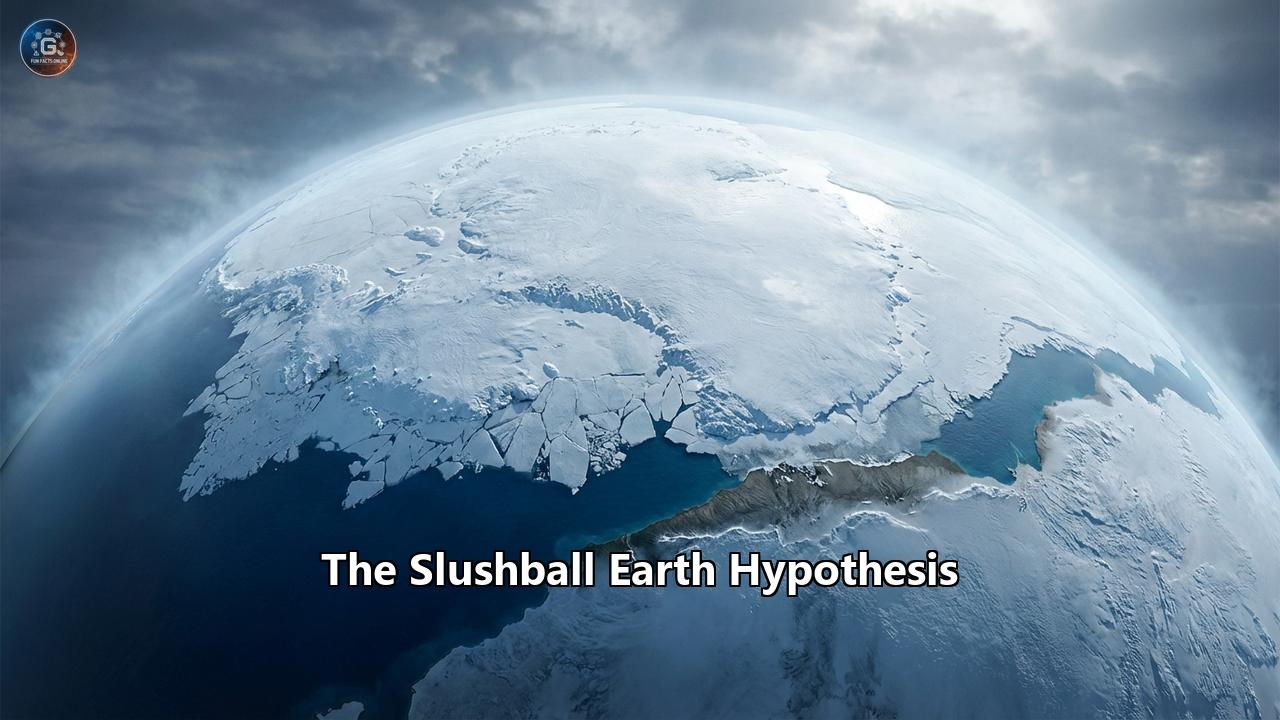
The Neoproterozoic Era, specifically the Cryogenian Period (roughly 720 to 635 million years ago), stands as one of the most enigmatic and tumultuous chapters in Earth’s 4.5-billion-year history. It was a time when the planet plunged into a deep freeze so severe that ice sheets may have met at the equator, turning the blue marble into a brilliant white sphere. This is the realm of the "Snowball Earth" hypothesis. However, as scientific scrutiny of this frozen epoch has intensified, a competing, or perhaps refining, theory has emerged—one that paints a picture not of a sterile, solid ice ball, but of a dynamic, "slushy" world where life clung to existence in open waters. This is the Slushball Earth Hypothesis.
This article explores the Slushball Earth hypothesis in comprehensive detail, tracing its origins, the geological and biological evidence that supports it, the fierce debate it wages against the "Hard Snowball" model, and its profound implications for the evolution of complex life, including our own distant ancestors.
1. The Cryogenian Paradox: A World in Deep Freeze
To understand the Slushball hypothesis, one must first appreciate the "Snowball Earth" paradox it attempts to resolve. In the mid-20th century, geologists began finding glacial deposits—tillites, dropstones, and varves—in places that paleomagnetic data suggested were near the equator during the Neoproterozoic. The implications were staggering. If glaciers reached sea level at the tropics, the rest of the planet must have been frozen solid.
The original "Hard Snowball" theory, championed in the late 1990s by geologists like Paul Hoffman and Daniel Schrag, proposed a runaway ice-albedo feedback loop. As ice expanded from the poles, it reflected more sunlight (high albedo), cooling the Earth further and driving the ice edge closer to the equator. Once the ice crossed a critical latitude (around 30°), the cooling became self-sustaining, and the ice sheets rapidly snapped shut at the equator, encasing the entire ocean in a shell of ice up to a kilometer thick.
In this scenario, the hydrological cycle would have virtually stopped. The oceans would be sealed off from the atmosphere, causing oxygen levels in the water to plummet as respiration continued without photosynthetic replenishment. Life, limited to single-celled organisms and simple algae, would have faced a mass extinction, surviving only in deep-sea hydrothermal vents or perhaps in pockets of meltwater on the ice surface.
However, as researchers dug deeper into the rock record, cracks began to appear in this solid ice model. The biological record did not show a mass extinction event consistent with a total global freeze. Sedimentary structures requiring open water, such as wave ripples, were found within glacial sequences. Climate models struggled to simulate a "hard" snowball without breaking the laws of physics or requiring unrealistic conditions to melt the ice.
Enter the Slushball Earth Hypothesis.
2. Defining the Slushball Earth
The Slushball Earth hypothesis (sometimes referred to as the "Waterbelt" hypothesis) proposes that while the Earth did experience severe glaciation, it never completely froze over. Instead, a band of open water, perhaps moving seasonally or persisting year-round, remained around the equator.
In this scenario:
- Ice Extent: Massive ice sheets covered the continents and much of the polar and mid-latitude oceans, but the tropical oceans remained partially open.
- Hydrological Cycle: Because of the open water, evaporation and precipitation continued, albeit at reduced rates compared to today. This allowed glaciers to be "wet-based" (moving and eroding rock) rather than "cold-based" (frozen to the bedrock and stagnant).
- Life’s Refuge: The open tropical waters provided a vast refugium for photosynthetic life. Algae and cyanobacteria could continue to harvest sunlight, maintaining oxygen levels in the surface waters and supporting a food web that would eventually drive the evolution of multicellular animals.
The Slushball model essentially argues for a "soft" freeze—a planetary state that balances on the knife-edge between a modern climate and a full Snowball, stabilized by feedback loops that prevented the ice from closing the equatorial gap.
3. Geological Evidence: The Rocks Don't Lie
The primary battlefield for the Slushball vs. Snowball debate is the geological record. Proponents of the Slushball hypothesis point to several specific features in Cryogenian rocks that are difficult to explain with a solid ice cover.
A. Wave Ripples and Storm Deposits
One of the most damning pieces of evidence against a solid ice cover is the presence of wave-formed sedimentary structures within glacial deposits. In the Nantuo Formation of South China and similar deposits in Australia and Death Valley, geologists have identified sandstone beds with symmetrical ripple marks.
- The Physics of Ripples: Symmetrical ripples are formed by the oscillatory motion of water waves generated by wind. For wind to generate waves that touch the sea floor, there must be open water exposed to the atmosphere.
- The Implication: If these rocks were deposited during the height of the glaciation, as the stratigraphy suggests, then the oceans could not have been covered by a thick, stagnant ice shelf. There must have been enough open water for winds to whip up storms and generate swells.
B. Dropstones in Non-Glacial Varves
"Dropstones" are large rocks found in fine-grained sediments, interpreted as debris dropped from melting icebergs. In a Hard Snowball, the ocean surface is a solid ice shelf; icebergs cannot drift freely and drop stones into open water sediments. However, many Cryogenian deposits show dropstones embedded in laminated mudstones (varves) that show signs of current activity and regular sediment deposition. This implies a "drift ice" scenario—like the modern Southern Ocean—where icebergs calve from continental glaciers and float into open seas, melting and dropping their stony cargo.
C. The "Zipper-Rift" and Tectonic Context
Some geologists argue that the glacial deposits interpreted as global are actually regional events caused by the breakup of the supercontinent Rodinia. The "Zipper-Rift" model suggests that as Rodinia tore apart, the uplifted rift shoulders created high-altitude environments where glaciers could form even at the equator, shedding ice into nearby basins. While this doesn't strictly confirm a Slushball, it provides a mechanism for low-latitude glaciation that doesn't require a planetary deep freeze, aligning better with the "partial freeze" aspect of the Slushball model.
D. Glacial Erosion and Sediment Volume
A thick, stagnant ice shell (Hard Snowball) would exert little erosional force on the continents because the hydrological cycle (snowfall) would be minimal. However, the Cryogenian rock record contains massive volumes of glacial sediment (diamictites).
- The Slushball Engine: A Slushball Earth, with its functioning hydrological cycle, would support vigorous evaporation from the open tropical oceans. This moisture would fall as heavy snow on the continents, feeding active, flowing glaciers that ground down mountains and transported vast amounts of sediment to the oceans. The sheer volume of Cryogenian glacial rock supports the idea of a "wet" and dynamic ice age, not a "dry" and static one.
4. The Biological Smoking Gun: Life in the Ice House
Perhaps the most compelling argument for the Slushball hypothesis comes from biology. If the Earth had truly frozen over completely for millions of years, the consequences for life should have been catastrophic. Yet, the fossil record tells a different story.
A. Survival of Phototrophs
Photosynthetic organisms (algae, cyanobacteria) require sunlight. In a Hard Snowball scenario, the ice cover is estimated to be hundreds of meters to a kilometer thick. While some light might penetrate thin ice, a kilometer of ice would plunge the ocean into absolute darkness.
- The Evidence: Analysis of biomarkers (molecular fossils) and black shales from the Cryogenian reveals that eukaryotic algae—specifically benthic phototrophic macroalgae—not only survived but thrived during this period.
- The Shennongjia Discovery: In 2023, researchers working in the Shennongjia Forestry District in China discovered fossils of multicellular algae in black shales dating to the Marinoan glaciation. These organisms lived on the seafloor in shallow waters. Their preservation implies that sunlight was reaching the bottom of the sea, which is impossible under a thick ice shelf but perfectly consistent with the open waters of a Slushball Earth.
B. No Mass Extinction
The geological record shows no evidence of a mass extinction event corresponding to the onset of the Snowball Earth. In fact, the diversity of acritarchs (microfossils of unsure affinity, likely algae) remains relatively stable or even increases across the glacial intervals. A hard freeze should have wiped out the vast majority of surface-dwelling life, leaving a distinct "dead zone" in the fossil record. The absence of such a gap suggests that widespread refugia—like the tropical open ocean of the Slushball model—allowed lineages to persist uninterrupted.
C. The Evolution of Multicellularity
Recent research (2024-2026) has flipped the script, suggesting that the Cryogenian glaciations were not just a hurdle for life to survive, but the very driver of complex life.
- The Viscosity Trap: A colder ocean is more viscous (thicker). For microscopic, single-celled organisms that rely on diffusion or simple flagella to move and feed, a viscous ocean is a nightmare. It creates a "starvation trap" where nutrients don't diffuse fast enough.
- Size Matters: Models show that one way to overcome this physical constraint is to get bigger. Larger organisms can move more efficiently through viscous fluids and access more nutrient flow.
- The Slushball Catalyst: The Slushball Earth provided a unique environment: cold, viscous oceans with limited but available nutrients in open water zones. This selective pressure may have forced single-celled eukaryotes to aggregate or evolve larger multicellular forms to survive. Thus, the Slushball state might have been the crucible that forged the first animals, setting the stage for the Ediacaran biota and the subsequent Cambrian Explosion.
5. Climate Modeling: The "Jormungand" State
For years, climate modelers struggled to create a stable Slushball. Simple Energy Balance Models (EBMs) tended to be "bistable"—the Earth was either warm or fully frozen. Once the ice passed 30° latitude, the albedo feedback was assumed to be unstoppable.
However, newer, more sophisticated models have identified a stable intermediate state, often referred to as the Jormungand State (named after the Norse sea serpent that encircles the world).
A. The Dynamics of Sea Ice
Early models treated sea ice as a static white sheet. Real sea ice is dynamic. It flows, cracks, and exposes dark water (leads) that absorbs heat. It can also be thin and translucent (nilas), allowing sunlight to warm the water beneath.
- The Wind Factor: When models incorporate wind-driven ice dynamics, the strong tropical trade winds push sea ice away from the equator. This mechanical force works against the freezing temperature, constantly opening up "polynyas" (areas of open water) in the tropics.
- The Waterbelt: These models show that a stable "Waterbelt" of open ocean can exist even when global temperatures are freezing. This belt acts as a thermostat, absorbing enough solar radiation to prevent the ice sheets from closing, even as the rest of the planet remains in a deep freeze.
B. The Exit Problem
One of the biggest criticisms of the Hard Snowball theory is the "Exit Problem." To melt a fully frozen Earth, volcanic CO2 would need to build up to incredibly high levels (perhaps 10% of the atmosphere, or 350x modern levels) to overcome the high albedo of the ice. This would result in an instant "super-greenhouse" or "hothouse" Earth the moment the ice melted, cooking the planet.
- The Slushball Solution: A Slushball Earth has a lower albedo than a Snowball because of the dark open water. Therefore, it requires less CO2 to "deglaciate." This aligns better with proxy records of Cryogenian CO2, which, while high, do not always show the extreme spikes required by the Hard Snowball termination. The transition from Slushball to a warm interglacial is a smoother, more plausible climatic shift.
6. The Great Debate: Hard vs. Soft
The scientific community remains divided, though the consensus has been shifting towards the Slushball (or at least a "dynamic" Snowball) end of the spectrum.
The "Hard" Argument
Proponents of the Hard Snowball (like Hoffman) argue:
- Cap Carbonates: The massive limestone layers (cap carbonates) that sit directly on top of glacial deposits are best explained by the rapid meltdown of a Hard Snowball. The theory is that the super-high CO2 atmosphere caused intense acid rain, weathering the continents violently and dumping carbonate into the oceans.
- Synchronicity: Uranium-lead dating suggests the glaciations started and ended synchronously around the globe, implying a global climate control mechanism like the ice-albedo runaway.
- Iron Formations: The reappearance of Banded Iron Formations (BIFs) suggests an anoxic (oxygen-free) ocean, which fits a sealed-off "Hard" Snowball better than a ventilated Slushball.
The "Slushball" Rebuttal
Slushball proponents counter:
- Cap Carbonates: These can also form via the mixing of alkalinity-rich deep waters with surface waters during a deglaciation, without requiring a "super-greenhouse" atmosphere.
- BIFs in Slush: Even in a Slushball, the deep ocean would likely go anoxic as circulation slowed (but didn't stop), allowing iron to build up. The open tropical waters would remain oxygenated, creating a stratified ocean that explains both the BIFs (deep water) and the survival of aerobic life (surface water).
- The "Impossible" Physics: They argue that the energy required to freeze the tropical ocean to a kilometer depth is staggering and that the latent heat of the ocean, combined with wind and currents, makes a 100% freeze nearly impossible to achieve in realistic 3D circulation models.
7. Conclusion: The Cradle of Animals
The debate between Snowball and Slushball is more than just geological pedantry; it is the origin story of complex life on Earth.
If the Earth was a Hard Snowball, then life is incredibly resilient, surviving in the most extreme bottleneck imaginable, perhaps huddling around volcanic vents like refugees in a nuclear winter. In this view, the Cambrian Explosion was a "rebound"—a release of evolutionary energy after millions of years of suppression.
If the Earth was a Slushball, then the glaciations were not a suppressor but an incubator. The open tropical belt was a crucible where intense competition, isolation, and unique physical pressures (like ocean viscosity) forced life to innovate. The first experiments in multicellularity, cell differentiation, and cooperation likely occurred in these frigid, slushy waters.
Current evidence—the wave ripples in the rocks, the survival of algae, the physics of sea ice, and the newest climate models—heavily favors the Slushball scenario. It paints a portrait of a Cryogenian Earth that was hostile but habitable, a planet that was "down but not out."
In the slushy, sun-dappled waters of the Cryogenian equator, amidst bobbing icebergs and howling winds, the first ancestors of all animals may have swum. The Slushball was not the end of the world; it was the beginning of ours.
Reference:
- https://chrisrackauckas.com/assets/Slides/ChrisRackauckas-JormungandStateWebinarSlides.pdf
- https://www.giss.nasa.gov/research/features/archive/201508_slushball/
- https://astrobiology.com/2023/04/snowball-earth-might-have-been-slushball-earth.html
- https://www.youtube.com/watch?v=MzYy9bEZnbw
- https://en.wikipedia.org/wiki/Snowball_Earth
- https://pmc.ncbi.nlm.nih.gov/articles/PMC4418898/
- https://www.caltech.edu/about/news/signatures-of-ice-free-ancient-ponds-and-lakes-found-on-mars
- https://www.space.com/earth-slush-ball-650-million-years-ago
- https://www.britannica.com/science/Slushball-Earth-hypothesis
- https://www.researchgate.net/publication/228749202_Snowball_versus_slushball_Earth_Dynamic_versus_nondynamic_sea_ice