
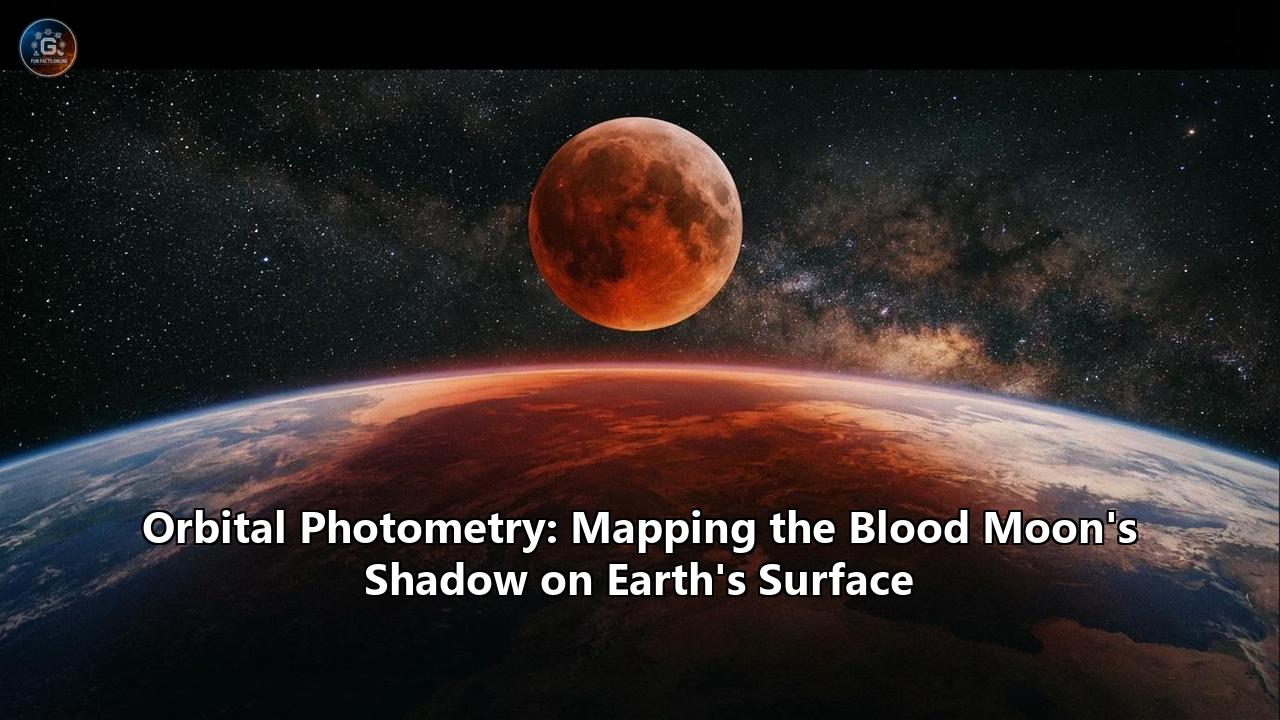
For millennia, humanity’s relationship with lunar eclipses has been defined by an upward gaze. We stand on the nighttime hemisphere of our planet, eyes fixed on the heavens, watching as the familiar silvery disk of the full moon is slowly swallowed by a creeping darkness, only to reemerge bathed in a striking, bruised crimson. This phenomenon, colloquially known as a "Blood Moon," is a masterpiece of celestial mechanics. But while millions of skywatchers across the Americas, East Asia, Australia, and the Pacific turned their attention upward during the total lunar eclipse on March 3, 2026, a different kind of observation was taking place from low Earth orbit.
Instead of looking up at the Moon, sophisticated environmental satellites were looking down at the Earth.
Using advanced techniques in orbital photometry, scientists have pioneered a fascinating new way to study the Earth-Moon system. By mapping the "shadow" of the Blood Moon—the dramatic reduction and color shift of lunar illumination reflecting off Earth's surface—researchers are unlocking insights into everything from atmospheric dynamics to the search for life on exoplanets. It is a story of cutting-edge satellite technology, the physics of light, and the profound interconnectedness of our solar system.
The Celestial Reversal: Redefining the "Shadow"
To understand the concept of the Blood Moon's shadow, we must first reverse our traditional perspective of an eclipse. During a total solar eclipse, the Moon passes directly between the Earth and the Sun, casting a physical shadow (the umbra) that races across the Earth's surface. This is a localized event, plunging specific, narrow swathes of the planet into daytime darkness.
A lunar eclipse, however, is the exact opposite. The Earth passes directly between the Sun and the Moon, casting our planet's massive shadow onto the lunar surface. Because the Earth is much larger than the Moon, its shadow can engulf the entire lunar sphere, making the eclipse visible to anyone on the nighttime side of Earth.
But what effect does this have on Earth itself?
Under normal circumstances, a full moon acts as a giant cosmic mirror, reflecting harsh, unfiltered sunlight down onto the nocturnal Earth. This "lunar glare" is powerful enough to cast sharp shadows in a dark forest, illuminate snow-capped mountains, and reflect brightly off the oceans. When Earth slips between the Sun and the Moon, it effectively cuts off this secondary light source. The "shadow" mapped on Earth's surface during a Blood Moon is not an umbra cast by the Moon, but rather the sudden, dramatic absence of the moonlight that normally bathes our planet's night side.
The Physics of the Blood Moon
Why doesn't the Moon go completely dark during a total lunar eclipse? The answer lies in the Earth's atmosphere.
If our planet were a barren rock devoid of air, a lunar eclipse would render the Moon practically invisible. However, Earth is enveloped in a thick, nitrogen-rich atmosphere. As sunlight streams past the edges of the Earth, this atmosphere acts like a giant, spherical lens. It bends, or refracts, some of the sunlight into the dark cone of the Earth's umbra.
Simultaneously, the atmosphere filters this light through a phenomenon known as Rayleigh scattering. Gas molecules and airborne particles scatter the shorter wavelengths of light (blues and greens) away, leaving only the longer wavelengths (reds and oranges) to pass through. This is the exact same mechanism that gives us breathtaking red sunsets and sunrises. In effect, if you were standing on the surface of the Moon during a total lunar eclipse, you would look back at Earth and see a dark sphere completely ringed by a brilliant, glowing halo of every sunrise and sunset happening on Earth at that exact moment.
This refracted, coppery light travels 240,000 miles to the Moon, bathes its desolate craters in red, and then weakly reflects back to Earth. The light returning to our planet during totality is up to a million times dimmer than a standard full moon, and its spectral signature has been fundamentally altered. Measuring this faint, ghostly echo of light from space requires extraordinary technology.
Orbital Photometry: Eyes in the Dark
The scientific discipline of measuring the intensity, flux, and properties of light from astronomical or orbital bodies is known as photometry. When conducted from satellites looking down at the Earth, it is referred to as orbital photometry.
The hero of the March 2026 lunar eclipse mapping was the NOAA-21 satellite, part of the Joint Polar Satellite System (JPSS) operated by NASA and the National Oceanic and Atmospheric Administration. Aboard this satellite is an instrument called the Visible Infrared Imaging Radiometer Suite (VIIRS).
VIIRS is a marvel of modern engineering. Among its various sensors is the Day/Night Band (DNB), a highly sensitive photometer capable of detecting nighttime light in a range of wavelengths from green to near-infrared. The DNB is so sensitive that it can observe the faint glow of city lights, the bioluminescence of marine organisms, the dance of the aurora borealis, and, crucially, the exact amount of moonlight reflecting off the Earth's surface.
The DNB doesn't just take a single photograph; it scans the Earth in continuous swaths as the satellite orbits from pole to pole. By employing complex filtering techniques and a massive dynamic range, the sensor can amplify the faintest light signals without becoming oversaturated by brighter sources. This allows scientists to map the topography of darkness with unprecedented precision.
Mapping the 2026 Eclipse in Real-Time
On March 3, 2026, as the Earth, Moon, and Sun locked into perfect syzygy, the NOAA-21 satellite silently orbited 512 miles above the planet's surface, crossing the Arctic and North America. Because the satellite orbits the Earth roughly every 100 minutes, it was able to capture a time-lapse mosaic of the eclipse as it unfolded in real-time.
The resulting composite images released by NASA's Earth Observatory are nothing short of spectacular. They provide a visual timeline of the moonlight's ebb and flow across the frozen landscapes of Alaska and the Yukon.
- Pre-Eclipse (The Brilliant Snow): The earliest swaths captured by VIIRS, taken before the Earth's shadow began to heavily obscure the Moon, show a radiant nocturnal landscape. The full moon’s glare brightly illuminated the ice caps, clouds, and snowfields, painting the Arctic in stark, silvery monochrome.
- The Creeping Penumbra: As the eclipse progressed, the satellite data recorded a measurable drop in photometric intensity. The landscape began to dim, resembling a fading photograph. The high-albedo (highly reflective) surfaces of the snow still caught some light, but the stark contrasts of the lunar shadows began to soften.
- Totality (The Deep Dark): The most dramatic data was acquired at 11:20 Universal Time (2:20 a.m. Alaska Standard Time), about 15 minutes after the total phase of the eclipse had begun. With the Moon fully engulfed in Earth's umbra, the amount of moonlight reaching Earth plummeted to its absolute minimum.
During this 11:20 UTC pass, the Earth was thrown into profound darkness, but the satellite images were far from empty. Stripped of the overpowering lunar glare, the hidden lights of the nocturnal Earth suddenly took center stage. The VIIRS sensor captured striking, luminous ribbons of the aurora borealis glowing vibrantly in the upper atmosphere. Below them, the tiny specks of artificial light from remote human settlements in the Yukon and eastern Alaska stood out with pin-prick clarity.
- Post-Eclipse (The Return of the Light): As the Moon slowly exited the umbra, subsequent satellite swaths recorded the creeping return of the lunar glare, eventually restoring the bright, moonlit landscape to its pre-eclipse state.
Why Map the Shadow? The Scientific Payoff
To the layperson, measuring how dark the Earth gets during a lunar eclipse might seem like an overly complex parlor trick. However, in the realm of planetary science and environmental monitoring, orbital photometry during a Blood Moon serves several critical functions.
1. Instrument Calibration and the "Lunar Standard"
Satellites like NOAA-21 and Suomi-NPP rely on consistent light sources to ensure their instruments are accurately calibrated. The Moon, lacking an atmosphere and exhibiting highly predictable reflectance, is widely used as a photometric calibration standard for spaceborne instruments. However, observing the Earth during a total lunar eclipse provides a rare "control" environment. By measuring the Earth's surface when the primary nighttime light source is "turned off," scientists can fine-tune the noise algorithms in the VIIRS sensors, improving their ability to detect subtle phenomena like illegal fishing boat lights, subtle weather patterns, and power grid failures during standard nights.
2. Atmospheric Tomography and Aerosol Tracking
Because the red light of the Blood Moon is filtered through Earth's atmosphere, the exact color, brightness, and photometric intensity of the Moon—and the faint light it reflects back to Earth—contain a wealth of data about our own planet's air quality.
If the Earth's atmosphere is relatively clear, the Blood Moon will appear a bright, coppery orange. However, if major volcanic eruptions or massive wildfires have recently injected millions of tons of ash, aerosols, and particulate matter into the stratosphere, the atmosphere becomes more opaque. This scatters even the red wavelengths, resulting in a Blood Moon that is deep, dark red, or even nearly invisible. By using satellites to precisely measure the drop in moonlight returning to Earth, scientists can effectively take a global "core sample" of the Earth's atmospheric aerosol load.
3. Ecological Impacts and Diel Vertical Migration
The waxing and waning of the Moon dictates the biological rhythms of countless species on Earth. The most massive animal migration on the planet happens every single night: the Diel Vertical Migration. Billions of tons of zooplankton and small marine organisms rise from the deep ocean to the surface under the cover of darkness to feed, and sink back down to the depths before dawn to avoid visual predators.
This migration is deeply tied to moonlight. During a bright full moon, many of these organisms stay deeper in the water column to avoid being illuminated. But what happens during a sudden, unexpected 100-minute plunge into darkness during a total lunar eclipse? By using orbital photometry to map the exact light levels at the ocean's surface, marine biologists can correlate satellite data with acoustic sonar tracking of the oceans, observing how the sudden shadow of the Blood Moon temporarily tricks the marine biosphere into altering its ancient migration patterns.
From Earth's Shadow to Alien Worlds: The Exoplanet Connection
Perhaps the most thrilling application of mapping the Blood Moon's light relies on using Earth as a proxy for the cosmos. We are currently living in the golden age of exoplanet discovery. Astronomers have confirmed over 5,000 planets orbiting distant stars, but merely finding them is no longer the ultimate goal. The current frontier is characterizing their atmospheres and surfaces to find potentially habitable worlds—and perhaps, biosignatures of life.
This is incredibly difficult because exoplanets are incredibly faint, constantly outshined by the blinding glare of their host stars. To study them, astronomers use a technique called transit spectroscopy. When an exoplanet passes directly in front of its star (a transit), starlight filters through the planet's atmosphere. By analyzing the spectra of this light, scientists can determine the chemical composition of the alien atmosphere.
Here is where the Blood Moon becomes vital. A total lunar eclipse is, from the perspective of the Moon, an Earth transit. Earth is passing in front of the Sun. The red light that paints the Blood Moon is the exact same kind of filtered light that astronomers analyze when looking at transiting exoplanets.
In a landmark 2009 study by Pallé et al., astronomers essentially pointed their telescopes at the Blood Moon to capture the transmission spectra of Earth. They analyzed the light reflected off the Moon to see what Earth's "alien" signature looked like. Unsurprisingly, the spectra revealed strong signatures of oxygen, ozone, water vapor, and methane—the chemical fingerprints of a living biosphere.
By using orbital photometry to meticulously map how this light interacts with Earth's surface during an eclipse, scientists are refining their models for "exo-cartography". As upcoming super-telescopes come online, researchers plan to map the surfaces of exoplanets using photometric variability. By studying how a distant planet's brightness changes as it rotates, or as it goes through its own eclipses, scientists hope to create coarse maps revealing continents, oceans, and weather systems on worlds light-years away. The techniques developed to map the Blood Moon's shadow on Earth are actively laying the mathematical and observational groundwork for this monumental task.
Furthermore, if an exoplanet has a large moon, the photometric shadow cast during an alien lunar eclipse could one day be detectable by our most advanced instruments, allowing us to study the dynamics of distant exomoon systems.
Looking Ahead: The Future of Eclipse Cartography
The March 3, 2026 lunar eclipse offered a breathtaking demonstration of humanity’s evolving perspective of the cosmos. We are no longer passive observers bound to the ground. Through the lens of environmental satellites and orbital photometry, we have effectively stepped outside our own world, looking back at our planetary home as it participates in the grand, clockwork dance of the solar system.
Those who missed the 2026 event will have to wait for the next major opportunity. The next total lunar eclipse visible to a large swath of the globe will occur on December 31, 2028, promising to add a unique celestial fireworks display to New Year’s Eve celebrations across Europe, Africa, Asia, Australia, and the Pacific.
When that night arrives, millions will undoubtedly stand outside, tilt their heads upward, and marvel at the copper-red sphere hanging in the sky. But high above them, hurtling through the thermosphere at 17,000 miles per hour, our unblinking robotic emissaries will be looking down—silently mapping the shadows, measuring the light, and continuing to decode the secrets hidden in the darkness.
Reference:
- https://www.skyatnightmagazine.com/earth-from-space/march-2026-lunar-eclipse-from-space
- https://www.cbsnews.com/news/satellite-image-moon-shadow-over-us-solar-eclipse-nasa/
- https://www.livescience.com/space/the-sun/eclipse-from-space-see-the-moons-shadow-race-across-north-america-at-1500-mph-in-epic-satellite-footage
- https://www.skyatnightmagazine.com/news/sen-april-eclipse-video
- https://ksa.go.ke/assets/files/The_Blood_Moon.pdf
- https://science.nasa.gov/earth/earth-observatory/shades-of-a-lunar-eclipse/
- https://www.semanticscholar.org/paper/73a2a9a4a143ef2090f6bf2476515a96eeeecd44
- https://pmc.ncbi.nlm.nih.gov/articles/PMC6016572/
- https://www.discovermagazine.com/watch-the-moons-shadow-flit-over-the-earths-surface-27227