
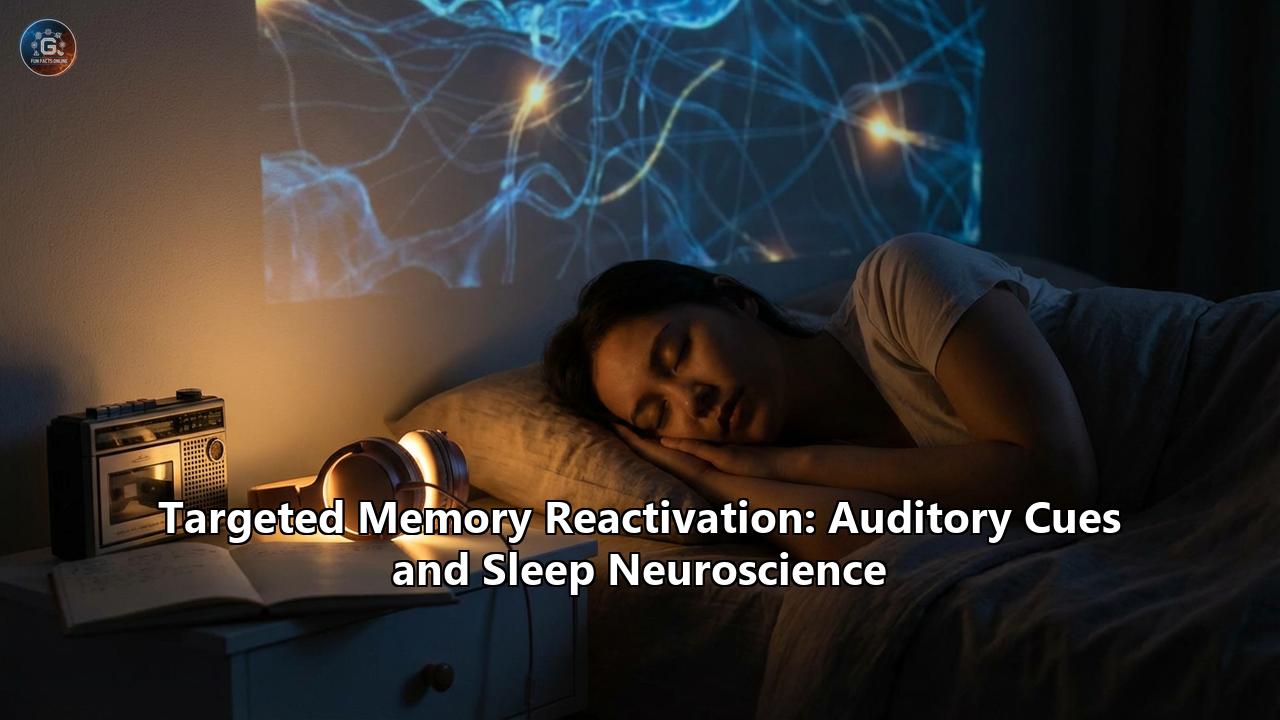
For decades, the concept of sleep-learning—often referred to as hypnopaedia—has captivated the public imagination, famously appearing as a dystopian tool for mass conditioning in Aldous Huxley’s Brave New World. The seductive idea that we could place a textbook under our pillow, or play an audio recording of a new language while we slumber, and wake up fluent or enlightened, has long been dismissed by modern science as pure science fiction. You cannot learn entirely new, complex information from scratch while unconscious. However, over the last two decades, neuroscience has uncovered a truth that is perhaps even more fascinating: while sleep cannot create knowledge out of thin air, it can be precisely hacked to selectively strengthen, alter, and even disarm the memories we have already formed. This revolutionary technique is known as Targeted Memory Reactivation (TMR).
Targeted Memory Reactivation leverages the brain's natural nocturnal mechanisms to manipulate memory processing during sleep. By using sensory cues—most prominently auditory cues like specific sounds, melodies, or spoken words—scientists can reach into the sleeping mind and dictate which memories the brain chooses to rehearse and consolidate. From accelerating language acquisition and refining fine motor skills, to pioneering new treatments for Post-Traumatic Stress Disorder (PTSD) and depression, TMR represents a frontier in cognitive neuroscience that transforms sleep from a passive state of rest into an active, programmable window for human enhancement and psychological healing,.
To understand how playing a simple sound to a sleeping person can physically alter the architecture of their brain, we must first dive deep into the neurobiology of sleep and the mechanisms of memory consolidation.
The Symphony of the Sleeping Brain: How Memories are Made
For a long time, sleep was viewed simply as a biological shutdown—a period of rest for the body and brain. In reality, the sleeping brain is a hive of electrical and neurochemical activity, engaged in a highly choreographed symphony essential for our cognitive survival. The most critical function performed during this nightly symphony is memory consolidation, the process by which fragile, newly formed memories are stabilized and integrated into the brain's long-term storage networks.
When we learn something new during waking hours, the information is initially encoded in the hippocampus, a seahorse-shaped structure deep within the medial temporal lobe. The hippocampus acts as a rapid-learning system, a temporary USB drive that quickly captures the events, facts, and spatial maps of our day. However, the hippocampus has a limited capacity and its memory traces are highly unstable. For memories to become permanent, they must be transferred to the neocortex, the brain's massive hard drive responsible for higher-order functioning and long-term storage.
This transfer largely occurs while we sleep, specifically during non-rapid eye movement (NREM) sleep, which includes the deepest stage of rest known as slow-wave sleep (SWS). During SWS, the brain initiates a continuous dialogue between the hippocampus and the neocortex, driven by a triad of distinct electrophysiological rhythms: slow oscillations, sleep spindles, and sharp-wave ripples.
- Cortical Slow Oscillations: Originating in the neocortex, these are massive, slow-moving brain waves (0.5–4 Hz) that sweep across the brain. They represent the synchronized firing (up-states) and silencing (down-states) of millions of neurons.
- Thalamic Sleep Spindles: Triggered by the up-states of slow oscillations, the thalamus generates brief, rapid bursts of electrical activity (10–16 Hz) known as sleep spindles. Spindles are thought to open the gates of synaptic plasticity, allowing the neocortex to wire new connections.
- Hippocampal Sharp-Wave Ripples (SPW-Rs): In response to the slow oscillations and spindles, the hippocampus fires off explosive, high-frequency ripples of activity (140-200 Hz),.
During these sharp-wave ripples, a phenomenon known as "neural replay" occurs,. The exact sequence of neurons (such as "place cells" that fired when navigating a maze) that were active during the daytime learning event spontaneously fire again in the dark. This replay happens at warp speed—often in fast-forward or fast-reverse—essentially "playing back" the memory to the cortex. Through this repeated, rapid-fire playback during sleep, the synaptic connections in the cortex are strengthened, while the hippocampal ties gradually dissipate, effectively downloading the memory into long-term storage,.
Under normal circumstances, the brain autonomously decides which memories to replay and save, and which trivial details of the day to discard—a process sometimes called "memory triage". But what if we could hijack this triage system? What if we could tell the brain exactly which memories to hit "replay" on? This is the exact mechanism of Targeted Memory Reactivation.
The Mechanics of Targeted Memory Reactivation
The foundational premise of TMR is classical conditioning applied to the sleep state. The process unfolds in two distinct phases: the wakeful encoding phase and the sleep reactivation phase.
In a typical auditory TMR experiment, a participant engages in a learning task during the day. For example, they might be asked to memorize the specific spatial locations of various objects on a computer screen grid. Crucially, as they learn the location of each object, a distinct sound is played. If the object is a cat, they hear a "meow"; if it is a bomb, they hear an explosion. Through this process, the brain forms a strong associative link between the declarative memory (the spatial location on the grid) and the auditory cue (the sound).
Following the learning phase, the participant goes to sleep, usually while hooked up to an electroencephalogram (EEG) to monitor their brain waves in real-time,. Once the EEG detects that the participant has entered deep, slow-wave sleep, the researchers stealthily intervene. They begin to play a subset of the sounds from the learning phase through speakers or headphones at a volume carefully calibrated to be audible to the brain, but quiet enough not to wake the sleeper,.
When the sleeping brain registers the sound, the auditory cortex processes the cue and sends signals down to the hippocampus. Because the sound is heavily associated with the specific memory learned earlier, the cue acts as a neurological trigger. It forces the hippocampus to generate a sharp-wave ripple containing the specific neural replay for that exact memory. Studies in rodents have directly observed this: when a sound associated with a specific maze trajectory is played during sleep, the neurons representing that specific path immediately fire in sequence,.
When the participant wakes up, their memory is tested. Consistently, across dozens of experiments over the past decade, participants show significantly better recall for the items that were cued during sleep compared to the items that were left uncued,. The memories attached to the played sounds have been artificially pushed to the front of the consolidation queue, protected from the natural decay of forgetting.
While early pioneering studies by researchers like Jan Born and Björn Rasch successfully used olfactory cues (smells) to trigger memories, auditory cues have become the gold standard in TMR research,. Smells are difficult to clear from a room, meaning an odor cue lingers and loses its precise timing. Sounds, however, offer exquisite temporal precision. A sound can be played for exactly one second, timed perfectly to hit the peak of a slow-wave up-state, allowing scientists to target dozens of different memories in a single night with a wide library of distinct audio clips,.
Upgrading the Mind: Applications in Cognitive Enhancement
The implications of effectively controlling memory consolidation are staggering. A 2020 meta-analysis of over 90 TMR experiments definitively confirmed that auditory cueing during NREM sleep reliably enhances memory performance across a variety of domains with a moderate but highly significant effect size.
Spatial and Declarative MemoryTMR is exceptionally effective for declarative memory—the conscious recall of facts and events. Beyond laboratory games of placing objects on a grid, researchers are exploring how this can aid real-world studying. By pairing distinct background music or specific auditory tones with studying vocabulary or complex academic material, students could potentially replay those same tones at night to cement their knowledge. Research on language acquisition has shown that TMR can significantly boost both the retention of new vocabulary and the integration of complex grammatical rules when cues are played during SWS.
Procedural Memory and Motor SkillsYou do not just memorize facts; you also memorize movements. Procedural memory—the type of memory used to ride a bike, play a piano, or perform surgery—also undergoes rigorous consolidation during sleep. TMR has proven highly effective in this domain. In a landmark study mimicking the video game Guitar Hero, participants learned to play two different melodies by pressing specific keys. During their subsequent sleep, the researchers played the auditory sequence of just one of those melodies. Upon waking, the participants were able to play the cued melody with significantly greater accuracy and speed than the uncued one.
This motor-enhancement capability opens incredible avenues for physical rehabilitation. For stroke victims suffering from paresis, physical therapy requires grueling, repetitive attempts to rewire the brain's motor networks to regain control of limbs. By pairing distinct sounds with successful movements during daily therapy, and playing those sounds back during sleep, TMR could theoretically double the brain's practice time without any extra physical exertion, accelerating neuroplasticity and recovery. Similarly, athletes and musicians could utilize TMR to refine muscle memory and complex motor patterns overnight.
Disarming the Mind: TMR, Trauma, and Psychiatry
While enhancing memory is valuable, arguably the most profound application of TMR currently being researched is its ability to alter and weaken memories, particularly in the realm of emotional regulation, anxiety, and Post-Traumatic Stress Disorder (PTSD),.
For years, researchers primarily focused on playing cues during slow-wave sleep (SWS) because it reliably strengthens declarative memories. However, sleep is not a monolith. The other major phase of sleep is Rapid Eye Movement (REM) sleep. While SWS is characterized by slow, synchronized waves, REM sleep features fast, desynchronized brain activity resembling wakefulness, accompanied by vivid dreaming and a near-complete paralysis of the body's muscles.
Crucially, during REM sleep, the brain is bathed in a unique neurochemical environment where the stress hormone noradrenaline is almost completely shut off. Neuroscientists theorize that one of the primary functions of REM sleep is emotional processing: it allows the brain to replay the emotional events of the day in a neurochemically safe, stress-free environment, effectively stripping the "visceral sting" from the memory so that it can be stored as a neutral fact,. In individuals with PTSD, this mechanism often breaks down, leading to nightmares and the chronic physiological arousal associated with trauma.
Recent breakthroughs in 2024 and 2025 have illuminated how TMR can be deployed during REM sleep to actively disarm toxic memories,. In a 2025 study by the MRC Brain Network Dynamics Unit, participants were shown highly upsetting images paired with specific sounds. Later, during REM sleep, those sounds were played back to them. Functional MRI scans taken 48 hours later revealed that the REM-targeted memories elicited a significantly reduced response in the brain's Salience Network, particularly the amygdala (the brain's fear center) and the anterior insula. The physical manifestations of fear, such as heart rate deceleration, were also mitigated. By forcing the brain to process the traumatic memory during the safe state of REM sleep, TMR successfully decoupled the factual memory from the physiological fear response,.
This has paved the way for immediate clinical applications. A groundbreaking 2024 study conducted by researchers at Amsterdam Neuroscience provided the "first proof of principle" that TMR can augment existing PTSD treatments. Patients undergoing Eye Movement Desensitization and Reprocessing (EMDR) therapy had their therapeutic breakthroughs paired with specific auditory cues. Those cues were then played to the patients during sleep. The researchers found that TMR safely strengthened the newly modified, therapeutic memory without triggering nightmares or disrupting sleep. Patients who received this sleep-based augmentation were significantly less inclined to avoid their trauma memories subsequently. Follow-up clinical trials, initiated in late 2024, are currently expanding this protocol to multiple nights of cueing, treating sleep as a massive, previously locked "treatment window" for psychiatric disorders.
Beyond PTSD, researchers at institutions like Cardiff University are developing "Overnight Therapy" protocols utilizing TMR. By using positive TMR during NREM sleep to strengthen uplifting memories, and negative TMR during REM sleep to disarm toxic autobiographical memories, scientists hope to disrupt depressive rumination and fundamentally improve mood disorders while the patient sleeps. TMR is also being investigated to weaken maladaptive behaviors, potentially helping individuals break deep-seated phobias, addictions, and negative habits,.
Out of the Lab: The Democratization of Sleep Hacking
Historically, TMR was tightly confined to specialized sleep laboratories. It required expensive, high-density EEG caps, polysomnography machines, and a trained technician manually watching the brainwaves through the night to trigger sounds at the exact right millisecond of deep sleep. This bottleneck severely limited the scale of TMR research and its real-world viability.
However, the rapid advancement of wearable technology and machine learning between 2022 and 2026 has initiated the democratization of TMR. Systems like "SleepStim," developed to automate TMR in the home, represent a major leap forward. These systems utilize commercially available smartwatches to monitor heart rate, movement, and sleep architecture, paired with smartphones running machine-learning algorithms. The algorithm predicts when the user has entered deep sleep and automatically triggers the auditory cues from the phone's speaker.
While early iterations of automated home TMR faced challenges—such as accidentally playing sounds too loudly and disrupting the delicate sleep architecture, which negates any memory benefit—recent refinements in volume modulation and closed-loop stimulation have allowed at-home TMR to replicate the robust memory improvements seen in highly controlled laboratory settings. Closed-loop systems using consumer-grade EEG headbands can now read the electrical activity of the brain in real-time and deliver a brief auditory click exactly on the ascending phase of a slow-wave oscillation. This precise timing supercharges the natural slow wave, pushing the brain into an even deeper state of consolidation.
The availability of these tools means we are approaching a future where TMR could become as ubiquitous as setting an alarm clock. Language learners could download an app that pairs with their smart-ring, quietly whispering Spanish vocabulary during their slow-wave cycles. Athletes could use biofeedback devices that seamlessly transition daytime motor-skill audios into their nocturnal sleep architecture to refine their golf swing.
The Boundary Conditions, Limitations, and Ethical Frontiers
As with any technology capable of altering the human mind, Targeted Memory Reactivation is bound by specific physiological limitations and raises novel ethical questions.
First and foremost is the boundary of prior knowledge. TMR is not a magic bullet for inserting unknown information into the brain. You cannot play an audio book of quantum physics to a sleeping person who has never studied it and expect them to wake up a physicist. TMR strictly relies on prior encoding; the associative network must be formed during wakefulness. TMR acts as a spotlight, highlighting and strengthening what is already there, rather than a pen writing new information.
Secondly, the success of TMR is highly dependent on sleep quality. If the auditory cues are too loud, or if the individual's sleep is fragmented, TMR can actually impair memory. Sleep is a delicate state of vulnerability. Intruding upon it with sensory stimulation runs the risk of pulling the brain out of SWS, causing micro-arousals that disrupt the natural physiological restoration the body requires,.
On an ethical level, the commercialization of TMR opens the door to potential "sleep exploitation." If the sleeping brain is highly receptive to auditory cues, and these cues can alter behavior and memory, it introduces the risk of subliminal manipulation. Could advertisers embed specific sounds in television commercials during the day, and then use smart-home devices to softly play those same sounds at night to strengthen positive associations with a brand? While complex psychological manipulation via TMR is still largely theoretical, the fact that emotional associations can be altered during REM sleep without the subject's conscious awareness warrants rigorous ethical foresight,.
There is also the question of "memory triage." The brain naturally forgets the vast majority of our daily experiences, which is a healthy and necessary function to prevent cognitive overload and maintain neural efficiency. If we use TMR to artificially force the brain to remember massive amounts of data, does this come at a cost? Does artificially strengthening one set of memories via auditory cues cause the accelerated decay of other, uncued memories due to limited synaptic real estate? Current research is still investigating these zero-sum dynamics, but it underscores the need to approach sleep manipulation with caution.
The Dawn of Active Sleep
For millennia, sleep has been considered a passive void—a necessary third of our lives lost to the dark. Targeted Memory Reactivation has shattered this paradigm. We now understand that the sleeping brain is an incredibly active, dynamic machine, tirelessly working to weave the tapestry of our memories, skills, and emotional resilience.
By decoding the electrophysiological language of the brain—the slow oscillations, the spindles, the sharp-wave ripples—and using simple auditory cues to speak back to it, science has unlocked a direct interface to human cognition,. The implications echo across every facet of the human experience. Whether it is accelerating the learning of a student, aiding the physical rehabilitation of a stroke survivor, or gently disarming the haunting nightmares of a trauma patient,, TMR proves that our most profound cognitive transformations do not just happen while we are awake. Some of our greatest leaps in healing and learning happen in the dead of night, triggered by a simple sound in the dark. As the neuroscience of sleep continues to evolve, we are stepping into an era where we no longer just go to sleep to rest; we go to sleep to become better versions of ourselves.
Reference:
- https://www.psychology.hku.hk/scnlab/files/publications/2020/Hu%20et%20al.,%202020,%20Psychological%20Bulletin.pdf
- https://esrs.eu/news/sleep-science-friday/targeted-memory-reactivation-during-sleep/
- https://www.inverse.com/science/19777-targeted-memory-reactivation-will-make-you-smarter-as-you-sleep
- https://www.amsterdamumc.org/en/research/institutes/amsterdam-neuroscience/news/targeted-memory-reactivation-to-augment-treatment-in-post-traumatic-stress-disorder
- https://pmc.ncbi.nlm.nih.gov/articles/PMC2824214/
- https://www.frontiersin.org/journals/neural-circuits/articles/10.3389/fncir.2022.885684/full
- https://www.frontiersin.org/journals/neural-circuits/articles/10.3389/fncir.2017.00092/full
- https://www.youtube.com/watch?v=NteHQv0ceN4
- https://discovery.ucl.ac.uk/id/eprint/10084943/8/Bendor_How%20Targeted%20Memory%20Reactivation%20Promotes%20the%20Selective%20Strengthening%20of%20Memories%20in%20Sleep_AAM.pdf
- https://faculty.wcas.northwestern.edu/paller/TICS2013.pdf
- https://www.diva-portal.org/smash/get/diva2:1787891/FULLTEXT01.pdf
- https://pmc.ncbi.nlm.nih.gov/articles/PMC5798898/
- https://www.media.mit.edu/publications/improving-memory-via-automated-targeted-memory-reactivation-during-sleep/
- https://backyardbrains.com/pages/experiment-study-while-you-sleep-targeted-memory-reactivation
- https://pmc.ncbi.nlm.nih.gov/articles/PMC5804984/
- https://www.jneurosci.org/content/39/34/6728
- https://rotel.pressbooks.pub/biologicalpsychology/chapter/8-6-memory-reconsolidation-new-views-and-applications/
- https://www.mrcbndu.ox.ac.uk/papers/disarming-emotional-memories-using-targeted-memory-reactivation-during-rapid-eye-movement
- https://www.cardiff.ac.uk/research/explore/research-units/neuroscience-and-psychology-of-sleep-lab-naps