
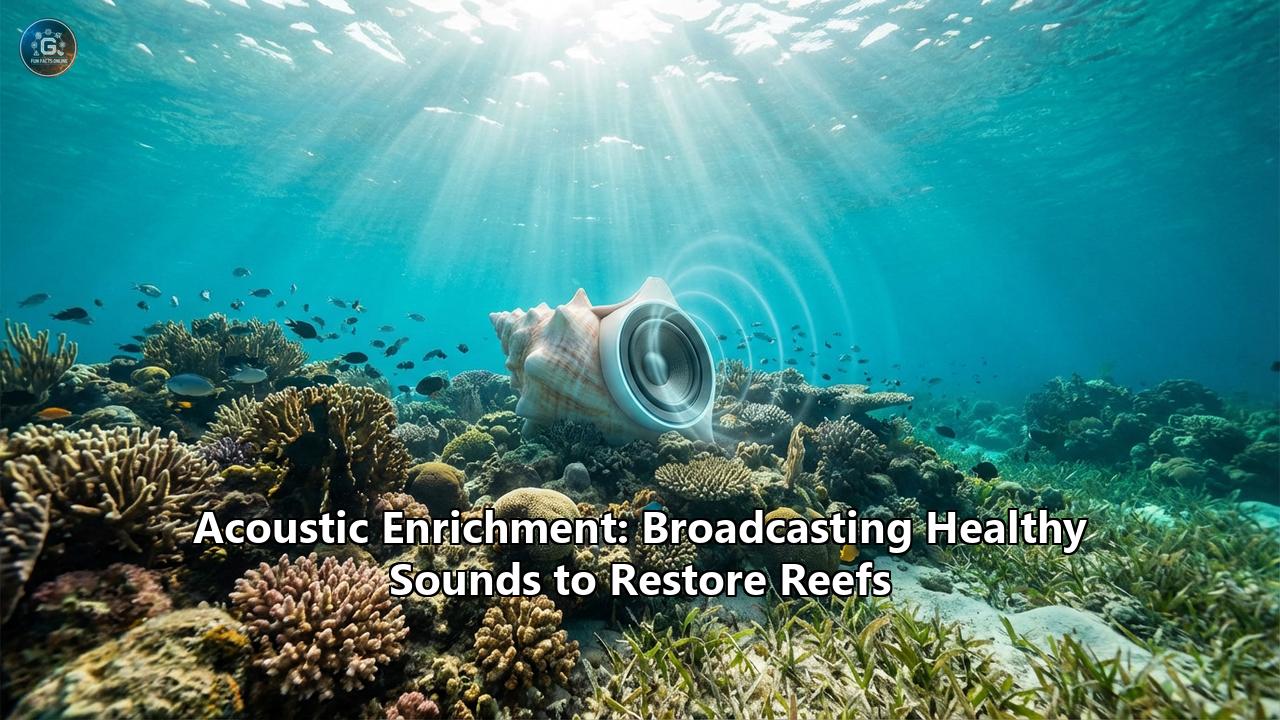
The ocean is not the silent world we once imagined. For eons, healthy coral reefs have been raucous, bustling underwater metropolises—a cacophony of crackles, pops, grunts, and whoops that can be heard kilometers away. But today, as climate change and human activity ravage these ecosystems, a ghostly silence is falling over the world’s reefs.
This silence is more than just a symptom of death; it is a driver of it.
In a groundbreaking convergence of marine biology and acoustic engineering, scientists have discovered that sound is a critical "homing beacon" for the next generation of marine life. This discovery has birthed a revolutionary restoration technique: Acoustic Enrichment. By broadcasting the recorded symphony of a healthy reef using underwater speakers, researchers are successfully tricking fish and coral larvae into returning to degraded habitats, kickstarting the natural recovery process.
This is the story of how we are learning to speak the language of the reef to save it.
The Sound of Life: The Underwater Symphony
To understand why acoustic enrichment works, we must first understand the soundscape of a healthy reef. If you were to dive into a pristine coral ecosystem and close your eyes, you wouldn't hear silence. You would hear a sound akin to bacon frying or a crackling campfire.
This pervasive background noise is created by snapping shrimp (Alpheidae). These tiny crustaceans possess a specialized claw that snaps shut with such velocity that it creates a cavitation bubble. The collapse of this bubble generates a shockwave and a loud snap—up to 218 decibels, rivaling the volume of a jet engine at takeoff. With millions of shrimp snapping simultaneously, they create a continuous, high-frequency crackle that serves as the "heartbeat" of the reef.
Overlaid on this backdrop is the vocalization of fish. Clownfish chirp to defend territory; damselfish pop and pulse; grouper produce low-frequency booms that resonate through the water. This "biophony" is information-rich. It tells a drifting larva everything it needs to know: There is food here. There is shelter here. There is a community here.
The Silence of Degradation
When a reef dies—whether from bleaching, dynamite fishing, or pollution—the soundscape changes instantly. The fish leave or die. The shrimp population collapses. The vibrant, complex symphony is replaced by the hollow whisper of wind and waves.
For decades, we missed the significance of this silence. We assumed that marine larvae drifted passively with the currents, settling wherever luck took them. We were wrong.
The Biological Mechanism: How Larvae "Hear" Their Way Home
Most reef organisms, including fish and corals, have a pelagic larval phase. They are born on the reef but are swept out into the open ocean to develop. Days or weeks later, they must find their way back to a reef to settle and mature.
In the vast, featureless blue of the open ocean, how does a creature smaller than a grain of rice find a specific reef?
1. Fish Hearing (Otoliths):Fish have ears. Inside their heads are calcium carbonate structures called otoliths (ear stones). As sound waves travel through water (which is much denser than air), they vibrate the fish's body. The denser otoliths lag slightly behind the rest of the body's movement, bending sensory hairs and triggering a nerve impulse. This allows fish larvae to detect the low-frequency grunts and groans of a healthy reef from kilometers away.
2. Coral Hearing (The Cilia Mystery):The idea that coral—an animal with no ears, no brain, and a simple nervous system—could "hear" was long considered scientifically absurd. However, recent research has overturned this dogma. Coral larvae (planulae) are covered in tiny hair-like structures called cilia.
It is now believed that these cilia act as mechanoreceptors. They vibrate in resonance with the sound waves of the reef. Specifically, the low-frequency "thrum" of a healthy reef seems to trigger a behavioral response. When a coral larva "hears" this sound, it stops swimming, drops out of the water column, and attaches itself to the seabed.
This mechanism is phonotaxis: movement in response to sound. It is the evolutionary key to acoustic enrichment.
The Great Barrier Reef Experiment: Bringing Back the Fish
The first major proof-of-concept for acoustic enrichment came in 2017, led by Dr. Steve Simpson (University of Bristol) and Dr. Tim Gordon (University of Exeter).
Working on the northern Great Barrier Reef, specifically around Lizard Island, the team faced a scene of devastation. Consecutive cyclones and mass bleaching events had turned vibrant reefs into graveyards of rubble. The silence was palpable.
The Experiment:The team built 33 experimental patch reefs using dead coral rubble. They divided these reefs into three groups:
- Acoustically Enriched: Underwater speakers played recordings of a healthy, bustling reef.
- Acoustic Control: Speakers were deployed but played no sound (to rule out the visual attraction of the equipment).
- Natural Control: No speakers, just silent rubble.
The findings, published in Nature Communications, were staggering.
- Double the Abundance: The reefs playing healthy sounds attracted twice as many fish as the silent reefs.
- 50% More Diversity: The species richness increased by 50%. It wasn't just one type of fish; the sounds attracted herbivores, planktivores, and predatory species.
- Trophic Guilds: All major levels of the food web were represented.
The researchers discovered that the fish arrived earlier and stayed longer. The sound didn't just attract them; it convinced them to settle. This was crucial because fish are the engineers of the reef. Herbivores like surgeonfish eat the algae that would otherwise smother baby corals. Their presence is a prerequisite for coral recovery.
The Caribbean Breakthrough: Calling the Corals
While attracting fish was a major victory, the holy grail of restoration is the coral itself. Could acoustic enrichment directly increase coral settlement?
In 2024, a team from the Woods Hole Oceanographic Institution (WHOI), led by Nadège Aoki and Dr. Aran Mooney, answered this question with a definitive "yes."
The Study:Working in the US Virgin Islands, the team focused on two species: Porites astreoides (mustard hill coral) and the golfball coral (Favia fragum). They deployed the Reef Acoustic Playback System (RAPS)—a solar-powered, high-fidelity underwater speaker system—at degraded reef sites.
The Results:- 1.7 to 7 Times Higher Settlement: Depending on the distance from the speaker, settlement rates for Porites astreoides were 1.7 times higher on average, with some areas seeing a seven-fold increase compared to silent control sites.
- Distance Effect: The effect was potent up to 30 meters from the speaker, suggesting that a single device could influence a significant area of reef.
- Golfball Coral Success: In a subsequent study, golfball coral larvae showed a similar response, settling significantly more during the first 36 hours of sound exposure.
This finding fundamentally changes the restoration playbook. We now know that we can actively guide the "building blocks" of the reef to the restoration sites where we need them most.
The Technology: The Reef Acoustic Playback System (RAPS)
Broadcasting sound underwater is not as simple as dropping a waterproof Bluetooth speaker into the ocean. The physics of underwater acoustics requires specialized engineering.
1. Fidelity and Frequency:The speakers must be able to reproduce the full frequency range of a reef—from the deep <100Hz throb of a grouper to the high-frequency >2kHz crackle of shrimp. If the sound is "tinny" or distorted, larvae may not recognize it, or worse, may be repelled.
2. Power and Autonomy:Restoration sites are often remote. The RAPS units developed by WHOI are designed to be autonomous. They utilize:
- Solar panels on surface buoys to charge batteries.
- Micro-controllers to manage play schedules (e.g., playing only at night when many larvae are active).
- Ruggedized housing to withstand saltwater corrosion and bio-fouling (barnacles and algae growing on the equipment).
The ocean is noisy with human sounds (shipping, boating). The playback must be loud enough to overcome this "acoustic smog" without adding to the noise pollution problem. The goal is enrichment, not pollution.
Ecological Implications: The "Field of Dreams" Hypothesis
The principle behind acoustic enrichment is often compared to the movie Field of Dreams: "If you build it, they will come." In restoration terms: "If you play it, they will come."
However, the ecological reality is more complex. Acoustic enrichment acts as a catalyst for a positive feedback loop:
- The lure: Sound attracts pioneer fish larvae.
- The cleaners: These fish (herbivores) graze down the turf algae.
- The substrate: Clean rocks are necessary for coral larvae to attach.
- The settlement: Sound attracts coral larvae to these now-clean rocks.
- The growth: As corals grow, they provide habitat for more invertebrates (shrimp).
- The natural sound: The new shrimp and fish produce their own sound, eventually making the artificial speakers obsolete.
This creates a self-sustaining engine of recovery. The speakers are merely the "starter motor" for the reef's engine.
The Risks: The "Ecological Trap"
Despite the excitement, scientists urge caution. The most significant risk of acoustic enrichment is the creation of an Ecological Trap.
Imagine a reef that has died because of poor water quality or low oxygen. If we place a speaker there and broadcast healthy sounds, we are effectively lying to the larvae. We lure them into a "death trap" where they will settle but fail to survive.
Mitigation:Acoustic enrichment must never be a standalone solution. It must be paired with active management:
- Water Quality Improvement: ensuring the site is chemically viable.
- Physical Restoration: stabilising rubble or planting nursery-grown corals.
- Protection: enforcing "No-Take" fishing zones to ensure the attracted fish aren't immediately caught.
As Dr. Aoki notes, "You don't want to encourage them to settle where they will die."
The Future: A Multi-Sensory Approach
The future of reef restoration lies in "sensory manipulation." Sound is powerful, but it is just one channel.
- Chemical Cues: Researchers are investigating the "smell" of healthy reefs—chemical compounds released by corals and algae. Combining acoustic lures with chemical attractants could supercharge settlement rates.
- Visual Decoys: Using 3D-printed coral structures to provide immediate visual shelter for the fish attracted by the sound.
The vision is to deploy fleets of RAPS buoys across damaged reef tracts immediately after a disturbance (like a cyclone) to ensure that the very next spawning event results in rapid recolonization, preventing algae from taking over.
Conclusion: A Symphony of Hope
For decades, we have watched coral reefs die in silence. Acoustic enrichment represents a profound shift in our relationship with the ocean. We are no longer just passive observers of the decline; we are active participants in the recovery, engaging in a dialogue with the ecosystem.
By broadcasting the sounds of the past, we are helping to secure a future for coral reefs. It is a reminder that even in the wake of destruction, nature has a powerful drive to recover—sometimes, it just needs a little encouragement to find its way home.
The speakers are playing. The larvae are listening. The restoration has begun.
Reference:
- https://hakaimagazine.com/news/using-the-sound-of-the-sea-to-help-rebuild-ocean-habitats/
- https://earth.org/can-soundscapes-save-coral-reefs/
- https://www.smithsonianmag.com/innovation/playing-recordings-healthy-ocean-can-help-restore-marine-ecosystems-180979130/
- https://www.theguardian.com/environment/2024/mar/13/playing-thriving-reef-sounds-underwater-speakers-save-damaged-corals
- https://www.whoi.edu/press-room/news-release/sonic-youth-healthy-reef-sounds-increase-coral-settlement/
- https://www.sciencedaily.com/releases/2024/10/241023130930.htm
- https://www.whoi.edu/press-room/news-release/whoi-researchers-prove-acoustic-enhancement-as-a-reef-restoration-method/
- https://www.ecowatch.com/healthy-coral-reef-sounds-restoration.html
- https://royalsocietypublishing.org/rsos/article/11/3/231514/92630/Soundscape-enrichment-increases-larval-settlement
- https://cordap.org/dipl-team-member/sound-on-using-acoustic-enrichment-to-boost-coral-larval-settlement/
- https://www.researchgate.net/publication/337631084_Acoustic_enrichment_can_enhance_fish_community_development_on_degraded_coral_reef_habitat
- https://www.the-kingfisher.org/environment/oceans/global/reef_acoustics.html
- https://www.frontiersin.org/journals/marine-science/articles/10.3389/fmars.2023.1111599/full
- https://pubmed.ncbi.nlm.nih.gov/31784508/