
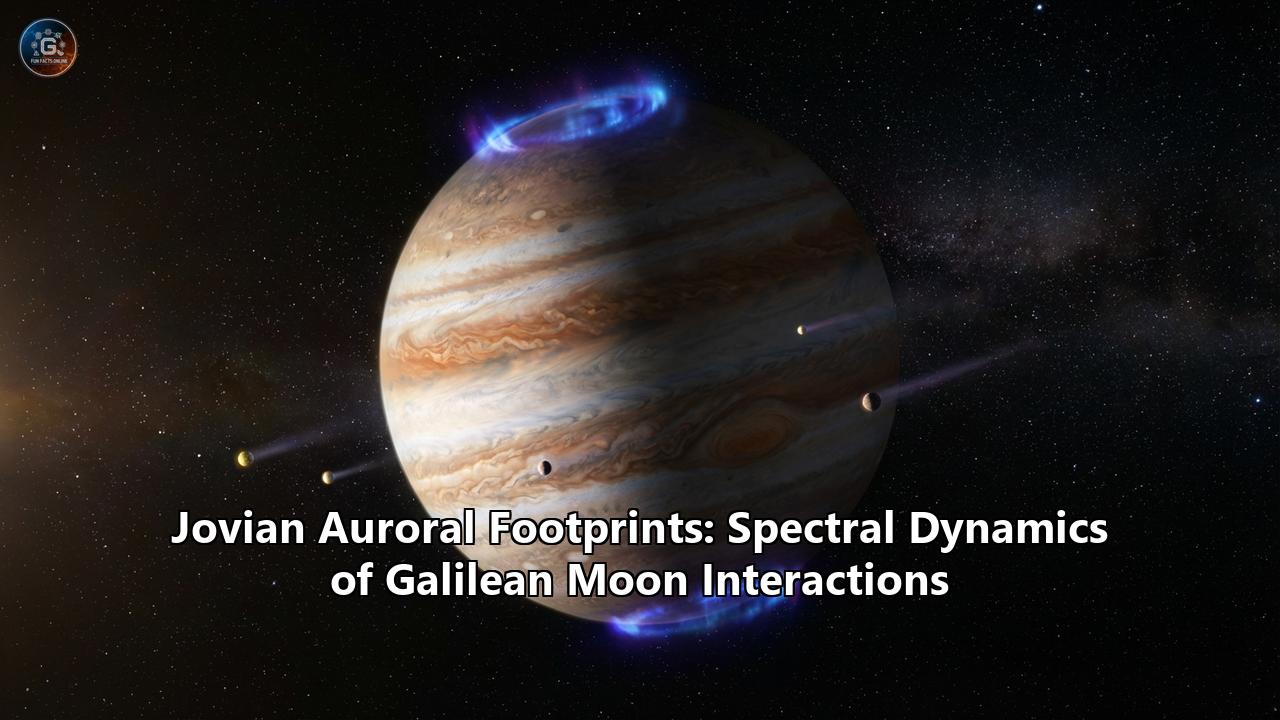
High above the swirling, tempestuous cloud tops of Jupiter, a silent and spectacular light show plays out in the extreme ultraviolet and infrared spectrums. Jupiter’s aurorae are the most powerful in the solar system, dwarfing Earth’s northern and southern lights by orders of magnitude in both sheer size and energetic output. But amidst the vast, glowing auroral ovals that crown the gas giant's poles, there exists a phenomenon utterly alien to our home planet: a delicate, dancing array of glowing spots and trailing ribbons of light. These are the Jovian auroral footprints—glowing manifestations of an invisible, electromagnetic tether linking Jupiter to its largest moons.
The Galilean moons—Io, Europa, Ganymede, and Callisto—do not merely orbit Jupiter; they actively participate in a colossal electromagnetic circuit. As these moons plow through the dense, rapidly rotating plasma environment of Jupiter's magnetosphere, they act as massive electrical generators. The resulting electrodynamic interactions launch powerful waves along Jupiter's magnetic field lines, eventually crashing into the planet's upper atmosphere to produce distinct, glowing footprints.
Decoding the spectral dynamics of these footprint interactions has become one of the most thrilling frontiers in planetary science. Through the combined lenses of the Hubble Space Telescope, the James Webb Space Telescope (JWST), and crucially, the unprecedented in-situ and remote-sensing capabilities of NASA’s Juno spacecraft, scientists have begun to unravel the microscopic plasma physics driving this macroscopic cosmic dance.
The Engine of the Gods: Jupiter’s Co-Rotating Magnetosphere
To understand the auroral footprints, one must first understand the environment in which they are forged. Jupiter’s magnetic field is a leviathan, roughly 20,000 times stronger than Earth’s, creating a magnetosphere so immense that if it glowed in the visible spectrum, it would appear larger than the full moon in Earth's night sky.
Crucially, Jupiter completes a full rotation on its axis in under 10 hours. This rapid spin forces the planet's magnetic field—and the charged particles trapped within it—to co-rotate at blistering speeds. The innermost Galilean moons travel much slower in their orbital paths than the sweeping rotation of this magnetic field. Consequently, the moons are continuously bombarded from behind by a hurricane of co-rotating magnetospheric plasma.
This relative motion is the spark that ignites the auroral footprints. When a moon, which acts as an obstacle, disrupts this supersonic plasma flow, it generates immense electrical currents and perturbations. The interaction triggers a phenomenon known as an Alfvén wave—a type of magnetohydrodynamic wave that ripples along the magnetic field lines like a plucked guitar string.
These Alfvén waves travel vast distances from the orbital plane of the moons down into the polar regions of Jupiter. Because the waves take time to travel along the magnetic flux tubes while Jupiter continues to rotate, the auroral footprints do not appear exactly at the magnetic footprints of the moons. Instead, they are observed at a "lead angle," shifted forward in the direction of the plasma flow. Measuring these lead angles has allowed scientists to calculate the exact travel time of the Alfvén waves and rigorously test models of Jupiter's internal magnetic field, such as the JRM33 model.
The Electrodynamic Tether: Acceleration and Precipitation
When the Alfvén waves arrive at Jupiter’s upper atmosphere—the ionosphere—they undergo complex transformations. The waves develop oscillating electric fields parallel to the magnetic field lines, a process that accelerates ambient electrons to extraordinary speeds.
Juno's JADE (Jovian Auroral Distributions Experiment) and Waves instruments have provided definitive proof of these mechanisms. As Juno physically flew through the magnetic flux tubes connected to the moons, it detected broadband electron energy distributions—a hallmark signature of Alfvénic acceleration. These accelerated electrons, traveling at thousands of kilometers per second, smash into the molecular hydrogen (H2) in Jupiter’s atmosphere. The impact excites the hydrogen, causing it to emit photons in the ultraviolet (UV) and infrared (IR) spectrums as the molecules return to their ground state.
However, the interaction is not a one-way street. The process also creates an upward flow of particles. Juno has detected "upward electron conics" and Transhemispheric Electron Beams (TEBs)—electrons that bounce back from Jupiter's atmosphere, travel all the way along the magnetic field line past the moon, and strike the opposite hemisphere of the planet, creating a secondary, fainter footprint.
Each of the four Galilean moons interacts with this environment uniquely, dictated by their distinct atmospheric, geological, and magnetic properties.
Io: The Volcanic Dynamo and the Vortex Street
Io is the most volcanically active body in the solar system, and its footprint is the brightest and most complex. Io spews approximately one ton of sulfur dioxide (SO2) into space every second. This material is quickly ionized, forming the Io Plasma Torus—a dense, donut-shaped cloud of plasma that fundamentally alters Jupiter's magnetosphere.
Because Io sits deep within this dense torus, its interaction with the Jovian magnetic field is violently intense. The moon carries powerful field-aligned currents on the order of 1 Mega-Ampere (MA). High-resolution observations from Juno's Jovian Infrared Auroral Mapper (JIRAM), which observes in the 3.3–3.6 micron L-band with a spatial resolution of up to 10 kilometers, have revealed that Io’s footprint is far from a simple dot.
Instead, the Io footprint consists of a bright Main Alfvén Wing (MAW) spot followed by a regularly spaced array of smaller emission features trailing downstream. This breathtaking pattern resembles a von Kármán vortex street—a swirling, repeating pattern of vortices that forms when a fluid flows past a cylindrical obstacle. This discovery was revolutionary; the small 100-kilometer scale of these multiple features proved incompatible with older theories that relied solely on large-scale Alfvén wave reflections between hemispheres.
Furthermore, observations of Io's trailing tail reveal a bifurcated structure—a pair of closely spaced parallel arcs extending far downstream of the leading footprint. By studying the variability of the Io footprint’s position and brightness over time, scientists have been able to reverse-engineer the density and temperature fluctuations within the Io Plasma Torus, noting significant variations independent of Jupiter's rotation (non-System III variations). Spectral profiles of the footprint show that the H3+ (trihydrogen cation) emissions peak at approximately 600 kilometers above the 1-bar pressure level of Jupiter's atmosphere, a height that perfectly aligns with the broadband energy distribution of the precipitating electrons measured in-situ.
Ganymede: A Magnetosphere Within a Magnetosphere
If Io’s footprint is defined by its volcanic plasma, Ganymede’s is defined by its unique magnetic architecture. Ganymede is the largest moon in the solar system and the only one known to possess its own intrinsic magnetic field. This creates a "mini-magnetosphere" embedded within Jupiter’s giant magnetosphere.
As the Jovian plasma flow encounters Ganymede, magnetic reconnection occurs. The magnetic field lines of Jupiter break and reconnect with Ganymede’s field lines, carving a magnetic hole in the surrounding environment. This highly structured interaction is beautifully mirrored in Ganymede's auroral footprint.
JIRAM and UVS (Ultraviolet Spectrograph) images have shown that Ganymede casts a "double shadow"—a bifurcated main auroral footprint consisting of two distinct spots, often preceded by a dimmer precursor spot.
In a historic maneuver on November 8, 2020, during its thirtieth perijove (PJ30), the Juno spacecraft flew directly through the magnetic flux tube connecting Ganymede to its auroral footprint. The remote UVS instrument measured the UV-brightness of the leading footprint spot at a staggering 411 ± 42 kiloRayleighs (kR). Simultaneously, Juno's in-situ instruments recorded the precise physics of the flux tube. They measured intense Alfvénic activity with Poynting fluxes (the directional energy flux of the electromagnetic field) of around 100 mW/m². These waves were actively accelerating broadband electrons, resulting in a precipitating downward energy flux of ~11 to 13 mW/m², meaning the energy transfer from the wave to the particles operates at roughly 10% efficiency. These measurements elegantly bridged the gap between theoretical plasma physics and the glowing ultraviolet reality seen at Jupiter's poles.
Europa: The Ocean World's Ethereal Glow
Europa presents a middle ground between the brute volcanic force of Io and the magnetic shielding of Ganymede. Europa does not have a strong intrinsic magnetic field, but the salty, subsurface ocean churning beneath its icy crust generates an induced magnetic field as it moves through Jupiter’s magnetosphere.
Europa’s auroral footprint is dimmer than Io's and Ganymede's, but it holds secrets to the moon's interior. Occasionally, the Hubble Space Telescope and Juno have observed fluctuations and morphological changes in Europa's footprint and its trailing tail. Scientists theorize that these variations could be linked to the episodic eruption of water vapor plumes from Europa’s icy surface. When a plume erupts, it acts as a sudden, localized injection of mass into the Jovian magnetosphere—briefly increasing the local plasma density and altering the Alfvénic currents.
Interestingly, while the footprints of Io and Ganymede are dominated by Alfvén wave acceleration, in-situ measurements connected to Europa’s footprint tail have shown distinct signs of electrostatic acceleration. Juno detected enhanced precipitating electrons in the 0.38–25 keV energy range, suggesting that steady, localized electric fields (rather than oscillating waves) play a significant role in drawing the Europa-connected electrons down into the Jovian atmosphere. As missions like Europa Clipper prepare to visit this ocean world, the auroral footprint serves as a remote beacon, offering real-time hints about the moon's outgassing and internal ocean dynamics.
Callisto: The Faint Whisper at the Edge
Callisto, the outermost of the Galilean moons, orbits far from the dense inner regions of the plasma torus. Because the co-rotating plasma is much more tenuous at Callisto's distance, the electromagnetic interaction is incredibly weak. For decades, the auroral footprint of Callisto was a mere theoretical concept, evading detection. Its expected position lies very close to Jupiter's main auroral oval, meaning the moon's faint signature is almost always swallowed by the blinding glare of the main auroral emission.
However, the cosmos occasionally provides perfect conditions. During a period of unusual magnetospheric conditions, Jupiter’s main auroral oval experienced a significant equatorward shift, exposing the higher-latitude regions. Under these rare circumstances, Juno's UVS successfully captured the auroral footprint of Callisto for the first time in a single observation that captured all four Galilean moons simultaneously.
The Callisto footprint revealed a double-spot structure, much like the other moons, with a maximum UV brightness of 137 ± 15 kR. In-situ measurements within Callisto’s flux tube revealed field-aligned electrons with characteristic energies of 10 keV, depositing an energy flux of 55 mW/m² into the atmosphere. In infrared false-color imaging, the Callisto footprint appeared distinctly redder than those of the inner moons, indicating a different penetration depth and energy profile of the precipitating electrons. The detection of Callisto's footprint proves that the Alfvénic electrodynamic engine operates even at the very fringes of the Jovian system.
Decoding the Light: Spectral Dynamics Across Wavelengths
To truly understand the physics of these interactions, scientists cannot rely on a single wavelength of light. The spectral dynamics of the footprints—how they behave across different bands of the electromagnetic spectrum—tell a layered story of energy deposition and atmospheric chemistry.
The Ultraviolet Canvas (Direct Impact)
Ultraviolet observations, primarily conducted by Juno-UVS and Hubble, capture the immediate, violent impact of the precipitating electrons. When the high-energy electrons strike H2 molecules, they emit strongly in the Lyman and Werner bands of the UV spectrum.
By analyzing the "color ratio" of these UV emissions—comparing the intensity of different UV wavelengths—scientists can determine the penetration depth of the electrons. Shorter UV wavelengths are easily absorbed by the methane (CH4) layer situated lower in Jupiter's stratosphere. If a footprint shows a suppressed short-wavelength UV signal, it means the electrons were incredibly energetic, penetrating deep into the atmosphere below the methane homopause before depositing their energy. Conversely, a bright short-wavelength signal indicates lower-energy electrons that stopped higher up in the ionosphere. The spectral data from the footprints confirms a broad range of electron energies, with the bulk of the particles arriving at energies under 1 keV, though tails of the distribution reach up to 100 keV.
The Infrared Crucible (Thermal Afterglow)
While UV light shows the direct flash of impact, infrared light reveals the lingering thermal and chemical consequences. Juno’s JIRAM instrument dominates this field, utilizing its L-band imager to map the emissions of the H3+ ion.
H3+ is created when H2 is ionized by the electron bombardment and subsequently reacts with neutral H2. This molecular ion is a powerful cooling agent for the Jovian upper atmosphere. By observing the H3+ emissions at high spatial resolution (down to 10 km), scientists can track how the energy from the moons' footprints heats the atmosphere and how that heat is distributed and dissipated.
Because H3+ relies on a chemical reaction and subsequent thermal excitation, the infrared footprints can exhibit a slight "thermal lag" or persistence compared to the instantaneous UV flashes. This allows the IR tails of the footprints—such as the von Kármán vortices of Io—to stretch out for thousands of kilometers, persisting long after the initial Alfvén wave has passed.
The Juno Revolution and the Road Ahead
Before the arrival of the Juno spacecraft in 2016, our view of Jovian auroral footprints was akin to watching a shadow play from across a vast theater. We could see the shapes shifting, but we could not see the strings. Juno’s highly elliptical polar orbit changed everything. By repeatedly diving through the very magnetic flux tubes that connect the moons to the planet, Juno transformed remote speculation into empirical fact.
Juno has proven that Alfvénic acceleration is the primary driver of these emissions. It has revealed the swirling vortex streets of Io, the bifurcated shadows of Ganymede, the electrostatic whispers of Europa, and the elusive ghost of Callisto. It has mapped the exact altitude profiles of the atmospheric glow and definitively linked the invisible roil of the Io plasma torus to the shifting dance of the footprints.
Yet, the Jovian system remains a tapestry of unsolved mysteries. How exactly do the potential water plumes of Europa modulate its auroral tail? What causes the precise spacing of Io's vortex spots? How does Ganymede's intrinsic magnetic reconnection fluctuate over time?
As Juno continues its extended mission, it paves the way for the next generation of explorers. The European Space Agency’s JUICE (Jupiter Icy Moons Explorer) and NASA’s Europa Clipper are set to arrive in the Jovian system in the early 2030s. Armed with next-generation instrumentation, these spacecraft will orbit the icy moons themselves, looking directly down the magnetic barrel toward Jupiter. By combining their close-up observations of the moons' plasma environments with continued monitoring of the planetary aurorae, scientists will finally complete the circuit.
The study of Jovian auroral footprints is far more than planetary meteorology. It is a masterclass in fundamental plasma physics. It provides a localized, observable laboratory for magnetic reconnection, wave-particle interactions, and electrodynamic tethering—processes that govern the behavior of pulsars, black hole accretion disks, and exoplanetary systems across the cosmos. When we look at the glowing spots at Jupiter's poles, we are not just seeing the shadows of moons; we are witnessing the universal engine of electrodynamics, written in the spectral light of a giant world.
Reference:
- https://www.sci.news/space/juno-images-io-ganymede-footprint-jupiters-aurorae-06175.html
- https://www.swri.org/newsroom/press-releases/swri-scientists-connect-the-dots-between-galilean-moon-auroral-emissions-jupiter
- https://earthsky.org/space/auroral-tails-for-jupiters-moons/
- https://iris.cnr.it/handle/20.500.14243/343555
- https://www.researchgate.net/publication/370500628_The_Io_Europa_and_Ganymede_auroral_footprints_at_Jupiter_in_the_ultraviolet_Positions_and_equatorial_lead_angles
- https://orbi.uliege.be/bitstream/2268/315900/1/Moirano%20et%20al.%20-%202024%20-%20The%20Infrared%20Auroral%20Footprint%20Tracks%20of%20Io%2C%20Europ.pdf
- https://spacephysics.princeton.edu/sites/g/files/toruqf1376/files/media/20_szalay_c.pdf
- https://pds-ppi.igpp.ucla.edu/data/juno-waves-electron-density/document/sulaiman-grl-2024.pdf
- https://www.researchgate.net/publication/373095235_Variability_of_the_Auroral_Footprint_of_Io_Detected_by_Juno_-JIRAM_and_Modelling_of_the_Io_Plasma_Torus
- https://www.semanticscholar.org/paper/The-Infrared-Auroral-Footprint-Tracks-of-Io%2C-Europa-Moirano-Mura/83bb04aebf0f4666a7100fda0a6cfb13d92bb073
- https://www.researchgate.net/publication/318544963_The_tails_of_the_satellite_auroral_footprints_at_Jupiter_SATELLITE_FOOTPRINT_TAILS