
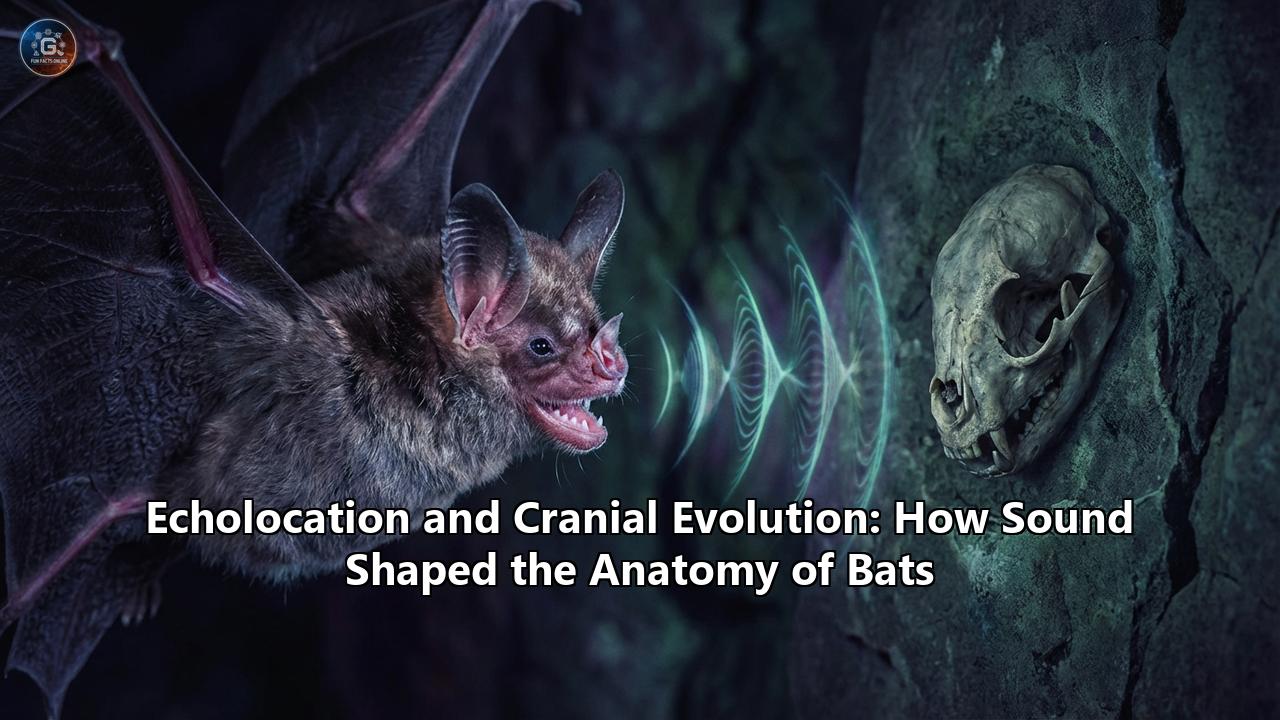
When night falls, the skies become an invisible acoustic arena. For millions of years, while most creatures rely on the fading light to navigate, one group of mammals took to the air equipped with an extraordinary biological superpower: echolocation. Bats, which account for more than 20% of all living mammal species, have conquered the darkness not by improving their eyesight, but by mastering the physics of sound. By emitting high-frequency vocalizations and meticulously analyzing the returning echoes, bats can paint a three-dimensional acoustic image of their surroundings. This ability allows them to weave through dense forests, avoid hair-thin obstacles, and snatch insects from the air in pitch blackness.
But echolocation is far more than just a behavioral quirk. To project piercing ultrasound and receive faint, delayed echoes requires profound physical transformations. Over the span of tens of millions of years, the mechanical and acoustic demands of echolocation have fundamentally sculptured the anatomy of bats, fundamentally altering their skeletal architecture. The evolutionary pressure to produce, direct, and interpret high-frequency sound waves transformed the bat cranium into a highly specialized bio-acoustic instrument. By examining the fossil record, developmental biology, and high-resolution micro-CT scans of bat skulls, scientists are piecing together a spectacular evolutionary puzzle. We now know that the interplay of sound, sensory perception, and eventually diet, drove an incredible diversification of skull shapes, leaving us with a living testament to the power of evolution.
The Evolutionary Origins of Echolocation
To understand how echolocation shaped the anatomy of bats, we must travel back more than 50 million years into the Eocene epoch. The early stages of bat evolution have long been shrouded in mystery due to a sparse fossil record. However, key discoveries have sparked intense debates among paleontologists regarding which came first: powered flight or echolocation.
One crucial piece of the puzzle is Onychonycteris finneyi, a 52-million-year-old fossil bat discovered in Wyoming. Onychonycteris possessed primitive wings that indicate a style of flight less advanced than modern bats, and initial anatomical analyses of its skull suggested that it lacked the enlarged inner ear structures typically associated with ultrasonic hearing. This led to the "flight first" hypothesis—the idea that early bats evolved to fly before they developed the capacity to echolocate. However, the debate remains alive. Recent re-examinations utilizing computer-aided tomography have revealed tantalizing clues, such as specific bone connections in the throat and ear regions that mirror those seen in modern echolocating bats, suggesting that O. finneyi might have possessed rudimentary echolocating capabilities.
The discovery of Vielasia sigei, a remarkably preserved 50-million-year-old uncrushed bat skull from southern France, provided what researchers call the "Rosetta Stone" of bat echolocation. Analysis of Vielasia confirmed that its inner ear structures were highly akin to those of modern echolocating bats, meaning that advanced, high-frequency echolocation had firmly evolved long before the origin of modern bat families.
Interestingly, while we see varying abilities in adult bats today—with Old World fruit bats (megabats) largely lacking laryngeal echolocation—developmental biology offers a striking revelation. Studies on bat embryos have shown that all bats, even the non-echolocating fruit bats, begin life in the womb with an exceptionally large cochlea. This embryonic structure acts as a "living fossil," strongly suggesting that the common ancestor of all living bats possessed the ability to echolocate. In the lineages that eventually shifted strictly to visual foraging and frugivory, this rapid cochlear growth simply halts during later fetal development, demonstrating how deeply the legacy of sound is inscribed into the ancestral bat blueprint.
Engineering the Skull: The Anatomy of a Biological Sonar System
Between 58 and 34 million years ago, echolocation was the undisputed primary driver of skull shape evolution across early bat lineages. Emitting sound that can travel through space, bounce off a tiny, moving target, and return with enough acoustic fidelity to be processed by the brain requires highly specific structural engineering.
To achieve this, the bat cranium underwent significant alterations, specifically tailored to the frequencies the animals utilize. A sweeping analysis of hundreds of bat skulls housed in European natural history collections revealed a striking correlation: the overall size and shape of a bat's skull have evolved to physically "match" the frequencies of its sonar. Bats that emit high-frequency sonar signals typically possess noticeably shorter faces and smaller skulls, but disproportionately wider ear bones, a reflection of their need to capture and process incredibly short-wavelength echoes. Conversely, species utilizing lower-frequency echolocation tend to have larger skulls.
The most profound divergence in skull morphology, however, stems from the literal exit point of the sound. Within the world of laryngeally echolocating bats, there is a clear anatomical dichotomy: mouth emitters and nasal emitters.
The Mouth EmittersThe ancestral and more common approach to echolocation is oral emission, where bats project ultrasonic pulses through their open mouths. To optimize this acoustic pathway, mouth-emitting bats typically possess skulls with an upward tilt. This craniofacial tilt allows the bat to fly with its head angled to direct the sonar beam straight forward into its flight path. Because the mouth serves the dual purpose of vocalizing and catching prey, the rostrum (the snout region) must be engineered to rapidly snap shut on an insect the millisecond the echoes pinpoint its location.
The Nasal EmittersOn the other side of the evolutionary divide are the nasal emitters, such as the horseshoe bats and leaf-nosed bats. These species hunt with closed mouths, instead forcing their laryngeal calls up through specialized nasal passages and out through their nostrils. Transitioning from mouth to nose emission required a monumental redesign of the microchiropteran face.
In nasal emitters, the palate is un-tilted to facilitate sound emission straight through the nasal cavity. More importantly, the internal nasal cavities evolved complex, maze-like bony structures (turbinals) that act as resonant chambers, fine-tuning the sound before it ever leaves the bat's body. Externally, this acoustic specialization is often adorned with elaborate "nose-leaves"—fleshy, highly modified facial structures that act like parabolic megaphones to focus and direct the ultrasonic beam. For these bats, the skull shape and the complex internal chambers of the rostrum are heavily constrained by the physics of sound amplification and resonance.
The Bony Connection: Bridging Voice and Ear
One of the most fascinating anatomical adaptations hidden beneath the skin of an echolocating bat involves the intricate connection between the apparatus that produces sound and the apparatus that receives it.
Most mammals have a hyoid apparatus—a series of small bones in the throat that support the larynx and tongue. In non-echolocating mammals and non-echolocating fruit bats, the stylohyal bone (part of this throat apparatus) hangs freely, separated from the ear bones. However, in laryngeally echolocating bats, evolution forged a unique, physical bridge: the proximal end of the stylohyal bone directly articulates with, and is often fused to, the tympanic bone, which forms the floor of the middle ear.
This bony connection is absolute in laryngeally echolocating species and entirely absent in all others, acting as a definitive skeletal signature for true echolocation. When a bat produces an ultrasonic call, the muscular contractions are incredibly forceful. This direct connection between the larynx support and the middle ear likely serves a crucial mechanical role. It may help coordinate the firing of middle-ear muscles to dampen the bat's hearing at the exact millisecond a loud call is emitted, protecting the delicate inner ear from self-deafening, and immediately relaxing to capture the faint returning echo. This exquisite anatomical synergy perfectly illustrates how heavily sound has influenced the bat skeleton.
The Inner Ear: A Masterpiece of High-Frequency Hearing
Producing sound is only half the echolocation equation. The ability to hear and decipher high-frequency echoes requires profound neurological and morphological adaptations of the inner ear. The primary organ of hearing, the cochlea, underwent massive evolutionary expansion in bats.
Compared to non-echolocating fruit bats, which average 1.75 turns in their spiral-shaped cochleae, laryngeal echolocating bats boast greatly enlarged cochleae that coil between 2.5 to 3.5 times. This extended spiraling vastly increases the length of the basilar membrane, allowing for a much higher density of hair cells tuned to specific, ultra-high frequencies.
Recent comparative genomic studies have illuminated the genetic groundwork underlying these physical changes. Scientists have identified numerous genes related to hearing and auditory processes that underwent positive, adaptive selection in both echolocating bats and toothed whales (dolphins and sperm whales)—a classic example of convergent evolution. Genes governing cochlear bony development, ion balance, and auditory signal transduction mutated in parallel ways to support high-frequency ultrasonic hearing in these vastly different mammalian lineages. Specifically, sites in genes like TECPR2 evolved to enhance the functional capability of the cochlea, proving that the pressure to hear high-frequency echoes fundamentally altered bats at the molecular level.
Beyond the gross morphology of the ear bones, the very wiring of the bat brain has been shaped by the type of echolocation utilized. The thousands of echolocating bat species broadly trace back to two distinct evolutionary lineages: the "Yin" and "Yang" bats. A breakthrough anatomical study utilizing micro-CT scans revealed that these two lineages process sound using completely different neuroanatomies of the inner ear. In "Yin" bats, the inner ear ganglion (the structure of neurons connecting the inner ear to the brain) follows a more constrained, traditional mammalian blueprint. However, the "Yang" bats—which rely heavily on highly complex, frequency-modulating echolocation—evolved a novel anatomical configuration that removed the physical space constraint on the inner ear ganglion. This structural freedom allowed the ganglion cells in Yang bats to multiply extensively, creating a denser network of neurons to process highly complex sound variations. This neurological remodeling is credited with driving the massive evolutionary diversification seen in the "Yang" bat lineage.
The Decoupling of Cranium and Jaw: A Dual Evolutionary Force
While echolocation dictated the fundamental architecture of the bat skull for millions of years, an interesting shift occurred approximately 26 million years ago. As bats expanded across the globe, they began moving into diverse ecological niches that offered an array of new food sources. While many bats remained strict insectivores, certain lineages—most notably the New World leaf-nosed bats—experienced an explosion of dietary diversification. Over a relatively short evolutionary window, leaf-nosed bats evolved to eat fruit, nectar, small vertebrates, and even blood.
This presented an evolutionary conflict: how does a bat modify its skull to consume drastically different foods without ruining its precisely tuned acoustic equipment?
Evolution solved this through a phenomenon researchers call "decoupling". Sophisticated 3D computational modeling of hundreds of bat species revealed that the evolutionary pressures of diet and echolocation began acting on different parts of the skull independently. Because the upper portion of the skull (the cranium) is responsible for housing the brain, protecting the inner ear, and shaping the nasal cavities for sound resonance, it remained highly constrained by the physical laws of echolocation.
The lower jaw (the mandible), however, is primarily tasked with feeding. The decoupling allowed the lower jaw immense evolutionary freedom. As a result, the lower jaws of bats morphed wildly to accommodate different diets—elongating into thin snouts to lap nectar from deep flowers, robustly thickening with powerful musculature to crack open hard fruits, or modifying into razor-sharp instruments to slice mammalian skin for blood-feeding. In insectivorous bats that rely on capturing prey on the wing, the jaw and cranium co-evolved under a tight functional trade-off, balancing bite force with acoustic efficiency. But in the remarkably diverse leaf-nosed bats, the lower jaw could drastically change shape while the upper cranium maintained its acoustical integrity.
The Legacy of Sound in Bone
The bat skull is one of the most remarkable examples of evolutionary engineering found in nature. It stands as a testament to the fact that evolution is not merely about adapting to physical environments like climate or terrain, but also about mastering invisible forces. Through the relentless pressures of survival, the ethereal nature of sound became a sculptor, physically molding bone, tissue, and genetics over millions of generations.
From the dramatic shortening of the face to accommodate high-frequency sonar, to the complex internal spiraling of the cochlea, and the intricate fusing of throat and ear bones, every millimeter of a bat's skull tells a story of acoustic optimization. The divergence into mouth and nasal emitters, the neurological rewiring of the inner ear ganglia, and the evolutionary decoupling of the jaw from the braincase to allow for dietary variety illustrate the profound plasticity of mammalian anatomy.
Today, as bats perform their nightly, silent symphonies across global ecosystems—pollinating flowers, controlling insect populations, and dispersing seeds—they carry with them a 50-million-year-old architectural legacy. The evolution of the bat cranium reveals that, sometimes, the most profound changes in the physical world are driven by things we cannot even see. Sound didn't just guide bats through the dark; it built them.
Reference:
- https://biologicalsciences.uchicago.edu/news/bat-echolocation-inner-ear-structure
- https://www.burkemuseum.org/news/bats-evolved-diverse-skull-shapes-due-echolocation-diet
- https://www.washington.edu/news/2019/05/02/bats-evolved-diverse-skull-shapes-due-to-echolocation-diet/
- https://www.sciencedaily.com/releases/2019/05/190502075839.htm
- https://pmc.ncbi.nlm.nih.gov/articles/PMC3598973/
- https://www.reddit.com/r/BatFacts/comments/dpdbb7/onychonycteris_finneyi_had_a_simple_cochlea_that/
- https://www.researchgate.net/publication/41123794_A_bony_connection_signals_laryngeal_echolocation_in_bats
- https://pubmed.ncbi.nlm.nih.gov/20724993/
- https://www.salford.ac.uk/news/50-million-year-old-fossil-skull-uncovers-evolutionary-history-of-bat-echolocation
- https://www.ucd.ie/newsandopinion/news/2017/jan/11/allbatsoncehadtheabilitytoecholocate/
- https://www.labmanager.com/bats-evolved-diverse-skull-shapes-due-to-echolocation-diet-1975
- https://www.nhm.ac.uk/discover/news/2026/february/how-the-echolocation-of-bats-has-shaped-their-skulls.html
- https://www.cambridge.org/core/books/abs/evolutionary-history-of-bats/echolocation-evodevo-and-the-evolution-of-bat-crania/7154E130F06F2C984A36316E58317A92
- https://researchonline.ljmu.ac.uk/id/eprint/12640/
- https://www.microphotonics.com/utilizing-micro-ct-study-evolution-bats/
- http://paleomammiferi.blogspot.com/2010/01/bones-and-echolocation.html
- https://pmc.ncbi.nlm.nih.gov/articles/PMC7145703/
- https://www.researchgate.net/publication/235382118_Evolutionary_origins_of_ultrasonic_hearing_and_laryngeal_echolocation_in_bats_inferred_from_morphological_analyses_of_the_inner_ear