
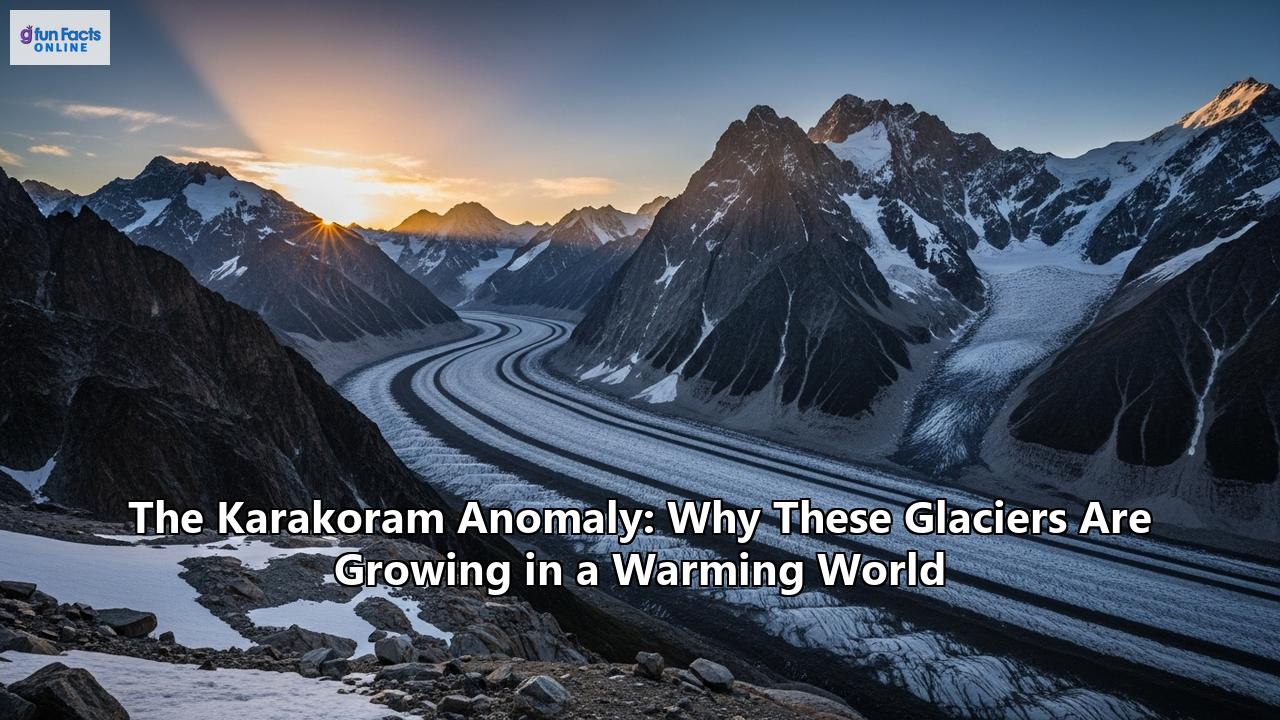
The Karakoram Anomaly: A Bastion of Ice in a Warming World
In an era defined by the pervasive and often alarming narrative of climate change, where glaciers across the globe are in a state of rapid retreat, a peculiar and fascinating phenomenon offers a glimmer of scientific intrigue and a sliver of hope. High in the rugged, unforgiving expanse of the Karakoram mountain range, a sprawling icy kingdom that straddles the borders of Pakistan, India, and China, many glaciers are not shrinking. In a stark defiance of global trends, they are stable, and in some cases, even expanding. This is the Karakoram Anomaly, a complex and compelling puzzle that has captivated glaciologists and climate scientists for decades.
The Karakoram range, a part of the greater Hindu Kush Himalaya region, is one of the most heavily glaciated areas outside of the polar regions. It is a land of giants, home to K2, the world's second-highest peak, and a multitude of other towering summits. These mountains cradle thousands of glaciers, including the colossal Siachen and Biafo glaciers, which are among the largest outside the Arctic and Antarctic. For the millions of people living downstream, the meltwater from these frozen reservoirs is a lifeline, particularly in the arid and semi-arid regions of South and Central Asia.
The story of the Karakoram Anomaly began to gain significant traction in the scientific community in the late 1990s and early 2000s. As the overwhelming majority of the world's glaciers were succumbing to rising temperatures, observations in the central Karakoram revealed a startlingly different picture. Geology professor Kenneth Hewitt was among the first to formally describe this anomalous behavior in a 2005 paper, highlighting observations of mass gains in the 1990s and setting the stage for years of intensive research into its potential causes.
A Tale of Two Climate Systems: The Role of the Westerlies
The primary explanation for the Karakoram Anomaly lies in the unique meteorological conditions that govern this high-altitude region. Unlike the rest of the Himalayas, which receive the bulk of their precipitation from the summer monsoon, the Karakoram is predominantly fed by a different weather system: the mid-latitude westerlies. These winds, originating from the Mediterranean and Caspian Seas, bring moisture-laden storms to the region, primarily during the winter months.
Recent research has revealed that these Western Disturbances (WDs) have been instrumental in triggering and sustaining the Karakoram Anomaly. Studies suggest that WDs are the primary source of snowfall for the region in winter, contributing to as much as 65% of the total seasonal snowfall volume and around 53% of the total seasonal precipitation. Furthermore, the intensity of the precipitation from these disturbances has increased by approximately 10% in the last two decades, enhancing their role in nourishing the glaciers.
In a striking contrast, precipitation from non-WD sources has seen a significant decrease. This revival and intensification of the westerlies have led to increased winter snowfall in the Karakoram, a critical factor for glacier mass balance. While other parts of the Himalayas are experiencing declining snowfall, the Karakoram is receiving a steady, and in some cases, increased supply, allowing its glaciers to accumulate mass.
The Karakoram Vortex: A Shield of Cold Air
Adding another layer to this complex climatic puzzle is the discovery of a large-scale circulation system, or vortex, that forms over the Karakoram. This vortex of cold air has a profound impact on the regional climate, particularly during the summer months. While the vortex influences the temperature over the entire 2,000-kilometer mountain range in winter, it contracts during the summer, concentrating its cooling effect over the Karakoram and the western Pamir mountains.
This summer cooling is a crucial element of the anomaly. It creates a stark temperature contrast with the rest of the Himalayas, which are experiencing warming trends. The interaction between the Karakoram vortex and the South Asian Monsoon acts as a kind of counter-weighted temperature control. In recent decades, this interplay has resulted in stormier conditions over the Karakoram, further contributing to the stability of its glaciers.
The presence of this vortex helps to explain why climate models have often struggled to accurately represent the conditions in the Karakoram. While most models predict warming across the entire Himalayan region, the localized cooling effect of the vortex has been a missing piece of the puzzle.
The Insulating Blanket: The Role of Debris Cover
An early hypothesis for the Karakoram Anomaly centered on the extensive debris cover found on many of the region's glaciers. Glaciers are powerful agents of erosion, and as they move, they transport vast amounts of rock and sediment. This debris, when thick enough, can have a significant impact on a glacier's mass balance.
A thin layer of debris can actually accelerate melting by absorbing more solar radiation. However, a thicker layer, typically more than a few centimeters, acts as an insulating blanket, protecting the ice from the sun's rays and slowing down the rate of ablation (melting and evaporation). In the Karakoram, where many glaciers are heavily covered in debris, this insulating effect was thought to be a key factor in their stability.
However, while debris cover does play a role in reducing ablation, with some studies suggesting a basin-averaged reduction of around 14%, it is no longer considered the primary driver of the anomaly. The widespread nature of the phenomenon, affecting both debris-covered and clean-ice glaciers, pointed towards a larger-scale climatic explanation. Moreover, the sudden onset of glacier expansion in the late 1990s suggested that a more dynamic process was at play, as the debris cover itself is not a new phenomenon.
The Human Dimension: Socio-Economic Impacts and Future Uncertainties
The Karakoram Anomaly is not just a scientific curiosity; it has profound implications for the millions of people who depend on the region's water resources. The stability of these glaciers provides a crucial buffer against water scarcity, particularly in the face of a changing climate. The meltwater from the Karakoram feeds major river systems like the Indus, which are vital for agriculture, hydropower, and drinking water in Pakistan and India.
The construction of the Karakoram Highway has already brought significant socio-economic changes to the region, increasing access to markets, education, and healthcare. However, the very glaciers that make this region so vital are also a source of potential hazards. The advancement of some glaciers has led to the formation of ice-dammed lakes, which can burst their banks and cause devastating glacial lake outburst floods (GLOFs). These events pose a significant threat to downstream communities and infrastructure, including the China-Pakistan Economic Corridor (CPEC).
The future of the Karakoram Anomaly remains a subject of intense scientific debate. While some models suggest that the conditions sustaining the anomaly could persist until the end of the century, others indicate a potential weakening of this unusual behavior. Some recent studies have even suggested that the anomaly may have ended in the last decade, with some glaciers in the region now showing signs of mass loss.
The case of Norwegian glaciers offers a cautionary tale. In the 1990s, many glaciers in Norway experienced a period of growth, only for their mass balance to turn sharply negative in the 2000s. The long-term persistence of the Karakoram Anomaly in a world of continued warming seems unlikely.
A Window into a Complex Climate
The Karakoram Anomaly is a powerful reminder of the intricate and often counterintuitive workings of the Earth's climate system. It demonstrates that while the global trend of warming is undeniable, its regional manifestations can be highly variable. This bastion of ice in a warming world offers a unique natural laboratory for scientists to study the complex interplay of atmospheric circulation, topography, and glacial dynamics.
The ongoing research in the Karakoram is not just about solving a scientific puzzle. It is about understanding the future of one of the world's most critical water towers and ensuring the resilience of the communities that depend on it. The story of the Karakoram's growing glaciers is a testament to the complexity of our planet and a compelling call for continued scientific exploration in the face of a changing climate.
Reference:
- https://www.drishtiias.com/daily-updates/daily-news-analysis/karakoram-anomaly
- https://nsidc.org/learn/ask-scientist/karakoram-anomaly-it-real
- https://www.icimod.org/the-karakoram-anomaly-no-change-in-the-karakoram-glacier-region-since-the-1970s/
- https://tc.copernicus.org/articles/8/941/2014/
- https://www.researchgate.net/publication/359833963_Does_the_recent_revival_of_Western_Disturbances_govern_the_Karakoram_Anomaly
- https://www.sciencedaily.com/releases/2017/08/170807112835.htm
- https://www.researchgate.net/publication/348986736_Glacial_change_and_hydrological_implications_in_the_Himalaya_and_Karakoram
- [https://bioone.org/journals/mountain-research-and-development/volume-25/issue-4/0276-4741(2005)025%5B0332%3ATKAGEA%5D2.0.CO%3B2/The-Karakoram-Anomaly-Glacier-Expansion-and-the-Elevation-Effect-Karakoram/10.1659/0276-4741(2005)025[0332:TKAGEA]2.0.CO;2.short](https://bioone.org/journals/mountain-research-and-development/volume-25/issue-4/0276-4741(2005)025%5B0332%3ATKAGEA%5D2.0.CO%3B2/The-Karakoram-Anomaly-Glacier-Expansion-and-the-Elevation-Effect-Karakoram/10.1659/0276-4741(2005)025[0332:TKAGEA]2.0.CO;2.short)
- https://www.princeton.edu/news/2014/10/22/researchers-resolve-karakoram-glacier-anomaly-cold-case-climate-science
- https://theraisinahills.com/western-disturbances-give-karakoram-glaciers-climate-change-resilience/
- https://voisplanet.com/article/karakoram-anomaly-western-disturbance
- https://www.researchgate.net/publication/275240062_Impact_of_debris_cover_on_glacier_ablation_and_atmosphere-glacier_feedbacks_in_the_Karakoram
- https://pmc.ncbi.nlm.nih.gov/articles/PMC6949123/
- https://tc.copernicus.org/articles/9/1617/2015/tc-9-1617-2015.pdf
- https://lib.icimod.org/records/0wad4-gm131
- https://oeconomiajournal.com/index.php/view/article/download/15/14/45
- https://ijmcr.com/socio-economic-impact-of-karakoram-highway-on-peoples-life-a-case-study-of-aliyabad-hunza-gilgit-pakistan/
- https://twasp.info/journal/archive/6%20(11)%20150-171.pdf%20150-171.pdf)
- https://pubmed.ncbi.nlm.nih.gov/31915463/
- https://research.wur.nl/en/publications/manifestations-and-mechanisms-of-the-karakoram-glacier-anomaly