
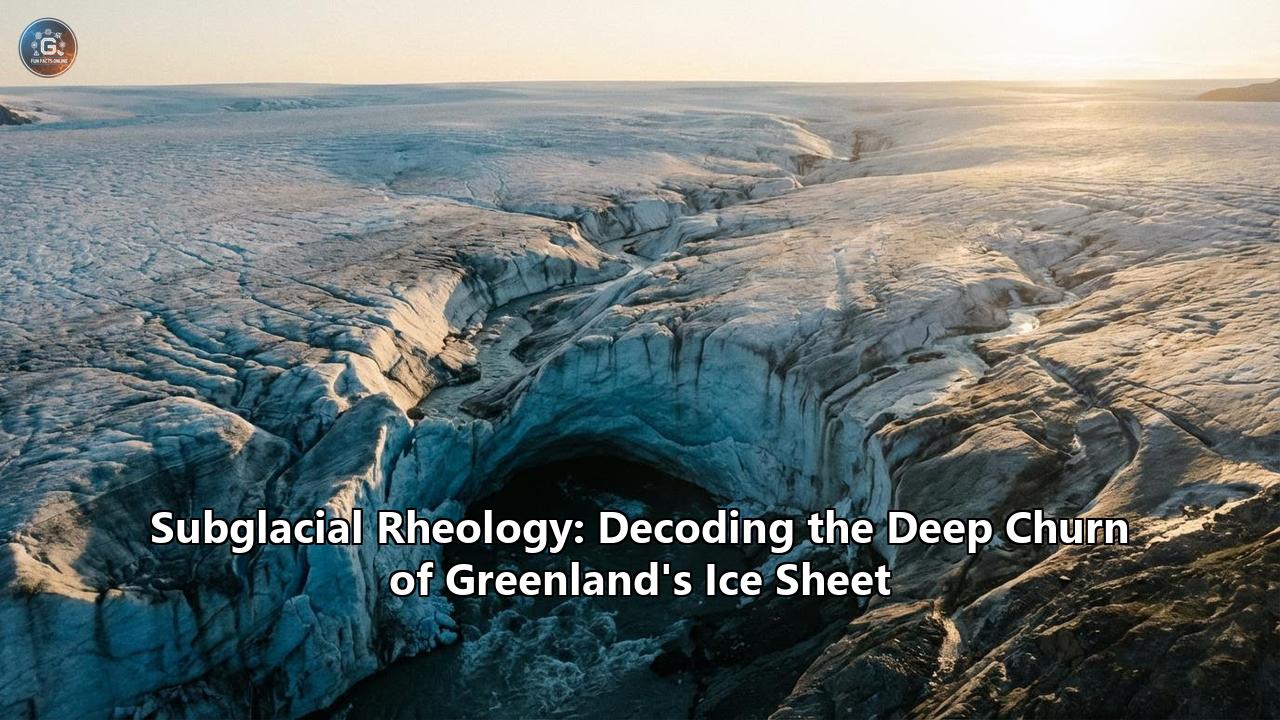
Imagine standing on the blindingly white, windswept surface of the Greenland Ice Sheet. Stretching across 1.7 million square kilometers, this colossal dome of frozen water seems utterly static, a monolithic relic of the Pleistocene locked in a deep, silent freeze. But this stillness is a magnificent illusion. Beneath your boots, descending through as much as three kilometers of solid ice, lies a hidden world of unimaginable violence, crushing pressures, and relentless motion. Down in the absolute dark, where the ice meets the bedrock, the glacier is not merely sitting; it is churning, tearing, sliding, and transforming.
To understand the future of our global coastlines, scientists are increasingly turning their attention away from the melting surface and looking deep into this abyssal zone. The science that governs this buried world is known as subglacial rheology—the study of how matter flows and deforms under the titanic stresses of an overlying ice sheet. Decoding the deep churn of Greenland’s basal environment is no longer just an academic curiosity. With the ice sheet containing enough water to raise global sea levels by over seven meters, mastering the physics of its foundation is one of the most urgent scientific imperatives of our time.
The Rheological Revolution: From Hard Rock to Soft Bellies
For decades, classical glaciology operated on a relatively clean, simple assumption: glaciers and ice sheets were massive blocks of ice that slid over unyielding, hard bedrock. Pioneering physicists in the mid-20th century developed elegant mathematical models describing how ice deforms internally under its own weight and how it slips over rigid bumps through a combination of pressure-melting and plastic flow. In this traditional paradigm, the bedrock was an anvil, the ice was the hammer, and the resulting motion was dictated by the topography of the rock and the temperature of the ice.
But as seismic surveys and ground-penetrating radar technologies advanced, researchers awoke from their "clean studies" to realize that life at the subglacial bed was far messier, darker, and more dynamic than previously imagined. The Greenland Ice Sheet does not rest entirely on a pristine bedrock floor. Instead, vast swaths of the ice sheet are underlain by thick, water-saturated layers of crushed rock, gravel, and mud known as subglacial till.
This revelation fundamentally shattered existing models of ice sheet dynamics. If a glacier sits on a bed of soft, deformable sediment rather than solid rock, the rules of its movement change entirely. It is the difference between sliding a block of wood over sandpaper versus sliding it over a layer of wet mud. The sediment itself begins to shear and flow, carrying the ice sheet along for the ride. Mobilized subglacial till acts as a granular fluid, highly sensitive to changes in pore-water pressure, meaning that the ice sheet's speed is inextricably linked to the structural integrity of the mud beneath it.
This realization sparked one of the most intense and enduring debates in modern glaciology: the rheological nature of subglacial till. How exactly does this subterranean mud flow? Early attempts to model till assumed a "viscous" rheology, suggesting that the till flowed continuously like thick honey, with its deformation rate increasing proportionally to the stress applied by the moving ice. This model, championed in the late 1980s, had the appeal of mathematical simplicity and was easily plugged into early computer simulations.
However, a growing body of rigorous experimental and field data challenged this view. Researchers analyzing the micro-sedimentological clues of subglacial tills and conducting sheer-box experiments on glacial muds discovered that till behaves far more like a plastic material governed by the Coulomb failure criterion. Like soil in a landslide, subglacial till possesses a "yield strength." It remains rigid and unyielding until a specific threshold of stress is crossed. Once that threshold is breached—often facilitated by pressurized water pushing the grains apart—the till structurally fails and begins to deform rapidly. This plastic behavior means that the Greenland Ice Sheet's flow is not necessarily a smooth, continuous ooze, but rather a complex system of sticking, yielding, and sliding that can shift dramatically based on local pressure and hydrology.
Water: The Great Lubricator and the Plumping of the Bed
The rheology of the subglacial world cannot be understood without its most critical catalyst: liquid water. The base of the Greenland Ice Sheet is remarkably wet. Heat radiates upward from the Earth's geothermal flux, while the immense friction of the sliding ice generates additional thermal energy. Furthermore, the sheer weight of three kilometers of ice acts as a pressure cooker, lowering the melting point of the basal ice and creating conditions for continuous melting.
But the water at the bed does not just originate from below. The surface of the Greenland Ice Sheet is increasingly subjected to intense summer melting. This meltwater pools into massive supraglacial lakes, which can suddenly catastrophic drain through vertical shafts known as moulins. Billions of gallons of surface water free-fall through the ice column, injecting massive pulses of thermal energy and hydraulic pressure directly to the subglacial bed.
When this water arrives at the bed, it radically alters the subglacial rheology. Water forced into the pores of the subglacial till increases the pore-water pressure, supporting the weight of the overlying ice and reducing the friction between individual sediment grains. The till weakens, the yield strength drops, and the ice sheet suddenly accelerates, surging forward in a process known as enhanced basal lubrication. Seismic data has captured this exact phenomenon, recording the transient weakening of subglacial sediments following the rapid drainage of surface lakes, triggering complex, short-term accelerations in ice flow.
Yet, the hydrology of the deep churn is full of paradoxes. One might assume that more water automatically equals faster ice flow, but the reality is governed by the architecture of the subglacial drainage system. Early in the melt season, water spreads out in a highly pressurized, distributed "sheet" or network of isolated cavities, jacking the ice up and causing rapid sliding. However, as the melt season progresses and water volume increases, the friction of the flowing water melts the surrounding ice, carving out large, efficient, arborescent (tree-like) tunnel networks.
Once these large channels form, they act like storm drains. They efficiently funnel the water toward the ocean, causing the overall hydraulic pressure across the wider subglacial bed to drop. When the pressure drops, the ice settles back down, the subglacial till re-strengthens, and the glacier paradoxically slows down, despite the massive influx of water. This self-regulating mechanism—shifting from an inefficient, high-pressure distributed system to an efficient, low-pressure channelized system—is a crucial rheological safety valve that currently tempers the acceleration of Greenland's land-terminating margins.
However, whether this self-regulation will hold under the strain of future, exponentially warmer climates remains a fierce topic of debate. If melt seasons extend too long, or if the sedimentary control of the basal till overrides the hydrodynamic regulation, Greenland's flow could cross a tipping point, leading to sustained, runaway acceleration.
The Architecture of the Interface: Sticky Patches and Subglacial Roughness
While soft till dominates many of the deep, fast-flowing outlet glaciers, the base of the Greenland Ice Sheet is highly heterogeneous. The ice flows over a hidden landscape of jagged mountain ranges, deep canyons, and vast, flat plains. This subglacial topography dictates the "roughness" of the bed, a critical parameter in understanding how the ice deforms.
Using decades of airborne radio-echo sounding data, scientists have systematically mapped the subglacial roughness of Greenland. They have found that fast-flowing regions of the ice sheet often exhibit rougher beds than the slow-flowing interior. As ice flows over a bedrock bump, it is forced to deform. On the upstream side of the bump, the immense pressure causes the ice to melt, flowing around the obstacle as a thin film of water, only to refreeze on the lower-pressure downstream side—a process known as regelation.
In slow-flowing marginal regions, recent borehole tilt-sensor arrays have revealed astonishing data. Even over hard, rough bedrock during the dead of winter—when no surface meltwater is reaching the bed—sliding completely dominates the ice motion, accounting for up to 90% of the movement. This implies that the bed is inherently "slippery," likely due to sparse, localized bedrock bumps acting as isolated "sticky patches" that provide the only real resistance to the immense driving stress of the ice sheet.
These variations in slipperiness cause the ice to undergo complex stress transfers. As the ice flows over alternating soft tills and hard, sticky bedrock patches, the deformation is not uniform. The ice sheet experiences internal shear bands, pulling and tearing in a highly depth-dependent manner. Flow-to-sliding transitions blur, and the resulting motion is a tangled interplay of internal ice stretching and basal slipping. Incorporating this spatially varying subglacial roughness into mathematical frameworks like the Parallel Ice Sheet Model (PISM) or the Community Ice Sheet Model (CISM) is incredibly complex, yet entirely necessary to accurately predict how quickly ice will be discharged into the ocean.
The Basal Ice Layer: Silty Ice, Folds, and Relict Landscapes
To truly decode the rheology of the deep churn, one must look at the ice itself—specifically, the basal ice layer. The ice at the very bottom of the Greenland Ice Sheet is not the pure, pristine, blue glacial ice found near the surface. It is a dark, heavily deformed, and highly complex substance known as "silty ice".
Deep ice core drilling projects—such as Dye 3, GRIP, GISP2, and NEEM—have penetrated all the way to the bedrock, bringing up cylinders of this mysterious basal material. What they found within these cores is a stratigraphical marvel. The silty ice is packed with ancient debris, sediment, and rocks that the glacier has aggressively plucked and scoured from the bedrock over millennia.
But the basal ice is more than just dirty; it is a rheological mixing zone. Isotopic analysis of the water molecules and trapped gases in the central Greenland ice cores reveals that this basal layer contains "relict" non-glacial ice—remnants of ancient precipitation, and possibly even frozen bogs or permafrost that existed before the ice sheet fully formed millions of years ago. As the ice sheet moves, it does not simply slide cleanly over the bedrock; it actively entrains the underlying material.
The incredible shear forces operating at the base of the ice sheet cause the ice to fold and buckle. Layers of clean glacial ice are continuously interfolded with layers of silty, debris-laden ice. As the ice flows into bedrock depressions, it undergoes flow separation and circular motion, churning the ancient sediments like a slow-motion geological blender. This entrained debris profoundly alters the rheology of the ice. Debris-laden ice is mechanically stiffer than clean ice, changing the viscosity and the basal temperature gradient. The presence of this silty ice dictates the basal shear stress, directly influencing how the entire 3,000-meter column of ice above it responds to gravity.
Convection in the Deep: A Shifting Paradigm
Perhaps one of the most astonishing recent discoveries regarding Greenland's subglacial rheology challenges the very nature of how we view ice as a solid. Using advanced radar stratigraphy, scientists have long noticed enigmatic, massive disruptions in the layers of the ice sheet—huge, plume-like features rising hundreds of meters up from the bed, severely distorting the isochrones (layers of equal-aged ice).
For years, these plumes were hypothesized to be the result of the ice freezing directly onto the bed, or the chaotic folding of ice moving over "slippery spots". However, cutting-edge geodynamic modeling has presented a paradigm-shifting hypothesis: thermal convection.
Under specific conditions—particularly in the softer, low-shear regions of northern Greenland—the basal ice is warmed by geothermal heat to a point where its effective viscosity drops drastically. The modeling suggests that the ice becomes so "soft" that it actually begins to convect, much like the molten rock in the Earth's mantle or the wax in a lava lamp. Warmer, slightly more buoyant ice at the bed slowly rises, punching upward through the colder overlying layers over millennial timescales, creating massive englacial plumes.
This revelation is critical for subglacial rheology because it bounds the physical properties of the ice. To allow for such convection, the effective viscosity of the deep ice must be an order of magnitude lower than glaciologists commonly assumed. This ultra-soft basal ice implies that the ice sheet in these regions may deform internally far more easily than previously thought, potentially reducing the reliance on basal slip to accommodate surface velocities. Integrating this softer basal ice rheology into numerical models is the next great frontier in reducing the uncertainties surrounding future ice-sheet mass balance.
The Climate Connection: Why the Deep Churn Matters
Why dedicate such immense scientific effort to understanding the microscopic deformation of mud and the slow-motion convection of ice hidden miles beneath the surface? The answer lies in the pressing reality of anthropogenic climate change.
Greenland is currently losing mass at an accelerating rate. While surface melting is highly visible and deeply concerning, the dynamic discharge of ice—the physical transport of solid ice out into the fjords and oceans by fast-flowing outlet glaciers—accounts for a massive portion of Greenland's contribution to eustatic sea-level rise. The speed of this dynamic discharge is entirely governed by subglacial rheology.
If we cannot accurately model how subglacial till behaves when it gets wet, or how sticky patches on the bedrock transfer stress through the ice column, or how the deep ice plastically deforms, we cannot accurately predict how fast the Greenland Ice Sheet will flow in a warming world. Global climate models and sea-level rise projections rely heavily on equations that parameterize these basal sliding coefficients. When these parameters are based on flawed assumptions—such as treating plastic till as a viscous fluid, or ignoring the presence of subglacial sedimentary basins—the resulting predictions of sea-level rise can be dangerously underestimated or wildly unconstrained.
As surface meltwater production increases, sending more water plunging down moulins to the subglacial bed, understanding the threshold between enhanced lubrication and channelized self-regulation becomes a matter of global security. Will the sediments weaken completely, causing marine-terminating glaciers to surge uncontrollably? Or will the drainage networks adapt, safely routing the water to the sea and maintaining the frictional brake on the ice sheet?
The deep churn of Greenland is a masterclass in planetary physics. It is an alien world of crushing darkness, immense pressures, and microscopic sedimentary mechanics that, incredibly, holds the power to reshape the coastlines of every continent on Earth. As glaciologists continue to probe this buried frontier with seismic charges, deep ice cores, and supercomputer simulations, they are not just decoding the mechanics of ice and mud. They are reading the future of the planet, written in the dark, sliding, and inexorable rheology of the deep.
Reference:
- https://www.cambridge.org/core/journals/journal-of-glaciology/article/rheology-of-subglacial-till/C49C2F34433EB07BE5CE6093885D26BE
- https://www.tandfonline.com/doi/full/10.1080/03091929.2024.2346588
- https://www.cambridge.org/core/services/aop-cambridge-core/content/view/C49C2F34433EB07BE5CE6093885D26BE/S0022143000209787a.pdf/rheology-of-subglacial-till.pdf
- https://pmc.ncbi.nlm.nih.gov/articles/PMC5559208/
- https://pubs.geoscienceworld.org/sepm/jsedres/article/93/10/705/628837/Subglacial-tills-a-process-model-based-on
- https://www.pnas.org/doi/10.1073/pnas.2116036119
- https://www.pnas.org/doi/10.1073/pnas.1212647110
- https://tc.copernicus.org/articles/13/3093/2019/
- https://pmc.ncbi.nlm.nih.gov/articles/PMC6620096/
- https://www.cambridge.org/core/journals/journal-of-glaciology/article/sustained-high-basal-motion-of-the-greenland-ice-sheet-revealed-by-borehole-deformation/E2C7F615834E461F7D3DE966728DC7E1
- https://www.researchgate.net/figure/ce-rheology-basal-traction-and-periodic-setup-A-Rate-parameter-A-as-a-function-of_fig2_368425069
- https://epic.awi.de/id/eprint/59104/1/the-impact-of-spatially-varying-ice-sheet-basal-conditions-on-sliding-at-glacial-time-scales.pdf
- https://www.lyellcollection.org/doi/10.1144/GSL.SP.2000.176.01.02
- https://www.actuaries.org.uk/system/files/documents/pdf/harrison_climatechange.pdf
- https://tc.copernicus.org/articles/20/1071/2026/
- https://pure.ul.ie/en/publications/on-the-rheology-of-till/