
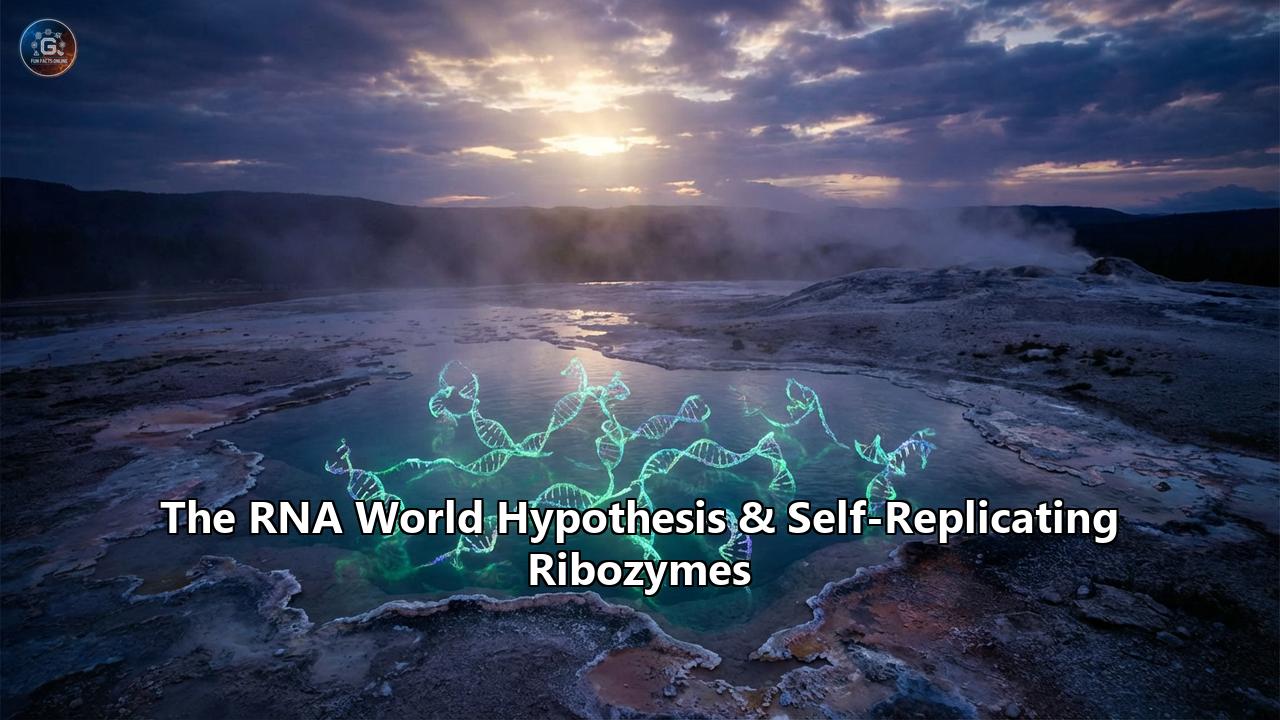
In the vast, silent theater of the cosmos, the emergence of life on Earth stands as the most dramatic and inexplicable act. For billions of years, the universe was a realm of physics and chemistry—lifeless matter governed by thermodynamics and gravity. And then, on a rocky, water-drenched planet orbiting a mediocre star, matter began to do something extraordinary: it began to remember.
The question of how life ignited from non-living matter—abiogenesis—remains the deepest mystery in science. It is a puzzle that forces us to look back four billion years, to a Hadean Earth that was violent, toxic, and alien. For decades, scientists were deadlocked by a logical paradox, a molecular version of the "chicken and egg" causality loop. Life as we know it relies on a complex triumvirate: DNA stores the instructions, proteins do the work (catalyzing reactions), and RNA acts as the messenger between them. DNA cannot replicate without protein enzymes; protein enzymes cannot be built without the instructions in DNA. How, then, could life begin if both were required for the other to exist?
The solution to this paradox, proposed in the late 20th century and bolstered by groundbreaking discoveries in 2024 and 2026, is the RNA World Hypothesis. It suggests that long before DNA banks and protein architects, there was a versatile, solitary virtuoso: Ribonucleic Acid (RNA). This molecule could do it all—store genetic information like a hard drive and catalyze chemical reactions like a machine.
This article explores the epic saga of the RNA World, tracing its history from a speculative idea to a robust scientific theory. We will delve into the molecular mechanics of ribozymes (RNA enzymes), examine the cutting-edge hunt for the "Holy Grail" of biology—the self-replicating RNA molecule—and discuss the revolutionary discoveries of the last few years, including the game-changing QT45 ribozyme and the systems chemistry of John Sutherland, which suggests that RNA may not have walked alone after all.
Part I: The Paradox of Existence
To understand the revolutionary nature of the RNA World, one must first appreciate the depth of the problem it solves. By the mid-20th century, the "Central Dogma" of molecular biology was established: DNA makes RNA makes Protein.
DNA (Deoxyribonucleic acid) is chemically stable, perfect for long-term storage. It is the "genotype." Proteins, folded into intricate three-dimensional shapes, are the "phenotype"—the active agents that build cells, digest food, and copy DNA. This division of labor is efficient, but it creates an origin problem.
If you strip a modern cell down to its basics, you find a factory where the blueprints (DNA) and the workers (proteins) are useless without each other. Spontaneous generation of a DNA molecule is statistically impossible; the spontaneous generation of a functional protein is equally absurd. Sir Fred Hoyle famously compared the likelihood of a protein forming by chance to "a tornado sweeping through a junkyard and assembling a Boeing 747."
For a long time, this impasse seemed insurmountable. Origin-of-life researchers were divided into "genes-first" (believing a replicator came first) and "metabolism-first" (believing a chemical cycle came first) camps.
The Prophet of RNA
In the late 1960s, a few visionary thinkers began to suspect that the middle manager of the Central Dogma—RNA—might be the hero in disguise. Francis Crick (co-discoverer of the DNA double helix), Leslie Orgel, and Carl Woese independently suggested that RNA might have been the primordial molecule.
Their reasoning was based on the structure of RNA. Unlike DNA, which is a rigid double helix locked in a stable embrace, RNA is typically single-stranded. This flexibility allows RNA to fold back on itself, forming loops, stems, and complex 3D structures much like a protein. If it can fold like a protein, could it act like a protein? Could it catalyze reactions?
In 1986, Nobel laureate Walter Gilbert coined the term "The RNA World" to describe this hypothetical era. He painted a picture of a primitive Earth where RNA molecules rained down into pools, storing information in their sequence and facilitating their own replication through their folded shapes. It was an elegant solution. The chicken and the egg were the same molecule.
Part II: The Ribozyme Revolution
The RNA World hypothesis would have remained a neat "just-so" story if not for a seismic discovery in the early 1980s. Thomas Cech at the University of Colorado and Sidney Altman at Yale University were studying gene expression—specifically, how cells process RNA.
Cech was working with Tetrahymena thermophila, a single-celled pond organism. He was trying to isolate the protein enzyme responsible for cutting out a section of "junk" RNA (an intron) from a larger strand. He purified the RNA, added it to a test tube, and removed every trace of protein. To his shock, the RNA spliced itself. The molecule was performing surgery on itself without any protein surgeon present.
Simultaneously, Altman discovered that RNase P, an enzyme that processes tRNA, was composed of both protein and RNA. When he separated them, the protein was useless. The RNA, however, could still do the work.
They had discovered Ribozymes (Ribonucleic Acid Enzymes). This shattered the biological law that "all enzymes are proteins." RNA was not just a passive messenger; it was a chemical actor. For this paradigm-shifting work, Cech and Altman shared the Nobel Prize in Chemistry in 1989.
The Smoking Gun: The Ribosome
The most profound evidence for the RNA World lies deep within your own cells, inside the ribosome. The ribosome is the universal machine of life, responsible for translating RNA into proteins. It is a massive complex of RNA and proteins.
For decades, biologists assumed the ribosomal RNA (rRNA) was just a scaffold to hold the "important" ribosomal proteins in place. But as X-ray crystallography improved, a startling truth emerged. In 2000, the high-resolution structure of the ribosome revealed that the "active site"—the place where amino acids are actually stitched together to make proteins—is made entirely of RNA. There are no proteins within 18 angstroms of the catalytic center.
The ribosome is a ribozyme.
This means that protein synthesis is catalyzed by RNA. At the deepest level of our biology, we are still RNA-based life forms using an ancient RNA machine to build our modern protein bodies. The ribosome is a molecular fossil, a relic from the RNA World that survived because it was too essential to change.
Part III: The Quest for the Self-Replicator
If the RNA World existed, there must have been a "First Replicator"—an RNA molecule capable of copying itself without the aid of proteins. Finding or creating such a molecule became the "Holy Grail" of experimental evolution.
For thirty years, this quest was defined by frustration and incremental progress. RNA is chemically fragile. It degrades easily in water (hydrolysis). Furthermore, copying a long strand of RNA is difficult because of the "fidelity threshold." If a replicator makes too many mistakes, the errors accumulate, the information is lost, and the system collapses (an "error catastrophe").
The Early Contenders: The Ligase Ribozymes
In the 1990s, David Bartel and Jack Szostak used a technique called SELEX (Systematic Evolution of Ligands by Exponential Enrichment) to evolve new ribozymes in the lab. They started with trillions of random RNA sequences, selected the ones that could perform a task, copied them (with mutations), and repeated the process.
They succeeded in creating the Class I Ligase, a ribozyme that could join two pieces of RNA together. This was a crucial step—ligation is the basis of polymerization. However, the ligase could not copy itself. It could only perform a single reaction.
The Polymerase Problem
The real goal was an RNA-dependent RNA polymerase (RdRp)—a ribozyme that moves down a template strand, grabbing free nucleotides and stitching them into a new copy.
By 2013, the lab of Philipp Holliger at the MRC Laboratory of Molecular Biology (LMB) in Cambridge had evolved the tC19Z ribozyme. This molecule could copy RNA sequences up to 95 nucleotides long. It was a masterpiece of molecular engineering, but it had a fatal flaw: it couldn't copy itself. It was too large and complex to be replicated by its own limited ability.
The field hit a wall. To be a true self-replicator, a ribozyme needs to be:
- Processive: It must hold onto the template long enough to finish the job.
- Accurate: It must have high fidelity to avoid error catastrophe.
- General: It must be able to copy any sequence, including its own complex folded structure.
- Small enough: It needs to be simple enough to be copied by its own catalytic power.
Part IV: The Breakthrough Era (2024–2026)
History will likely view the mid-2020s as the golden age of origin-of-life research. Two separate breakthroughs, one from the Salk Institute in California and one from the LMB in the UK, fundamentally changed the landscape.
The Salk Polymerase: Chasing the Dawn
In 2024, the lab of Gerald Joyce at the Salk Institute announced a major leap forward. Joyce, a titan in the field who had been working on this problem for decades, utilized a new form of "continuous in vitro evolution."
Instead of manually selecting RNA strands, his team built a system where the RNA had to survive in a test tube by constantly replicating a "hammerhead" ribozyme (a small RNA that cuts itself). If the polymerase made a mistake, the hammerhead wouldn't work, and the line would die out.
After hundreds of rounds of evolution—simulating millions of years of natural selection in a few months—they produced a polymerase ribozyme with unprecedented fidelity. This enzyme could copy RNA with greater than 90% accuracy. Crucially, it could evolve. When the researchers pressured the system, the ribozyme developed mutations that made it faster and more robust.
Joyce called this "chasing the dawn of evolution." For the first time, we had an RNA molecule that was not just a static catalyst, but a dynamic, evolving entity capable of sustaining a lineage of genetic information.
QT45: The Minimalist Miracle
While Joyce's lab focused on high-fidelity polymerases, a team led by Edoardo Gianni at the MRC Laboratory of Molecular Biology (LMB) took a different approach. They suspected that the previous ribozymes (which were often 200+ nucleotides long) were too bloated. A primitive Earth wouldn't produce a 200-unit monster by chance. They needed something small.
In early 2026, they published a paper that sent shockwaves through the scientific community. They had discovered QT45.
QT45 is a ribozyme only 45 nucleotides long. To put that in perspective, it is a fraction of the size of modern enzymes. Despite its diminutive size, QT45 is a powerhouse.
- Self-Replication: It can catalyze the synthesis of its own complementary strand.
- Simplicity: Its small size makes it statistically plausible that such a sequence could arise spontaneously in a prebiotic pool enriched with nucleotides.
- Cross-Replication: It can copy other RNA strands as well.
The discovery of QT45 bridged the "complexity gap." Skeptics of the RNA World had long argued that the probability of a functional ribozyme forming by chance was zero. QT45 showed that catalytic ability exists in very short, simple RNA motifs. It wasn't a Boeing 747; it was a paper airplane—simple, functional, and capable of flight.
Part V: The Strand Inhibition Problem and The Ice World
Even with a perfect ribozyme, there is a physical problem that physics imposes on the RNA World: Strand Inhibition.
When an RNA strand copies a template, the result is a double-stranded RNA helix (duplex). This helix is very stable. The two strands stick together tightly. In a modern cell, protein enzymes (helicases) rip these strands apart so they can be copied again. In the RNA World, there were no helicases. Once an RNA copied itself, it would be stuck to its copy, effectively dead.
How did the first replicators separate?
The Freeze-Thaw Solution
Recent work by James Attwater and others has proposed a solution involving the physical environment. The answer might be ice.
In a "warm little pond," the strands stick. But consider a volcanic island with freezing winters or high-altitude pools.
- Freezing: When water freezes, it forms pure ice crystals. Impurities (like RNA and salt) are excluded from the ice lattice and concentrated in the tiny liquid brine channels between the crystals. This concentration helps the RNA find nucleotides and polymerize.
- Melting: When the ice melts (or when the pool heats up during the day), the water dilutes the system.
- Viscosity and Convection: The cycling of temperatures causes convection currents.
Attwater’s 2025 study demonstrated that using trinucleotide triphosphates (short 3-letter chunks of RNA) instead of single letters allowed for replication that was less prone to "sticking." Furthermore, temperature cycling (hot to cold) could mechanically separate the strands. The heat melts the duplex (separating the strands), and the cold concentrates them to allow copying.
This suggests the origin of life may not have happened in a tropical paradise, but in a harsh, fluctuating environment—perhaps a geyser field in a snowy volcanic caldera.
Part VI: Prebiotic Chemistry – The Systems Approach
We have replicators, but where did the RNA building blocks (nucleotides) come from? This was historically the weakest link in the RNA World hypothesis.
A nucleotide has three parts: a phosphate, a sugar (ribose), and a base (A, U, G, or C). For years, chemists tried to make these separately and glue them together. It never worked. The bonds were too unstable in water.
The Sutherland Synthesis
Enter John Sutherland of the MRC LMB. In 2009, he revolutionized prebiotic chemistry by proposing a "Systems Chemistry" approach. Instead of making the parts separately, he threw the raw materials together.
He found that Hydrogen Cyanide (HCN) and Hydrogen Sulfide (H2S)—two deadly poisons—when exposed to Ultraviolet (UV) light, could undergo a cascade of reactions that produced the precursors for everything.
- The Common Origin: Sutherland showed that the same reaction network produces precursors for lipids (cell membranes), amino acids (proteins), and nucleotides (RNA).
- The Crystal Purifier: As these reactions proceed, some byproducts crystallize and fall out of the solution, naturally purifying the remaining mixture.
- The 2024 Update: Recent work from his lab has shown that this "cyanosulfidic" chemistry is robust. It creates "chimeric" intermediates—molecules that are half-sugar, half-base—which then fuse together perfectly to form nucleotides.
This work implies that there wasn't strictly an "RNA World" followed by a "Protein World." Instead, the raw materials for RNA, peptides, and lipids likely co-emerged from the same chemical soup. The RNA World wasn't a lonely place; it was a cluttered nursery of diverse chemical species.
Part VII: The Rise of the RNP World (Ribonucleoprotein)
The strict definition of the RNA World—that RNA acted alone for millions of years—is currently evolving into a more nuanced view: the RNP World.
While RNA was likely the master architect, it probably had help from the start. Small peptides (short chains of amino acids) are easy to make prebiotically. Sutherland’s chemistry makes them alongside RNA.
Recent theories, championed by researchers like Charles Carter and Peter Wills, suggest a co-evolution.
- Peptides as Chaperones: RNA is fold-prone and sticky. Small, positively charged peptides could have bound to RNA, stabilizing its structure and helping it fold into active ribozymes.
- RNA as Scaffolds: In return, RNA provided a surface for peptides to assemble.
This leads to a model where the ribosome didn't just "appear." It evolved from a primitive association between RNA (which handled the coding) and peptides (which stabilized the RNA). The "breakthrough" was when an RNA discovered it could make the very peptides that helped it survive. This feedback loop—RNA makes peptide, peptide protects RNA—is the engine that likely drove the origin of the Genetic Code.
Part VIII: Modern Applications and Synthetic Biology
The study of the RNA World is not just archaeology; it is the blueprint for the future of biotechnology.
- Aptamers: Using the same SELEX technology used to find the first ribozymes, scientists now evolve "Aptamers"—DNA or RNA molecules that can bind to specific targets (like cancer cells) with the specificity of antibodies.
- CRISPR: The gene-editing revolution is based on an ancient bacterial immune system that uses RNA guides to target DNA. This is a direct descendant of RNA-based regulation.
- mRNA Vaccines: The COVID-19 vaccines proved the power of synthetic RNA. We delivered a genetic message to our cells, asking them to manufacture a viral protein. This is a functional application of the central dogma, bypassing the nucleus entirely.
- Synthetic Life: Labs like Joyce’s are not just trying to recreate the past; they are trying to build new life. By creating self-replicating RNA systems that evolve, they are on the verge of creating "Life 2.0"—organisms that do not use the standard DNA-Protein operating system.
Part IX: Conclusion – We Are Stardust and Nucleotides
The journey from a sterile rock to a planet teeming with consciousness is a story of molecular heroism. The RNA World hypothesis provides the most compelling narrative for this transformation. It explains how information and action could arise from the same source.
The recent discoveries of QT45, the high-fidelity Salk polymerase, and the cyanosulfidic systems chemistry have moved the RNA World from the realm of "plausible" to "probable." We now know that:
- The building blocks of RNA arise naturally from simple poisons (HCN).
- Small, simple RNA sequences (like QT45) can replicate themselves.
- RNA can evolve in a test tube to become complex, accurate, and lifelike.
We are, in a very real sense, the descendants of those first fragile ribozymes. Every time a cell in your body divides, every time a ribosome stitches an amino acid into a protein, it is an echo of a process that began in a freezing, volcanic pool four billion years ago. The RNA World didn't end; it just built a shell of DNA and protein around itself and started exploring the universe.
The mystery of the origin of life is no longer an impenetrable black box. It is a puzzle whose pieces are finally snapping into place, revealing a picture of a universe that is wired, at the molecular level, to wake up.
Reference:
- https://www.ebsco.com/research-starters/history/rna-world
- https://www.thebrighterside.news/post/groundbreaking-experiment-reveals-how-life-on-earth-may-have-started/
- https://www.vusci.org/a-history-of-the-rna-world-hypothesis/
- https://www.earth.com/news/life-copying-itself-scientists-create-a-self-replicating-rna-system/
- https://pmc.ncbi.nlm.nih.gov/articles/PMC3495036/
- https://www.researchgate.net/publication/390547255_The_RNA_World_Hypothesis_Past_Triumphs_Current_Challenges_and_Future_Questions
- https://www.biotechniques.com/molecular-biology/saying-goodbye-to-the-rna-world-theory/
- https://scienceandculture.com/2024/04/fact-check-a-monumental-breakthrough-in-understanding-lifes-origin/
- https://pubmed.ncbi.nlm.nih.gov/22793875/
- https://www.ukri.org/news/scientists-chemical-breakthrough-sheds-light-on-origins-of-life/
- https://www.nasa.gov/wp-content/uploads/2019/09/caetano_2012.pdf
- https://www.salk.edu/news-release/modeling-the-origins-of-life-new-evidence-for-an-rna-world/
- https://www.biorxiv.org/content/10.1101/2024.10.11.617851v1
- https://pubmed.ncbi.nlm.nih.gov/25803468/
- https://www.simonsfoundation.org/2014/08/12/john-sutherland-studies-prebiotic-chemistry/
- https://pmc.ncbi.nlm.nih.gov/articles/PMC2926754/