
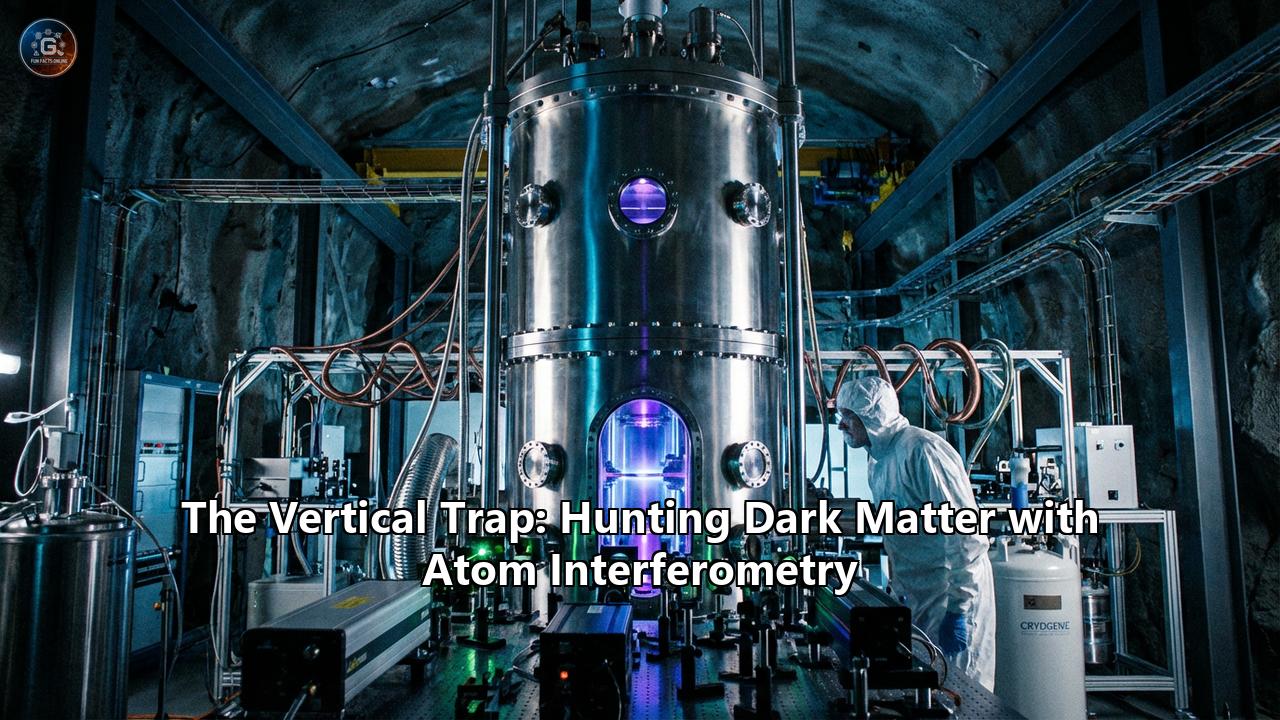
The hunt for dark matter has historically been a game of "catching a ghost in a net," where the net is made of liquid xenon and buried deep underground, waiting for a heavy particle to crash into it. But for decades, the net has remained empty. Now, physicists are changing the game. Instead of a net, they are building a "vertical trap"—mammoth towers of vacuum and light that turn the very nature of atoms into quantum sensors.
This is the story of the Vertical Trap: the rise of long-baseline atom interferometry, the engineering of 100-meter-tall quantum machines like MAGIS-100 and AION, and how falling atoms might finally reveal the invisible scaffolding of our universe.
Part I: The Silence of the WIMPs
To understand why we are building 100-meter towers to catch dark matter, we must first understand the frustration that built them. For forty years, the ruling paradigm of dark matter was the WIMP—the Weakly Interacting Massive Particle. Theory suggested that dark matter consisted of heavy, slow-moving particles that swarmed through our galaxy.
We built cathedrals to catch them. We hollowed out mountains and descended into gold mines. We built tanks filled with tons of liquid xenon, lined them with photomultiplier tubes, and waited for a single WIMP to bump into a xenon nucleus and produce a flash of light. The experiments—LZ, XENON1T, PandaX—became masterpieces of silence, shielding out all cosmic radiation until they were the quietest places in the universe.
And yet, silence is all they found. The WIMP did not show up.
This silence forced a revolution. Theorists began to ask: What if we are looking for the wrong thing? What if dark matter isn't a heavy particle that acts like a billiard ball? What if it’s incredibly light—so light that it behaves more like a wave than a particle?
Enter Ultralight Dark Matter (ULDM). In this model, dark matter is a vast, oscillating field that permeates all of space. It doesn't "hit" things; it undulates. And if it undulates, it might cause the fundamental constants of nature—the mass of an electron, or the strength of electromagnetism—to wobble slightly in time.
To catch a billiard ball, you need a heavy shield. But to catch a wave that changes the tick rate of the universe’s clock, you need a stopwatch of unimaginable precision. You need an atom.
Part II: The Quantum Stopwatch
The technology at the heart of the Vertical Trap is Atom Interferometry. To the uninitiated, it sounds like science fiction; to the physicist, it is the ultimate ruler.
At our macroscopic scale, an atom is a dot of matter. But cool that atom down to a fraction of a degree above absolute zero, and it reveals its quantum nature: it acts like a wave. Just as ripples in a pond can overlap and interfere with each other, atomic waves can be split, separated, and recombined.
Here is the recipe for the "trap":
- Cooling: You take a cloud of atoms—usually Strontium-87—and blast them with lasers to slow them down until they are "ultracold." They stop behaving like frenetic billiard balls and start behaving like a coherent quantum cloud.
- The Launch: You drop them. Or, in some designs, launch them upward like a fountain.
- The Split (The Knife of Light): As the atoms fall, you hit them with a pulse of laser light. This is the "beam splitter." In the quantum world, this puts the atom into a superposition. Half of the atom’s probability wave absorbs the photon and gets a "kick," moving upward. The other half ignores the photon and keeps falling. The single atom is now in two places at once, traveling two different paths.
- The Mirror: After they drift apart, a second laser pulse hits them. This reverses their paths, sending the two halves of the atom back toward each other.
- The Recombination: A final laser pulse recombines the waves.
Here is the magic: If the two paths were perfectly identical, the waves line up (constructive interference) and the atom appears in a specific state. But if anything changed the environment of one path relative to the other—a passing gravitational wave stretching space, or a dark matter field changing the mass of the atom—the waves will be out of sync (phase shift).
When they recombine, they create an interference pattern. By reading this pattern, scientists can measure forces with a precision that makes the best mechanical sensors look like stone tools.
Part III: The Vertical Imperative
Why build these machines vertically? Why dig 100-meter shafts into the earth?
The answer is Time.
Sensitivity in atom interferometry scales with the square of the time the atoms spend in free fall ($T^2$). If you hold an atom in a horizontal trap, you have to fight gravity with magnetic or optical fields, which introduces noise. If you let them fall in a small 1-meter tube, you only get a fraction of a second of free fall (about 0.45 seconds).
But if you have a 100-meter vertical vacuum tube, you can let the atoms fall (or launch them up and let them fall back) for seconds at a time. A 100-meter drop gives you roughly 4.5 seconds of hang time. Because the sensitivity scales as $T^2$, increasing the flight time by a factor of 10 increases your sensitivity by a factor of 100.
Furthermore, a long baseline (the distance between the top and bottom of the tower) allows you to place two interferometers far apart. By comparing the signals from an atom cloud at the top and an atom cloud at the bottom, you create a Gradiometer. This cancels out common noise (like the laser shaking) and leaves only the differential signal—the signal of something that affects the top of the tower differently than the bottom.
This logic gave birth to the titans: MAGIS-100 in the United States and AION in the United Kingdom.
Part IV: MAGIS-100 – The Titan in the Shaft
Fermilab, located in the flat plains of Batavia, Illinois, is famous for its particle accelerators. But its newest experiment doesn't accelerate particles; it drops them.
MAGIS-100 (Matter-wave Atomic Gradiometer Interferometric Sensor) is currently being installed in the MINOS access shaft. This shaft is a 100-meter-deep concrete silo that was originally built to send a beam of neutrinos through the earth to Minnesota. Now, it serves a new master. The Anatomy of the Beast:The experiment consists of a 100-meter-long steel vacuum tube, shielded against magnetic fields which could mess with the atoms' energy levels.
- The Source: At the top (and potentially bottom/middle), a "source chamber" generates a cloud of Strontium-87 atoms. Strontium is chosen because it is an "alkaline earth metal" with a very specific electronic structure that makes it an excellent atomic clock.
- The Laser Link: A high-power, incredibly stable laser system runs the length of the tube. This laser is the ruler against which the atoms are measured.
- The Drop: The atoms are cooled to microkelvins. They are released into the dark vacuum. As they fall, the laser pulses slice and recombine them.
Dropping atoms 100 meters isn't simple. The Earth is rotating. As the atoms fall, the Earth turns beneath them. This creates a Coriolis force that can push the atoms out of the laser beam. To counter this, MAGIS-100 has to use tip-tilt mirrors that rotate the laser beam in real-time to track the falling atoms, compensating for the rotation of the planet.
The "Dark" Goal:MAGIS-100 is hunting for Scalar Dark Matter. If this dark matter exists, it couples to the standard model particles. As the dark matter wave passes through Earth, it might cause the mass of the electron to oscillate. This would slightly change the energy spacing of the electron shells in the Strontium atom.
Because the atoms spend seconds in the "superposition" state, this tiny oscillation accumulates a phase shift. If the interference pattern at the end of the drop looks "wrong," it could be the signature of dark matter singing its song.
Part V: AION and the Global Web
Across the Atlantic, the United Kingdom is building the AION (Atom Interferometer Observatory and Network).
The philosophy of AION is "network." A single detector can be fooled by local noise—a truck driving by, a micro-earthquake, or thermal expansion of the building. But if you have one detector in Oxford and another in Illinois (MAGIS), and they both see the same signal at the same time? That is discovery.
AION is a staged program:
- AION-10: A 10-meter tower at the University of Oxford (specifically in the Beecroft Building). This serves as the prototype to prove the technology.
- AION-100: A planned 100-meter version, likely to be situated at a major facility like CERN or the Boulby Underground Laboratory (a mine 1.1 km deep in North Yorkshire).
The Boulby site is particularly intriguing. Being a kilometer underground shields the experiment from cosmic rays and surface seismic noise (wind shaking the ground, traffic). A 100-meter tube buried inside a 1-kilometer deep mine is the ultimate "quiet place" for quantum sensing.
The collaboration between MAGIS and AION creates a "intercontinental baseline." It allows them to triangulate signals and verify that a detected anomaly isn't just a local glitch.
Part VI: The Gravitational Wave Window
While Dark Matter is the primary prey, these Vertical Traps have a secondary, equally massive target: Gravitational Waves.
We have already detected gravitational waves with LIGO. But LIGO is tuned to hear the "screams" of the universe—violent, fast events like black holes colliding, which produce waves at frequencies of 10 Hz to 1000 Hz.
On the other end, we are planning LISA (Laser Interferometer Space Antenna) to hear the "rumbles" of the universe—supermassive black holes merging over months, at frequencies of 0.0001 Hz to 0.1 Hz.
But there is a gap. The Mid-band (0.1 Hz to 10 Hz).
This is the "blind spot" of gravitational wave astronomy.
Vertical Atom Interferometers like MAGIS-100 and AION are perfectly tuned for this mid-band.
Why do we care about the mid-band?
- Early Warnings: A black hole merger doesn't just happen instantly. The black holes spiral around each other for years before they collide. During this inspiral, they emit mid-band waves. MAGIS could detect a merger weeks before it hits the LIGO band, giving astronomers time to point every telescope on Earth at the spot.
- White Dwarf Binaries: There are millions of binary white dwarfs in our galaxy. They hum in the mid-band.
- Inflationary Physics: Some models of the early universe predict gravitational waves from the Big Bang itself that would be visible in this frequency range.
In a gravitational wave search, the atom interferometer works differently than a dark matter search.
A gravitational wave stretches space. It changes the distance between the laser mirror and the falling atoms. The laser light has to travel a slightly different distance to hit the atom. The atom, acting as a clock, records this travel time variation.
Because the atoms are in free fall, they are "inertial test masses"—perfectly decoupled from the shaking earth (mostly). The vertical shaft allows for the detection of vertical strain in spacetime.
Part VII: The Engineering of Nothingness
Building a Vertical Trap is an exercise in extreme engineering.
1. The Vacuum:The tube must be an ultra-high vacuum (UHV), with pressures around $10^{-10}$ Torr. If there is air in the tube, the falling atoms will crash into air molecules and be knocked out of the trap. Maintaining this vacuum over a 100-meter volume is a nightmare of welding and pumping.
2. The Magnetic Shield:The energy levels of Strontium atoms are sensitive to magnetic fields (Zeeman effect). The Earth's magnetic field is huge compared to the sensitivity of the instrument. The entire 100-meter tube must be wrapped in layers of "mu-metal"—a nickel-iron alloy that sponges up magnetic fields—to create a magnetic void inside.
3. The Laser Wavefront:The laser beam must be perfectly flat. If the laser beam is "aberrated" (curved or distorted), an atom at the center of the beam will see a different phase than an atom at the edge. To get the precision required, the laser wavefronts must be flat to within fractions of a wavelength over a distance of 100 meters. This requires custom optics that are some of the most precise ever manufactured.
4. Seismic Noise (The Shaking Earth):Even in a deep mine, the Earth shakes. Ocean waves hitting the continent thousands of miles away create "microseismic" hums.
This is where the Gradiometer design saves the day. By measuring the difference between two atom clouds in the same shaft, the shaking of the Earth (which moves the whole shaft together) cancels out. However, "gravity gradient noise" (a passing cloud, or a tumbleweed, or a person walking by) exerts a gravitational pull on the top atom cloud different from the bottom one. This "Newtonian Noise" is the ultimate limit of terrestrial detectors.
Part VIII: Into the Void (Space)
The ultimate destiny of the Vertical Trap is to leave the verticality of Earth behind.
The European Space Agency and collaborators are proposing AEDGE (Atomic Experiment for Dark Matter and Gravity Exploration).
In space, you don't need a 100-meter tower. You can have two satellites thousands of kilometers apart.
In space, you have infinite free-fall time.
In space, there is no seismic noise.
AEDGE would effectively be an atom interferometer with a baseline the size of a continent, floating in the dark. It would probe dark matter models that are currently impossible to test and listen to gravitational waves from the very dawn of time.
Epilogue: The New Observatory
For centuries, astronomy was about looking up with eyes, then with glass lenses, then with radio dishes.
Now, we are entering the era of Quantum Astronomy.
We are using the smallest things in the universe (atoms) to detect the largest things (dark matter fields and black holes).
The Vertical Traps—MAGIS-100 rising from the Illinois plains, AION descending into British mines—are the pioneers. They are the prototypes of a new way of sensing reality.
They are betting that the universe is not just silent emptiness, but a choir of quantum whispers. And for the first time, we have built an ear sensitive enough to hear it.
If dark matter is indeed a light wave washing over us, it is washing over you right now. It is passing through the Earth, through your walls, and through your body. Soon, inside a cold steel tube in a deep shaft, a single atom of Strontium will split in two, dance with the invisible, and reunite to tell us the truth.
Reference:
- https://scoap3-prod-backend.s3.cern.ch/media/harvested_files/10.1103/zxtk-bwnf/zxtk-bwnf.pdf
- https://www.ppd.stfc.ac.uk/Pages/AION.aspx
- https://indico.global/event/3094/contributions/33142/attachments/17139/27771/AIONarXivDocument.pdf
- https://news.liverpool.ac.uk/2024/01/24/university-of-liverpool-joins-magis-100-xperiment/
- https://arxiv.org/abs/2504.09158