
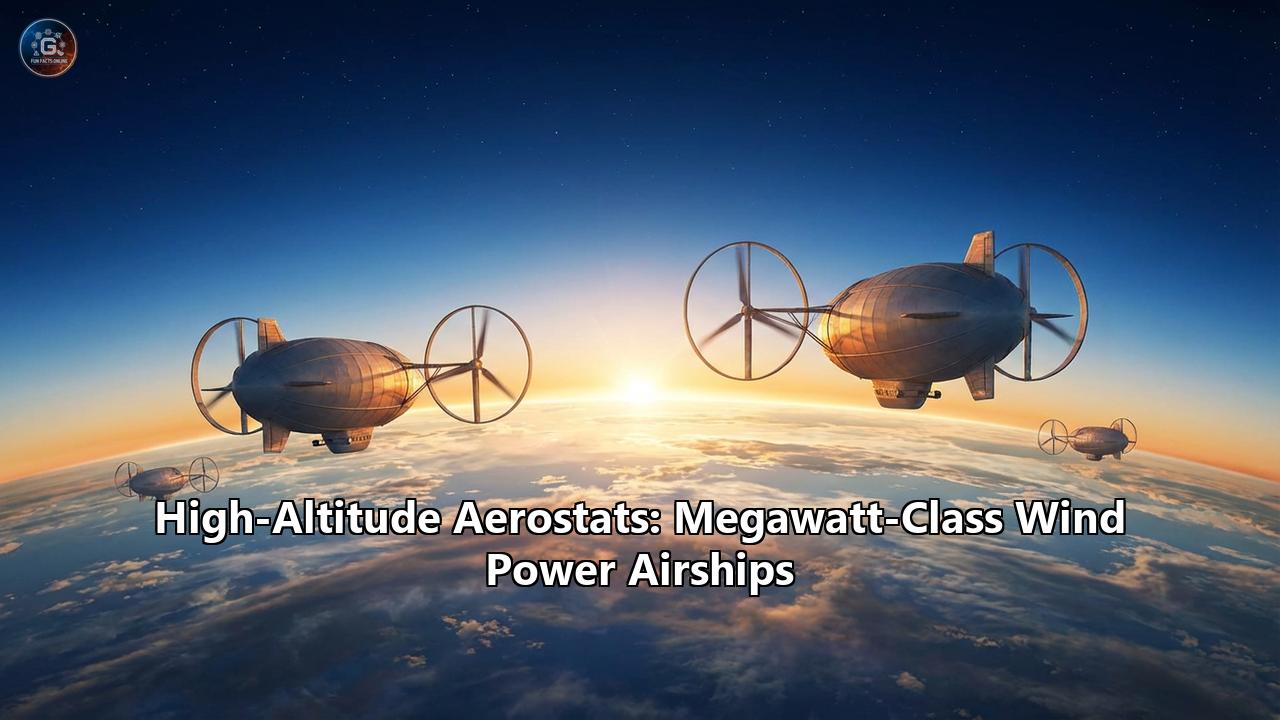
Imagine standing on a vast, open plain, gazing up at the sky. To the naked eye, the space above is simply empty air. But from the perspective of an energy engineer, the sky is an invisible, roaring ocean of untapped power. For decades, humanity has attempted to harvest this energy by building increasingly massive steel towers, anchoring them to the earth, and hoping the wind blows hard enough near the ground. But what if we didn't have to wait for the wind to come to us? What if we could send our power plants up into the sky to meet the wind where it is strongest?
Welcome to the cutting-edge frontier of Airborne Wind Energy Systems (AWES)—specifically, the revolutionary development of High-Altitude Aerostats, or megawatt-class wind power airships. Blending aerospace engineering, advanced composite materials, and next-generation renewable technology, these "power banks in the sky" are preparing to rewrite the rules of global energy generation.
The Physics of the Sky: Why Higher is Exponentially Better
To understand why engineers are attaching wind turbines to giant, helium-filled blimps, we first need to look at the physics of wind. Ground-based wind turbines suffer from a significant limitation: the Earth itself. The friction caused by trees, mountains, buildings, and the ground surface creates turbulence and drastically slows down the wind in the lower boundary layer of the atmosphere.
However, as you ascend, the wind profile changes dramatically. At altitudes of 500 to 2,000 meters (roughly 1,600 to 6,500 feet), the winds are unobstructed. They are significantly faster, highly consistent, and flow with a smooth, laminar predictability that ground-level turbines can only dream of.
Here is where the math becomes magical: the kinetic energy available in the wind is proportional to the cube of the wind speed. This means that if you double the wind speed by moving from ground level to 2,000 meters, the available energy doesn't just double—it increases by a factor of eight. Some studies indicate that high-altitude wind power can generate several times, or even dozens of times, more electricity than traditional ground-based wind power. By accessing this high-altitude jet stream, a floating wind power airship can achieve a capacity factor (the percentage of time it generates maximum power) that rivals nuclear or coal baseload plants, solving the notorious intermittency problem of traditional renewables.
Anatomy of a Megawatt-Class Wind Power Airship
At first glance, a high-altitude aerostat looks like a vehicle pulled straight from the pages of a sci-fi novel. But every inch of its design is a masterclass in functional engineering. The system generally consists of four main components:
1. The Buoyant Envelope (The Airship)Unlike a traditional blimp designed for transport, a wind power aerostat is essentially a massive, inflatable lifting body designed to stay stationary in gale-force winds. The outer shell is crafted from highly advanced, lightweight, weather-resistant composite materials that prevent the lifting gas (usually helium, though hydrogen-nitrogen mixes have been studied) from leaking. Some of the most advanced designs feature a hollow, annular (doughnut-like) shape. This hollow space acts as a duct, capturing the wind from all sides and funneling a concentrated, high-velocity stream of air directly into the turbine blades.
2. The Turbine ArrayInstead of a single, massive rotor that weighs tons, modern megawatt-class airships use a distributed array of smaller, highly efficient turbines. These generators are often constructed from ultralight carbon fiber. By distributing the generation across multiple turbines—sometimes up to 12 individual rotors mounted within the airship's aerodynamic duct—the system balances torque, reduces structural stress, and maximizes the extraction of kinetic energy.
3. The Tether System: An Umbilical Cord of PowerThe tether is arguably the most critical engineering marvel of the entire system. It serves two distinct purposes: acting as a high-strength anchor to keep the massive airship from blowing away, and serving as the conductive conduit that transmits the generated electricity down to the earth. These tethers are typically constructed with an inner core of ultra-high-molecular-weight polyethylene (like Dyneema or Kevlar) for immense tensile strength, wrapped around conductive elements to send power to the grid, and fiber-optic cables to relay real-time telemetry and control data.
4. The Ground StationAt the base of the tether is a mobile ground station. This unit houses a heavy-duty winch system that can autonomously deploy the airship, automatically adjusting its altitude to hunt for the optimal wind speeds, or reeling it back down to safety during severe superstorms. The ground station also contains power conditioning equipment, ensuring the electricity sent down the tether is cleanly integrated into the local microgrid or utility network.
From Concept to Megawatt Reality
The journey to megawatt-class airborne wind energy has been marked by bold pioneers and recent, staggering leaps in scale.
The Pioneer: Altaeros Energies and the BATIn the early 2010s, an MIT spin-off named Altaeros Energies proved that the concept was viable. They developed the Buoyant Airborne Turbine (BAT), an automated, helium-filled cylindrical aerostat with a single turbine suspended in the center. In 2014, Altaeros successfully tested the BAT in Maine and Alaska, deploying it at altitudes of up to 1,000 feet. While the BAT was a relatively small system—generating enough power for a few dozen homes—it proved that high-altitude aerostats could survive severe weather (up to 45 mph winds) and transmit steady, affordable electricity to remote, off-grid locations.
The Giant: China’s S2000 SAWESFast forward to early 2026, and the technology has achieved a monumental milestone. Beijing-based Linyi Yunchuan Energy Technology successfully tested the world's first megawatt-level airborne wind power system, the S2000 Stratosphere Airborne Wind Energy System (SAWES).
The scale of the S2000 is breathtaking. Measuring 60 meters long, 40 meters wide, and 40 meters high, the S2000 has a volume of nearly 20,000 cubic meters—resembling a colossal floating stadium. During its maiden flight in China’s Sichuan Province, the S2000 ascended to an altitude of 2,000 meters (6,560 feet). At this height—hovering 1,000 meters above the tip of the Burj Khalifa—the airship deployed its 12 integrated turbines, successfully generating and feeding 385 kilowatt-hours of electricity into the grid during its test. With a maximum rated capacity of 3 megawatts, the S2000 has taken airborne wind energy out of the realm of experimental prototypes and firmly into utility-scale commercial viability.
The Groundbreaking Advantages of Airborne Wind
Why go through the trouble of building floating power plants when we already have traditional wind turbines? The advantages of high-altitude aerostats are disruptive to the current energy landscape:
- Logistical Simplicity and Rapid Deployment: Building a traditional wind turbine is a massive civil engineering project. It requires clearing land, pouring thousands of tons of concrete for a foundation, and using specialized, oversized trucks and mega-cranes to assemble the tower and blades. In contrast, an aerostat system like the S2000 can be packed into standard shipping containers. Once on-site, it requires virtually no groundwork. You simply inflate the envelope, activate the winch, and the power plant lifts itself into the sky. A system can be operational in a matter of days, not months.
- Zero Visual and Noise Pollution: Ground-based turbines face heavy opposition from local communities due to noise and the obstruction of natural skylines. A wind power airship operating at 2,000 meters is practically invisible to the naked eye and completely inaudible from the ground. This opens up the possibility of deploying high-capacity renewable energy directly above populated urban centers without inciting "Not In My Backyard" (NIMBY) protests.
- Minimal Ecological Footprint: Ground turbines require large swaths of land and can pose risks to low-flying local bird and bat populations. The aerostat requires only the footprint of its ground station winch, preserving agricultural land and forests, while operating well above the flight paths of most avian wildlife.
Deploying the Future: Real-World Applications
The flexibility of megawatt-class wind power airships opens up entirely new applications for renewable energy.
Disaster Relief and Emergency ResponseWhen hurricanes, earthquakes, or tsunamis wipe out regional power grids, the immediate lack of electricity severely hampers rescue and medical operations. Currently, disaster relief relies on trucking in heavy diesel generators and constant fuel supplies. An airborne wind system acts as a "power bank in the sky." It can be rapidly deployed to a disaster zone, floating above the devastation to immediately beam megawatts of clean, reliable power down to emergency hospitals and command centers.
Off-Grid and Remote OutpostsFor remote island communities, polar research stations, and isolated mining camps, connecting to a national grid is impossible. These locations rely on imported diesel fuel, resulting in exorbitant electricity costs (sometimes over $1.00 per kilowatt-hour) and heavy carbon emissions. High-altitude aerostats offer an economically viable, highly stable alternative, providing continuous baseload power without the need for complex infrastructure.
Urban Grid SupplementationBecause they leave no visual footprint and require almost no land, these systems can be tethered near the perimeters of massive megacities, tapping into the stratosphere to feed immense amounts of electricity directly into power-hungry urban grids, creating a layered, three-dimensional energy supply.
Navigating the Turbulence: Engineering and Regulatory Challenges
Despite the incredible promise of the technology, turning the sky into a global power grid comes with unique challenges that engineers and regulators are actively working to solve.
- Helium Containment and Material Science: Helium is an incredibly tiny molecule, prone to escaping through the microscopic pores of almost any material. For an aerostat to be economically viable, it must remain aloft for months at a time without requiring constant, expensive helium top-offs. Developers are investing heavily in high-performance, multi-layered polymer laminates to create near-perfect gas barriers.
- Tether Dynamics and Drag: A cable stretching 2,000 meters into the sky is subject to immense aerodynamic drag and the phenomenon of "vortex-induced vibration"—the same physical force that makes a guitar string hum. The tether must be aerodynamically stable to prevent snapping, while remaining light enough not to weigh the blimp down.
- Airspace Integration: Tethering a giant blimp miles into the sky introduces a massive, invisible cable into active airspace. Widespread adoption of AWES will require close coordination with aviation authorities (like the FAA and EASA). Ground stations will need to be equipped with transponders, radar reflectors, and restricted airspace geofencing to ensure the absolute safety of commercial and private aircraft.
A New Horizon for Renewable Energy
The successful flight of megawatt-class wind power airships marks a pivotal moment in the history of energy generation. We are no longer bound by the friction of the earth. By utilizing advanced aerospace materials, cutting-edge turbine design, and the simple elegance of buoyancy, we are finally unlocking the massive, raging rivers of wind that circle our globe.
As manufacturing scales up—with companies already establishing production bases capable of churning out millions of linear feet of high-performance envelope materials—we are inching closer to a future where clean, infinite energy is pulled directly out of the sky. In the near future, the silent sentinels of the stratosphere won't just be weather balloons or satellites; they will be the very engines powering our world below.
Reference:
- https://www.yankodesign.com/2026/01/29/worlds-first-mw-class-s2000-airborne-wind-turbine-just-powered-the-grid-in-china/
- https://www.springerprofessional.de/en/airborne-wind-energy/15581884
- https://www.jeccomposites.com/news/by-jec/chinas-first-s2000-airborne-power-station-at-an-altitude-of-2000-metres/?news_type=announcement,applications&tax_product=carbon-fiber,fibres,gelcoats-coatings,polyurethane
- https://www.mdpi.com/1996-1073/18/9/2373
- https://wes.copernicus.org/articles/8/1153/2023/
- https://docs.nrel.gov/docs/fy21osti/79992.pdf
- https://newatlas.com/energy/s2000-sawes-wind-power-aerostat/