
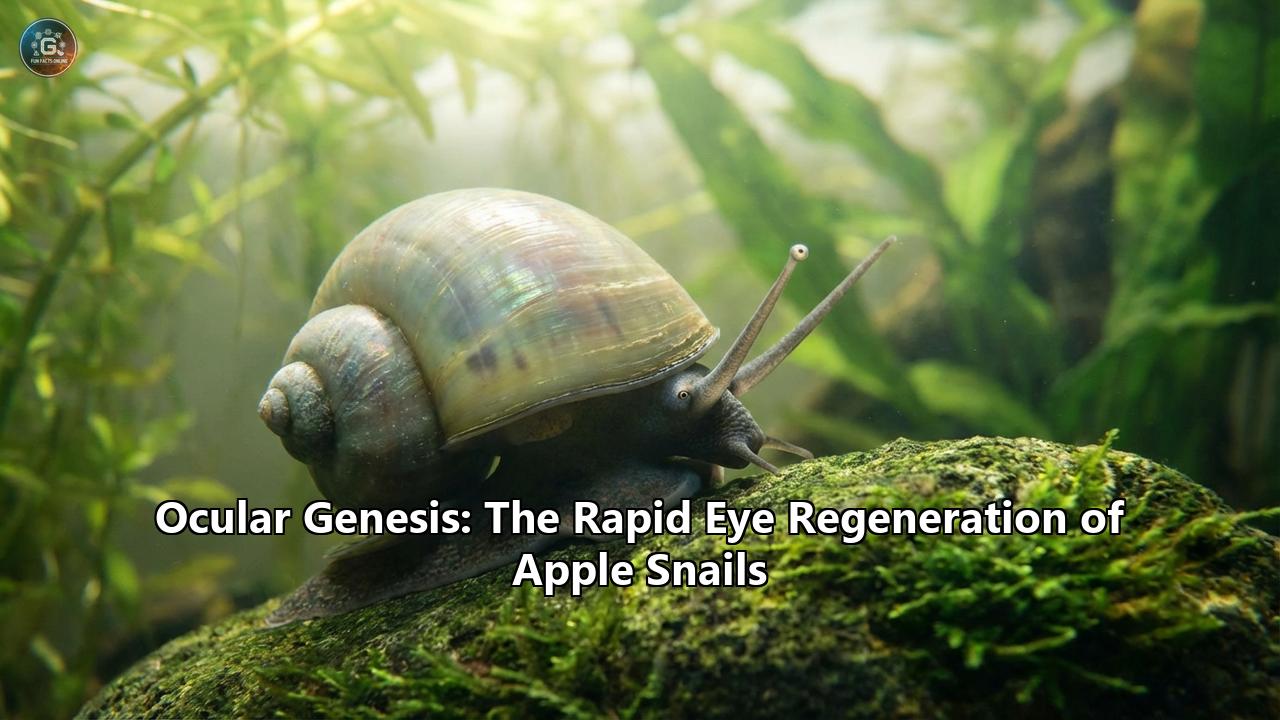
In the murky waters of the Amazon basin, a small, unassuming creature performs a miracle that modern medicine can only dream of. If a golden apple snail (Pomacea canaliculata) loses an eye to a predator or injury, it does not resign itself to a life of partial blindness. Instead, it engages a biological program of startling complexity and speed. Within a mere 28 days, a new eye emerges—complete with a cornea, lens, retina, and optic nerve—anatomically indistinguishable from the original.
This phenomenon, which we might call "Ocular Genesis," has recently catapulted this invasive freshwater mollusk from the status of an agricultural pest to a superstar of regenerative biology. For centuries, scientists have looked to salamanders and newts for clues about limb regrowth. But the apple snail offers something potentially more profound: a blueprint for regenerating a complex "camera-type" eye, an organ strikingly similar in structure to our own.
From Rice Paddy Pest to Laboratory Prize
To understand the magnitude of this discovery, one must first understand the snail itself. The golden apple snail is a study in resilience. Native to South America, it was introduced to Asia and other parts of the world as a potential food source, only to escape and become a notorious invasive species. In rice paddies from the Philippines to Spain, they are reviled for their voracious appetites and explosive reproductive rates. They are survivors, capable of breathing air via a siphon and enduring harsh environmental shifts.
It is precisely these traits—rapid breeding, hardiness, and genetic adaptability—that caught the attention of researchers like Dr. Alice Accorsi and Dr. Alejandro Sánchez Alvarado at the Stowers Institute for Medical Research (and later UC Davis). While the scientific community had long focused on traditional models like mice (which do not regenerate eyes) or zebrafish (which have different eye structures), the apple snail presented a unique opportunity. It possessed a complex eye and a regeneration speed that was practically unheard of for such an organ.
The Miracle of the Month: A 28-Day Timeline
The process of ocular regeneration in the apple snail is a masterclass in biological engineering. Unlike the slow, often imperfect healing seen in mammals, the snail's body executes a precise, four-stage architectural plan.
Stage 1: The Emergency Response (Hours 0-24)
Immediately following the loss of an eye, the snail's immune system springs into action. In humans, a severe injury triggers a "fibrotic" response—essentially, the body rushes to plug the hole with scar tissue. This scar serves as a patch but prevents functional tissue from growing back. The apple snail, however, bypasses scarring. Within 24 hours, the wound is sealed not by a chaotic clot, but by a clean layer of epithelial cells that prepares the site for construction.
Stage 2: The Blastema Formation (Days 2-6)
This is the "magic" phase that distinguishes regenerators from non-regenerators. A mound of white, unspecialized cells begins to accumulate at the site of the lost eye. This structure is known as a blastema. It is a biological blank slate—a collection of cells that have seemingly forgotten their previous identities and are waiting for new instructions. Whether these are resident stem cells rushing to the scene or mature cells that have "de-differentiated" (reverted to a youthful state) remains one of the most exciting questions in the field.
Stage 3: Differentiation and Genesis (Days 7-14)
By the second week, the amorphous blob of the blastema begins to take shape. The genetic volume is turned up, and cells start to organize. An invagination occurs, forming the optic cup. We begin to see the translucent hint of a cornea and the formation of a primitive lens. Deep within the developing tissue, neurons are being born, destined to become the retina—the light-sensing film of the eye.
Stage 4: Maturation and Wiring (Days 15-28)
In the final stretch, the eye doesn't just grow; it refines. The lens crystallizes into transparency. The retina develops its complex layers of photoreceptors. Most crucially, the optic nerve grows backward from the new eye, seeking out the brain to re-establish a connection. By day 28, the new eye is morphologically complete. While it may take a few more weeks for the neural connections to fully mature and the eye to reach its adult size, the organ is, for all intents and purposes, reborn.
The Genetic Architect: The Role of Pax6
The question that haunts every biologist watching this process is: How does the snail know how to build an eye from scratch?
The answer lies in the deep, shared history of life on Earth. Researchers performing transcriptional profiling—essentially taking a census of every active gene during regeneration—found that immediately after injury, nearly 9,000 genes changed their activity levels. But one gene stood out: ---Pax6---.
Pax6 is often called the "master control" gene for eye development. It is so ancient and so essential that it is found in everything from fruit flies to humans. If you mutate Pax6 in a mouse, it is born with small or missing eyes. If you do it in a human, it leads to a condition called aniridia (absence of the iris).Dr. Accorsi’s team confirmed that Pax6 is the conductor of the apple snail’s symphony. When they used CRISPR-Cas9 gene-editing technology to disable Pax6 in snail embryos, the snails grew up without eyes, proving the gene is indispensable for development. More importantly, they found that Pax6 is reactivated in adult snails at the site of amputation.
This discovery is profound because it suggests that regeneration is essentially a "re-run" of development. The snail doesn't invent a new way to heal; it simply re-opens the blueprints it used as an embryo. Humans also have the Pax6 gene, but in our adult bodies, the "on" switch seems to be broken or locked away behind layers of evolutionary inhibition.
A Case of Convergent Evolution
One might ask: "Why care about a snail eye? Isn't it just a simple spot that detects light?"
This is a common misconception. The apple snail possesses a camera-type eye, a structure that is remarkably similar to the human eye. It has a spherical lens to focus light, a cornea to protect the opening, and a retina to capture the image.
This is a classic example of convergent evolution. Mollusks and vertebrates split from a common ancestor over 500 million years ago—an ancestor that likely had no eyes at all, perhaps just a few light-sensitive cells. Yet, completely independently, both lineages evolved a complex camera eye because it is an efficient physical solution for high-resolution vision.
Because the final product is so similar to ours, the apple snail is a far better model for understanding human eye repair than the compound eye of a fruit fly or the simple pigment cup of a flatworm. If a snail can regrow a lens and a retina that looks like ours, the molecular machinery it uses might be compatible with our own biology.
The Vision Test: Can They Actually See?
Anatomically, the regenerated eye is a masterpiece. But does it work?
This is the current frontier of the research. Early studies confirm that the regenerated retina contains all the necessary photoreceptor cells and that the optic nerve physically reconnects to the brain. However, proving "vision" in a snail is tricky—you cannot ask them to read an eye chart.
Researchers are currently developing behavioral assays to test this. For example, apple snails typically retreat into their shells when a shadow passes over them (a predator avoidance reflex). If a snail with a regenerated eye reacts to a shadow just as quickly as one with an original eye, we will have functional proof of sight restoration. Preliminary data is promising, suggesting that these new eyes are not just cosmetic dummies, but functional sensory organs.
Implications for Human Medicine
The leap from snail to human is vast, but the bridge is built of shared DNA. The inability of humans to regenerate eyes is a major medical tragedy. Conditions like macular degeneration, glaucoma, and retinal detachment cause permanent vision loss because our retinal cells, once dead, do not come back.
The apple snail teaches us that the genetic instructions for building an eye are not discarded after birth; they are simply dormant. If we can identify the specific "switches" that allow the snail to turn Pax6 and its downstream gene network back on in adulthood, we might be able to trigger a similar response in human tissues.
Imagine a future where a damaged retina could be induced to grow new photoreceptors by temporarily reactivating a "snail-like" regenerative program. Or where bio-engineered eye tissues could be grown in a lab using the chemical signals identified in the snail's blastema.
Conclusion: Nature's Hidden Blueprint
The apple snail is a reminder that nature is a vast library of solutions to biological problems. For millions of years, this creature has carried the secret to ocular genesis in its DNA, thriving in the mud while we looked to the stars.
As research continues, the "Ocular Genesis" of Pomacea canaliculata stands as a beacon of hope. It challenges the dogma that complex organs cannot be replaced and suggests that the potential for regeneration may lie dormant within us, waiting for the right key to unlock it. We are only just beginning to read the manual.
Reference:
- https://longevity.technology/news/more-than-a-snails-pace-toward-eye-regeneration/
- https://koolsci.com/2025/08/23/apple-snails-eye-regeneration-could-aid-human-therapy/
- https://www.news-medical.net/news/20250806/Apple-snail-eye-regeneration-offers-new-insights-into-human-sight-restoration.aspx
- https://www.eyefox.com/news/2483/snails-as-new-model-for-eye-regeneration-research.html
- https://biology.ucdavis.edu/news/snails-eyes-grow-back-could-they-help-humans-do-same
- https://www.sciencenews.org/article/snail-human-eye-regeneration
- https://scienceblog.com/this-snail-regrows-its-eyes-and-may-help-us-see-again/
- https://www.popsci.com/science/eye-regeneration-apple-snails/
- https://arthropoda.wordpress.com/2010/02/21/evolving-a-camera-eye-anyone-can-do-it/
- https://journals.openedition.org/bergsoniana/1578
- https://en.wikipedia.org/wiki/Cephalopod_eye
- https://www.rctn.org/bruno/CTBP/land-fernald.pdf
- https://www.accorsilab.com/research