
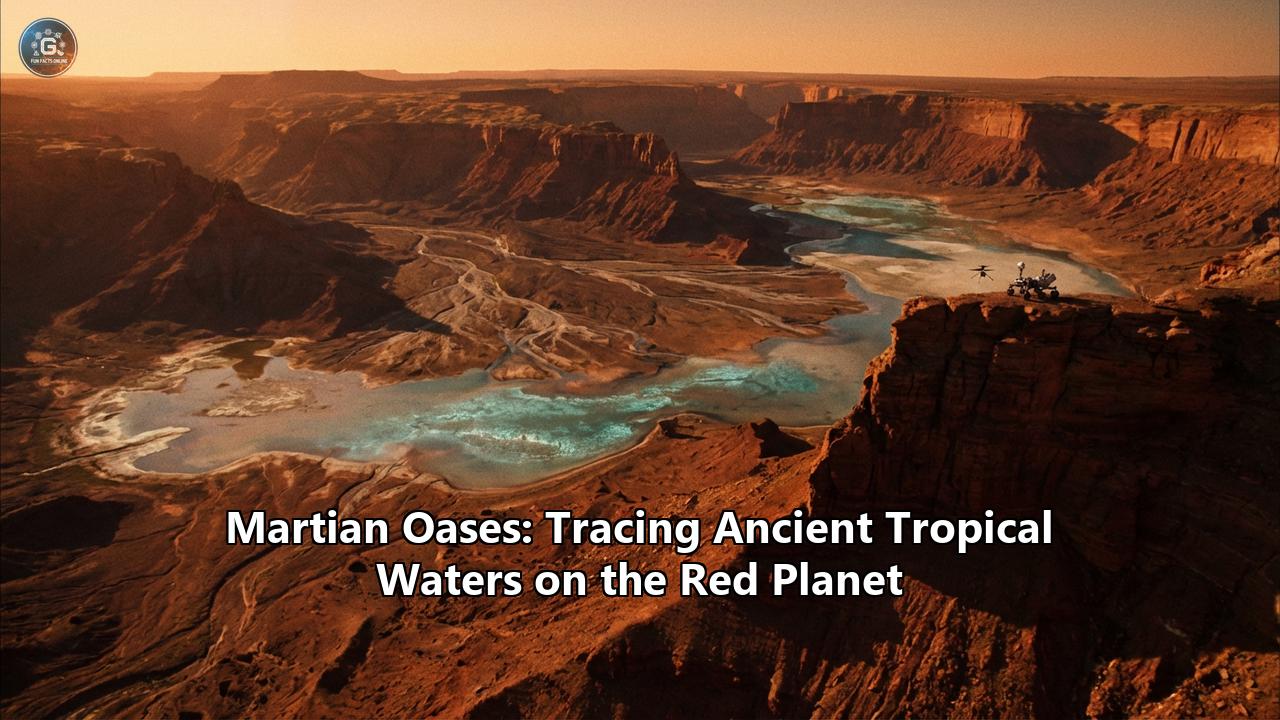
For decades, the story of water on Mars was a simple one: a frozen, desiccated world that may have once seen brief, catastrophic floods. But a revolution is underway in planetary science. Recent discoveries from NASA’s Perseverance and Curiosity rovers, combined with high-resolution orbital maps, have shattered the "cold and dead" paradigm. We are now uncovering evidence of a Mars that was episodically warm, wet, and shockingly "tropical"—a planet that sustained active hydrological cycles, rain-driven weathering, and stable lake systems for millions of years.
This article traces the ghost waters of ancient Mars, journeying from the clay-rich delta of Jezero Crater to the lost inland seas of the southern highlands, exploring how these Martian oases formed, why they vanished, and what secrets they still hold about the potential for life in the universe.
Part I: The Tropical Signal
The "Float Rocks" of Jezero
The most startling evidence for a wet, tropical Mars comes from a collection of unassuming stones found scattered across the floor of Jezero Crater. In late 2024 and 2025, scientists analyzing data from the Perseverance rover identified a specific type of rock that shouldn't exist in a cold, icy desert: kaolinite.
Kaolinite is an aluminum-rich clay mineral that, on Earth, tells a very specific story. It does not form from sudden floods or in freezing conditions. It forms through intense "chemical weathering"—a process where rock is relentlessly battered by warm, slightly acidic rainfall for hundreds of thousands, if not millions, of years. It is the mineralogy of the Congo, the Amazon, and the humid tropics of Southeast Asia.
These "float rocks"—so named because they were transported from the crater rim and deposited on the floor—suggest that the watershed feeding Jezero wasn't just "wet." It was subjected to a high-energy, rain-soaked climate. This implies that Mars didn't just have water; it had weather. It had clouds, storms, and a water cycle robust enough to leach bedrock down to its aluminum skeleton.
The Delta Chronicles
Jezero Crater itself was once a body of water the size of Lake Tahoe. As Perseverance climbed the "sedimentary fan" (a massive river delta) at the crater’s edge, it read the layers of history like pages in a book.
- Bottom Layers (The Clay Era): The base of the delta is rich in smectite clays, which form in pH-neutral lakes. This was the "Goldilocks" era of the lake—calm, long-lasting, and habitable.
- Top Layers (The Boulder Era): Sitting atop the fine clays are massive boulders, some as large as cars. These speak to a violent change in climate—massive flash floods that tore across the landscape, carrying heavy debris.
This transition paints a picture of a climate that was dynamic, shifting from a stable, tropical oasis to a chaotic, flood-prone system as the planet began its long death spiral.
Part II: Mapping the Lost Oases
While Jezero grabs the headlines, it was merely a puddle compared to the massive bodies of water that once dotted the Martian surface. New orbital mapping has revealed a network of "Paleolakes" and inland seas that rival Earth’s largest water bodies.
The Eridania Sea: Mars' Cradle of Life?
Deep in the southern highlands lies the ghost of a giant: the Eridania Basin. Roughly 3.7 billion years ago, this was not merely a lake; it was an inland sea holding more water than all of Earth’s Great Lakes combined—an estimated 480,000 cubic kilometers.
What makes Eridania truly fascinating is not just its size, but its energy.
- Hydrothermal Vents: Spectral analysis from the Mars Reconnaissance Orbiter (MRO) has detected massive deposits of seafloor minerals like saponite, talc, and carbonates. On Earth, this specific mix of minerals forms in deep-sea hydrothermal vents.
- The Origin of Life? These ancient vents would have pumped heat and mineral-rich fluids into the cold waters of the Eridania Sea. This created a chemical gradient—an energy source that life can exploit without sunlight. Many biologists believe life on Earth began in exactly this kind of environment. Eridania stands as the most compelling target for understanding if life ever started on the Red Planet.
The Argyre Ocean
To the south lies the Argyre Basin, an impact crater so colossal (1,800 km wide) it likely hosted a liquid ocean the size of the Mediterranean Sea.
- A Global System: Argyre wasn't isolated. It was fed by river channels (Uzboi, Ladon, Morava) that stretched for thousands of kilometers, connecting the southern highlands to the northern lowlands. This suggests a planet-wide groundwater and river system, where water flowed from one oasis to another.
- Glacial Lakes: Evidence suggests Argyre remained liquid for millions of years, potentially protected by a thick ice cover as the climate cooled, creating a "sub-glacial lake" environment similar to Lake Vostok in Antarctica—another prime habitat for extremophiles.
The Groundwater Sanctuaries
As the surface began to dry, the water didn't disappear—it went underground.
- McLaughlin Crater: This deep crater shows evidence of carbonate-rich clays that formed inside the crater, not washed in from outside. This indicates a groundwater-fed lake. As the surface became hostile, these deep, fed-from-below lakes would have been the final refuges for Martian life, protected from radiation and extreme cold.
- Columbus Crater: Here, researchers found alternating layers of sulfates and clays. This "bathtub ring" geology shows a lake that slowly evaporated, fluctuating between fresh and salty phases—a common cycle in drying oases that drives chemical complexity.
Part III: The Noachian World
To understand these oases, we must transport ourselves back to the Noachian Period (roughly 4.1 to 3.7 billion years ago).
The Climate Paradox
For years, scientists struggled with the "Faint Young Sun Paradox." Four billion years ago, our Sun was about 30% dimmer than it is today. How could Mars, which is further away than Earth, sustain liquid water?
The new consensus points to Episodic Warmth. Mars likely wasn't a tropical paradise all the time. Instead, it may have been a cold, icy world punctuated by periods of intense volcanism or orbital shifts that thickened the atmosphere with greenhouse gases (CO2, methane, sulfur dioxide).
- The "Great Thaws": During these windows—which could last tens of thousands to millions of years—the ice melted. Rain fell. Rivers carved the "valley networks" we see today. The kaolinite clays formed.
- The Tropical Analog: Even if the average temperature was low, the equatorial regions would have experienced "tropical" conditions during these peaks, creating the stable oases where life could gain a foothold.
Part IV: The Great Collapse
The tragedy of Mars is that its tropical era was doomed from the start. Around 3.7 to 3.5 billion years ago, the lights went out.
The Death of the Dynamo
Deep inside Mars, the molten iron core ceased its convection. The planet's global magnetic field—its force field against the cosmos—sputtered and died.
- Sputtering: Without a magnetic shield, the Solar Wind began to strip away the Martian atmosphere. The MAVEN mission measured this process directly, observing ions being ripped from the upper atmosphere.
- The Transformation: As the atmosphere thinned, pressure dropped. Liquid water could no longer remain stable on the surface; it either boiled away into space or froze into the crust.
- The Acid Shift: The chemistry changed, too. The planet transitioned from the Phyllosian era (clay-rich, neutral pH, friendly to life) to the Theiikian era (sulfate-rich, acidic, hostile). The oases dried up, leaving behind salty, cracked mudstones—the graveyards of the Martian hydrosphere.
Part V: Searching for Residents
Today, our robotic explorers are sifting through the wreckage of these ancient worlds.
Perseverance (Jezero Crater)
The rover is currently collecting samples of the clay-rich delta front. These chalk-sized tubes of rock are destined to be returned to Earth in the 2030s via the Mars Sample Return mission. Scientists will scan them for "biosignatures"—patterns in carbon isotopes or microscopic fossil structures that only life could create.
Curiosity (Gale Crater)
Curiosity is climbing Mount Sharp, driving through the timeline of the Great Collapse. It has recently moved from the clay-bearing unit (wet, habitable) into the sulfate-bearing unit (drying, acidic), documenting the exact moment the oases began to die.
The Future: Going Deeper
While rovers scratch the surface, the next frontier is the deep subsurface. If life existed in the Eridania vents or the groundwater of McLaughlin Crater, its chemical fossils are likely buried too deep for current rovers. Future mission concepts propose drilling meters into the ice-cemented ground or exploring the "chaos terrain" where ancient aquifer waters burst forth, bringing deep biosignatures to the surface.
Conclusion: The Mirror World
Mars serves as a haunting mirror to Earth. Both planets started with vast oceans, thick atmospheres, and the chemical ingredients for life. One retained its shield and blossomed; the other lost it and froze.
By tracing the ancient tropical waters of the Red Planet, we are doing more than mapping geology. We are asking the most profound question of all: Was the universe lonely from the start?
The clays of Jezero and the sea-beds of Eridania suggest that for a brief, shining moment, two blue marbles circled the Sun. One is still blue. The other is now red. But in the dry dust of its ancient oases, the memory of water—and perhaps the memory of life—endures, waiting for us to find it.
Reference:
- https://medium.com/starts-with-a-bang/mars-could-have-lived-even-without-a-magnetic-field-75d70d04dbca
- https://jatan.space/nasa-maven-mars-orbiter/
- https://indianexpress.com/article/explained/explained-sci-tech/how-mars-atmosphere-went-missing-new-study-offers-clues-9595140/
- https://www.thebrighterside.news/post/scientists-discover-16-giant-river-networks-on-ancient-mars-where-life-could-have-thrived/
- https://bigthink.com/hard-science/mars-lost-oceans-magnetic-field/
- https://daily.jstor.org/how-mars-lost-its-magnetic-field-and-then-its-oceans/
- https://www.quora.com/How-did-Marss-loss-of-atmosphere-impact-its-climate-and-the-presence-of-water-on-the-planet
- https://physicstoday.aip.org/quick-study/how-did-mars-lose-its-atmosphere-and-water
- https://science.nasa.gov/missions/maven/nasas-maven-makes-first-observation-of-atmospheric-sputtering-at-mars/