
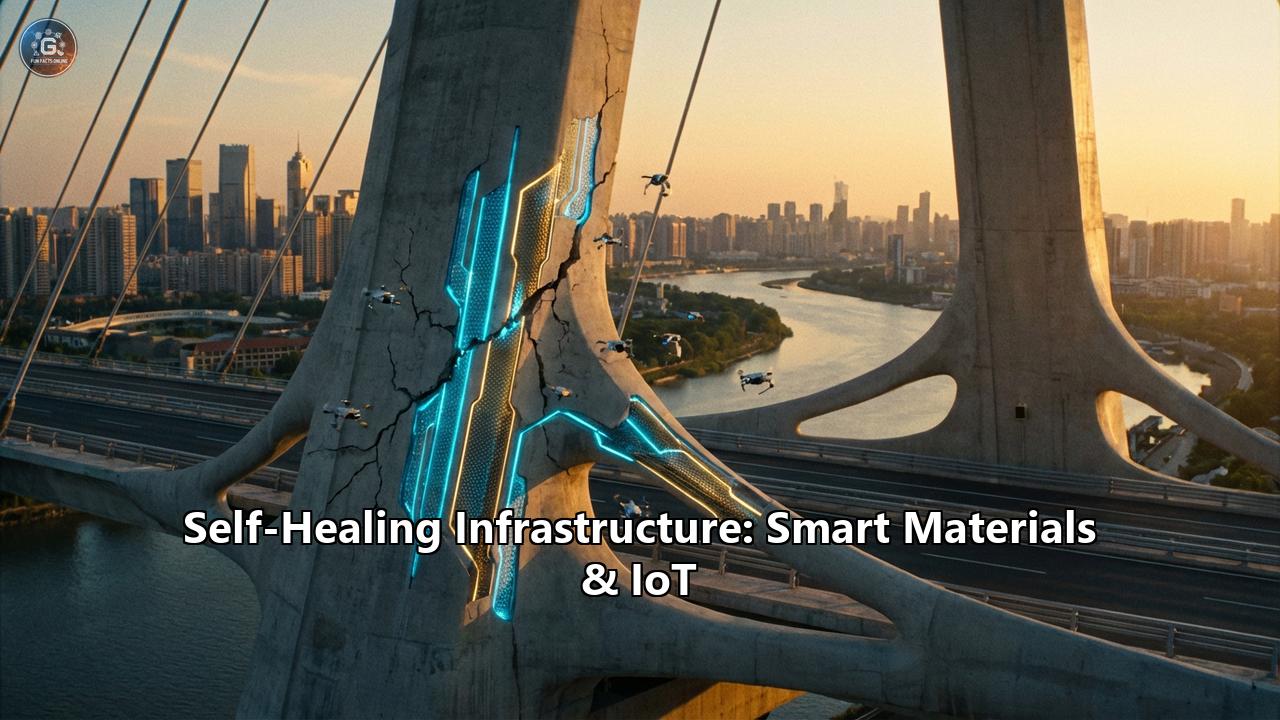
But as we stand here in early 2026, the script is being rewritten. We are witnessing the birth of the "Immune City."
Just as a biological organism heals a scratch on its skin without the conscious intervention of the brain, our cities are beginning to heal themselves. The convergence of two distinct technological revolutions—Smart Materials (specifically self-healing concrete and asphalt) and the Internet of Things (IoT)—has created a new paradigm. We are moving from "dumb" static structures to "smart" dynamic systems that can sense injury, diagnose the severity, and initiate a cure.
This is not science fiction. As of this year, pilot projects in the Netherlands, the UK, and Japan have graduated from university labs to public highways and commercial buildings. Bridges are "feeling" stress fractures before they become visible to the human eye. Roads are "healing" their own potholes using induction energy. The era of the self-repairing city is here.
This comprehensive guide explores the science, the technology, the economics, and the future of this infrastructure revolution.
Part 1: The Silent Crisis and the Biological Solution
To understand the magnitude of the solution, we must first appreciate the scale of the problem. Concrete is the second most consumed substance on Earth, after water. It is the backbone of modern civilization. However, it has a fatal flaw: it cracks under tension.
Micro-cracks are inevitable. They allow water, oxygen, and de-icing salts to penetrate the structure, reaching the steel reinforcement bars (rebar) inside. When the rebar rusts, it expands, spalling the concrete and leading to structural failure. In the US alone, the "infrastructure deficit" was estimated at over $2.5 trillion in the early 2020s.
The "Living" Concrete
The first line of defense in the new Immune City is biological self-healing concrete.
Developed initially by pioneers like Professor Henk Jonkers at TU Delft, this technology treats concrete not as a dead rock, but as a host for dormant life. The secret ingredient is a specific strain of bacteria (typically Bacillus species) encapsulated in biodegradable plastic or clay pellets, along with a food source (calcium lactate).
These bacteria are extremophiles; they can survive in a dormant spore state for up to 200 years. When a crack forms in the concrete, water enters. This water dissolves the pellet, waking the bacteria. Hungry and active, the bacteria consume the calcium lactate and, as a metabolic byproduct, excrete limestone (calcite).
In 2025, we saw the maturation of this technology. The bacteria act as a biological mortar, filling cracks up to 1mm wide in a matter of weeks. The result is a structure that "scabs over," sealing the pathway against water and salt, effectively stopping corrosion before it starts.
Recent Breakthroughs (2024-2025):- Fungi-Based Healing: Researchers at Washington State University and other hubs have expanded beyond bacteria to fungi. Fungal hyphae (long, branching filaments) can grow faster and bridge larger gaps than bacteria, knitting the concrete together like a microscopic rebar.
- Algae Biocomposites: In 2024, studies at TU Delft and the University of Colorado Boulder explored using photosynthetic algae. These not only heal the crack but sequester carbon dioxide during the process, turning the building into a carbon sink.
The "Vascular" System
Biology isn't the only inspiration. Material scientists have also mimicked the human circulatory system. In vascular self-healing, a network of hollow tubes (or vascular channels) is embedded within the concrete. These tubes are filled with a liquid healing agent (like sodium silicate or epoxy).
When a crack ruptures a tube, the pressure differential causes the healing agent to flow into the crack, where it polymerizes and hardens. In 2025, we saw the first "multi-cycle" vascular systems. Unlike the single-use capsules, these vascular networks can be refilled from an external tank, allowing a bridge to heal itself repeatedly over a 100-year lifespan.
Part 2: The Pothole Killers – Self-Healing Asphalt
While concrete supports our buildings, asphalt supports our movement. And asphalt is notoriously fragile. UV radiation oxidizes the bitumen (the black glue holding the stones together), making it brittle. Traffic load causes fatigue. The result: potholes.
The UK, facing a "pothole crisis" that cost its economy an estimated £143.5 million annually by 2025, became a testing ground for the most exciting development in road tech: AI-Designed Asphalt.
The Swansea Breakthrough (2025)
In early 2025, a collaboration between Swansea University, King’s College London, and researchers in Chile unveiled a new generation of asphalt. Using Artificial Intelligence, they modeled the molecular behavior of bitumen to design a mix that includes tiny porous capsules filled with a rejuvenator (often derived from biomass waste, such as sunflower oil).
When the asphalt cracks, the capsules break, releasing the oil. The oil softens the oxidized bitumen, restoring its flexibility and "stickiness."
Induction Healing: The "Magic Wand"
The most visually spectacular method, however, is Induction Heating. This approach involves mixing steel wool fibers into the asphalt mix. Steel is conductive; asphalt is not.
When a road begins to show micro-cracks, a specialized maintenance vehicle equipped with a large induction coil drives over it. The coil emits an electromagnetic field that heats the steel wool fibers buried in the road. This heat radiates into the surrounding bitumen.
At around 85°C, the bitumen transitions from a solid to a viscous liquid. It flows into the micro-cracks, effectively resetting the pavement. Studies in the Netherlands have shown that this "heat treatment" can double the lifespan of a road, from 10-12 years to over 20 years.
Part 3: The Nervous System – IoT and Digital Twins
Self-healing materials are impressive, but they are often "dumb." A bacterium doesn't know why the crack formed; it just reacts to water. To create a truly resilient city, we need a brain.
This is where the Internet of Things (IoT) and Digital Twins enter the equation.
The Rise of Self-Sensing Concrete
In the "Smart Infrastructure" projects of 2026, the concrete itself is a sensor. By adding conductive fillers like carbon nanotubes or graphene to the mix, the entire structure becomes piezoresistive. This means that when the concrete is compressed or stretched, its electrical resistance changes.
A bridge deck made of self-sensing concrete acts like a giant scale and strain gauge. It can detect:
- Traffic Loads: Weighing every truck that passes in real-time.
- Seismic Activity: Detecting vibrations invisible to standard sensors.
- Damage: A crack breaks the electrical circuit, pinpointing the exact location of the failure.
The "Closed-Loop" Active System
The Holy Grail of infrastructure engineering—achieved in pilot forms by late 2025—is the Active Closed-Loop Healing System.
Imagine this scenario on a bridge in 2026:
- Sense: An embedded fiber-optic sensor detects a strain anomaly in Sector 4 of the bridge deck during a winter storm.
- Analyze: The data is transmitted via 5G to the bridge's Digital Twin (a virtual replica running in the cloud). The AI analyzes the pattern and confirms a stress fracture is forming due to thermal contraction.
- Act: The Digital Twin sends a command back to the physical bridge. It activates an embedded resistive heating layer in Sector 4.
- Heal: The heat activates the shape-memory polymers or melts the bituminous capsules embedded in the material. The crack closes.
- Verify: The sensor reports that strain levels have returned to normal. The Digital Twin logs the repair.
No human crew was dispatched. No lanes were closed. No traffic jam occurred. The bridge healed itself.
Part 4: Real-World Case Studies (The 2026 Landscape)
The theory is solid, but where is this happening right now?
1. The UK "Net Zero" Highways
Following the 2025 trials, parts of the UK's strategic road network have begun incorporating the Swansea-developed biomass asphalt. The goal is two-fold: eliminate potholes and reduce carbon. Traditional asphalt relies on fossil fuels; the new "green" asphalt uses waste oils and lasts twice as long, slashing the carbon footprint of road maintenance by up to 40%.
2. The "Living Wall" at TU Delft (Netherlands)
The Netherlands has long been the Silicon Valley of water and concrete. The "Green Village" at TU Delft serves as a regulatory-free zone for testing. In 2025, the "Living Wall" project demonstrated a quay wall that not only heals its own mortar cracks using bacteria but is designed to be "bioreceptive"—encouraging the growth of specific mosses and plants to insulate the building and clean the urban air.
3. The Self-Healing Data Centers
While not "concrete," the concept of self-healing has matured fastest in IT. Companies like Dell and Netflix have perfected "AIoT" (Artificial Intelligence of Things). In 2026, we see this logic transferring to the physical structures housing these servers. Data centers are now being built with "smart skins"—building envelopes that regulate their own temperature and heal minor breaches to ensure the pristine environment required for the AI processors inside.
Part 5: The Economics of Immortality
Why aren't all roads self-healing yet? The answer, historically, was cost. Self-healing concrete can cost 20-30% more upfront than standard concrete. However, the economic model of 2026 has shifted from Capex (Capital Expenditure) to Totex (Total Expenditure over lifecycle).
The Cost-Benefit Analysis:- Traditional Road: Costs $1M/km. Requires patching every 2 years. Major resurfacing every 10 years. Total 50-year cost: ~$5M/km.
- Self-Healing Road: Costs $1.3M/km. "Heals" itself (bacteria/induction) for 20 years. Resurfacing at year 25. Total 50-year cost: ~$3.5M/km.
The savings are not just in materials. They are in uptime. The cost of closing a major highway for repairs is measured in millions of dollars of lost productivity per day. Self-healing infrastructure effectively buys time and reliability.
Furthermore, the Carbon Credit market is driving adoption. With the cement industry responsible for roughly 8% of global CO2 emissions, any technology that extends the life of a concrete structure by 50% is effectively a massive carbon reduction tool. In 2026, governments are offering tax incentives for "high-durability" materials, making the expensive bacteria-infused concrete cheaper on paper than the cheap stuff.
Part 6: Challenges and the Future
Despite the optimism, hurdles remain.
- Standardization: There is no global standard for "how healed" a crack must be. Construction codes are slow to change.
- Longevity of the "Cure": Bacteria can sleep for 200 years, but capsules might degrade. We need to ensure the healing agent is still viable 50 years after the pour.
- Cybersecurity: A bridge that can be heated remotely via IoT is a bridge that can be hacked. Ensuring the "Digital Twin" is secure is as important as the physical rebar.
By the end of the decade, we expect "passive" self-healing (bacteria/capsules) to be standard in critical infrastructure (tunnels, dams, sea walls). "Active" systems (induction/vascular) will dominate high-value assets like airport runways and smart highways.
We are witnessing the end of the "dead" city. The city of the future is a living, breathing, sensing, and healing super-organism. It protects us, and finally, it has learned to protect itself.
Reference:
- https://www.tudelft.nl/bk/onderzoek/projecten/wall-garden
- https://cmqconsulting.com/the-first-ever-building-that-used-self-healing-concrete/
- https://www.mdpi.com/2673-4109/5/3/29
- https://www.youtube.com/watch?v=7dIeCKR_M-s
- https://www.birminghammail.co.uk/motoring/motoring-news/drivers-face-uk-rollout-groundbreaking-30946345
- https://www.swansea.ac.uk/press-office/news-events/news/2025/02/ai-powered-self-healing-asphalt-a-step-toward-sustainable-net-zero-roads.php
- https://www.rac.co.uk/drive/news/state-of-the-roads/could-self-healing-asphalt-end-the-uks-pothole-problem/
- https://www.highwaysindustry.com/self-healing-ai-designed-asphalt-could-revolutionise-uk-roads/
- https://www.h-a-d.hr/pubfile.php?id=1069
- https://pubmed.ncbi.nlm.nih.gov/39597425/
- https://www.mdpi.com/1996-1944/17/22/5602
- https://www.youtube.com/watch?v=xeZT4eKUAKA
- https://www.researchgate.net/publication/385651227_Self-Healing_Asphalt_Using_Steel_Fibers_Induction_Heating
- https://www.mdpi.com/2071-1050/13/18/10129
- https://nsdrafter.com/the-use-of-self-healing-concrete-in-construction/
- https://www.youtube.com/watch?v=C2eR1SedXDw
- https://www.tudelft.nl/innovatie-impact/home-of-innovation/special/the-green-village
- https://ecopowerhub.com/year-in-review-the-biggest-renewable-energy-innovations-in-2025/
- https://www.tudelftcampus.nl/projects/next-phase-2/
- https://ijirt.org/publishedpaper/IJIRT172746_PAPER.pdf