
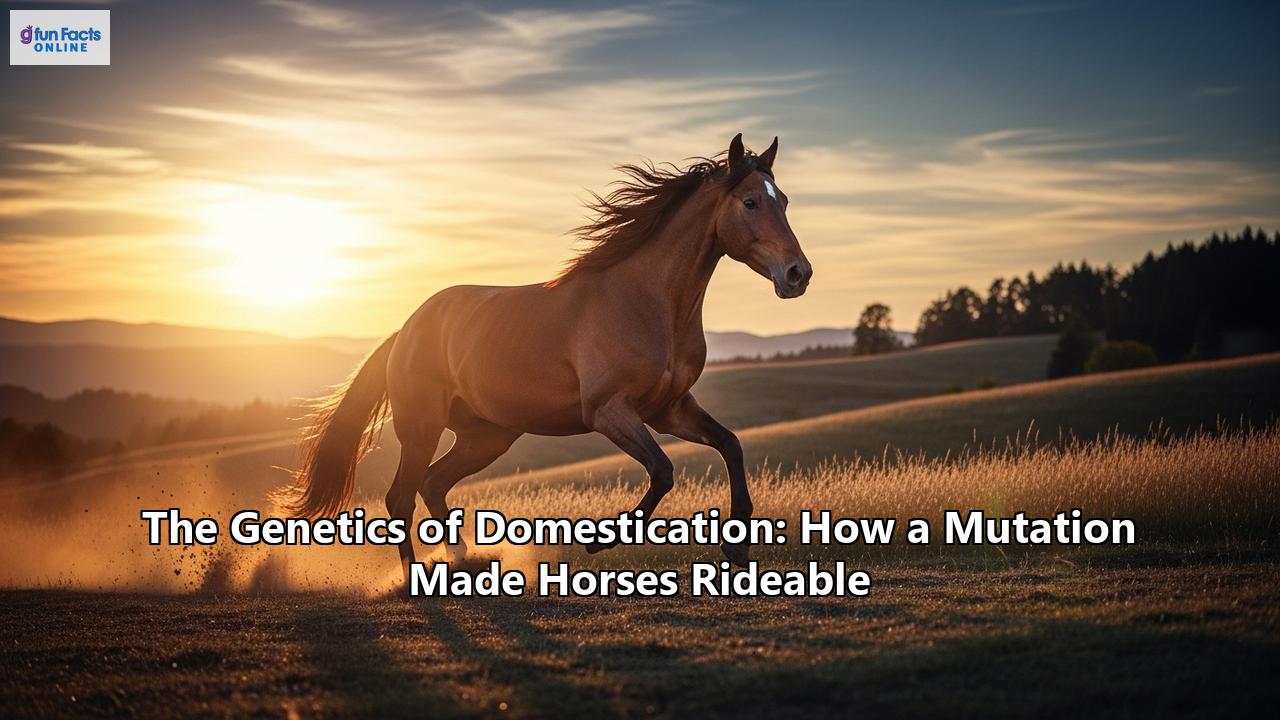
The Genetic Revolution of Horsemanship: Unlocking the Secrets of a Rideable Steed
The thundering hooves of horses have echoed through the annals of human history, carrying with them the rise and fall of empires, the expansion of trade routes, and the very evolution of our societies. For millennia, the horse has been an unparalleled partner in labor, warfare, and exploration. But how did this powerful, skittish creature transform into a willing and capable mount? The answer, it appears, is written not just in the pages of history books, but deep within the horse's genetic code. Recent scientific breakthroughs have pinpointed specific genetic mutations that were instrumental in this transformation, turning a wild animal into our trusted steed. Two genes, in particular, stand out for their profound impact: the GSDMC gene, which physically prepared the horse's back for a rider, and the DMRT3 gene, the "gait-keeper" that provided a smoother ride.
The Domestication Puzzle: Taming the Wild
The domestication of the horse was a pivotal moment in human civilization, a "biotechnological" leap that revolutionized transportation, agriculture, and warfare. For a long time, the precise origins of this partnership remained a mystery. While early evidence of horse exploitation for meat dates back tens of thousands of years, the transition to a domesticated and rideable animal is a more recent and complex story.
Archaeological evidence and genetic studies now point to the steppes of the Don-Volga region in Eastern Europe as the cradle of modern domestic horses, around 4,200 years ago. But what made these horses different? What genetic ingredients were necessary to mold a wild equid into a cooperative partner? Scientists have delved into the genomes of ancient and modern horses to uncover the genetic underpinnings of this remarkable transformation.
Building a Better Back: The GSDMC Revolution
A groundbreaking study published in the journal Science has shed new light on the physical adaptations that made horses suitable for riding. A team of researchers led by Ludovic Orlando from the Center for Anthropobiology and Genomics in Toulouse, France, analyzed the DNA of hundreds of ancient horses, looking for genetic markers that showed signs of strong selection by early breeders.
Their findings pointed to a significant mutation in the GSDMC gene. In humans, mutations near this gene are ironically linked to chronic back pain and spinal issues. However, in horses, a specific variant of this gene appears to have had the opposite effect. Experiments on mice engineered to lack this gene revealed they developed straighter spines and stronger forelimbs. The researchers theorize that this mutation in horses led to a more robust spinal structure, better able to bear the weight of a rider without strain or injury.
What is particularly striking is the speed at which this beneficial mutation spread. Around 4,750 years ago, the GSDMC variant was rare among horse populations. But within a few hundred years, as the domestication of the horse intensified, it became nearly ubiquitous. This rapid proliferation is a clear indication of strong human-driven selection; early horse breeders were intentionally choosing and breeding the animals that were physically better suited for riding. These horses, with their stronger backs, had a significant reproductive advantage, with estimates suggesting they produced about 20% more offspring than their non-mutated counterparts. This genetic revolution didn't just alter the horse's anatomy; it laid the very foundation for the rise of equestrian civilizations.
The "Gait-Keeper" Gene: A Smoother Ride
While a strong back was crucial, another genetic mutation played a pivotal role in making long-distance riding not just possible, but comfortable. This mutation is found in the DMRT3 gene, often dubbed the "gait-keeper" gene.
Wild horses, and many domestic breeds, naturally possess three gaits: the walk, the trot, and the canter/gallop. The trot, a two-beat diagonal gait, can be bouncy and uncomfortable for a rider over long distances. To maintain balance, riders often have to adopt a posting motion, which can be physically demanding.
The mutation in the DMRT3 gene, however, unlocks the ability for horses to perform alternative, smoother gaits. This single change in the DNA sequence results in a premature stop codon, leading to a truncated protein. This alteration affects the neural circuits in the spinal cord that coordinate limb movement, allowing for a different footfall pattern.
Instead of the diagonal trot, horses with the DMRT3 mutation can perform four-beat ambling gaits. These gaits, known by various names depending on the breed—such as the running walk, the rack, the tölt, or the paso largo—are characterized by having at least one foot on the ground at all times, eliminating the suspension phase that causes the bounciness of the trot. The result is a remarkably smooth ride, so much so that it is claimed a rider on a Paso Fino, a breed with a high frequency of this mutation, can carry a glass of wine without spilling it.
The Spread of a Smoother Stride
The discovery of the "gait-keeper" mutation was the result of research led by Leif Andersson, a professor of functional genomics at Uppsala University in Sweden. His team analyzed the DNA of thousands of horses from 141 breeds across the globe and found the DMRT3 mutation in gaited breeds worldwide, from North and South America to Europe and Asia. The presence of this mutation in such a wide array of geographically dispersed breeds is a testament to its value to humans.
The mutation is not only prevalent in gaited riding horses but also in breeds used for harness racing, such as the Standardbred. In these horses, the mutation allows them to maintain a trot or pace at high speeds without breaking into a canter.
Interestingly, the prevalence of the DMRT3 mutation varies between breeds and even within them. For instance, in Icelandic horses, which are famous for their five gaits (walk, trot, canter, tölt, and pace), the mutation is highly desirable. Homozygosity for the mutation (having two copies of the mutated gene) is linked to the ability to pace and a better quality tölt. Conversely, horses with one copy of the mutation may excel at the trot and gallop. The frequency of the mutated allele has been increasing in the Icelandic horse population due to selective breeding for these prized gaits.
While the DMRT3 mutation is a key enabler of ambling gaits, it's not the whole story. Some horses from gaited breeds that display these smooth movements do not carry the mutation, suggesting that other "gait" genes may still be waiting to be discovered.
The Final Piece of the Puzzle: A Calmer Mind
Beyond physical prowess, the temperament of the horse was a critical factor in its domestication. A skittish, fearful animal would have been a poor candidate for a close partnership with humans. Concurrent with the selection for a stronger back, early breeders also appear to have favored horses with a more docile nature.
Genetic analysis has revealed signs of selection in another gene, ZFPM1. In mice, this gene is known to regulate anxiety and fear responses. The fact that a specific variant of this gene became more common in horses around 5,000 years ago suggests that early humans were actively selecting for calmer, less fearful animals. This selection for a more cooperative temperament was likely the first crucial step in the journey of horse domestication, setting the stage for the later selection of physical traits for riding.
A Legacy Written in DNA
The story of horse domestication is a powerful example of how humans have shaped the evolution of another species to suit their needs. The identification of the GSDMC, DMRT3, and ZFPM1 genes provides a fascinating glimpse into the genetic toolkit that made this possible. From a stronger, more resilient back to a smoother, more comfortable gait and a calmer, more willing mind, these genetic mutations were instrumental in transforming the horse from a wild prey animal into an indispensable partner that has carried humanity forward for centuries. The legacy of these ancient genetic selections continues to canter and gallop in the diverse breeds of horses we see today, a living testament to a partnership forged in the crucible of evolution and human ingenuity.
Reference:
- https://hayadan.com/horse-domestication-genetic-mutation-bronze-age
- https://www.youtube.com/watch?v=TgGlDnQGVjY
- https://en.wikipedia.org/wiki/Domestication_of_the_horse
- https://pmc.ncbi.nlm.nih.gov/articles/PMC5068837/
- https://www.jpost.com/archaeology/article-865803
- https://www.myscience.org/news/2025/animal_domestication_a_key_mutation_behind_horse_based_mobility_identified-2025-cnrs
- https://www.zmescience.com/science/news-science/a-single-mutation-made-horses-rideable-and-changed-human-history/
- https://practicalhorsemanmag.com/news/gaited-horses-genes-16492/
- https://finishlinehorse.com/2015/01/the-gait-keeper-gene-horse-gaits-shaped-by-humans/
- https://www.agrojournal.org/24/04-21.pdf
- https://www.discovermagazine.com/a-single-mutation-made-it-easier-to-ride-horses-11528
- https://etalondx.com/horse-genetics/equine-performance/dmrt3-gait/
- https://etalondx.com/news-media/let-s-talk-about-equine-dmrt3-or-the-gait-gene/
- https://ker.com/equinews/genetic-patterns-influence-horse-gait-quality/
- https://avian2.animalgenetics.com/Equine/Equine%20Performance/Gait.asp