
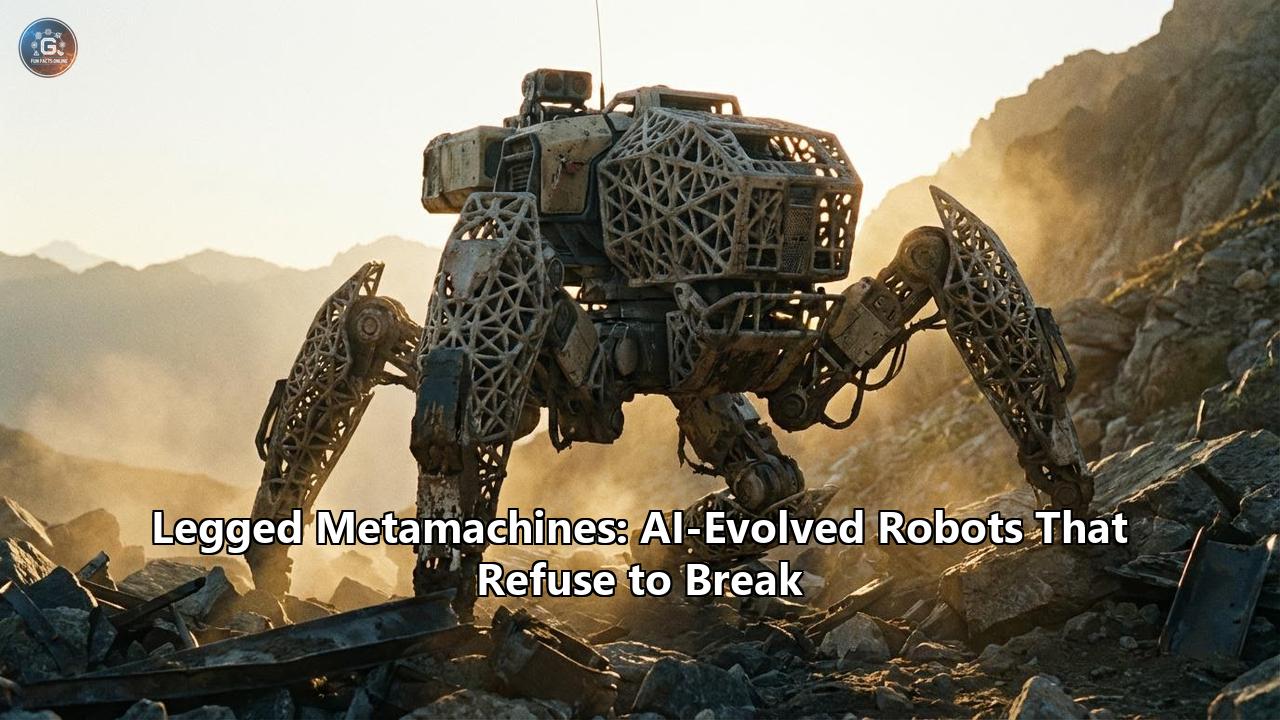
Imagine a scene straight out of a science fiction thriller: A quadrupedal machine is navigating a rugged, unpredictable patch of gravel. Suddenly, a violent impact—a heavy wooden plank swinging with immense force—strikes the machine. The impact is devastating. A limb is cleanly severed from the main body. In the traditional paradigm of robotics, this is the end of the line. A multi-million-dollar machine becomes a heavy, spark-showering paperweight. But this robot doesn't stop. It staggers for a fraction of a second, quietly recalibrates its internal logic, and continues its march forward. Even more astonishingly, the severed limb on the ground doesn't die. It twitches, rights itself, and begins to independently roll back toward its host, ready to rejoin the collective.
This is not Hollywood CGI; this is a reality staged and filmed by researchers at Northwestern University. Led by roboticist Sam Kriegman, the team has successfully unveiled a radically new class of robotic entity: the "legged metamachine". Published in the Proceedings of the National Academy of Sciences in March 2026, this breakthrough represents a profound leap in artificial intelligence, mechanical engineering, and synthetic evolution. These are robots born in the virtual crucible of a supercomputer, designed by Darwinian algorithms, and built to be virtually indestructible in the physical world.
The Fragility of the Traditional Robot
To fully appreciate the magnitude of the legged metamachine, we must first understand the fundamental flaw inherent in almost all modern robots. From the nimble, back-flipping humanoids that dominate viral videos to the four-legged mechanical dogs patrolling industrial sites, traditional robotics relies on an architecturally centralized design.
Centralization means there is a single "brain" (the central processing unit) and a single "torso" from which limbs, sensors, and actuators depend. The entire control system, the complex mathematical models dictating gait, balance, and trajectory, is meticulously hand-engineered around a fixed, permanent geometric body. If a traditional robot steps in a hidden pothole and shatters a knee joint, the control system receives a cascade of contradictory sensory data. The mathematical model collapses. The robot falls and cannot get up, because its brain does not know how to operate a three-legged body. It represents a single point of failure.
Northwestern’s metamachines completely abandon this top-down, centralized philosophy. Instead of designing one permanent robot, the engineers created a robot made entirely out of other, smaller robots. It is a collective, a swarm that snaps together to form a greater whole. Because each component is an autonomous agent, the resulting machine possesses no single point of failure.
Anatomy of a Mechanical Cell
The genius of the metamachine lies in the simplicity of its fundamental building block. Think of it as a mechanical cell. Each module is roughly half a meter long when fully extended and looks deceptively simple: a pair of rod-like sticks joined in the middle by a central spherical hub.
But inside that spherical hub lies the magic. As Kriegman explains, "Inside the sphere, the robot has everything it needs to survive: a 'nervous system,' a 'metabolism' and 'muscle'". In engineering terms, this translates to a dedicated circuit board (the brain/nervous system), a battery (the power source/metabolism), and a motor (the actuator/muscle).
Mechanically, these modules are astonishingly basic, capable of rotating around only a single axis. Yet, on its own, a solitary module is a fully functional robot that can independently roll, turn, and jump. It is simple, complete, and autonomous.
The true potential of these modules is unlocked when they connect. Utilizing Lego-like snapping mechanisms, multiple modules can physically link together in an endless variety of configurations. When they merge, they pool their computational resources and mechanical leverage. A solitary, single-axis module might only be able to hop or roll, but when three, four, or five modules connect, the resulting metamachine can exhibit incredibly complex, multi-dimensional kinematics.
Evolution in the Machine: How AI Plays Darwin
If you have a set of universal robotic building blocks, how do you know the best way to assemble them? Human engineers naturally gravitate toward biomimicry—we try to build things that look like humans, dogs, or spiders because those are the shapes we recognize as successful in nature. But human intuition is limited by our terrestrial bias.
To overcome this, the Northwestern team handed the design process over to artificial intelligence. But this wasn't a generative AI that simply spits out a blueprint; this was an evolutionary algorithm mimicking natural selection.
The researchers seeded a physics simulation with digital models of the modules. They gave the AI a simple objective: design a body plan capable of efficient, versatile, and robust locomotion. The algorithm then went to work, simulating thousands upon thousands of random configurations.
In this virtual crucible, a sped-up version of Darwinian evolution played out. The algorithm tested each design. Could it walk? Could it turn? Did it fall over immediately? The weak, inefficient designs were ruthlessly discarded. The most successful configurations were kept, mathematically recombined with one another, and subjected to random virtual "mutations" to create the next generation.
Through millions of iterations of trial and error, accelerated by vast computational power, the AI churned out alien, bizarre "species" of machines that no human engineer would have ever anticipated. Because the AI wasn't burdened by the necessity of making the robot look familiar, it found highly unconventional but mathematically superior ways to combine the modules. In these AI-evolved architectures, a modular stick might function as a leg in one scenario, but act as a stabilizing spine or a balancing tail depending on the movement required.
Depending on how the algorithm assembled them, the resulting metamachines moved in fascinating ways. Some configurations undulate across the ground with the rippling motion of a seal. Others bound forward with the splayed, jerky athleticism of a lizard, or coil and spring into the air like a kangaroo.
Hitting the Ground Running: Surviving the Unstructured World
Simulation is one thing; reality is another. In robotics, the discrepancy between virtual physics and real-world physics is notoriously known as the "reality gap." A robot that runs flawlessly in a frictionless computer simulation often collapses the moment it encounters the unpredictable resistance of real carpet or the wind resistance of the physical world.
Yet, the legged metamachines conquered the reality gap with astonishing grace. "These are the first robots to set foot outdoors after evolving inside of a computer," noted Kriegman. "They are rapidly assembled and then quite literally hit the ground running".
The research team built physical versions of the top-performing three-, four-, and five-legged designs generated by the AI. They took them out of the pristine, climate-controlled laboratory and released them into the wild. The metamachines traversed rugged, unstructured terrains: gravel driveways, thick grass, tangled tree roots, piles of dead leaves, shifting sand, deep mud, and uneven brick surfaces.
Astoundingly, the metamachines navigated these chaotic environments without needing elaborate, real-time recalibration or environment-specific retraining for each terrain. The AI-evolved geometries were inherently stable. They demonstrated "athletic intelligence"—hopping over obstacles, performing mid-air spins, and, crucially, recovering from disastrous orientations. When a metamachine was forcefully flipped upside down, it didn't lie there helplessly like an overturned turtle. Instead, it instinctively reorganized its modular movements, thrashing and contorting until it successfully righted itself and continued on its path.
The Amputation-Agnostic Controller: A Masterclass in Resilience
Physical robustness is only half the story; cognitive resilience is the other. How does a robot know how to walk when its body has been suddenly and violently altered?
To solve the problem of catastrophic damage, the researchers developed what they call an "amputation-agnostic" controller. In traditional robotics, if you lose a leg, the software effectively crashes. In the metamachine, the software adapts instantly.
During the AI's training phase, the algorithm wasn't just taught how to walk in perfect condition. It was subjected to a barrage of virtual trauma. The researchers forced the AI to generate expert movement policies for a wide variety of damage scenarios—what to do if the front left module fails, what to do if two modules are severed, what to do if only a single module remains.
The AI then distilled the knowledge from all these distinct traumatic scenarios into a single, universal neural policy that generalizes in real-time. This overarching policy acts as a generalized survival instinct. When the physical robot is deployed in the real world and subjected to previously unseen amputations (like a limb being smashed off by a wooden plank), the controller doesn't panic. It seamlessly leverages its past training, instantly redistributing the workload among the surviving modules.
The performance metrics of this controller are staggering. In tests involving severe, previously unseen amputations—such as the removal of one hindlimb, both hindlimbs, or even all but a single module—the robot retained its locomotion consistently. Under certain conditions, the damaged robot managed to maintain roughly 105 percent of the undamaged robot’s original intact speed, finding strange, highly optimized new gaits to compensate for its missing mass.
The Frankenstein Phenomenon: Life After Dismemberment
Perhaps the most visually arresting and philosophically intriguing aspect of the legged metamachines is what happens to the pieces that are broken off. Because each module is a completely self-contained robot with its own power, computing, and sensing capabilities, a severed limb does not become dead weight.
When the wooden plank shatters the machine, the main body recalibrates and walks away. But the detached leg is still "alive". It senses its isolation. Utilizing its single-axis motor and its own onboard intelligence, the separated module can independently roll or crawl across the terrain. In field demonstrations, these severed limbs actively navigated back toward the main collective, eventually catching up and potentially rejoining the parent machine.
This modular immortality completely redefines the lifecycle of a machine. Every single module can "sense its surroundings, move from place to place, compute and learn". Metamachines can be dynamically repaired, redesigned, and recombined on the fly, directly in the field of operation. If a swarm of these robots is sent on a mission and half of them are destroyed by a falling object, the surviving pieces can literally snap themselves together to form newly customized, fully capable machines to finish the job.
Implications for the Future of Automation and Exploration
The advent of AI-evolved legged metamachines opens up breathtaking possibilities across numerous industries and scientific frontiers. We are transitioning from an era where robots are treated as fragile, bespoke tools to an era where they function as adaptable, resilient synthetic organisms.
1. Space Exploration:The harsh, unforgiving environments of Mars, Europa, or the Moon are no place for fragile machinery. A traditional rover with a jammed wheel is a multi-billion-dollar tragedy. A rover built from legged metamachines, however, could simply eject a damaged module and dynamically reconfigure its remaining parts to continue the mission. If it encounters an unpassable ravine, the modules could disconnect, individually jump or roll across the gap, and reassemble on the other side.
2. Disaster Response and Search & Rescue:
In the chaotic aftermath of an earthquake or an industrial collapse, environments are completely unstructured. Rubble shifts, passages collapse, and conditions are violently unpredictable. Metamachines could crawl into deep crevices as a single snake-like chain, reassemble into a multi-legged heavy-lifting crab to move debris, and adapt instantly if crushed by falling rocks.
3. Hazardous Environment Maintenance:Inside nuclear reactors, deep-sea oil wells, or toxic chemical spills, human intervention is impossible. Metamachines offer a fail-safe robotic workforce. Because their controllers are amputation-agnostic, even if intense radiation or chemical corrosion destroys half the machine, the remaining modules will intuitively limp home or complete the task, preventing catastrophic environmental disasters.
4. Evolving Tactical & Logistical Chains:The capacity for a machine to absorb damage, scatter into independent pieces, and reassemble behind an obstacle represents a paradigm shift in logistics and autonomous systems. A robotic supply chain built on these principles would inherently refuse to break under pressure.
The Philosophical Shift: Blurring the Line Between Machine and Life
Beyond the engineering marvel, the Northwestern team’s creation forces us to confront deep philosophical questions about the nature of machines. For decades, the defining characteristic of a machine has been its rigid adherence to a human-designed purpose. A clock ticks. A car drives. A robotic arm welds. If you break a gear, pop a tire, or snap the arm, the machine ceases to be. It has no instinct to survive.
But Sam Kriegman and his team have injected something resembling a survival instinct into the cold circuitry of the metamachine. By subjecting these robots to the evolutionary pressures of a simulated environment, they have bypassed top-down human engineering and tapped into the same blind, creative force that shaped biological life on Earth.
"By combining physical modularity with AI-driven design, the researchers have opened the door to a new class of robots that don't just survive the real world—they adapt to it,". They point toward a future where our mechanical creations are no longer pre-programmed automatons, but resilient, evolving lifeforms.
When we watch a metamachine take a crippling blow, stagger, reorganize its geometry, and continue limping forward while its severed limb desperately rolls behind it to catch up, we are not just watching a clever algorithm. We are witnessing the birth of synthetic resilience. We are looking at a machine that, in its own primitive, mathematical way, refuses to die.
A New Chapter in Human Ingenuity
The legged metamachine stands as a testament to the compounding power of modern technology. It represents the perfect convergence of physical modularity, high-density energy storage, advanced physics simulation, and, most importantly, artificial intelligence.
AI is no longer just confined to generating text, painting digital pictures, or optimizing supply chains. It is now designing physical bodies. It is playing the role of a hyper-accelerated Mother Nature, iterating through generations of robotic DNA in a matter of hours to solve mechanical problems that have stumped human engineers for decades.
As we look toward the future, the modules of tomorrow may not be half a meter long. They may be the size of a golf ball, or a grain of rice, or eventually, a single microscopic nano-cell. The principles of the legged metamachine—decentralization, AI-driven evolution, and amputation-agnostic control—will scale downwards into programmable matter and upwards into massive, shape-shifting infrastructure.
For now, the image of the resilient, limping robot on the outdoor gravel driveway remains permanently etched in the minds of anyone tracking the future of technology. It is a powerful symbol of what is to come. The era of the fragile, easily broken machine is drawing to a close. We have officially entered the age of the metamachine—robots that are born from algorithms, built for chaos, and stubbornly, remarkably, refuse to break.
Reference:
- https://scienceblog.com/ai-evolved-robots-survive-amputation-and-keep-running/
- https://www.spacewar.com/reports/AI_evolved_legged_robots_reconfigure_run_and_survive_damage_999.html
- https://www.mccormick.northwestern.edu/news/articles/2026/03/evolved-robots-are-born-to-run-and-refuse-to-die/
- https://sixdegreesofrobotics.com/robot-news/northwesterns-legged-metamachines-hint-at-a-different-future-for-robotics
- https://www.eurekalert.org/news-releases/1119131
- https://www.eurekalert.org/multimedia/1118688