
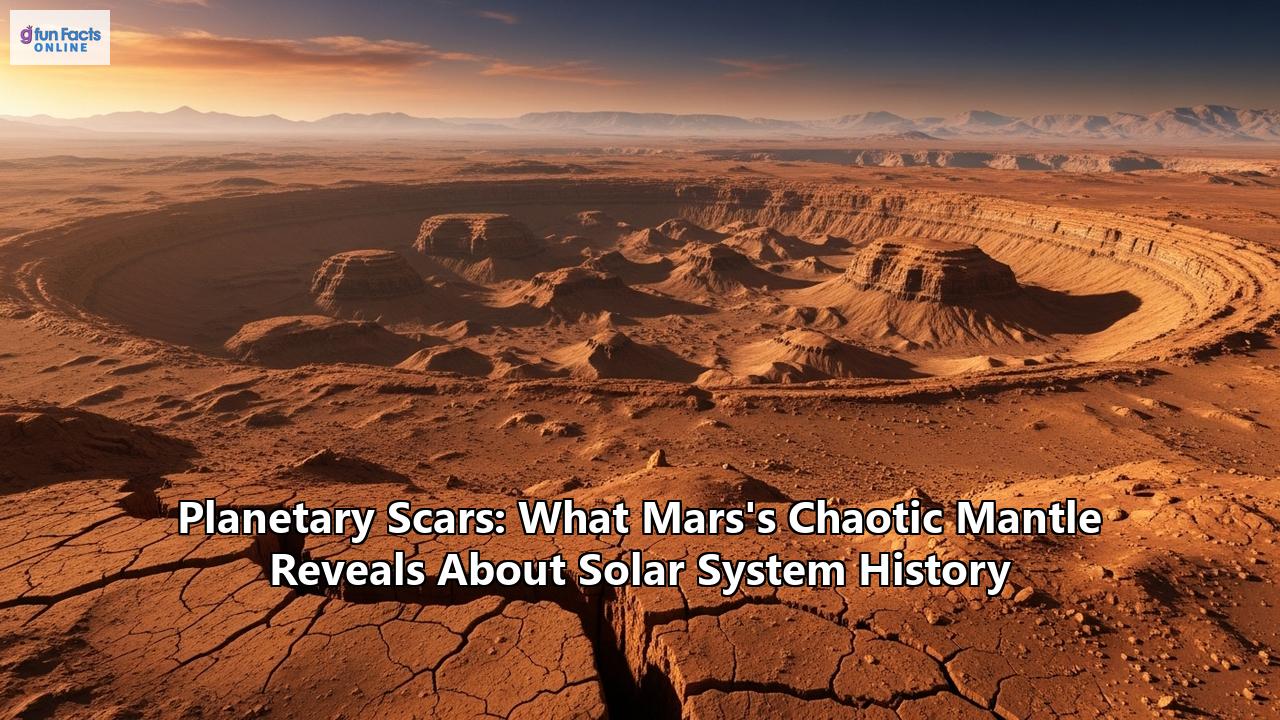
Planetary Scars: What Mars's Chaotic Mantle Reveals About Solar System History
Beneath the rust-red dust and across the silent, cratered landscapes of Mars lies a story of cosmic violence and planetary evolution, a tale told by the very bones of the planet. For centuries, we have gazed at our celestial neighbor, but only recently have we begun to listen to its deepest secrets. The now-silent NASA InSight lander, through its sensitive seismometer, has unveiled a tumultuous and "lumpy" interior, a chaotic mantle that stands in stark contrast to Earth's relatively well-mixed inner layers. This lumpy heart of Mars is more than a geological curiosity; it's a time capsule, preserving the scars of a violent youth and offering unprecedented insights into the chaotic early history of our solar system.
A Tale of Two Planets: The Lumpy Heart of Mars
On Earth, the continuous churn of plate tectonics recycles the planet's crust and stirs its mantle, erasing the evidence of its primordial past. But Mars, a smaller world that cooled more quickly, lacks this global system. Its crust solidified early into a single, stagnant lid, sealing away the evidence of its formation. This geological stasis means that Mars's mantle holds a frozen record of its violent beginnings, a record that the InSight mission has finally allowed us to read.
For four years, InSight listened to the faint rumbles of "marsquakes," seismic waves traveling through the planet's interior. The data revealed a startling picture: the Martian mantle is not the uniform, well-behaved layer planetary scientists had expected. Instead, it is highly heterogeneous, a "chaotic mixture of possibly primordial debris." Analysis of seismic waves from marsquakes showed systematic delays in their arrival times as they passed through the deeper mantle, indicating the presence of subtle, kilometer-scale compositional variations. These "lumps" are thought to be ancient fragments, some up to four kilometers wide, remnants of a time when Mars was subjected to cataclysmic impacts. These events were so energetic that they fractured the planet's interior, mixing material from the crust and even the impactors themselves into the mantle. This "fractal" distribution of fragments, with a few large pieces and many smaller ones, is akin to the shattering of glass, a testament to the overwhelming energy of these ancient collisions.
The Great Dichotomy: A Planet Divided
One of the most enigmatic features of Mars, visible even from a distance, is its stark hemispheric dichotomy. The southern hemisphere is a heavily cratered, high-standing bastion of ancient crust, while the northern hemisphere is dominated by smooth, low-lying plains. This dramatic difference in elevation and crustal thickness has long been a subject of debate, with two main competing theories: a single, colossal impact or long-term processes within the mantle.
The giant impact hypothesis suggests that a massive object, perhaps the size of a small planet, slammed into the northern hemisphere of Mars early in its history, carving out a vast basin that would later be filled with volcanic flows. This would explain the roughly elliptical shape of the northern lowlands.
However, recent evidence from marsquake data lends significant weight to the endogenic, or internal, origin theory. By analyzing the attenuation of seismic waves, scientists have discovered a significant temperature difference in the mantle beneath the two hemispheres. The mantle under the southern highlands is estimated to be around 1,000°C, while under the northern lowlands, it's a cooler 800°C. This higher temperature in the south would lead to a lower viscosity and more dynamic mantle convection. This supports the idea of "degree-1 mantle convection," a pattern where a large-scale upwelling of hot mantle material dominates one hemisphere, while downwelling occurs in the other. This powerful, single-plume convection could have pushed up the southern highlands, creating the dichotomy we see today. It's even possible that a giant impact could have triggered this pattern of mantle convection, suggesting a hybrid origin for this planetary scar.
Hellas and the Scars of the Late Heavy Bombardment
Another profound scar on the Martian surface is the Hellas Planitia, a colossal impact basin in the southern hemisphere. Spanning over 2,200 kilometers in diameter and plunging to depths of over 7 kilometers, Hellas is one of the largest and best-preserved impact structures in the solar system. Its formation, estimated to have occurred around 4.1 billion years ago, was an event of unimaginable violence, the result of a collision with an asteroid likely over 100 kilometers across.
The creation of the Hellas basin was a planet-altering event. The impact would have excavated a massive amount of crustal material and sent shockwaves deep into the planet's interior, further contributing to the chaotic nature of the mantle. The rim of the basin is marked by uplifted, rugged mountains, a testament to the immense forces at play. In the eons since its formation, Hellas has been a focal point for geological activity, with evidence of volcanism, fluvial processes, and glaciation modifying its floor and rim.
Hellas, along with the countless other craters that pockmark the southern highlands, are relics of a turbulent era in the early solar system known as the Late Heavy Bombardment. This period, from about 4.1 to 3.8 billion years ago, saw a dramatic increase in the rate of impacts on the inner planets. Evidence for this "lunar cataclysm" first came from the dating of moon rocks brought back by the Apollo missions, which showed a clustering of impact melt ages in this timeframe.
Mars, with its ancient, preserved crust, serves as a crucial "witness plate" for this violent epoch. Unlike Earth, where geological activity has erased most of its oldest craters, Mars's surface is a museum of this early bombardment. The chaotic state of its mantle is a direct consequence of this intense pummelling, with each impact contributing to the jumbled interior we are now detecting. These impacts didn't just scar the surface; they may have also delivered significant quantities of water and organic molecules, essential ingredients for life, to the young planet.
Arabia Terra: A Land of Ancient Mysteries
Stretching across a vast expanse of the northern hemisphere lies Arabia Terra, one of the oldest and most heavily cratered terrains on Mars. This upland region is a complex tapestry of eroded craters, canyons, and layered deposits, hinting at a dynamic and varied geological history. The presence of extensive layered rock formations suggests a past involving various depositional environments, possibly including volcanic ash, wind-blown dust, and even underwater sedimentation.
Within Arabia Terra, scientists have identified features that resemble terrestrial supervolcanoes – massive, low-relief calderas that would have been the sites of colossal explosive eruptions. The fine-grained pyroclastics and outgassed sulfur from these ancient volcanoes could have contributed to the formation of the altered, layered sedimentary rocks found throughout the region. This suggests a period of intense volcanic activity in Mars's early history, fueled by the heat and turmoil within its mantle. The presence of hydrated minerals in these deposits also points to the significant role of water in this ancient landscape, possibly in the form of groundwater or even surface lakes within impact basins.
The battered and altered landscape of Arabia Terra, much like the southern highlands, is another testament to the planet's tumultuous youth. Its heavily cratered surface speaks to its great age, placing its formation firmly within the era of the Late Heavy Bombardment. The geological features within this region provide further evidence of the interplay between impacts, volcanism, and water on early Mars, all ultimately driven by the processes within its chaotic mantle.
The Ghost of a Magnetosphere: A Lost Shield
Perhaps one of the most profound consequences of Mars's chaotic early history is the loss of its global magnetic field. Today, Mars is a magnetically dead world, but evidence locked in its ancient crust reveals that it once possessed a powerful magnetic dynamo, similar to Earth's. This magnetic shield would have been crucial for protecting the planet's early atmosphere from being stripped away by the solar wind, and thus for maintaining liquid water on its surface.
The Martian dynamo was likely powered by convection in the planet's molten iron core, a process that relies on the efficient removal of heat from the core into the overlying mantle. The demise of this dynamo, around 4.1 to 3.8 billion years ago, remains a topic of intense scientific investigation. Several theories link the shutdown to the evolution of the Martian mantle.
One leading hypothesis suggests that as the mantle cooled and gave up its water and other volatile elements through volcanism, it became stiffer and less efficient at convecting and carrying away heat from the core. This "drying out" of the mantle would have reduced the rate of core cooling, eventually causing the dynamo to sputter and die.
Another intriguing possibility is that the giant impacts of the Late Heavy Bombardment played a direct role in killing the magnetic field. A single, massive impact could have deposited a huge amount of heat into the mantle, disrupting its convection patterns and significantly reducing the heat flow from the core. A reduction in the heat flow at the core-mantle boundary by as little as 10-40% could have been enough to shut down the dynamo. Given the timing of the dynamo's cessation, which coincides with the era of giant impacts and the formation of basins like Hellas, this causal link is a compelling area of research. The increased thermal conductivity of Mars' core, as recent studies suggest, would have also contributed to the rapid decay of the dynamo.
A Window into a Violent Past
The planetary scars of Mars, from its global dichotomy to its colossal impact basins, are the surface expressions of a chaotic and turbulent interior. The lumpy, heterogeneous mantle revealed by the InSight mission is a direct consequence of the planet's violent formation and the intense bombardment it endured during the early days of the solar system. The lack of plate tectonics has allowed Mars to preserve this record of its primordial past, making it a unique laboratory for understanding how terrestrial planets form and evolve.
By studying the scars on Mars, we are not just learning about the history of a single planet. We are gaining a deeper understanding of the processes that shaped our entire solar system. Mars stands as a silent witness to a time when cosmic collisions were commonplace and the fate of young worlds hung in the balance. Its chaotic mantle, a relic of that long-lost era, reminds us that the path to a habitable world like Earth is not a given, and that the geological history of a planet is written not just on its surface, but deep within its heart.
Reference:
- https://en.wikipedia.org/wiki/Martian_dichotomy
- http://mathis.colorado.edu/szhong/papers/Citron_Zhong_PEPI_2012.pdf
- http://redplanet.asu.edu/index.php/2012/02/what-turned-off-the-martian-magnetic-field/
- https://english.cas.cn/newsroom/research_news/earth/202502/t20250206_899570.shtml
- https://www.mantleplumes.org/MarsDichotomy.html
- https://scispace.com/pdf/degree-1-convection-in-the-martian-mantle-and-the-origin-of-gzc5kk1vir.pdf
- https://marspolar.space/files/hellas-basin-preliminary.pdf
- https://www.geo.fu-berlin.de/en/geol/fachrichtungen/planet/press/archiv2014/hellas1/index.html
- https://www.researchgate.net/publication/234200932_Hellas_basin_Mars_Formation_by_oblique_impact
- https://pubs.usgs.gov/imap/i2694/i2694pamphlet.pdf
- https://www2.boulder.swri.edu/~bottke/Reprints/Bottke_Norman_2017_AnnuRev-Earth-Planet_45_619_Late_Heavy_Bombardment.pdf
- https://en.wikipedia.org/wiki/Late_Heavy_Bombardment
- https://www.lpi.usra.edu/meetings/bombardment2008/pdf/3030.pdf
- http://lunar.earth.northwestern.edu/courses/438/roberts2009.pdf
- https://manyworlds.space/2022/11/17/the-late-heavy-bombardment-brought-oceans-of-water-to-ancient-mars-new-research-says/
- https://en.wikipedia.org/wiki/Arabia_Terra
- https://www.science.gov/topicpages/a/arabia+terra+mars.html
- https://www.cambridge.org/core/books/abs/atlas-of-mars/arabia-mc12/8D70815CFA1271A4D99A49A213A1BA51
- https://www.researchgate.net/publication/241318857_Widespread_Layers_in_Arabia_Terra_Implications_for_Martian_Geologic_History
- https://www.researchgate.net/publication/225023532_Equatorial_layered_deposits_in_Arabia_Terra_Mars_Facies_and_process_variability
- https://en.wikipedia.org/wiki/Magnetic_field_of_Mars
- https://pmc.ncbi.nlm.nih.gov/articles/PMC10954222/