
1. Introduction: The Silent Spectrum and the Quantum Key
In the vast electromagnetic spectrum that governs our modern lives—from the radio waves carrying our music to the X-rays scanning our bones—there lies a notoriously difficult frontier known as the "Terahertz Gap." Situated comfortably between the high-frequency microwaves used in radar and 5G, and the infrared light we perceive as heat, the terahertz (THz) band (approximately 0.1 to 10 THz) has long been a technological no-man's-land.
For decades, engineers and physicists have looked at this gap with longing. Terahertz waves possess a unique combination of superpowers: they can penetrate materials like clothing, cardboard, and wood, yet they are non-ionizing and harmless to biological tissue, unlike X-rays. They hold the potential to carry vast amounts of data, promising wireless speeds up to 100 times faster than 5G. Yet, harnessing them has been a struggle. They are too fast for traditional electronics to process effectively and too slow for standard optical photon detectors to "see" without extreme cryogenic cooling.
Enter the "Atomic Antenna."
We are currently witnessing a paradigm shift in how we detect and measure electromagnetic fields. Instead of relying on metal rods, loops, and dipoles—the "classical" antennas that have defined radio for a century—scientists are turning to nature’s own perfectly identical sensors: atoms. Specifically, Rydberg atoms.
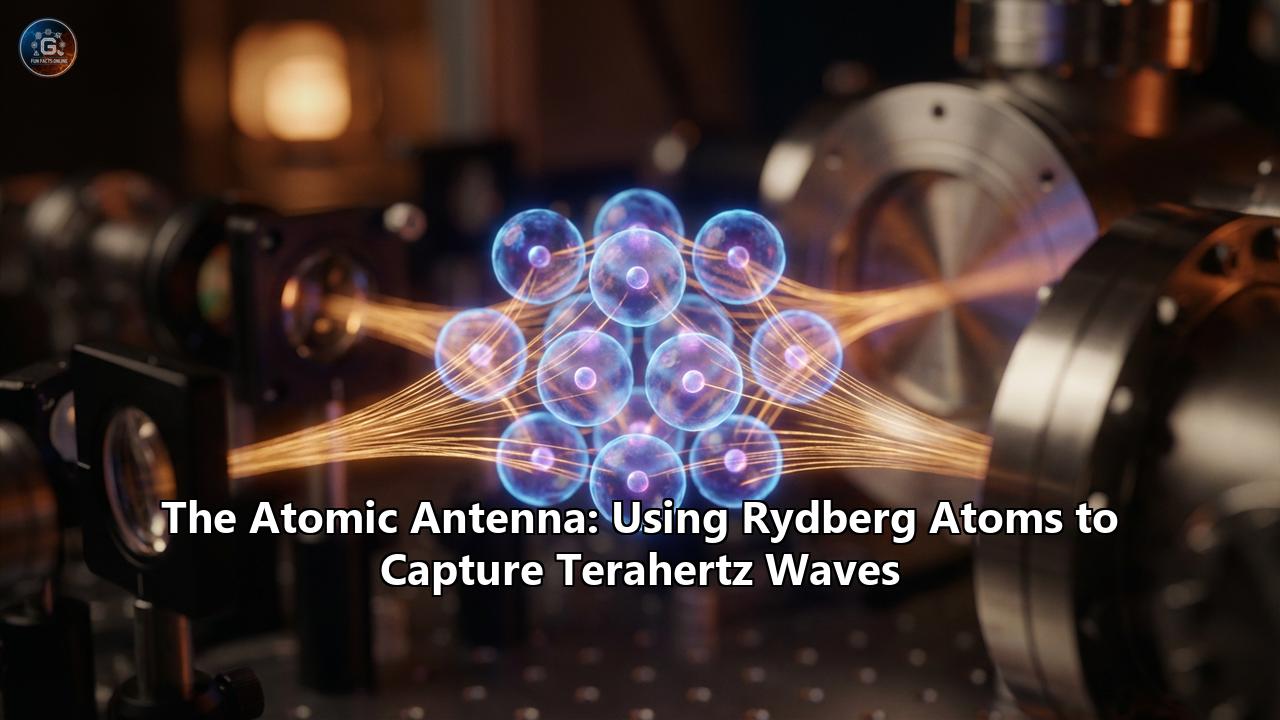
These are not ordinary atoms. They are atoms that have been excited into a high-energy state, inflating them to thousands of times their normal size. In this swollen state, they become exquisitely sensitive to passing electric fields, acting as quantum receivers capable of capturing the elusive terahertz waves with a sensitivity that rivals and often exceeds the best classical technologies.
This article explores the revolutionary emergence of the Atomic Antenna. We will journey through the quantum mechanics that make a single atom a radio receiver, explore the recent breakthroughs in "six-wave mixing" that allow for single-photon detection, and visualize a future where our 6G networks, medical scanners, and even space telescopes are powered not by silicon and copper, but by a vapor of "giant" atoms glowing with laser light.
2. The "Giant" Atom: Understanding Rydberg Physics
To understand the Atomic Antenna, one must first appreciate the peculiar nature of the Rydberg atom. Named after the Swedish physicist Johannes Rydberg, who first described the formula predicting their spectral lines in the late 19th century, these atoms are the giants of the microscopic world.
The Anatomy of an Exaggerated AtomIn a typical atom, such as a ground-state Rubidium atom (a common choice for these sensors), the valence electron orbits relatively close to the nucleus. However, if you bombard this atom with a very specific frequency of laser light, you can kick that outer electron into a highly excited state, characterized by a high principal quantum number, denoted as n.
While a ground-state atom might have an n of 5, a Rydberg atom can easily have an n of 50, 80, or even 100.
- Size: The radius of an atom scales as $n^2$. A Rydberg atom with $n=100$ is 10,000 times larger than its ground state. If a normal atom were the size of a marble, a Rydberg atom would be the size of a hot air balloon.
- Dipole Moment: The sensitivity of an atom to an electric field depends on its electric dipole moment—essentially, how "stretchable" the electron cloud is. This property scales as $n^2$. A Rydberg atom is millions of times more "stretchy" than a normal atom. When an electromagnetic wave (like a THz signal) passes by, it grabs onto this loosely held electron and shakes it with ease.
- Polarizability: Even more dramatic is the polarizability, which scales as $n^7$. This means the atom's reaction to an external field is amplified by a factor of trillions compared to a standard atom.
This extreme sensitivity is what makes Rydberg atoms the ultimate "antenna." In a classical antenna, an incoming radio wave induces a small current of electrons to slosh back and forth along a metal rod. The efficiency of this process depends on the size of the antenna relative to the wavelength. For THz waves, which have wavelengths of fractions of a millimeter, manufacturing perfect metal antennas is incredibly difficult. The metal itself becomes lossy (resistive) at these frequencies, turning the signal into heat rather than a usable current.
A Rydberg atom bypasses this entirely. It does not conduct electricity in the traditional sense. Instead, the incoming THz wave alters the quantum state of the atom. Because every atom of a specific element (like Rubidium-87) is identical by the laws of physics, an atomic antenna is arguably the most consistent and "perfect" sensor imaginable. It requires no physical calibration because its properties are defined by fundamental universal constants.
3. The Mechanism: How an Atomic Antenna Works
How do we "read" the signal caught by an atom? We cannot attach a wire to a single atom. Instead, we use light. The operation of a Rydberg atomic sensor relies on a phenomenon called Electromagnetically Induced Transparency (EIT).
The Setup: Vapor Cells and LasersThe core of an atomic antenna is a small glass cell (a vapor cell) filled with a gas of alkali atoms, usually Rubidium (Rb) or Cesium (Cs). Two lasers shine through this cell:
- Probe Laser: This laser is tuned to a frequency that the ground-state atoms would normally absorb. If you looked at the cell with just this laser, it would appear opaque or dim because the atoms are blocking the light.
- Coupling Laser: This laser is tuned to excite the atoms from an intermediate state up to the "giant" Rydberg state.
When both lasers are tuned correctly, a quantum interference effect occurs. The atoms, which were previously blocking the probe laser, suddenly stop absorbing it. The medium becomes transparent. This is EIT. If you place a photodetector behind the cell, you will see a bright transmission signal—a "peak" of light passing through.
The "Radio" InteractionNow, imagine a Terahertz wave (the signal we want to detect) passes through the glass cell.
The frequency of the THz wave is chosen to match the energy gap between two adjacent Rydberg states (e.g., transitioning the electron from state n=50 to n=51).
When the THz wave hits the atoms, it disturbs the delicate quantum interference that created the transparency.
- Autler-Townes Splitting: Strong THz fields cause the single EIT transmission peak to split into two smaller peaks. The distance between these two peaks is directly proportional to the amplitude (strength) of the THz field.
- Amplitude/Phase Shift: For weaker signals, the THz wave causes a shift in the intensity or phase of the light passing through the cell.
By monitoring the light coming out of the cell, we can instantly "hear" the radio waves. If the THz signal carries data (like an AM or FM radio transmission), the light intensity will fluctuate in perfect sync with that data. We simply convert the light into an electrical signal using a fast photodiode, and we have recovered the information.
This entire process happens at room temperature, unlike many traditional high-performance THz detectors (like bolometers) that require liquid helium cooling.
4. Bridging the Terahertz Gap: A Historical Challenge
To appreciate the "Atomic Antenna" breakthrough, we must look at the problem it solves. The "Terahertz Gap" exists because THz frequencies fall between two mature worlds of physics that don't mix well.
Electronics vs. Photonics- From the Bottom (Electronics): We generate radio and microwaves by oscillating electrons in transistors. As we push the frequency higher, the transistors must switch faster and faster. By the time we reach 1 THz, the electrons simply cannot move fast enough through the semiconductor material. The power output drops to near zero, and the noise increases dramatically.
- From the Top (Photonics): We detect light (infrared, visible) using the photoelectric effect, where a photon knocks an electron loose. THz photons, however, have very low energy (milli-electron volts). They are too weak to knock electrons across the bandgap of standard sensors like silicon. They are "dark" to standard cameras.
Before Rydberg atoms, the primary way to detect THz was using Thermal Bolometers. These devices absorb the THz radiation, heat up, and change their electrical resistance.
- Limitation 1: They are slow. Heating up and cooling down takes time (milliseconds), making them useless for high-speed communication.
- Limitation 2: They are noisy. At room temperature, the random thermal jiggling of atoms drowns out the weak heat signal from the THz wave. This is why they often need cryogenic cooling.
Rydberg sensors bridge this gap by converting the low-energy THz "radio" wave into a high-energy optical signal (the laser light) that can be easily detected. They don't rely on heating, so they are fast. They don't rely on conduction, so they don't have resistive losses. They are, in essence, the perfect frequency converter, translating the difficult "Terahertz" language into the easy "Visible Light" language.
5. Technical Deep Dive: Six-Wave Mixing and Single-Photon Detection
While the standard EIT method described above is excellent for measuring field strength, recent research (2024-2025) has pushed the technology even further. A team at the University of Warsaw and other groups have pioneered a technique involving Six-Wave Mixing to achieve sensitivity that borders on the magical: detecting single photons of THz light.
Beyond Autler-TownesThe standard Autler-Townes splitting method is great for strong fields, but for very weak signals (like a whisper from a distant galaxy or a faint reflection from a deep tissue scan), the splitting is too small to see.
The Six-Wave Mixing BreakthroughIn this advanced setup, the atomic system is driven by a complex interplay of laser fields that effectively forces the atom to absorb a THz photon and immediately emit a visible photon in a specific direction.
- The system is primed by multiple lasers into a specific "dark state."
- An incoming THz photon interacts with the Rydberg state.
- This interaction triggers a "nonlinear" optical process where the energy of the THz photon is combined with the energy of the pump lasers.
- The atom emits a photon in the visible spectrum (e.g., green or blue) that carries the information of the THz photon.
We have excellent detectors for visible light—Avalanche Photodiodes (APDs) can detect a single photon with over 90% efficiency. By converting the "hard to see" THz photon into an "easy to see" visible photon, the Rydberg sensor inherits the extreme sensitivity of optical detectors.
This technique has allowed researchers to achieve a Noise Equivalent Power (NEP) in the range of $10^{-17} \text{ W}/\sqrt{\text{Hz}}$ or better. To put that in perspective, this is orders of magnitude more sensitive than the best room-temperature thermal sensors, which typically hover around $10^{-10}$ to $10^{-12}$. It allows the "Atomic Antenna" to detect signals that are billions of times fainter than what was previously possible without cryogenics.
6. Rydberg vs. Classical: A Comparative Analysis
For engineers and physicists, the comparison between an atomic antenna and a classical dipole is where the rubber meets the road.
| Feature | Classical Antenna (Dipole/Horn) | Atomic Antenna (Rydberg Sensor) |
| :--- | :--- | :--- |
| Physical Size | Must act as a resonator (typically $\lambda/2$). For low frequencies, this is huge. For THz, it is microscopic and hard to fabricate. | The sensor head is a vapor cell (mm to cm size). The "antenna" is the atom itself (micrometers). Size is independent of frequency resonance. |
| Bandwidth | Narrowband. Tuned to a specific frequency by its physical length. Requires different antennas for different bands. | Ultra-Wideband. Can be tuned from MHz to THz simply by changing the laser frequency. One sensor covers the whole spectrum. |
| Calibration | Requires anechoic chambers and reference standards. Prone to drift over time. | Self-Calibrating (SI Traceable). Properties are based on Planck’s constant and atomic mass. Does not drift. |
| Material Interference | Metal antennas scatter the field they are measuring, distorting the test environment. | The vapor cell is dielectric (glass) and largely transparent to RF. It provides a "non-invasive" measurement. |
| Sensitivity (NEP) | Limited by thermal noise (Johnson-Nyquist noise) in the metal. | Limited by "projection noise" (quantum shot noise). With EIT/Six-Wave Mixing, it far surpasses room-temp classical sensors. |
| Directionality | Naturally directional (dipole pattern). | Naturally isotropic (omnidirectional), but can be made directional using heterodyne techniques or phased arrays. |
The Chu-Harrington LimitClassical antennas are bound by the Chu-Harrington limit, which dictates a trade-off between the size of the antenna, its bandwidth, and its efficiency. Small antennas are generally inefficient and narrowband. Rydberg atoms circumvent this because they do not operate as resonant electrical conductors. They are quantum absorbers. This allows an electrically small sensor (the vapor cell) to detect long-wavelength signals (like VHF radio) or short-wavelength signals (THz) with high efficiency, defying the classical constraints of antenna engineering.
7. The 6G Revolution: Atomic Receivers in Telecommunications
The world is hungry for data. 5G is just the beginning. The next generation, 6G, envisions data rates of 1 Terabit per second (Tbps)—fast enough to download 100 movies in a second or stream holographic video in real-time. To get this speed, we must move up to the THz carrier frequencies (0.1 - 1 THz).
The Problem with 6G HardwareCurrent experimental 6G receivers are complex, expensive, and power-hungry. They rely on "Schottky diode" mixers that are pushed to their physical limits. They are noisy and struggle to separate the signal from the background hiss at these high frequencies.
The "RARE" SolutionResearchers are developing Rydberg Atomic Receivers (RARE) for 6G.
- Massive Bandwidth: A Rydberg sensor can carry huge amounts of data. In 2024, researchers demonstrated multi-channel streaming of high-definition video over a THz carrier using a Rydberg vapor cell.
- Integrated Sensing and Comm: 6G is not just about communication; it's about "sensing" the environment (using radio waves to track position, gesture, etc.). Because Rydberg atoms are highly sensitive field probes, a 6G base station equipped with atomic antennas could simultaneously transmit data and map the 3D environment with extreme precision.
- No Demodulation Circuitry: In a classical radio, you need a "Local Oscillator" (LO) and a mixer to down-convert the high-frequency signal. In a Rydberg setup, the atoms act as the mixer. The "down-conversion" happens quantum mechanically. The output is a simple optical signal that carries the data. This simplifies the electronic architecture of the receiver significantly.
Because atomic antennas are made of glass and gas, not metal, they have a very low radar cross-section. They are "transparent" to other radio waves. This is highly attractive for military communications and secure data links where you don't want your receiver to reflect signals back to an adversary.
8. Beyond Comms: Medical Imaging, Security, and Metrology
While 6G drives the funding, the unique properties of the Atomic Antenna unlock applications that were previously science fiction.
Medical TricordersTHz waves are non-ionizing (unlike X-rays) but can penetrate skin and differentiate between tissue types (unlike visible light). They are particularly good at detecting water content and analyzing biological molecules.
- Cancer Detection: Tumors often have higher water content and different blood flow than healthy tissue. A handheld Rydberg THz scanner could detect skin cancers or breast tumors without radiation risks, potentially spotting anomalies earlier than current methods.
- Burn Analysis: THz imaging can determine the depth of a burn wound precisely, helping surgeons decide whether skin grafts are necessary.
Current airport millimeter-wave scanners are bulky and slow. Atomic antennas could lead to "walk-through" security corridors where passive THz sensors detect the specific spectral signature of explosives or weapons hidden under clothes, without the need for the rotating gantries we see today. The high sensitivity of Rydberg atoms allows for "stand-off" detection—sniffing out dangerous materials from a distance.
SI-Traceable MetrologyThis is the most immediate commercial application. Companies like Rydberg Technologies have released the RFMS (Rydberg Field Measurement System).
In the past, calibrating an antenna involved sending it to a national lab (like NIST) for weeks. Now, because the Rydberg atom is a fundamental constant of nature, a portable Rydberg probe is a "primary standard." It provides absolute accuracy anywhere. This is revolutionizing how we test cell phones, radar dishes, and medical devices, ensuring they are safe and compliant with regulations.
9. From Lab Bench to Chip: The Engineering Frontier
The image of a "laser table" full of mirrors and lenses is not practical for a cell phone. The race is now on to miniaturize.
Chip-Scale Atomic Devices (CSAD)Engineers are shrinking the entire setup onto a microchip.
- MEMS Vapor Cells: Using micro-fabrication techniques, vapor cells are now being made the size of a grain of rice (mm scale).
- Photonic Integration: Instead of bulky lasers, light is delivered via fiber optics or waveguides etched directly onto a silicon or nitride chip.
- SWaP (Size, Weight, and Power): The goal is to create a Rydberg sensor module no larger than a matchbox. Early prototypes of "MiniSatSpec" devices are already demonstrating that this is possible.
- Rydberg Technologies (USA): The leader in commercial RF probes and atomic receivers. They recently launched a European spin-off, Rydberg Photonics (Berlin), to focus on the laser engines required for these sensors.
- Infleqtion (formerly ColdQuanta): Known for cold atom quantum computing, they are also leveraging their glass cell technology for sensing applications.
- Honeywell / Aerospace Defense: Major defense contractors are integrating these sensors into "electronic warfare" suites for their wideband capabilities.
10. Future Horizons: Dark Matter, Astronomy, and Beyond
The sensitivity of the Atomic Antenna is so high that it opens doors to fundamental physics.
Hunting for Dark MatterOne theoretical candidate for Dark Matter is the "Axion," a particle that (if it exists) would interact very weakly with electromagnetic fields. Some experiments propose using Rydberg atoms as detectors to listen for the faint "radio hum" that axions might generate in a strong magnetic field. The bandwidth and tunable nature of Rydberg sensors make them ideal for scanning the unknown frequencies where dark matter might be hiding.
Cosmic BackgroundsAstronomers look at the universe in THz to see the "cold" universe—dust clouds where stars are born. Current space telescopes require heavy cryocoolers to keep their detectors at near absolute zero. A room-temperature Rydberg sensor could reduce the weight and complexity of future space observatories, allowing for smaller, cheaper satellites that can still peer into the stellar nurseries of the galaxy.
Rydberg ThermometersNIST has even demonstrated using these atoms as thermometers. Because the atoms are sensitive to "blackbody radiation" (the heat glow of objects), they can measure temperature with absolute precision without touching the object.
11. Conclusion: The Dawn of Quantum Radio
We are standing at the threshold of a new era in radio technology. For over 100 years, we have relied on the motion of electrons in metal—a classical, macroscopic phenomenon. Now, we are moving to the quantum motion of electrons within a single atom.
The "Atomic Antenna" is not just a better antenna; it is a different kind of antenna. It breaks the rules of bandwidth, sensitivity, and size that have constrained engineers for decades. It turns the elusive Terahertz spectrum from a "gap" into a playground.
From 6G networks that beam holographic data to our pockets, to medical wands that see healable wounds, to telescopes that scan the dark edges of the universe, the Rydberg atom is the key. The future of wireless is not just faster; it is quantum. And it is being built, atom by "giant" atom, right now.
Reference:
- https://www.sciencedaily.com/releases/2025/12/251213032617.htm
- https://www.rydbergtechnologies.com/
- https://pubs.aip.org/aip/apl/article/126/19/194002/3346854/Digital-terahertz-communication-with-Rydberg-atom
- https://www.mdpi.com/1424-8220/23/18/7709
- https://thz.usst.edu.cn/_upload/article/files/21/8a/07c7e47d417a91f133ed519c3514/45d1fe32-c082-4878-8264-ff36dd22e230.pdf
- https://gtr.ukri.org/projects?ref=EP%2FS015973%2F1
- https://www.forbes.com/sites/moorinsights/2024/02/20/quantum-sensing-unleashed-how-rydberg-sensors-will-disrupt-telecom/
- https://m.researching.cn/articles/OJ859ef7e01fa1347/referenceandcitations
- https://www.mdpi.com/2304-6732/12/12/1228
- https://www.hpcwire.com/off-the-wire/rydberg-technologies-inc-announces-launch-of-rydberg-photonics-in-berlin/
- https://www.mdpi.com/2218-2004/13/7/59
- https://arxiv.org/pdf/2203.01733
- https://www.researchgate.net/figure/Advantages-and-limitations-of-atomic-electric-field-sensors-relative-to-traditional_fig1_349979980
- https://www.nist.gov/news-events/news/2025/01/new-atom-based-thermometer-measures-temperature-more-accurately
- https://en.wikipedia.org/wiki/Rydberg_atom
- https://www.researchgate.net/publication/396458522_Multi-Carrier_Rydberg_Atomic_Quantum_Receivers_with_Enhanced_Bandwidth_Feature_for_Communication_and_Sensing