
The era of the silicon monopoly is ending. For seventy years, we have equated computation with the rigid, crystalline order of etched wafers—billions of microscopic transistors flipping on and off in a binary dance of logic. We built cathedrals of data centers, consuming the energy of small nations, to train Artificial Intelligence models that—for all their brilliance—still struggle to match the energy efficiency of a housefly. We hit the "Silicon Wall," where the physical limits of thermodynamics and atomic scale began to throttle the exponential growth predicted by Moore's Law.
But while engineers were shrinking transistors to the size of DNA strands, biologists were quietly mastering the code of life itself. They weren't building better chips; they were growing them.
Welcome to the dawn of Organoid Intelligence (OI).
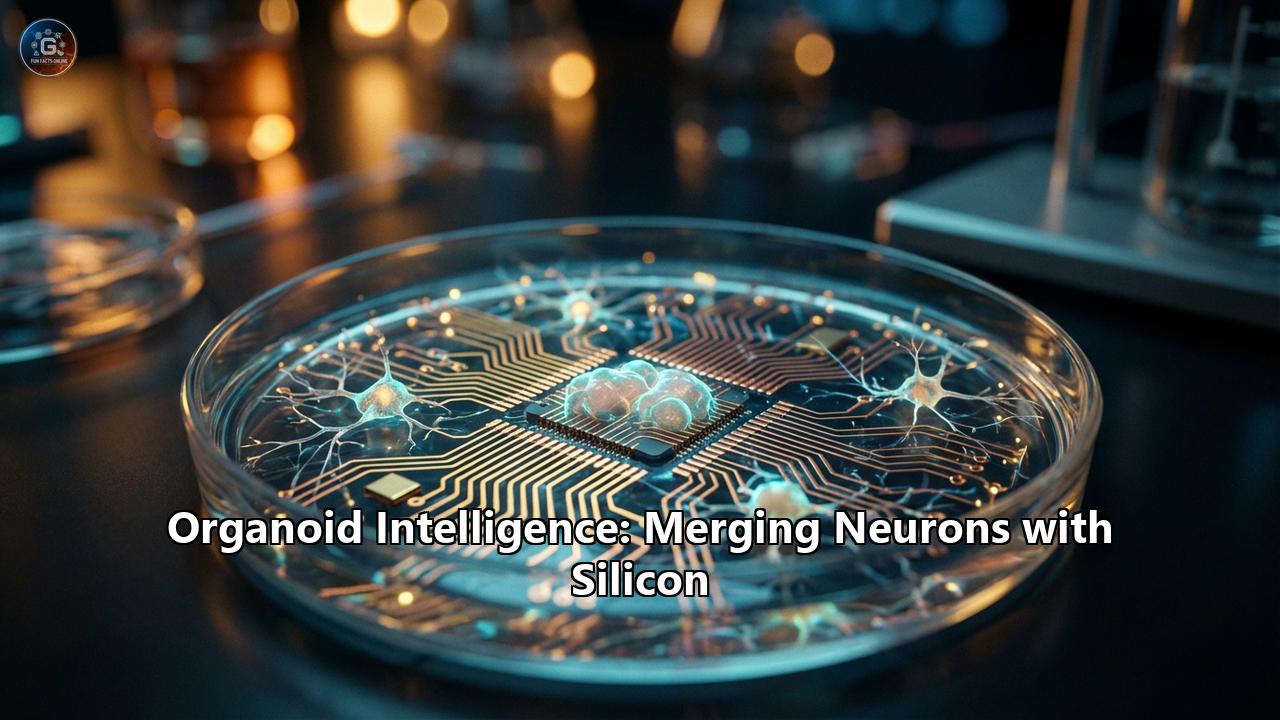
This is not science fiction. As of early 2026, in laboratories from Melbourne to Baltimore and Lausanne, living clusters of human neurons—grown from skin cells, housed in microfluidic bio-chambers, and interfaced with digital systems—are playing video games, solving mazes, and processing data. They are the first generation of "biocomputers." They are wet, they are warm, they eat sugar, and they are merging the raw, adaptive power of the human brain with the precision of silicon machines.
Part I: The Energy Crisis of Intelligence
To understand why we are turning to biology, we must first look at the failure of our current trajectory. The rise of Generative AI in the early 2020s was a triumph of brute force. Training a model like GPT-4 required gigawatt-hours of electricity and millions of gallons of water for cooling. By 2025, the global demand for AI compute was projected to outpace the energy grid's capacity in several developed nations.
Contrast this with the human brain. The organ sitting between your ears contains roughly 86 billion neurons and 100 trillion synaptic connections. It is the most complex structure in the known universe. It can compose symphonies, calculate trajectory dynamics of a flying ball in real-time, feel emotion, and imagine the future. And it does all of this on about 20 watts of power—barely enough to dim a lightbulb.
If a silicon supercomputer attempted to simulate the human brain at the cellular level in real-time, it would require a dedicated nuclear power plant to run. Biology has a multimillion-year head start on energy efficiency. The brain doesn't just process information; it physically restructures itself to do so better, a phenomenon known as neuroplasticity. Silicon is rigid; neurons are plastic. Silicon burns energy to flip switches; neurons only fire when necessary, operating on a sparse, event-based logic that engineers are desperate to emulate but have never fully matched.
The logic of Organoid Intelligence is simple: Instead of spending billions trying to build a silicon chip that acts like a brain, why not just use the brain itself?
Part II: What is a Brain Organoid?
The "hardware" of this new revolution is the brain organoid. To the naked eye, it looks like a tiny, pale pearl, no larger than a housefly's head, floating in a nutrient-rich pink broth. But under a microscope, it is a universe.
An organoid is not a full brain—it is not a conscious "mini-person." It is a three-dimensional tissue culture derived from human stem cells. The process begins with a technology that won the Nobel Prize: Induced Pluripotent Stem Cells (iPSCs).
Scientists can take a harmless skin sample from a donor—you, me, or a patient with Alzheimer's. They reprogram these skin cells back into a neutral, embryonic state. From there, using a specific cocktail of chemical growth factors, they coax these cells to become neurons. But unlike traditional "cell cultures" which grow in a flat 2D layer at the bottom of a petri dish, organoids are encouraged to grow in 3D.
In this three-dimensional space, magic happens. The cells self-organize. They don't just form a pile of neurons; they develop structures. They form cortical layers similar to the human cortex. They grow glial cells—the support staff of the brain—which are crucial for memory and cognition. They develop axons and dendrites, reaching out to connect with thousands of neighbors. Spontaneously, without any instruction, they begin to "fire." They generate electrical waves. They "talk" to each other.
By 2023, Professor Thomas Hartung at Johns Hopkins University had codified the roadmap for this field, coining the term "Organoid Intelligence." He pointed out that while flat cultures of neurons had been used for years, they were like a single sheet of paper compared to the library of a 3D organoid. The 3D structure allows for a density of connections—synaptic complexity—that is a prerequisite for higher-order computation.
Part III: The Interface—Merging Wetware and Hardware
A brain organoid floating in a jar is useless for computing if it cannot communicate with the outside world. It is a brain without senses, a processor without an input/output port. This is where the engineering challenge lies.
The solution is the Micro-Electrode Array (MEA).
Imagine a bed of nails, but the nails are microscopic, conductive pins made of platinum or gold. The organoid sits atop this bed. These electrodes serve a dual purpose: they are both the ears and the voice of the computer.
- Read (Output): When a neuron in the organoid fires, it creates a tiny voltage spike (an action potential). The electrodes detect this, digitizing the biological signal into binary code that a standard computer can analyze.
- Write (Input): The computer can send electrical pulses through the electrodes, stimulating specific regions of the organoid. To the organoid, this electrical stimulation is "sensation." It is the only reality it knows.
This bidirectional flow of information creates a feedback loop, the fundamental requirement for learning.
The "DishBrain" BreakthroughThe "Hello World" moment for this technology came from a lab in Australia. Cortical Labs, led by Dr. Brett Kagan, created a system they called "DishBrain." They grew a layer of 800,000 human neurons over a silicon chip and hooked it up to the arcade game Pong.
They didn't "program" the neurons to play. They couldn't—there is no programming language for biological tissue. Instead, they used the concept of Active Inference (championed by neuroscientist Karl Friston). The theory posits that biological systems hate "surprise" or unpredictability. They want their environment to be predictable.
The researchers set up a simple rule:
- When the paddle hit the ball (a good outcome), the neurons received a predictable, rhythmic electrical pulse.
- When the paddle missed the ball (a bad outcome), the neurons received a chaotic, unpredictable burst of noise.
The neurons, seeking to minimize the chaotic noise, physically rewired themselves. They learned that "firing in this specific pattern moves the paddle there, which prevents the chaos." Within five minutes, the clump of cells was playing Pong. It wasn't playing as perfectly as an AI, but it was learning faster, using fewer samples, and adapting in real-time. It was sentient in the most rudimentary sense: it possessed a model of its world and acted to change it.
Part IV: The Rise of the Bioprocessor
By 2024 and 2025, the field exploded from academic curiosity to commercial prototypes. The Swiss startup FinalSpark launched the "Neuroplatform," the world's first remote-access biocomputing lab.
For $500 a month, researchers could log in via the internet to a facility in Switzerland. There, 16 human brain organoids were kept alive in a specialized incubator, fed by microfluidic pumps that circulated oxygen and nutrients (a synthetic "blood"). Users could write Python code that sent signals to these living brains and read back their responses.
FinalSpark's data was startling. They claimed their "wetware" processors could potentially operate at one million times the energy efficiency of digital processors. While a GPU runs hot and sucks electricity, the organoids operated at room temperature, fueled by a small amount of glucose.
The "CL1" and Synthetic Biological IntelligenceCortical Labs followed up with the CL1, a server-rack unit that looked like standard IT equipment but housed living biological cartridges. They moved away from the term "Artificial Intelligence" and began using "Synthetic Biological Intelligence" (SBI).
The CL1 solved one of the massive logistical headaches of the field: life support. You can turn off a silicon server and walk away. If you turn off a biocomputer, it dies. The CL1 systems were designed with automated life-support systems, essentially robotic nurses that monitored the pH, temperature, and glucose levels of the cells 24/7.
These systems began to show prowess in tasks that silicon struggles with:
- One-Shot Learning: Show a human a photo of a strange animal (e.g., a platypus) once, and they can recognize it forever. An AI often needs thousands of examples. Organoids showed early signs of this rapid, low-data adaptability.
- Non-Linear Processing: The brain is excellent at handling "noisy" data and ambiguity. Biocomputers showed promise in speech recognition and identifying patterns in chaotic signals (like ECG heart rhythms) more efficiently than standard algorithms.
Part V: The Medical Revolution—"Clinical Trials in a Dish"
While the computing world salivated over energy efficiency, the medical world saw a different, perhaps more immediate, revolution.
For decades, we have relied on animal models (mice and rats) to study human brain diseases. But a mouse brain is not a human brain. Alzheimer's drugs have a 99% failure rate in human trials because they work in mice but fail in us.
Organoid Intelligence offers a bridge. Because organoids can be grown from specific donors, we can create "autistic organoids" or "Alzheimer's organoids."
Personalized MedicineImagine a child with severe, drug-resistant epilepsy. In the near future, doctors could take a skin scraping, grow a "digital twin" organoid of the child's brain, and test 100 different drug combinations on the organoid. They could stimulate the organoid with electricity to trigger a seizure and see exactly which drug stops it—without ever risking the child's safety.
Researchers at Johns Hopkins, led by Lena Smirnova, began using OI to study neurotoxicity. They could expose trained organoids—organoids that had "learned" a pattern—to potential environmental toxins or new drugs. If the organoid "forgot" the pattern or slowed down its processing, it was a sign of cognitive damage that a simple microscope inspection would never catch. This is functional toxicology: testing if a chemical makes you stupider, not just if it kills your cells.
Part VI: The Ethical Minefield
As with any technology that touches the substrate of the human mind, OI has walked straight into a philosophical and ethical minefield.
The Consciousness QuestionThe most haunting question is simple: Does it feel?
When a clump of neurons learns to play Pong to avoid "chaotic noise," is it experiencing suffering? Is the chaotic noise "pain"? Is the predictable signal "pleasure"?
Most neuroscientists, including Thomas Hartung and Brett Kagan, argue that current organoids are far too simple to possess consciousness as we know it. They lack the sensory richness, the size (millions of cells vs billions), and the complex architecture of a whole brain. They are more like a processor than a person.
However, the line is blurry. The "Baltimore Declaration", an ethical framework emerging from the growing OI community, emphasized "embedded ethics." It mandated that ethicists be part of the lab team, not just external observers.
The concerns escalated in late 2025 following the Asilomar meeting on Organoid Intelligence. Key issues included:
- Consent: If I donate skin cells for research, do I consent to them becoming a "computer" that is owned by a corporation? Do I have a claim to the intellectual property generated by my cells?
- The "Chimeric" Dilemma: Some researchers implanted human organoids into the brains of rats to provide them with a vascular system (blood supply), allowing them to grow larger. These "humanized" rats demonstrated higher intelligence. Does such a rat have human rights?
- Decommissioning: When a biocomputer becomes obsolete, you don't just unplug it. You kill it. Is there a moral cost to terminating a complex, learning neural network?
Regulators are currently scrambling to define a "Sentience Threshold"—a metric of complexity and autonomous behavior that, if crossed, would grant the organoid certain protections, similar to the regulations governing animal testing.
Part VII: The Roadmap—Vascularization and Hybrid Systems
Despite the hype, significant roadblocks remain. The biggest is vascularization.
The human brain is permeated by miles of blood vessels. Every neuron is within a hair's width of a capillary. Organoids, lacking this plumbing, rely on diffusion for nutrients. This limits their size to a few millimeters. If they grow bigger, the center dies (necrosis) because oxygen can't reach it.
Solving this is the "Holy Grail" of OI. Approaches in 2026 include:
- 3D Bioprinting: Printing artificial microscopic blood vessels into the organoid as it grows.
- Microfluidic Perfursion: Forcing nutrient fluid through the tissue under pressure.
The endgame is not to replace silicon, but to marry it. The future of computing is Hybrid AI.
Imagine a robot. Its "reflexes" (motor control, balance, fast sensory processing) are handled by traditional silicon chips, which are fast and reliable. But its "cortex"—the part responsible for learning new tasks, navigating novel environments, and making complex decisions—is a biological processing unit (BPU).
This BPU would provide the robot with the flexibility of a biological organism. If it encountered a situation it wasn't programmed for, it wouldn't crash; it would adapt. It would learn.
Conclusion: The Biological Singularity
Organoid Intelligence represents a fundamental shift in our relationship with technology. For the first time, we are not just building tools for our minds; we are building tools out of mind-stuff.
We are entering an era where the distinction between "born" and "made" is dissolving. The silicon chips that powered the information age are being joined by wet, living processors. This convergence promises a future where computers are not just smart, but intuitively adaptive; where medicine is personalized to the molecule; and where we may finally understand the deepest mystery of all: how the electrical storm in our heads gives rise to the experience of being human.
The computer of the future will not just calculate. It will live.
Extended Deep Dive: The Mechanics of "Wetware" Computing
To truly appreciate this technology, we must look under the hood—or rather, inside the incubator—at the intricate dance of biology and engineering that makes OI possible.
1. The Manufacturing Process: Brewing a Brain
Creating a bioprocessor is more akin to brewing beer or making cheese than soldering a circuit board. It requires a sterile environment, precise temperature control (37°C), and patience.
- Step 1: Expansion. The process starts with iPSCs. These are frozen in liquid nitrogen until needed. When thawed, they are placed in a spinner flask—a bioreactor that gently swirls the liquid to keep the cells from clumping too much and ensuring oxygen distribution.
- Step 2: Differentiation. Over 4 to 8 weeks, the chemical bath is changed periodically. Factors like Dual-SMAD inhibitors are added to push the cells toward the "neuroectoderm" lineage (brain tissue).
- Step 3: Maturation. This is the critical phase. Early organoids are like fetal brains—full of potential but erratic. To be useful for computing, they need to myelinate. Myelin is the fatty sheath that insulates neurons, allowing for high-speed signal transmission. In the human body, this takes years. In the lab, researchers use chemical accelerators to achieve myelination in months.
2. The Language of Spikes
How does a Python script "talk" to a neuron? The universal language is the Spike Train.
Neurons communicate via action potentials—sudden changes in voltage across their cell membrane.
- Encoding (Silicon to Bio): When a user types a command or inputs data (e.g., pixel data from an image), the computer converts this into a temporal pattern of electrical pulses. This is often done using "Rate Coding" (higher frequency = higher intensity) or "Temporal Coding" (the precise timing of the pulses carries the information).
- Decoding (Bio to Silicon): The MEA listens. It picks up the "hash" of thousands of neurons firing. Advanced machine learning algorithms (ironically, silicon AI) are used to "decode" this noisy chatter. They look for population vectors—patterns of activity across the whole group that correspond to a specific decision or output.
3. The Problem of Stability (The "Hangover" Effect)
One of the amusing, yet frustrating, challenges of biocomputing is that neurons get tired. Silicon chips can run at 100% load for years. Neurons deplete their neurotransmitters (the chemicals like dopamine and glutamate used to bridge the gap between cells).
If you stimulate an organoid too hard or too long, it suffers from excitotoxicity. Ideally, the cells just stop firing (exhaustion). In the worst case, they poison themselves and die.
This necessitates a "sleep cycle" for biocomputers. FinalSpark’s Neuroplatform, for instance, implies operational cycles where the organoids are allowed to rest and replenish their chemical stores. This creates a fascinating limitation: a computer that needs a nap.
4. The Plasticity Advantage
Why put up with a computer that needs sleep? Because of Hebbian Learning. The rule "neurons that fire together, wire together" is the basis of all biological learning.
In a silicon neural network (ANN), "learning" means mathematically adjusting the weights of the connections in a database. It involves massive matrix multiplications, consuming huge energy.
In an organoid, learning is physical. Synapses physically grow stronger or weaker. New connections physically sprout. The hardware becomes the software. This allows for "Continuous Learning."
- Catastrophic Forgetting: If you teach a standard AI to play Chess, and then teach it to play Go, it usually forgets how to play Chess. It overwrites its old weights.
- Biological Memory: A brain (and an organoid) can layer new knowledge on top of old knowledge without erasing it, thanks to the compartmentalization and incredible density of synaptic connections.
The Global Landscape of OI Research (2026 Status)
The race for Organoid Intelligence is global, with distinct flavors of research emerging in different regions:
- United States (Johns Hopkins, UCSD): The focus is heavily on Medical Applications and Standardization. The NIH and NSF are funding projects to ensure that organoids are reproducible—that an organoid grown in Baltimore behaves the same as one grown in San Diego. This is crucial for drug approval.
- Europe (Switzerland, Germany, UK): The focus is on Hardware/Software Integration and Ethics. Switzerland (FinalSpark) leads in the "Lab-as-a-Service" model. The UK is a hub for the philosophical and legal frameworks governing the use of human tissue in machines.
- Australia (Cortical Labs): The focus is Commercialization and Robotics. They are the most aggressive in trying to build a viable "product"—a chip you can buy or rent to do actual work.
- Asia (Japan, China): Focus on Scale and Automation. Research institutes here are pioneering robotic systems to grow thousands of organoids simultaneously, removing the "artisan" aspect of hand-rearing the cells.
Speculation: The 2030s and Beyond
If we project the current curves forward, the 2030s look radically different.
The "Hybrot" EraWe will likely see the deployment of "Hybrots" (Hybrid Robots) in niche industries.
- Search and Rescue: Tiny drones equipped with olfactory (smell) organoids. Biological noses are millions of times more sensitive than electronic sensors. A drone with a patch of bio-engineered mouse-neuron tissue could "smell" a survivor under rubble or detect a gas leak with uncanny precision.
- Autonomous Security: Systems that use visual cortex organoids to monitor security feeds. Unlike AI, which can be fooled by "adversarial examples" (specially designed patterns that look like noise to us but a gun to an AI), biological vision is robust. It sees what we see.
Some visionaries propose a "Wet-Cloud." Instead of server farms of silicon, we might have climate-controlled vaults of bioprocessors performing the complex, creative, and adaptive tasks of the internet, while silicon handles the rote storage and transmission.
The Uncanny Valley of MindAs organoids grow larger—reaching the 10-million cell count targeted by the Johns Hopkins roadmap—they will enter the range of cognitive complexity of small mammals. The ethical debate will shift from "Is this tissue?" to "Is this a subject?"
We may see the rise of "Organoid Rights" activists. We may face legal battles over the "cruelty" of running a biocomputer 24/7 without stimulation (sensory deprivation) or with negative reinforcement.
Final Thoughts: The Mirror in the Machine
Organoid Intelligence is more than just a new way to compute. It is a mirror. By trying to build intelligence from scratch, using the very building blocks that make us who we are, we are forced to confront the mechanisms of our own existence.
Every breakthrough in OI teaches us something about the human brain—how it learns, how it fails, how it heals. It is a convergence of our two greatest endeavors: the quest to build intelligent machines and the quest to understand ourselves.
The silicon age was defined by speed and logic. The organoid age will be defined by adaptation and life. The machines of the future will not be cold, hard, and static. They will be warm, fluid, and growing. They will be a part of us, in a way silicon never could be. And in that merger, we may find the key to solving challenges—from climate change to dementia—that neither biology nor technology could solve alone.
Reference:
- https://www.youtube.com/watch?v=7G6f1JaIg7w
- https://expertlinked.in/posts/2025-11-21-biocomputing-brain-organoids-healthcare-ai-frontier/
- https://www.kyuk.org/2025-12-25/experts-met-to-discuss-the-ethics-of-using-organoids-in-research
- https://www.justthink.ai/blog/the-worlds-first-bioprocessor-powered-by-human-brain-organoids
- https://www.eurekalert.org/news-releases/980084
- https://bioalps.org/finalsparks-neuroplatform-the-era-of-organic-computing-has-begun/
- https://news.abplive.com/science/researchers-unveil-roadmap-to-create-biocomputers-using-human-brain-cells-all-you-need-to-know-1585245
- https://robohub.org/scientists-unveil-plan-to-create-biocomputers-powered-by-human-brain-cells-interview-with-prof-thomas-hartung-senior-author-of-the-paper/
- https://hub.jhu.edu/2023/02/28/organoid-intelligence-biocomputers/
- https://softfutures.substack.com/p/brains-in-a-dish-are-the-future-of
- https://www.reddit.com/r/singularity/comments/1d4bcoa/worlds_first_bioprocessor_uses_16_human_brain/
- https://www.biospace.com/finalspark-launches-the-first-remote-research-platform-using-human-neurons-for-biocomputing
- https://www.tomshardware.com/pc-components/cpus/worlds-first-bioprocessor-uses-16-human-brain-organoids-for-a-million-times-less-power-consumption-than-a-digital-chip
- https://newatlas.com/brain/cortical-bioengineered-intelligence/
- https://www.thecourieronline.co.uk/the-ethics-of-organoid-intelligence/
- https://evolutionoftheprogress.com/organoid-intelligence/
- https://muckypaws.com/2025/10/19/the-new-frontier-of-biocomputing-power-ethics-and-the-perils-of-living-machines/
- https://medium.com/@JacksonAAaron/final-sparks-biocomputers-how-a-swiss-startup-is-building-the-world-s-first-living-computers-97ac3b07dd39