
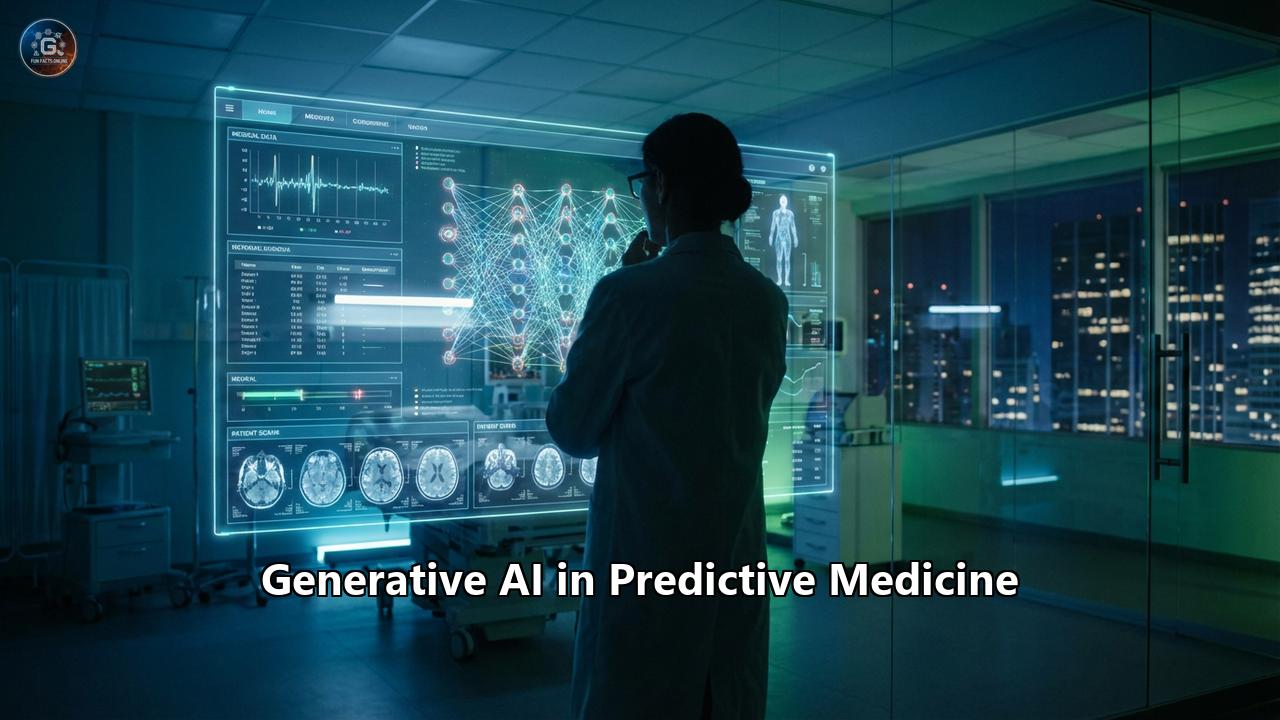
The year 2026 marks a definitive turning point in the history of medicine. We have officially moved past the "Peak of Inflated Expectations"—where artificial intelligence was promised as a magic bullet for every ailment—and have firmly landed on the "Slope of Enlightenment." Generative AI is no longer just writing emails or creating surreal images; in the high-stakes world of predictive medicine, it is saving lungs, decoding the secrets of "junk" DNA, and predicting hospital admissions before a patient even feels faint.
For decades, predictive medicine was a statistical game. It relied on regression models and risk scores that looked at the past to make an educated guess about the future. Today, Generative AI has flipped this script. Instead of just analyzing existing data, these models can simulate potential futures. They can generate novel molecular structures for drugs that never existed, synthesize "digital twin" patient records to test treatments without risking lives, and draft complex genomic prognoses that turn a binary "yes/no" diagnosis into a nuanced probability map.
This article explores the landscape of Generative AI in predictive medicine as of early 2026, detailing the breakthrough technologies, the real-world success stories in hospitals and pharmaceutical labs, and the ethical guardrails being built to keep this powerful engine on track.
The Pharmaceutical Revolution: From "Eroom’s Law" to Generative Discovery
For half a century, the pharmaceutical industry suffered from "Eroom’s Law" (Moore’s Law spelled backward), where the cost of developing a new drug doubled every nine years despite improvements in technology. In 2025, Generative AI finally broke this curse.
The Insilico Breakthrough: A Case Study in Speed
The most compelling evidence comes from Insilico Medicine, a pioneer that has turned the theoretical promise of AI into clinical reality. In mid-2025 and early 2026, the company released results that sent shockwaves through the industry. Their lead drug candidate, ISM001-055, designed to treat Idiopathic Pulmonary Fibrosis (IPF), achieved a milestone that many skeptics thought impossible for an AI-designed molecule.
IPF is a devastating lung disease with a poor prognosis, and traditional drug discovery had struggled to find effective targets. Insilico’s platform didn’t just screen existing libraries; it used a two-pronged generative approach:
- PandaOmics (Target Discovery): The AI analyzed massive datasets of omics data and identified TNIK (Traf2- and NCK-interacting kinase) as a novel anti-fibrotic target—a protein previously linked to cancer but overlooked in lung fibrosis.
- Chemistry42 (Generative Chemistry): Once the target was found, the generative engine designed a completely new molecule from scratch to inhibit TNIK. It wasn’t looking for a needle in a haystack; it built the needle.
The results, published in Nature Medicine and Nature Biotechnology, were undeniable. In a Phase IIa clinical trial completed in late 2025, patients receiving 60mg daily of ISM001-055 showed a dose-dependent improvement in lung function (+98.4 mL in Forced Vital Capacity), compared to a decline in the placebo group. This was the first time a drug fully discovered and designed by generative AI demonstrated such clear clinical efficacy in human trials, moving the technology from "experimental" to "essential."
AstraZeneca and the "De Novo" Era
While Insilico focused on small molecules, AstraZeneca bet big on biologics. By 2026, their collaboration with Algen Biotechnologies ($555 million investment) began to bear fruit. They utilized generative models to design de novo antibodies—proteins built atom-by-atom to bind to specific disease targets in immunology.
Unlike traditional methods that require immunizing mice and harvesting antibodies, AstraZeneca’s generative models could "imagine" protein structures that theoretically should bind to a target, and then refine them in silico before a single test tube was used. This reduced the hit-identification timeline from months to weeks, allowing them to tackle "undruggable" targets in chronic kidney disease and idiopathic pulmonary fibrosis.
The Clinical Frontline: AI Enters the Hospital
While pharma companies use AI to build weapons against disease, hospitals are using it to predict where the enemy will strike next. By the end of 2025, a study in JAMA Network Open revealed that nearly 56% of US hospitals were either actively using or implementing generative AI, a massive surge driven by teaching hospitals and major health systems.
Mount Sinai: Decoding the Genome’s "Maybe"
One of the most frustrating aspects of genetic testing is the "Variant of Uncertain Significance" (VUS). A patient gets a test, and the result is neither positive nor negative—it’s a shrug.
In August 2025, researchers at the Icahn School of Medicine at Mount Sinai published a landmark paper in Science that solved this ambiguity using AI. They developed a model that calculates "ML Penetrance" scores.
- The Problem: Having a genetic mutation doesn't mean you will get the disease. The "penetrance" (likelihood of developing symptoms) varies wildly.
- The Solution: The team trained a multimodal generative model on over 1 million electronic health records (EHRs). The model didn't just look at genetics; it ingested routine lab data—cholesterol levels, kidney function, blood counts—to contextualize the mutation.
- The Result: The model could predict the actual phenotypic risk for an individual patient. It could tell a patient with a specific heart disease variant, "Based on your bio-markers, your risk is actually minimal," or conversely, warn a low-risk variant carrier that their specific physiology made them a ticking time bomb. This moved genetic counseling from binary guesswork to continuous probability.
Mayo Clinic: The Foundation of Radiology
The Mayo Clinic, in collaboration with Microsoft Research and Cerebras Systems, has pioneered the use of "Foundation Models" for medical imaging. In 2025, they deployed a system capable of analyzing chest X-rays not just for specific diseases (like pneumonia) but for everything at once.
This "Med-Gemini" style approach allows a radiologist to ask the image questions: "Is the central line placed correctly?" "Show me evidence of early-stage fibrosis." The model acts as a super-specialized colleague, drafting reports that the human radiologist reviews. This "human-in-the-loop" workflow has become the gold standard, enhancing accuracy while handling the explosion of medical data.
Cleveland Clinic: The Silent Operator
At the Cleveland Clinic, the focus in 2026 shifted to the "unsexy" but critical backend of predictive medicine: operations. Partnering with G42 and AKASA, they implemented generative agents for Revenue Cycle Management and Sepsis Detection.
- Sepsis Prediction: By analyzing continuous streams of patient vitals, their AI agents can predict septic shock hours before clinical deterioration, alerting nurses to intervene early.
- Administrative AI: Generative agents now handle the complexity of medical coding and insurance denials. By freeing up resources here, the clinic reported a measurable shift in budget back toward direct patient care, proving that AI’s predictive power saves money as well as lives.
How It Works: The Tech Under the Hood
To understand why 2026 looks so different from 2023, we have to look at the evolution of the models themselves. We have moved beyond simple "text-in, text-out" chatbots.
- Multimodal Interweaves: The leading models of 2026 (like Google’s refined Med-Gemini family) are natively multimodal. They don't just "read" text; they "see" CT scans and "read" genomic sequences simultaneously. They understand that a shadow on an X-ray, a phrase in a doctor's note ("patient complains of night sweats"), and a dip in a lab value are connected.
- Digital Twins & Synthetic Data: Real patient data is messy, private, and expensive. 2026 has seen the rise of high-fidelity synthetic data. Companies like Generative Health AI create "synthetic cohorts"—fake patients that are statistically identical to real ones. Researchers can run thousands of "virtual clinical trials" on these digital twins to predict how a diverse population might react to a drug, spotting side effects that a small human trial might miss.
- Agentic AI: The buzzword of 2026 is "Agentic." Unlike a passive chatbot that waits for a prompt, an AI Agent can be given a goal—"Monitor this patient for signs of pre-eclampsia"—and it will actively check labs, scan notes, and alert the doctor only when necessary. It orchestrates the workflow rather than just participating in it.
Navigating the Minefield: Ethics, Bias, and The Law
The rapid ascent of these technologies has not been without peril. As AI takes on a greater role in life-and-death decisions, the scrutiny has intensified.
The "Black Box" and Bias
A sobering study from Mount Sinai in 2025 reminded the world that AI mirrors our own flaws. They found that commercial generative models could recommend different treatments for the same medical condition based solely on the patient’s race or socioeconomic status found in the notes. This "socio-demographic bias" has led to a demand for "Explainable AI" (XAI). Doctors are no longer accepting a score of "High Risk" without a breakdown of why—"Risk elevated due to rising creatinine and history of hypertension, not zip code."
The Regulatory Clampdown
Governments have stepped in to enforce these standards.
- FDA’s TPLC & PCCP: In January 2025, the FDA issued a game-changing draft guidance on "AI-Enabled Device Software Functions." It introduced the concept of the Predetermined Change Control Plan (PCCP). Previously, if a company updated its AI model, it needed re-approval. Now, companies can agree on a "plan" for how the model will learn and improve. As long as the AI stays within those guardrails, it can self-update without bureaucratic delay. This allows predictive models to get smarter in real-time.
- EU AI Act: With full provisions coming into force in August 2026, the EU has taken a hard line. Predictive AI in healthcare is classified as "High Risk," requiring rigorous data governance, human oversight, and transparency.
- California’s AB 3030: Effective January 1, 2025, this law mandates transparency. If a hospital uses GenAI to communicate with a patient (e.g., an AI-drafted message about lab results), it must disclose that the message was AI-generated, unless a human doctor reviewed it. This "Human-in-the-Loop" requirement is reshaping how hospitals deploy these tools, ensuring that efficiency never replaces empathy.
The Road Ahead: 2030 and Beyond
As we look toward the end of the decade, the trajectory is clear. We are moving toward Precision Health, where medicine is proactive rather than reactive.
- From Treatment to Interception: Generative AI will allow us to predict disease trajectories years in advance. A patient might receive a "health forecast" in their 30s predicting a high risk of Alzheimer’s in their 60s based on a multimodal analysis, prompting a 30-year preventive regimen.
- The End of the "Average" Patient: The concept of "standard of care" will become obsolete. Every treatment plan will be generated de novo for the individual, taking into account their unique genome, microbiome, and lifestyle.
In 2026, Generative AI in predictive medicine is no longer science fiction. It is the pill in the bottle, the alert on the nurse’s pager, and the invisible hand guiding the surgeon’s blade. The hype has faded, but the revolution has just begun.
Reference:
- https://insilico.com/news/tnrecuxsc1-insilico-announces-nature-medicine-publi
- https://www.clinicallab.com/mount-sinai-researchers-use-ai-and-lab-tests-to-predict-genetic-disease-risk-28393
- https://www.mountsinai.org/about/newsroom/2025/mount-sinai-researchers-use-ai-and-lab-tests-to-predict-genetic-disease-risk
- https://clpmag.com/diagnostic-technologies/digital-pathology/analytical-software-systems/ai-model-uses-routine-lab-tests-predict-genetic-disease-risk/
- https://hitconsultant.net/2025/08/28/mount-sinai-researchers-use-ai-and-lab-data-to-predict-genetic-disease-risk/
- https://www.sciencedaily.com/releases/2025/08/250830001209.htm
- https://www.duanemorris.com/alerts/california_passes_novel_law_governing_generative_ai_healthcare_1224.html
- https://www.bclplaw.com/en-US/events-insights-news/california-turns-to-the-use-of-ai-in-healthcare.html
- https://www.mbc.ca.gov/Resources/Medical-Resources/GenAI-Notification.aspx