
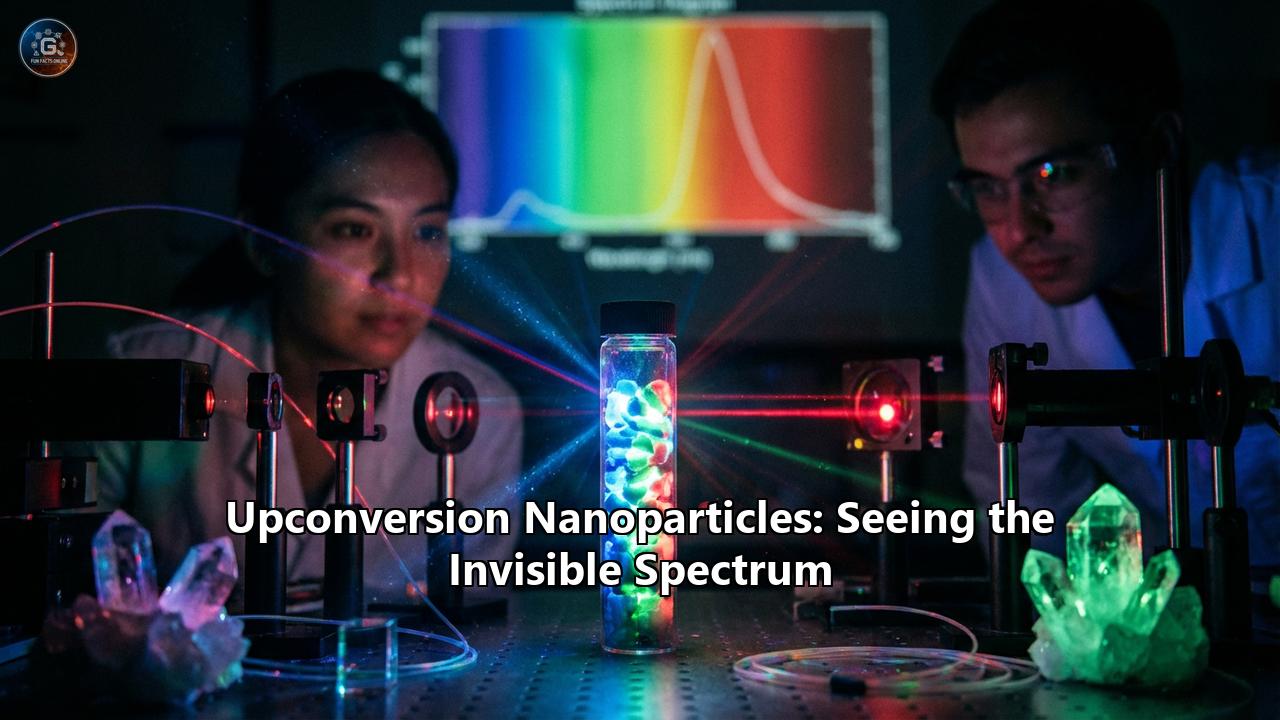
The universe is awash in light, yet our eyes are blind to most of it. From the radio waves that carry our music to the gamma rays that burst from dying stars, the electromagnetic spectrum is a vast ocean of energy. We, however, are stranded on a tiny island of perception known as "visible light"—a narrow band ranging roughly from 400 to 700 nanometers. For centuries, this limitation defined the boundaries of microscopy, photography, and biological imaging. We could only see what our eyes, or cameras designed to mimic our eyes, could catch. But what if we could break this fundamental rule? What if we could take low-energy, invisible light—like the infrared rays that pass harmlessly through our hand—and "upconvert" it into brilliant blues, greens, and reds?
Enter the world of Upconversion Nanoparticles (UCNPs). These are not merely new materials; they are photonic alchemists. Unlike traditional fluorescent dyes that operate on the principle of "downconversion" (absorbing high-energy UV or blue light and emitting lower-energy green or red light), UCNPs defy the conventional intuition of energy loss. They perform a photon-summing magic trick, absorbing two, three, or even more low-energy photons and combining their power to emit a single, high-energy photon.
This ability to "see the invisible" is revolutionizing fields as diverse as deep-tissue cancer imaging, solar energy harvesting, high-security anti-counterfeiting, and even the frontier of neuromorphic computing. In this exploration, we will journey into the quantum mechanics that make this possible, the chemical artistry required to synthesize these crystals, and the futuristic applications that are turning science fiction into reality.
Chapter 1: The Physics of the Impossible
To understand why Upconversion Nanoparticles are so special, we must first appreciate the "Stoke’s Shift," the rule that governs almost all other luminescent materials. Named after Sir George Gabriel Stokes, this law states that the light emitted by a material effectively always has a longer wavelength (and thus lower energy) than the light absorbed. It’s the second law of thermodynamics in action: you can’t get more energy out than you put in per photon, and you usually lose some to heat (vibration).
UCNPs, however, seem to cheat. They exhibit an anti-Stokes shift. They take in infrared light—lazy, low-energy waves—and spit out energetic visible or ultraviolet light. How? They don't violate thermodynamics; they just use teamwork.
1.1 The Ladder of Light: Energy Transfer Upconversion (ETU)
The secret lies in the unique electronic structure of the Lanthanides (rare-earth elements) doped into the nanoparticle crystal. Unlike organic dyes, which have broad, blurry energy bands, lanthanides like Ytterbium ($Yb^{3+}$), Erbium ($Er^{3+}$), and Thulium ($Tm^{3+}$) have sharp, ladder-like energy levels shielded by their outer electron shells.
The most efficient mechanism at play is Energy Transfer Upconversion (ETU). Imagine a ladder.
- The Sensitizer (The Collector): We dope the crystal heavily with a "sensitizer" ion, typically Ytterbium ($Yb^{3+}$). Ytterbium has a very simple job: it loves to absorb 980 nm near-infrared (NIR) light. It acts like an antenna, capturing these photons effectively.
- The Energy Handoff: When a $Yb^{3+}$ ion absorbs a photon, it gets excited. But instead of releasing that energy as heat or light immediately, it holds onto it just long enough to find a neighbor—an "activator" ion like Erbium ($Er^{3+}$).
- The Climb: The $Yb^{3+}$ transfers its energy to the $Er^{3+}$, pushing the Erbium up one rung on its energy ladder.
- The Second Step: While the Erbium is sitting on that first rung (a metastable state), another excited Ytterbium neighbor passes its energy over. This second boost pushes the Erbium up to a second, higher rung.
- The Emission: Now, the Erbium is highly energized. It relaxes back to the ground state, releasing all that accumulated energy in one go as a single photon of visible green light.
This "1+1=2" photon addition allows us to turn infrared (980 nm) into visible green (540 nm) or even blue (480 nm) light.
1.2 Excited State Absorption (ESA) and Photon Avalanche (PA)
While ETU is the dominant mechanism in modern high-efficiency UCNPs, other processes exist.
- Excited State Absorption (ESA): This occurs when a single ion absorbs a photon, jumps to an intermediate level, and then absorbs another photon itself to jump higher. It requires very high light intensity because the ion has to be "lucky" enough to get hit twice in quick succession.
- Photon Avalanche (PA): This is a runaway process. Once a critical threshold of pumping intensity is reached, cross-relaxation between ions rapidly populates the excited states, causing a sudden, massive increase in brightness. It’s highly non-linear and useful for sensing temperature or pressure changes.
1.3 The New Frontier: Superfluorescence
In 2024 and 2025, a groundbreaking discovery shook the UCNP community: Room-Temperature Superfluorescence.
Superfluorescence is a quantum phenomenon where all the excited ions in a nanoparticle synchronize their emission. Instead of each ion flashing randomly like sparkles, they lock phases and emit a short, intense "super-pulse" of light.
Normally, this requires temperatures near absolute zero to prevent thermal "noise" from breaking the synchronization. However, researchers found that because the lanthanide electrons are so well-shielded, UCNPs can exhibit this quantum behavior at room temperature. This leads to emissions that are millions of times brighter and faster than normal upconversion, opening the door to "Second-Generation Quantum Technologies" using these particles.
Chapter 2: Alchemy of the Nanoworld — Synthesis Strategies
Understanding the physics is one thing; building the engine is another. Synthesizing high-quality UCNPs is a delicate art of chemical engineering. The goal is to create a perfect crystal host that holds the lanthanide ions in precise positions without defects that would quench the light.
2.1 The Host Matrix: Sodium Yttrium Fluoride ($NaYF_4$)
The "gold standard" host material is hexagonal-phase Sodium Yttrium Fluoride ($\beta-NaYF_4$). Why fluoride? Because it has "low phonon energy." In simple terms, the crystal lattice doesn't vibrate much. High-vibration lattices (like oxides) would steal the energy from the excited lanthanide ions and turn it into heat before they could emit light. Fluorides are quiet, allowing the delicate upconversion process to proceed undisturbed.
2.2 The Hydrothermal & Solvothermal Methods
The most common way to cook these crystals is via thermal decomposition or solvothermal synthesis.
- The Recipe: You mix rare-earth chlorides ($YCl_3$, $YbCl_3$, $ErCl_3$) with oleic acid (a fatty acid found in olive oil) and a fluoride source (like ammonium fluoride) in a high-boiling solvent (octadecene).
- The Process: The mixture is heated to roughly 300°C in an oxygen-free environment. The oleic acid acts as a surfactant—it coats the growing crystals, controlling their size and preventing them from clumping.
- Phase Control: A critical challenge is ensuring the crystals grow in the hexagonal ($\beta$) phase, which is 10x brighter than the cubic ($\alpha$) phase. This is controlled by the ratio of sodium to rare-earth ions and the precise "cooking" temperature. Recent breakthroughs have used "delayed nucleation" pathways to separate the formation of seeds from their growth, resulting in perfectly uniform, monodisperse particles.
2.3 Core-Shell Engineering: The Onion Approach
A naked UCNP has a major weakness: its surface. Ions on the surface have "dangling bonds" and are exposed to solvent molecules that steal their energy (quenching).
To fix this, scientists build Core-Shell Nanostructures.
- Active Core: The center contains the sensitizers ($Yb$) and activators ($Er/Tm$).
- Inert Shell: A layer of undoped $NaYF_4$ is grown around the core. This shell acts as a shield, protecting the active ions from the outside world.
- Active Shell: Sometimes, the shell is also doped! For example, a "Nd-doped shell" can harvest 800 nm light (which penetrates tissue even better than 980 nm) and transfer it inward to the core. This "energy migration" strategy allows for extremely complex photon management, where different layers do different jobs.
Chapter 3: Engineering the Interface — Surface Chemistry
Fresh out of the reactor, UCNPs are coated in oleic acid. This makes them hydrophobic (water-hating)—great for dissolving in toluene, but terrible for injecting into a bloodstream. For biological applications, we need to dress them in a new "suit."
3.1 Ligand Exchange
This strategy involves stripping off the oleic acid and replacing it with a hydrophilic (water-loving) molecule.
- NOBF4 Method: A chemical called nitrosonium tetrafluoroborate can strip the oleic acid almost instantly, leaving a "naked," charged surface that can be easily coated with hydrophilic polymers.
- Polymer Coating: Polyethylene glycol (PEG) is the favorite here. Phosphate-modified PEG binds strongly to the lanthanide surface, creating a "stealth" particle that the immune system ignores, allowing it to circulate in the body longer.
3.2 Silica Encapsulation
Another popular method is growing a thin layer of glass ($SiO_2$) around the particle. This silica shell is chemically inert, transparent to light, and easy to modify with functional groups (like amines or carboxyls) that allow us to attach antibodies or drugs.
3.3 Antenna Effect: Dye Sensitization
One limitation of UCNPs is that lanthanides don't absorb light very strongly on their own. To boost efficiency, scientists attach "antenna dyes" (like Indocyanine Green) to the surface. These organic dyes absorb light 10,000 times more effectively than the ions. They catch the photons and funnel the energy into the nanoparticle, amplifying the brightness by orders of magnitude.
Chapter 4: Illuminating the Dark — Bioimaging
The "Killer App" for UCNPs is bioimaging. Traditional fluorescence microscopy uses UV or blue light, which has two problems:
- Low Penetration: Blue light scatters in tissue (that's why veins look blue). It can’t see deep inside a tumor.
- Autofluorescence: Biological tissues naturally glow green when hit with UV light (thanks to NADH and flavins). This creates a "noisy" background that hides faint signals.
UCNPs solve both.
- The NIR Window: They are excited by 980 nm or 808 nm light. These wavelengths fall into the "biological optical window"—tissue is semi-transparent to them. The light can penetrate centimeters deep rather than millimeters.
- Zero Background: Tissue does not upconvert. When you shine NIR light on a mouse, the tissue is dark. Only the UCNPs light up. This infinite signal-to-background ratio allows scientists to detect single nanoparticles deep inside an organ.
4.1 Multiplexed Imaging
Because we can tune the emission color by changing the dopants (Tm gives Blue, Er gives Green/Red), we can inject different colored particles to tag different things simultaneously.
- Example: A blue-emitting UCNP could tag a cancer cell nucleus, while a green-emitting one tags the drug carrier, allowing researchers to watch the drug release process in real-time.
4.2 MRI and CT Dual-Mode Imaging
Since UCNPs contain heavy elements (Ytterbium, Gadolinium), they show up on X-rays (CT scans) and Magnetic Resonance Imaging (MRI). A single UCNP injection can provide a high-resolution optical image and a deep-tissue anatomical scan.
Chapter 5: The Light that Heals — Therapy & Optogenetics
UCNPs are not just passive observers; they can be active agents of healing.
5.1 Photodynamic Therapy (PDT)
PDT is a cancer treatment where a drug (photosensitizer) generates toxic "singlet oxygen" when hit by light, killing the tumor.
- The Problem: Most photosensitizers need UV or visible light, which can’t reach deep tumors.
- The UCNP Solution: We attach the photosensitizer to the UCNP. We shine NIR light (which penetrates deep) into the body. The UCNP absorbs the NIR, upconverts it to Blue/UV, and the particle itself activates the drug right inside the tumor. This allows for non-invasive treatment of deep-seated cancers that were previously unreachable by light therapy.
5.2 Optogenetics: Remote Controlling the Brain
Optogenetics is a technique where neurons are genetically modified to fire when hit by blue light. It’s a powerful tool for studying the brain, but it usually requires sticking a fiber-optic cable into the skull because blue light can't go through bone and brain tissue.
- The Breakthrough: "Transcranial Optogenetics." Researchers inject UCNPs deep into the brain. Then, they shine a NIR laser on the outside of the skull. The NIR light passes through the bone and brain, hits the UCNPs, and is converted to blue light locally. This blue light triggers the neurons.
- Application: This has been used to stimulate dopamine release, stop seizures, and even trigger memory recall in mice—all without implanting a physical wire into the brain.
5.3 Drug Delivery
UCNPs can be coated with a "cage" that holds a drug. This cage is designed to break only when hit by UV light. By using UCNPs, doctors can inject the drug, wait for it to accumulate in the tumor, and then trigger the release using a harmless NIR laser, ensuring the toxic drug is released only where it is needed.
Chapter 6: Powering the Future — Solar Energy Harvesting
Our sun pours energy onto the Earth, but solar panels waste a lot of it. Silicon solar cells are great at absorbing visible light, but they are transparent to infrared light. Roughly 44% of solar energy is in the infrared—it passes right through the panel and is lost.
6.1 The Spectral Mismatch Solution
UCNPs offer a way to harvest this lost energy. By placing a layer of UCNPs behind the solar cell (or integrated into the back reflector), infrared photons that pass through the cell are caught.
- Mechanism: The UCNP layer absorbs the passing IR photons, converts them into visible photons, and reflects them back into the solar cell to be turned into electricity.
6.2 Perovskite Enhancement
Recent work (2024-2025) has focused on Perovskite Solar Cells (PSCs). These new, high-efficiency cells often lack stability and IR absorption.
- The Innovation: Integrating Neodymium-doped ($Nd^{3+}$) UCNPs with a Titanium Dioxide ($TiO_2$) shell into the electron transport layer of the cell.
- The Result: The $Nd^{3+}$ captures NIR light, converts it to UV/Blue light (which Perovskites love), and the $TiO_2$ shell helps extract the electrical charge. This architecture has demonstrated efficiency boosts of over 20%, pushing the power conversion efficiency of PSCs past the 21% mark while also improving their stability against humidity.
Chapter 7: Guardians of Authenticity — Anti-Counterfeiting
Counterfeiting is a trillion-dollar global problem, affecting everything from currency to life-saving medicines. Traditional security inks (like the UV holograms on credit cards) are easy to fake because UV ink is cheap and widely available. UCNPs offer a much higher level of security.
7.1 Tunable Emission Fingerprints
Because we can precisely control the ratio of Er, Tm, and Ho ions, we can create UCNPs that emit a unique "spectral fingerprint"—a specific barcode of color peaks that is impossible to replicate without the exact synthesis recipe.
7.2 Excitation-Dependent Color Tuning
This is the "James Bond" feature of UCNPs.
- The Concept: Some advanced UCNPs change color depending on how hard you hit them with the laser.
- Example: At low power (0.5 W/cm²), the particle might glow red. Turn the laser power up to 20 W/cm², and it shifts to green.
- Implementation: A security stamp on a luxury handbag could look invisible. Under a standard IR pen light, it glows red. But a customs officer with a high-power scanner would see it turn green. A counterfeiter using standard ink would only be able to replicate one color, failing the verification.
7.3 Pulsed Excitation
Using pulsed lasers introduces the dimension of "time." By changing the pulse width (how long the laser is on) or frequency, the emission color of core-shell nanoparticles can be manipulated. This adds a temporal lock-and-key mechanism: the security mark only reveals the correct code when interrogated by a laser with the specific pulse sequence.
Chapter 8: The Brain on a Chip — Neuromorphic Computing
The human brain is the ultimate computer—efficient, plastic, and capable of learning. Traditional computers (Von Neumann architecture) separate memory and processing, creating a bottleneck. Neuromorphic computing aims to mimic the brain's synaptic structure using hardware. UCNPs have found a surprising niche here.
8.1 The Optical Synapse
A biological synapse strengthens or weakens based on the timing of signals (plasticity). An artificial synapse needs to do the same.
- The Device: Researchers have created "Floating Gate Phototransistors" using a layer of UCNPs combined with a 2D material like Molybdenum Disulfide ($MoS_2$).
- How it Works:
1. NIR light hits the UCNP layer.
2. The UCNP converts it to visible light.
3. The $MoS_2$ channel absorbs this visible light and generates an electrical current (the synaptic signal).
- The Memory Effect: Because the upconversion process and the charge trapping in $MoS_2$ have time delays, the device exhibits "Short-Term Plasticity" (STP) and "Long-Term Potentiation" (LTP). If you pulse the NIR light quickly, the signal gets stronger and stays strong—just like a memory forming in the brain.
- Application: These devices are being used to build artificial neural networks that can recognize handwritten digits with high accuracy using only light as an input, paving the way for ultra-fast, low-power optical computers.
Chapter 9: Challenges and Horizons
Despite their promise, UCNPs face hurdles that must be cleared before they become ubiquitous.
9.1 The Quantum Yield Problem
The biggest Achilles' heel of UCNPs is efficiency.
- The Issue: The "Quantum Yield" (efficiency) of UCNPs is often less than 1%. Most of the absorbed energy is lost to surface quenching or cross-relaxation. Compared to Quantum Dots (which can be 90% efficient), UCNPs are dim.
- The Solution:
Pulsed Excitation: Recent studies show that hitting UCNPs with high-intensity pulses instead of a continuous beam can boost efficiency by orders of magnitude.
Plasmonic Enhancement: Placing UCNPs near gold or silver nanoparticles can create a "plasmonic hotspot" that amplifies the electric field, forcing the UCNPs to glow brighter.
* Dye Sensitization: As mentioned, using organic antennas is the most promising route to high brightness.
9.2 Toxicity and Biocompatibility
Lanthanides are heavy metals. While not as toxic as lead or cadmium, their long-term effects in the body are still under scrutiny.
- Stability: The fluoride host is generally stable, but in the acidic environment of a lysosome (inside a cell), it can degrade, leaking lanthanide ions.
- The Fix: Robust silica or polymer coatings are essential. Long-term studies in mice (up to 115 days) have shown promising results with minimal toxicity for surface-modified particles, but clinical trials in humans are the next necessary step.
9.3 The Thermal Issue
Shining a laser on tissue causes heating. Water absorbs 980 nm light, which can cook healthy cells during imaging.
- The Shift to 808 nm: Scientists are moving toward Nd-sensitized UCNPs that absorb at 808 nm. Water absorption at 808 nm is much lower than at 980 nm, reducing the overheating risk significantly.
9.4 Future Trends: Second-Generation Quantum Tech
The discovery of Superfluorescence positions UCNPs as a candidate for quantum information processing. The ability to generate coherent, ultra-short pulses at room temperature could allow UCNPs to serve as sources for quantum communication networks or ultrafast optical switches.
Conclusion
Upconversion Nanoparticles represent a triumph of materials science—a way to bend the rules of light to our will. They allow us to peer through the skin without cutting, to treat cancer with pinpoint precision, to harvest energy that was once lost, and to secure our world against fraud.
From the bubbling flasks of hydrothermal synthesis to the complex neural networks of optical chips, the journey of the UCNP is just beginning. As we master the challenges of brightness and biocompatibility, these tiny crystals will likely become invisible engines powering the visible future of medicine, energy, and technology. They are the dust that helps us see the universe in a new light.
Reference:
- https://www.researchgate.net/publication/376819860_Hydrothermal_Synthesis_of_NaYF4YbEr_Upconversion_Nanoparticles_and_Modification_of_Their_Surfaces_for_Biosensing
- https://pmc.ncbi.nlm.nih.gov/articles/PMC3166393/
- https://www.mdpi.com/1420-3049/30/10/2166
- https://pubmed.ncbi.nlm.nih.gov/40430338/
- https://www.researchgate.net/publication/316632125_Upconversion_Modulation_through_Pulsed_Laser_Excitation_for_Anti-counterfeiting
- https://www.mdpi.com/2079-4991/13/24/3102
- https://validate.perfdrive.com/?ssa=bf992beb-12f2-5d2c-9415-b2c73a1f276a&ssb=60930267116&ssc=https%3A%2F%2Fopg.optica.org&ssi=40ab52d6-d3hy-15c0-ee88-3307348b7174&ssk=botmanager_support@radware.com&ssm=11508244169796045131191092311224&ssn=6cb22dc03eed8911809392bfd0901930cac965d5862c-b33a-59d3-e63654&sso=5df20d3-e118-3d761e4256d743ab71720f372d5d74aa33a564ce39ffa08d&ssp=84767591211765612416176560439304758&ssq=68444920389208003937203891498568190614364&ssr=MTI0LjIxNy4xODkuMTE5&sst=python-requests%2F2.32.3&ssv=&ssw=
- https://www.researchgate.net/publication/348051974_Independent_Luminescent_Lifetime_and_Intensity_Tuning_of_Upconversion_Nanoparticles_by_Gradient_Doping_for_Multiplexed_Encoding