
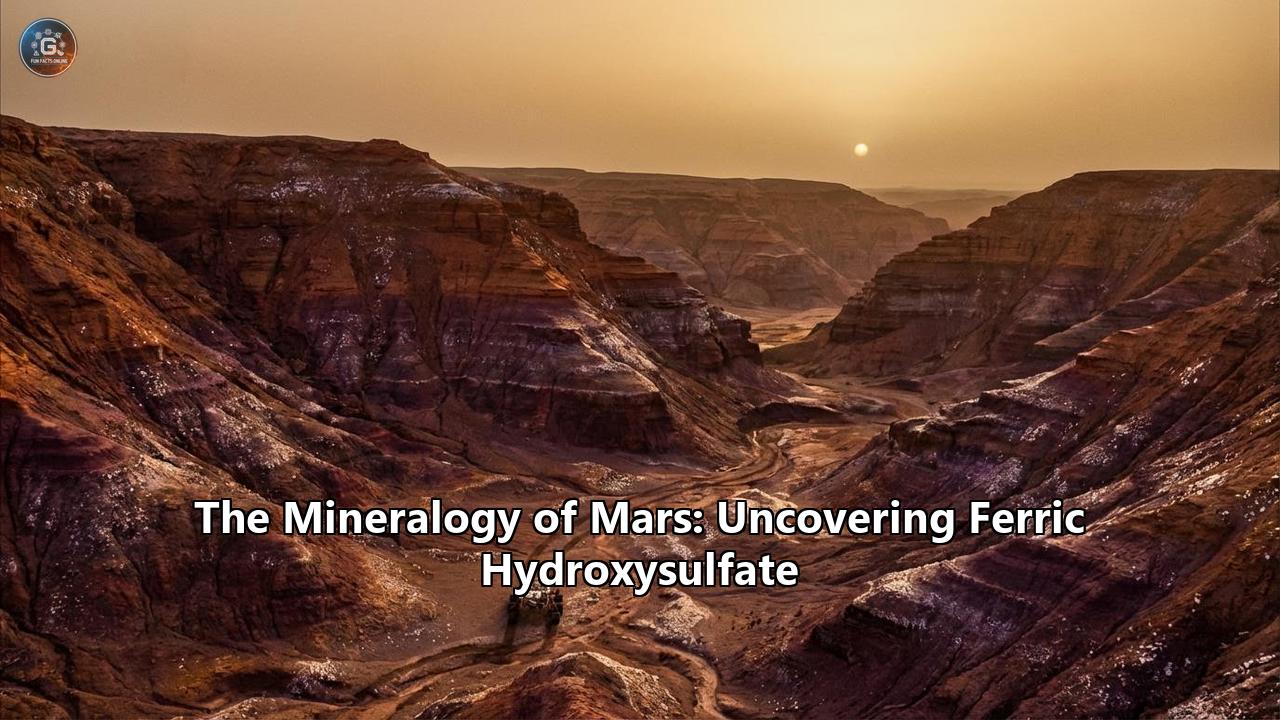
For billions of years, the Red Planet has guarded its secrets beneath a veil of freezing, oxidized dust. To the untrained eye, Mars is a static world—a barren, rust-colored desert suspended in the vacuum of space. But to planetary scientists and geochemists, the Martian surface is a dynamic, frozen archive of apocalyptic floods, ancient volcanoes, and churning hydrothermal systems. The key to unlocking this archive does not lie in the broad, sweeping vistas of impact craters or the towering peaks of extinct volcanoes, but in the microscopic crystalline structures of the rocks themselves.
The mineralogy of Mars is the ultimate storyteller of the planet's geologic and climatic past. Minerals are born of specific chemical reactions, requiring exact temperatures, pressures, and environmental conditions to form. By mapping the minerals present on Mars today, scientists can reverse-engineer the environments of a world that existed billions of years ago. And recently, this intricate practice of planetary forensics has yielded a profound breakthrough.
Hidden within the planet’s ancient, layered sedimentary rocks, scientists have uncovered a completely new phase of iron sulfate: ferric hydroxysulfate. This extraordinary discovery—an anomaly that puzzled researchers for nearly two decades—is not merely the addition of a new entry to the catalog of Martian geology. It is a revelation that rewrites our understanding of the planet’s thermal and chemical timeline, suggesting that Mars harbored intense geothermal and volcanic activity far more recently than previously believed.
To understand the magnitude of this discovery, we must take a deep dive into the evolution of Martian mineralogy, the profound role of sulfur and acidic brines on the Red Planet, and the cutting-edge fusion of orbital spectroscopy, artificial intelligence, and laboratory synthesis that finally solved a twenty-year mystery.
The Sulfur Story: A Tale of Two Planets
If you want to understand the history of water on Mars, you must follow the sulfur.
On Earth, sulfur is abundant, often spewed into the atmosphere by volcanic eruptions or locked within the crust. However, when sulfur combines with oxygen and other elements to form sulfate minerals on Earth, those minerals face a hostile environment: the terrestrial water cycle. Most sulfates are highly soluble. When exposed to Earth's relentless rain, flowing rivers, and churning oceans, they rapidly dissolve and wash away, recycling back into the planet's dynamic geochemical loop.
Mars, by contrast, is a hyper-arid, freezing desert. It lacks the persistent rainfall and tectonic recycling of Earth. Because of this, when water dried up on Mars billions of years ago, the sulfate minerals left behind were effectively frozen in time. They have persisted on the surface for eons, serving as pristine, durable chemical fossils that preserve the exact conditions of the water from which they precipitated.
The immense concentration of sulfur on the Martian surface has long been a defining characteristic of the planet. Data from the Viking landers in the 1970s first hinted at sulfur-rich soils, but it was the era of the modern rovers that truly blew the lid off the Martian sulfur story. The high elemental abundance of sulfur—sometimes reaching up to 30% by weight in certain soils in Gusev Crater—provided undeniable evidence that acid-sulfate weathering played a dominant role in shaping the planet's crust.
The Jarosite Paradigm: Opportunity at Meridiani Planum
The modern voyage of Martian mineralogical discovery achieved a landmark victory in 2004. NASA’s Opportunity rover had just bounced to a halt inside a small impact crater on the vast, flat expanse of Meridiani Planum. Upon examining the local bedrock outcropping dubbed "El Capitan," the rover’s Mössbauer spectrometer detected a mineral that would forever alter Martian history: jarosite.
Jarosite is an amber-yellow-brown hydrous sulfate of potassium and iron. On Earth, it is often found in harsh, toxic environments, such as the highly acidic runoff of mine drainage, or forming near volcanic vents where sulfur-rich fluids alter surrounding rock.
The presence of jarosite at Meridiani Planum was a smoking gun. Because jarosite requires liquid water, highly acidic conditions (a low pH), and an oxidizing environment to form, its discovery provided the first definitive, in-situ proof that liquid water once flowed on the Martian surface. But this was not the pure, neutral water of a babbling Earth brook; this was a dilute sulfuric acid groundwater, a caustic brine that percolated through the basaltic sands, leaching out iron and magnesium, and eventually evaporating to leave behind layered sulfate deposits.
The jarosite discovery established a new paradigm: early Mars was wet, but it was also incredibly acidic and salty. Similar findings followed. The Spirit rover found heavily leached acid-sulfate soils in Gusev Crater, and the Curiosity rover later discovered jarosite and hematite within the fluvial and lacustrine (lakebed) mudstones of Gale Crater.
However, while jarosite proved that Mars was once wet and acidic, it represented an ancient chapter in the planet's history—the Noachian and Hesperian periods, dating back over 3 billion years, when water was still relatively abundant. As Mars transitioned into the Amazonian period, its climate shifted drastically. The atmosphere thinned, the surface froze, and the water disappeared. Or so we thought.
The 20-Year Mystery of the 2.236 µm Anomaly
As the rovers crawled across the surface, a fleet of orbiters mapped the planet from above. Among the most powerful tools ever sent to Mars is the Compact Reconnaissance Imaging Spectrometer for Mars (CRISM), an instrument aboard NASA’s Mars Reconnaissance Orbiter (MRO).
CRISM is a hyperspectral imager. It analyzes the sunlight reflecting off the Martian surface, splitting the light into hundreds of distinct colors or "bands," including those in the near-infrared spectrum invisible to the human eye. Because different minerals absorb and reflect light at very specific wavelengths based on their molecular bonds and crystal structures, CRISM can effectively "see" the chemical composition of the ground from hundreds of miles in space.
In 2010, researchers poring over CRISM data noticed something entirely perplexing. In specific, highly localized regions of Mars, the spectrometer recorded a unique, deep absorption band at exactly 2.236 micrometers (µm).
This spectral fingerprint was an anomaly. It did not match jarosite. It did not match gypsum, hematite, szomolnokite, or any of the familiar iron or magnesium sulfates cataloged in the extensive libraries of known terrestrial minerals. The anomalous signature was found within thick, layered sedimentary rocks, teasing scientists with the promise of a major geochemical discovery. But without an Earth analog to compare it to, the mineral remained an unidentified ghost in the data for nearly twenty years.
The mystery was compounded by the notorious difficulty of analyzing Martian orbital data. "The light—which travels from the sun to the mineral to CRISM—has to go through the Martian atmosphere twice," explained Dr. Mario Parente, an associate professor at the University of Massachusetts Amherst and a key investigator in the mystery. The Martian atmosphere is packed with carbon dioxide and suspended dust, which scatter and absorb light, distorting the pristine spectral signals of the surface.
To cut through the noise, Parente and his team utilized advanced deep learning and artificial intelligence algorithms. By training AI to automatically recognize and correct for atmospheric distortions pixel by pixel, they were able to clean the CRISM data. This technological leap allowed the team to pinpoint exactly where this mystery mineral was located and to map its distribution with unprecedented clarity.
The refined maps revealed that this unknown mineral was concentrated in two highly compelling geological locations: Aram Chaos and the Juventae Plateau.
Aram Chaos and Juventae Plateau: Landscapes of Destruction
To understand the environment that birthed this mysterious mineral, one must visualize the sheer scale and violence of the Valles Marineris region. Valles Marineris is the grandest canyon in the solar system, a tectonic scar stretching 4,000 kilometers across the Martian equator, plunging up to 7 kilometers deep.
Just northeast of this massive chasm lies Aram Chaos. Aram Chaos is a heavily eroded, ancient impact crater measuring some 280 kilometers across. Its floor is a fractured, jumbled nightmare of massive blocky mesas and deep valleys—a "chaotic terrain." Geologists believe these landscapes formed when catastrophic mega-floods, triggered by the sudden melting of subsurface ice or the violent release of pressurized groundwater, undermined the surface, causing it to collapse into a chaotic jumble. As the floodwaters eventually drained and evaporated, they left behind massive, layered deposits of iron and magnesium sulfates.
Within Aram Chaos, the orbital data revealed a distinct stratigraphy (layering). The uppermost layers were rich in polyhydrated sulfates (sulfates containing multiple water molecules). But locked beneath them, shielded from the immediate surface, lay layers of monohydrated sulfates and the elusive 2.236 µm mystery mineral.
The second site, the Juventae Plateau, sits just north of Valles Marineris, bordering a 5-kilometer-deep canyon called Juventae Chasma. The plateau shows tantalizing signs of an ancient, wetter past, with dry channels carved into the landscape. But the unknown mineral wasn't found everywhere; it was isolated to a small, low-lying depression. Here, the mystery mineral sat in meter-thick layers, seemingly deposited when pools of highly concentrated, sulfate-rich water slowly evaporated.
With the locations mapped and the spectral data pristine, the challenge moved from the realm of computer science back to the chemistry lab.
Cooking the Rocks: The Synthesis of Ferric Hydroxysulfate
The definitive breakthrough was achieved by a team led by Dr. Janice Bishop, a senior research scientist at the SETI Institute and NASA’s Ames Research Center. Armed with the refined spectral data, Bishop's team set out to reproduce the Martian anomaly in the laboratory.
The prevailing theory was that the 2.236 µm band belonged to some form of dehydrated iron sulfate. The team began experimenting with various hydrated ferrous ($Fe^{2+}$) sulfates. One such starting material was rozenite, a tetrahydrated ferrous sulfate containing four water molecules. On Earth, rozenite is a secondary mineral that forms under specific, low-temperature, low-humidity conditions.
The researchers subjected the rozenite and other similar minerals to a gauntlet of environmental stresses, altering the temperature, acidity (pH), and atmospheric composition to simulate various Martian conditions.
The "Eureka" moment occurred when the researchers subjected the hydrous ferrous sulfates to intense heat in an acidic, oxygen-rich environment. When the temperature breached 100°C (212°F)—far hotter than the typical freezing ambient conditions of the Martian surface—the chemistry of the mineral underwent a radical transformation.
The heat and oxygen forced the ferrous ($Fe^{2+}$) iron to oxidize into ferric ($Fe^{3+}$) iron. Simultaneously, the mineral lost water molecules. The result was a new crystalline phase: ferric hydroxysulfate ($Fe^{3+}SO_4OH$).
When the team measured the light-absorbing properties of their newly synthesized laboratory mineral, the results were undeniable. The lab-grown ferric hydroxysulfate produced a strong, distinct absorption band at exactly 2.236 µm. The twenty-year mystery was solved. The spectral fingerprint spanning Aram Chaos and the Juventae Plateau belonged to ferric hydroxysulfate.
Interestingly, this discovery is so novel that ferric hydroxysulfate may represent an entirely new mineral species to science. "The material formed in these lab experiments is likely a new mineral due to its unique crystal structure and thermal stability," Dr. Bishop noted. The compound shares a crystal structure somewhat similar to szomolnokite (a monohydrated ferrous sulfate), but its unique chemical makeup sets it apart. By the strict rules of the International Mineralogical Association, a mineral can only be officially named and recognized if it is found occurring naturally on Earth. Until geologists find a natural deposit of ferric hydroxysulfate hidden in a terrestrial volcano or an acidic mine dump, it remains a mineral whose only known natural home is the planet Mars.
Fire and Water: Rewriting the Martian Timeline
The identification of ferric hydroxysulfate is not just a triumph of chemical sleuthing; it is a profound geologic time capsule that dramatically alters our understanding of Martian history.
To understand why, we must look at the thermodynamic requirements of the mineral. Ferric hydroxysulfate does not form in a cold, evaporating puddle. It requires an initial stage of water to form the base hydrated sulfates, followed by a secondary stage of intense, localized heating (50°C to well over 100°C) in an oxidizing environment.
The hydrated sulfates found on the surface of Mars generally formed through low-temperature alteration or slow evaporative processes. But the presence of ferric hydroxysulfate demands a source of extreme heat capable of baking these ancient, dried-up seabeds.
So, where did the heat come from?
The research team concluded that the environments at Aram Chaos and Juventae Plateau experienced two different mechanisms of extreme heating. At Aram Chaos, the heat was likely geothermal, emanating from deep within the Martian crust. The area's chaotic collapse may have been linked to subsurface magma bodies warming the overlying aquifers. The heat radiated upward, cooking the existing iron sulfate deposits and transforming them into ferric hydroxysulfate.
At the Juventae Plateau, the heating mechanism was likely more violent and direct. The presence of the mineral in isolated topographic depressions suggests that existing sulfate-rich pools were baked from above. This points toward active volcanism—specifically, the deposition of blistering volcanic ash or flowing lava blanketing the wet sulfate deposits, flashing the water to steam and chemically altering the rocks left behind.
The most staggering aspect of this conclusion is the timing. Geologic evidence and crater-counting methodologies suggest that the sulfate deposits at Aram Chaos and Juventae Plateau, and the subsequent heating events that created the ferric hydroxysulfate, likely occurred during the Amazonian period.
The Amazonian period is the current geological epoch of Mars, beginning roughly 3 billion years ago. For decades, the consensus in planetary science was that the Amazonian was a quiet, dead period—a time when Mars had already lost its thick atmosphere, its surface water had frozen or sublimated away, and its volcanic heart had largely gone cold.
The discovery of ferric hydroxysulfate shatters this notion. "This discovery suggests that parts of Mars have remained chemically and thermally active more recently than previously believed," offering profound new insights into a planet that refused to go quietly into the cosmic night. The presence of this mineral proves that long after the global oceans had vanished, Mars still possessed localized pockets of intense heat, liquid water, and violent chemical change.
The Chemistry of the Brines: Halogens and Habitability
The realization that Mars harbored hot, acidic, sulfate-rich environments late into its history directly impacts the greatest question of all: Could Mars have supported life?
To answer this, we must look at the specific nature of the water that facilitated these minerals. The Martian water was not pure; it was a brine. Laboratory simulations designed to mimic the Martian crust interacting with water and an acidic, volcanic atmosphere (rich in gases like $SO_2$, $HCl$, and $NO_2$) have successfully produced synthetic sulfate-chloride brines. These brines are heavily loaded with cations like calcium, magnesium, aluminum, and iron, and anions like sulfate and chloride.
Brines are crucial to the story of Martian habitability for a simple physical reason: salt lowers the freezing point of water. While pure water freezes at 0°C, a highly concentrated brine can remain liquid at temperatures plunging to -40°C or even -70°C for certain perchlorate mixtures. This means that briny water could persist in a liquid state on the frigid surface of Mars long after pure water would have turned to solid ice.
Furthermore, these ancient Martian brines were acting as chemical sponges, specifically absorbing halogens like chlorine and bromine. Recent experimental studies have systematically investigated how minerals like jarosite capture halogens from their environment. It turns out that jarosite acts as a highly selective "sink" for bromine in cold, acidic brines. When researchers analyze the halogen inventory locked within the crystal lattice of Martian sulfates, they are effectively reading a thermometer and a pH meter of the ancient waters, reconstructing the precise chemistry of the fluids that once flowed.
When we combine the persistent, low-temperature liquid nature of brines with the sudden introduction of extreme geothermal or volcanic heat—the exact conditions required to forge ferric hydroxysulfate—we create something extraordinary: a hydrothermal system.
On Earth, hydrothermal systems are the crucibles of extreme life. From the boiling, acidic, sulfur-rich hot springs of Yellowstone National Park to the deep-sea hydrothermal vents at the bottom of the ocean, where water and magma meet, biology thrives. Extremophiles—specifically acidophiles (acid-loving) and thermophiles (heat-loving) bacteria—flourish in these toxic, boiling chemical stews.
The discovery of ferric hydroxysulfate indicates that late-stage Mars had exactly these types of environments: wet, acidic, mineral-rich, and hot. "Temperature, pressure and conditions such as pH are all very important indications of what the paleoclimate was," notes Dr. Parente. "The presence of this mineral puts a lot more nuance on what was going on".
If microbial life ever originated on Mars during its wetter, more temperate Noachian youth, it would have been forced into retreating ecosystems as the planet cooled and dried. The geothermally heated, brine-filled aquifers and volcanic hot springs mapped by the presence of ferric hydroxysulfate would have served as the ultimate underground oases—the last habitable refuges for a dying Martian biosphere.
A New Lens on the Red Planet
The unmasking of ferric hydroxysulfate is a testament to the tenacity of the scientific process. It bridges the gap between robotic explorers millions of miles away, artificial intelligence churning through terabytes of distorted light, and geochemists patiently baking rocks in Earth-bound laboratories.
Every mineral identified on Mars adds a vital brushstroke to the painting of its past. When Opportunity found jarosite, it showed us a world of shallow, acidic, evaporating seas. When Curiosity drilled into the mudstones of Gale Crater, it showed us long-lived freshwater lakes that eventually turned to salty, sulfate-rich pools as the climate dried.
Now, the identification of ferric hydroxysulfate adds a dramatic new chapter of fire and steam. It tells the story of a world that, even as it was dying, still possessed enough internal fury to crack its crust, spew lava, and boil its remaining subterranean waters. It paints a picture of Aram Chaos and Juventae Chasma not just as frozen, desolate canyons, but as once-steaming, geothermally active cauldrons.
As humanity looks toward the horizon of Mars Sample Return missions and the eventual arrival of crewed expeditions, our understanding of Martian mineralogy becomes ever more critical. The rocks we choose to bring back to Earth will not be selected at random. They will be targeted based on their ability to preserve the past. Sulfates, with their incredible capacity to trap halogens, lock away isotopic signatures, and potentially entomb the organic biosignatures of ancient life, will be prime targets.
The rust-red dust of Mars is not a shroud of a dead world. It is the protective cover of a magnificent, violent, and complex geological history. By decoding the minerals hidden within it—one spectral band, one microscopic crystal at a time—we are finally learning to read the autobiography of a planet. And as the discovery of ferric hydroxysulfate proves, the Red Planet still has a few surprises left to reveal.
Reference:
- https://www.sciencedaily.com/releases/2026/03/260309225228.htm
- https://astrobiology.com/2025/08/characterization-of-ferric-hydroxysulfate-on-mars-and-implications-of-the-geochemical-environment-supporting-its-formation.html
- https://www.sci.news/space/new-mineral-mars-14262.html
- https://scitechdaily.com/a-mysterious-mineral-on-mars-may-rewrite-the-planets-geologic-history/
- https://www.seti.org/news/a-unique-martian-mineral-offers-fresh-clues-about-planet-s-past/
- https://ntrs.nasa.gov/api/citations/20160006674/downloads/20160006674.pdf
- https://www.ansto.gov.au/news/jarosite-on-earth-and-mars
- https://news.cornell.edu/stories/2004/03/how-obscure-mineral-provided-vital-clue-martian-water
- https://pubmed.ncbi.nlm.nih.gov/15483605/
- https://ahed.nasa.gov/datasets/b425b97a4c6d28c04f87d5b49f36
- https://www.umass.edu/news/article/umass-researchers-help-id-new-mineral-mars-providing-insight-red-planets-potential
- https://www.earth.com/news/mineral-discovery-sheds-light-on-mars-fiery-past/
- https://pmc.ncbi.nlm.nih.gov/articles/PMC12420771/
- https://www.eurasiareview.com/16122025-mars-salty-secrets-how-ancient-brines-imprinted-their-chemical-fingerprints-in-martian-minerals/