
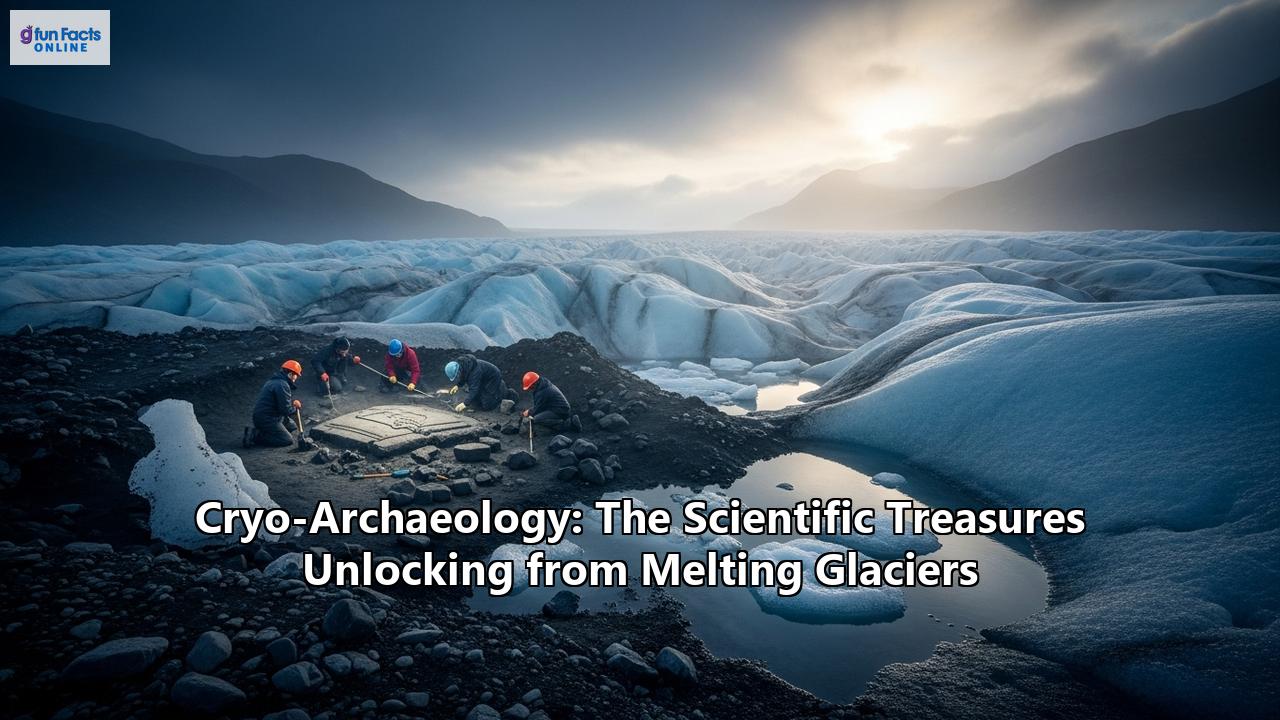
Cryo-Archaeology: The Scientific Treasures Unlocking from Melting Glaciers
In the vast, frozen expanses of our planet's high altitudes and polar regions, a silent and irreversible transformation is underway. Climate change is causing glaciers and ice patches, which have remained frozen for millennia, to melt at an unprecedented rate. While this retreat signals a profound environmental crisis, it is also paradoxically unveiling a treasure trove of perfectly preserved human history. This has given rise to a new and urgent field of scientific study: cryo-archaeology, or glacial archaeology. As these natural deep freezers release their hold, they are offering an unparalleled window into the lives of our ancestors, revealing artifacts and human remains in a state of preservation that revolutionizes our understanding of the past.
Cryo-archaeology is, in essence, a race against time. The very forces that expose these invaluable relics also threaten their immediate destruction. Organic materials like wood, leather, textiles, and flesh, which would normally decay and disappear from the archaeological record, are emerging from the ice in pristine condition. However, once exposed to the elements, they can deteriorate in a matter of days. This urgency has galvanized a dedicated community of archaeologists, scientists, and indigenous communities to collaborate on the recovery and study of these fleeting glimpses into our shared human story.
The Birth of a New Archaeological Frontier
The term "cryo-archaeology" is derived from the Greek "kryos," meaning "icy cold," and "archaeology," the study of human history and prehistory. It specifically refers to the investigation of artifacts and biological remains that have been preserved in glacial ice and are now being exposed due to melting. This emerging discipline has gained significant momentum in recent decades, directly linked to the accelerating impacts of global warming.
While local communities and mountaineers have sporadically encountered finds from the ice for centuries, the formal recognition of cryo-archaeology as a distinct field is a relatively recent development. It was the sensational discovery of "Ötzi the Iceman" in 1991 that catapulted this specialized area of research into the global spotlight. Found by hikers in the Ötztal Alps on the border between Austria and Italy, Ötzi is the naturally mummified body of a man who lived over 5,300 years ago. His remarkably preserved body, along with his clothing and a complete set of Copper Age tools, offered an unprecedented snapshot of life in prehistoric Europe. The sheer volume of scientific data gleaned from Ötzi underscored the immense potential of glacial ice as a repository of human history.
The discovery of Ötzi served as a catalyst, prompting archaeologists to wonder what other secrets were locked away in the world's mountain ice. It became clear that Ötzi was not an isolated miracle of preservation but rather the first of many incredible discoveries to come. In the years that followed, particularly with intensifying summer melts, a wave of significant finds began to emerge from ice patches in North America, Scandinavia, and the Alps, solidifying cryo-archaeology as a critical and time-sensitive field of study.
Time Capsules of the Past: The Nature of Glacial Finds
The unique preservative qualities of ice are what make cryo-archaeology so extraordinary. Unlike typical archaeological sites where organic materials rarely survive, the cold, low-oxygen environment of glaciers and ice patches acts as a natural deep freeze. This allows for the survival of artifacts made from wood, leather, birch bark, textiles, and even feathers, providing a much more complete picture of past material cultures.
These frozen archives are not limited to a single period but span a vast chronology of human history, from the Stone Age to the medieval period and beyond. The types of artifacts discovered are incredibly diverse, offering insights into various aspects of ancient life. These include:
- Hunting Equipment: A wealth of hunting tools has been recovered, including arrows with preserved feathers, bows, spears, and atlatls (spear-throwers). These finds not only demonstrate the evolution of hunting technology but also provide information about the species being hunted, such as reindeer and bison. In Norway, for example, a 1,300-year-old arrow was found in near-perfect condition, with its iron arrowhead and parts of its feather fletching still intact. Another remarkable find from Norway is a 1,500-year-old "scaring stick," used to guide reindeer toward waiting hunters.
- Clothing and Textiles: The discovery of ancient clothing and textiles offers a rare and intimate glimpse into the daily lives of past peoples. Finds range from a 3,400-year-old leather shoe in Norway to a 1,700-year-old tunic from the Lendbreen ice patch. In Canada, archaeologists have unearthed a 6,200-year-old piece of woven fabric and a moccasin-like boot. These garments provide invaluable information about ancient textile production, clothing styles, and how people adapted to cold environments.
- Transportation and Travel: Artifacts related to travel and transport in mountainous regions are also common. These include fragments of sleds, horseshoes, and even a complete 1,300-year-old ski with its binding, discovered in Norway. One of the most unique finds from the Viking Age is a packhorse net from Norway, which was used to carry goods over mountain passes. These discoveries are helping archaeologists reconstruct ancient trade and travel routes, such as the one identified at the Lendbreen ice patch, which was a vital corridor from the Roman Iron Age through the Viking Age.
- Human and Animal Remains: The preservation of human and animal remains is perhaps the most profound contribution of cryo-archaeology. Ötzi the Iceman remains the most famous example, but other significant human remains have been found, including the 300 to 550-year-old body of a young Indigenous man in the Yukon, named Kwaday Dän Ts'ìnchi, which translates to "long-ago person found." The remains of animals, such as packhorses, dogs, and ancient bison, also provide crucial data on past ecosystems and human-animal relationships.
Global Hotspots for Cryo-Archaeological Discoveries
While glacial finds can occur in any mountainous region with perennial ice, several areas around the globe have emerged as particularly rich hotspots for cryo-archaeology.
Scandinavia: A Window into the Viking Age and Beyond
The mountains of Norway have yielded an astonishing number of glacial artifacts, making it a leading region for this type of research. The "Secrets of the Ice" program, a collaboration between the Innlandet County Council and the Museum of Cultural History in Oslo, has been at the forefront of these discoveries. To date, they have recovered over 4,000 artifacts from more than 60 sites.
One of the most significant sites is the Lendbreen ice patch, which has been identified as a lost mountain pass. Used extensively from the Roman Iron Age to the medieval period, the pass has yielded over a thousand artifacts, including clothing, tools, and the remains of packhorses. The discoveries at Lendbreen paint a vivid picture of a bustling trade route, connecting inland farming communities with coastal regions. Another key area is the Jotunheimen Mountains, where finds have included the aforementioned Viking Age packhorse net and a 3,000-year-old arrow. The remarkable preservation of these objects, such as arrows with fletching and sinew still intact, provides an unparalleled level of detail for archaeologists.
North America: Uncovering Indigenous Heritage
In North America, cryo-archaeology is shedding new light on the long history of Indigenous peoples in mountainous regions. Ice patches in the Yukon Territory of Canada and the Rocky Mountains of the United States have preserved a rich record of ancient hunting practices. In the Yukon, the traditional territory of the Champagne and Aishihik First Nations, the discovery of Kwaday Dän Ts'ìnchi has been a poignant moment, connecting contemporary communities with their ancestors. DNA analysis of his remains has even identified living relatives.
In the Greater Yellowstone Area, archaeologists like Craig Lee have been instrumental in identifying and studying artifacts emerging from the ice. A 10,300-year-old atlatl dart, a type of throwing spear that predates the bow and arrow, was found near Yellowstone National Park, making it the oldest known wooden foreshaft in North America. Other finds in this region include a 650-year-old birch bark basket and a twisted leather artifact that is approximately 1,370 years old. These discoveries challenge previous understandings of high-altitude land use and demonstrate the advanced technological adaptations of ancient Indigenous peoples. In Alaska, collaborative projects with Indigenous communities are helping to piece together a 10,000-year history of human resilience and adaptation in the Arctic.
The Alps: The Legacy of Ötzi and More
The European Alps will forever be associated with cryo-archaeology due to the discovery of Ötzi the Iceman. Found at an altitude of 3,210 meters in the Tisenjoch pass, Ötzi's body was so well-preserved that scientists were able to determine his age (approximately 45), his health (he suffered from arthritis and intestinal parasites), his last meal, and even the fact that he was murdered, with an arrowhead lodged in his shoulder.
Beyond Ötzi, the Alps continue to yield significant finds. In Switzerland, the remains of Bronze Age bows, arrows, and a wooden "lunchbox" containing ground flour were discovered at an altitude of nearly 2,700 meters. These artifacts, likely left by hunters or herders around 4,000 years ago, provide further evidence of the long history of human activity in these high-altitude environments. The melting ice is also revealing artifacts from more recent history, including the remains of soldiers from World War I.
The Andes: High-Altitude Sanctuaries of the Inca
The Andes Mountains of South America represent another important frontier for glacial archaeology. Here, the focus has often been on high-altitude Inca sites. In 1999, archaeologist Constanza Ceruti co-discovered three incredibly well-preserved frozen mummies of Inca children on the summit of Mount Llullaillaco in Argentina, at an altitude of 6,739 meters. These children were part of an Inca ritual sacrifice, and their remains, along with a collection of associated artifacts, provide a wealth of information about Inca religious practices and beliefs.
More recently, research in the Peruvian Andes has uncovered evidence of some of the world's highest Paleoindian settlements, dating back around 13,000 years. The discovery of stone tools and the remains of hunted animals in the Pucuncho Basin at over 4,000 meters altitude demonstrates that early human populations were able to adapt to these harsh, high-altitude environments much earlier than previously thought.
The Science of Ice: Analyzing the Frozen Past
The artifacts and remains emerging from the ice are only the beginning of the story. A battery of scientific techniques is employed to extract as much information as possible from these finds, turning them into detailed chronicles of the past.
- Radiocarbon Dating: This is a fundamental technique used to determine the age of organic materials. By measuring the decay of carbon-14, scientists can accurately date everything from wooden arrow shafts to leather shoes and human remains, establishing a timeline for the artifacts and the human activities they represent.
- Ancient DNA (aDNA) Analysis: The cold, stable environment of the ice is ideal for the preservation of DNA. Analysis of aDNA from human remains, like that of Ötzi and Kwaday Dän Ts'ìnchi, can reveal genetic ancestry, relationships to modern populations, and even predispositions to certain diseases. aDNA from animal remains can shed light on the history of animal populations and their interactions with humans. Even the ice itself can contain environmental DNA from past plants and microbes, helping to reconstruct ancient ecosystems.
- Stable Isotope Analysis: This technique analyzes the ratios of different isotopes of elements like carbon, nitrogen, and oxygen in organic remains. This can provide a wealth of information about an individual's diet, their geographical origins, and the climate they lived in. For example, isotope analysis of Ötzi's teeth and bones revealed details about his diet and where he spent his childhood.
- Pollen Analysis (Palynology): Pollen grains are incredibly durable and can be preserved for thousands of years in ice and sediment. By analyzing the types and quantities of pollen found in ice cores or even on the artifacts themselves, scientists can reconstruct past vegetation and climates. This provides a crucial environmental context for the archaeological finds.
- Ice Core Analysis: Ice cores drilled from glaciers and ice sheets are like layered diaries of past climate and atmospheric conditions. Each layer of ice represents a specific time period, and trapped within the ice are air bubbles, dust, volcanic ash, and pollen. Analyzing these inclusions allows scientists to reconstruct past temperatures, greenhouse gas concentrations, and major environmental events, which can then be correlated with the archaeological record.
The Challenges of a Melting Archive
Cryo-archaeology is a field defined by its challenges. The extreme environments in which these discoveries are made, coupled with the race against time imposed by climate change, create a unique set of logistical, technical, and ethical hurdles.
Fieldwork in Extreme Environments
Conducting archaeological fieldwork in high-altitude glacial environments is a formidable undertaking. The field season is often very short, limited to a few weeks in late summer between the melting of the previous winter's snow and the arrival of the new. Archaeologists must be prepared for extreme and unpredictable weather, including blizzards and freezing temperatures.
The logistics of reaching these remote sites can be complex and expensive, often requiring long hikes with heavy backpacks, the use of packhorses, or even helicopters. Safety is a paramount concern, with risks including falls on treacherous terrain, hypothermia, and the dangers of working on or near unstable ice. The archaeologists who work in this field are often skilled mountaineers as well as scientists.
The process of finding sites itself is a challenge. Archaeologists use a combination of methods, including studying maps and satellite imagery to identify non-moving ice patches (which are better for preservation than active glaciers), looking for signs of past human activity like hunting blinds, and following up on reports from hikers and local residents. Once a site is identified, the survey work is painstaking, involving systematic searches along the edge of the melting ice.
The Race Against Decay: Conservation of Glacial Finds
Perhaps the most critical challenge in cryo-archaeology is the preservation of the artifacts once they are exposed. Organic materials that have been frozen for centuries are incredibly fragile and can begin to decay rapidly upon contact with air, sunlight, and moisture. This makes the immediate recovery and proper conservation of these objects absolutely essential.
Waterlogged artifacts, such as wood and leather, are particularly vulnerable. As they dry out, their cellular structures can collapse, leading to shrinkage and disintegration. To prevent this, conservators employ a range of specialized techniques. One common method is freeze-drying, where the object is frozen and the water is removed through a process of sublimation under a vacuum. This minimizes damage to the object's structure.
Another widely used technique, especially for large wooden artifacts, involves replacing the water in the wood cells with a stabilizing agent, such as polyethylene glycol (PEG). This is a slow and painstaking process that can take years to complete. Textiles recovered from the ice also require careful handling and storage in controlled environments with stable temperature and humidity to prevent deterioration. Freezing can also be used as a conservation method to kill insects that might damage textiles.
Ethical Considerations and Indigenous Collaboration
Cryo-archaeology raises a number of important ethical questions, particularly when it comes to the discovery of human remains and the investigation of sites with deep cultural significance to Indigenous communities. The excavation and study of ancestors like Ötzi and Kwaday Dän Ts'ìnchi require a respectful and sensitive approach.
In recent years, there has been a growing emphasis on collaborative archaeology, where researchers work in close partnership with Indigenous communities. This approach recognizes that Indigenous peoples have a profound and long-standing connection to the lands where these discoveries are made, and that their traditional knowledge and oral histories can provide invaluable context for the archaeological finds.
Collaborative projects, such as those in Alaska and the Yukon, involve Indigenous representatives in all stages of the research process, from planning and fieldwork to the interpretation and curation of artifacts. This not only ensures that the research is conducted in a culturally appropriate manner but also enriches the scientific understanding of the past. Furthermore, these projects can play a powerful role in cultural revitalization, helping to connect younger generations with their heritage and reaffirming the deep historical ties of Indigenous communities to their ancestral lands.
The Future of Cryo-Archaeology
The future of cryo-archaeology is inextricably linked to the future of our planet's climate. As glaciers and ice patches continue to melt, it is certain that more incredible discoveries will be made. This presents both a unique opportunity and a profound responsibility for the archaeological community.
Technological advancements will undoubtedly play a key role in the future of the field. Remote sensing technologies, such as satellite imagery and GIS (Geographic Information Systems), are becoming increasingly sophisticated, allowing archaeologists to more effectively identify potential sites and monitor melting in vast and inaccessible areas. Drones are also becoming a valuable tool for surveying and mapping sites.
International collaboration will also be crucial. The challenges of cryo-archaeology are global, and sharing knowledge, expertise, and resources across national borders will be essential for maximizing the scientific and cultural benefits of these discoveries.
However, the overarching reality is that cryo-archaeology is a field with a finite lifespan. Scientists estimate that a large percentage of the world's mountain ice could disappear by the end of this century. This means that the window of opportunity for recovering these frozen treasures is rapidly closing. The work being done by cryo-archaeologists today is not just about uncovering the past; it is a salvage operation on a global scale, an urgent mission to rescue our shared human heritage before it melts away forever.
The stories emerging from the ice are a poignant reminder of our deep connection to the environment and the profound impact that climate change is having on our planet. They are also a testament to the resilience, ingenuity, and rich cultural history of the people who came before us. As we continue to unlock these scientific treasures from the world's melting glaciers, we are not only rewriting the pages of human history but also gaining a deeper understanding of our place within it.
Reference:
- https://qz.com/1697545/climate-change-is-giving-life-to-the-study-of-glacial-archaeology
- https://secretsoftheice.com/news/2018/01/26/global-warming/
- https://medium.com/@lindaellisphd/how-climate-change-affects-archaeology-aca03fc3f840
- https://www.arcus.org/witness-the-arctic/2016/2/article/25680
- https://www.startmotionmedia.com/what-glacial-archaeology-is-and-why-its-growing/
- https://secretsoftheice.com/annet/glacier-archaeology-exhibitions/
- https://journal.equinoxpub.com/JGA/article/download/253/207/415
- https://www.jpost.com/archaeology/archaeology-around-the-world/article-843972
- https://journal.equinoxpub.com/JGA/article/view/19823
- https://www.researchgate.net/publication/231013159_The_freeze-drying_of_wet_and_waterlogged_materials_from_archaeological_excavations
- https://collectionstrust.org.uk/wp-content/uploads/2020/04/SMA_Fact_Sheet_Waterlogged_Materials.pdf
- https://www.smithsonianmag.com/blogs/national-museum-of-natural-history/2025/08/19/meet-the-scientist-tracing-10000-years-of-indigenous-life-along-alaskas-southern-coast/
- https://secretsoftheice.com/fieldwork/finding-the-glacial-archaeologcal-sites/
- https://www.tandfonline.com/doi/full/10.1080/00934690.2021.2012330
- https://secretsoftheice.com/fieldwork/documenting-glacial-archaeological-sites/
- https://journal.equinoxpub.com/JGA/about
- https://www.researchgate.net/publication/368912375_Glacial_Archaeology_Progress_and_Future_Directions
- https://www.scienceopen.com/collection/22d76b68-1604-4ea4-b924-a9d0239e2a81
- https://blockapps.net/blog/preservation-techniques-for-antique-textiles/
- https://www.tandfonline.com/doi/pdf/10.1080/00934690.2021.2012330
- https://maxwellmuseum.unm.edu/exhibits/traveling/archeology-ice
- https://www.discovermagazine.com/how-indigenous-oral-tradition-is-guiding-archaeology-and-uncovering-climate-42223
- https://news.artnet.com/art-world/norway-ice-archeology-2369685
- https://brigantesnation.com/guide-introduction-to-glacial-archaeology/
- https://courier.unesco.org/en/articles/impact-climate-change-archaeological-sites
- https://www.froilabo.com/blog/historic-textile-conservation-freezing-preservation-method/
- https://www.mdpi.com/1999-4907/12/9/1193
- https://cool.culturalheritage.org/jaic/articles/jaic31-03-006.html
- https://secretsoftheice.com/news/2017/03/02/insider/
- https://www.researchgate.net/publication/353971203_Tracking_the_Cold_Remote_Sensing_for_Glacial_Archaeology
- https://en.wikipedia.org/wiki/Conservation_and_restoration_of_waterlogged_wood
- https://www.museumoftheearth.org/exhibit/glacier-exhibit
- https://www.susted.com/wordpress/content/25-years-pioneering-high-altitude-and-glacial-archaeology-from-the-mountains-of-argentina_2022_02/
- https://www.sciencenorway.no/archaeology-climate-change/glacial-archaeologist-on-melting-ice-in-the-mountains-its-absolutely-extreme/2246091
- https://www.into.org/app/uploads/2022/10/8-Archaeology-Waterlogged-Remains.pdf
- https://highmountainla.com/en/expeditions/logistics-support/
- https://www.researchgate.net/publication/357035669_On_a_Mountain_High_Finding_and_Documenting_Glacial_Archaeological_Sites_During_the_Anthropocene
- https://www.yellowstone.org/high-altitude-archaeology/
- https://heritagecalling.com/2018/03/16/how-to-do-archaeological-conservation/