
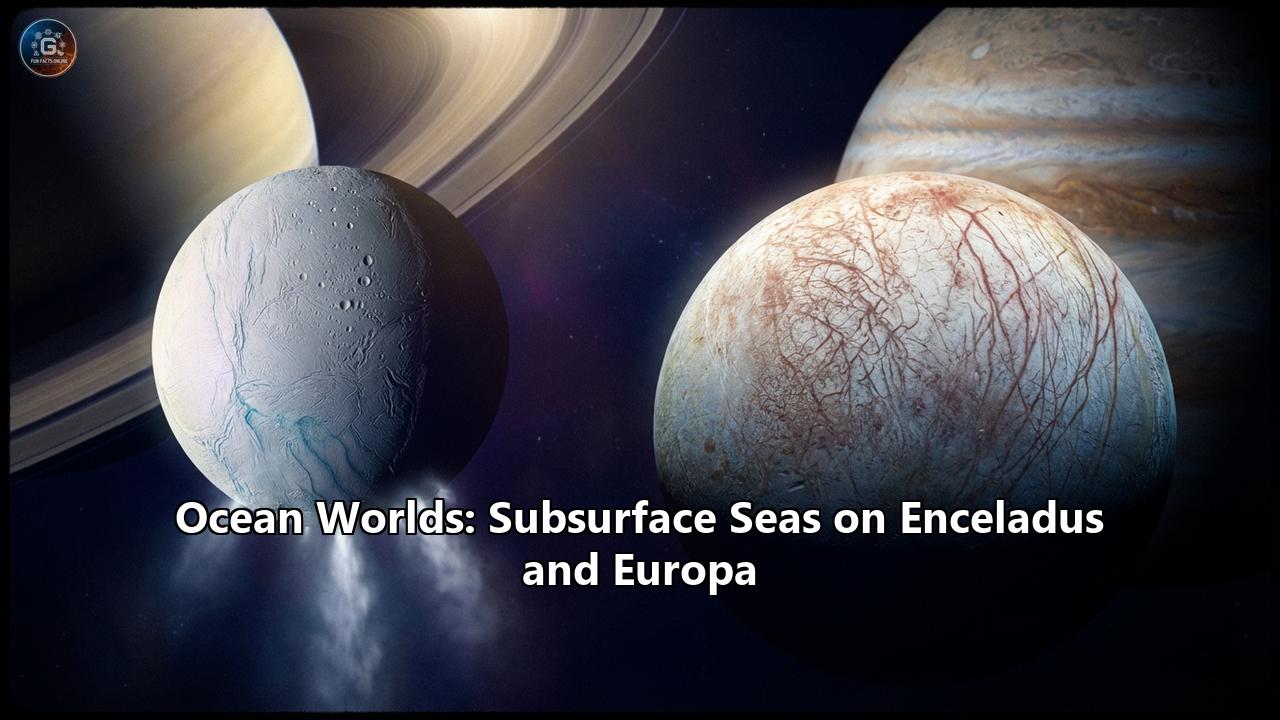
The exploration of our solar system has undergone a profound paradigm shift in the last few decades. For most of the space age, the search for habitable environments was a search for "Earth twins"—rocky planets with atmospheres thick enough to sustain liquid water on their surfaces, orbiting within the narrow "Goldilocks zone" of their parent stars. We looked for blue marbles in the black void, assuming that life required the specific stability of a sun-warmed surface. But the universe, it seems, has a different and far more abundant blueprint for habitability.
We have discovered that the most promising real estate for life in our own solar system is not on the red sands of Mars or the cloud-tops of Venus, but in the dark, cold outer reaches, orbiting the gas giants Jupiter and Saturn. Here, beneath shells of ice harder than granite, lie global oceans of liquid water, kept warm not by the sun, but by the gravitational kneading of their massive parent planets. These are the "Ocean Worlds," and two of them—Enceladus and Europa—stand as the most compelling targets in the history of astrobiology.
As of February 2026, humanity is in the midst of a dedicated return to these icy realms. The Europa Clipper spacecraft, launched in late 2024, is currently sailing through the dark, tracing its complex trajectory toward Jupiter. The European Space Agency’s JUICE mission is also en route, destined to unlock the secrets of the Jovian system. On Earth, laboratories are still decoding the treasure trove of data from the Cassini mission, revealing startling new truths about Enceladus—including the confirmation of phosphorus, a key ingredient for life, in its subterranean seas.
This comprehensive exploration will dive deep into the science, history, and future of Enceladus and Europa. We will peel back their icy crusts to explore the alien oceans beneath, examine the mechanics of their geysers, analyze the chemistry that might support a second genesis of life, and detail the robotic emissaries we have sent to answer the ultimate question: Are we alone?
Part I: The Paradigm Shift – From Surface to Subsurface
To understand the significance of Enceladus and Europa, one must first appreciate the revolution in planetary science that placed them center stage. In the mid-20th century, the "Habitable Zone" was strictly defined by distance from a star. Too close, water boils; too far, it freezes. By this logic, Jupiter (5.2 AU from the Sun) and Saturn (9.5 AU) were frozen wastelands, and their moons were expected to be geologically dead iceballs, preserved in deep-freeze since the solar system's birth.
The Voyager missions of the late 1970s shattered this assumption. As they sped past Jupiter, they saw Io, a moon convulsing with violent volcanism. They saw Europa, a smooth, cracked billiard ball of ice with almost no craters. At Saturn, they saw Enceladus, a tiny, brilliant jewel with terrain that looked suspiciously young. These observations birthed the concept of "Tidal Heating."
Unlike Earth, which is heated by the radioactive decay of elements in its core and residual heat from its formation, these moons are heated by gravity. As they orbit their massive parents in slightly elliptical paths, they are stretched and squeezed like stress balls. This internal friction generates massive amounts of heat—enough to melt rock on Io and, crucially, enough to maintain liquid water beneath the ice of Europa and Enceladus.
This realization expanded the habitable potential of the universe exponentially. If life can exist in a sunless ocean capped by kilometers of ice, fueled by chemical energy from the seafloor, then habitable worlds might outnumber "Earth-like" planets by orders of magnitude. Enceladus and Europa are the archetypes of this new class of world.
Part II: Enceladus – The Tiger of Saturn
Saturn’s moon Enceladus is small—only 504 kilometers (313 miles) in diameter. It could fit comfortably within the borders of the United Kingdom. Before the Cassini mission arrived in 2004, it was largely an afterthought, overshadowed by the methane-shrouded Titan. Yet, Enceladus has proven to be perhaps the single most accessible and promising extraterrestrial habitat we have ever found.
The Discovery of the Plumes
In 2005, the Cassini spacecraft detected something impossible: the moon was influencing Saturn's magnetic field. This prompted mission controllers to lower Cassini's altitude for a closer look. What they found changed history. Streaming from the south pole of this tiny moon were massive jets of water vapor and ice particles, blasting hundreds of kilometers into space at supersonic speeds.
These plumes were originating from four massive fissures dubbed the "Tiger Stripes"—warm, active tectonic fractures roughly 130 kilometers long and spaced 35 kilometers apart. The discovery was momentous. Enceladus was not a dead ice rock; it was active. It was "breathing" its ocean out into space.
The Global Ocean and Core
Initially, scientists debated if these plumes were merely local pockets of meltwater or the result of a global ocean. Over years of careful measurement, Cassini solved the puzzle. By measuring the "libration" (or wobble) of Enceladus as it orbited Saturn, researchers determined that the moon’s ice shell was entirely decoupled from its rocky core. The only explanation was a global layer of liquid water separating the two.
The ocean of Enceladus is estimated to be 30 to 40 kilometers deep, sitting beneath an ice shell that varies in thickness from 20 kilometers at the equator to less than 5 kilometers at the active south pole. Crucially, the data suggests that the ocean is in direct contact with a porous, rocky core. This rock-water interface is the engine of habitability. As tidal forces knead the rock, water circulates through deep fissures, getting heated and enriched with minerals before rising back to the ocean floor—a process known as hydrothermal circulation.
Chemical Treasure Trove
Because Enceladus ejects its ocean into space, Cassini didn't need to land or drill to sample it; it simply flew through the plumes. The "taste test" revealed a chemistry that astrobiologists dream of:
- Water Vapor (H2O): The primary constituent.
- Salts: Sodium and potassium salts were found in the heavier ice grains, indicating the ocean is salty and alkaline (pH 9-11), similar to "soda lakes" on Earth. This alkalinity suggests prolonged interaction between the water and the rocky core (serpentinization).
- Organics: Cassini detected both simple organics (methane, ethane) and complex macromolecular organics—large carbon-rich molecules with masses exceeding 200 atomic mass units. These are the potential building blocks of life.
- Molecular Hydrogen (H2): In a pivotal 2015 flyby, Cassini detected significant amounts of H2. This is a "smoking gun" for hydrothermal vents. On Earth, H2 is produced when hot water reacts with iron-bearing rocks. For microbes, H2 is like candy; it is a potent source of chemical energy that can be combined with carbon dioxide to produce methane (methanogenesis).
The Phosphorus Breakthrough (2023)
The most significant recent discovery—one that solidified Enceladus' status as a prime target—came in June 2023, years after Cassini had plunged into Saturn. A team led by Frank Postberg re-analyzed data from the Cosmic Dust Analyzer (CDA). They were looking at ice grains from Saturn's E-ring (which is formed by Enceladus' plumes).
They found high concentrations of sodium phosphates. Phosphorus is the "P" in CHNOPS (Carbon, Hydrogen, Nitrogen, Oxygen, Phosphorus, Sulfur), the six elements essential for life. It is the backbone of DNA and RNA, the currency of cellular energy (ATP), and a key component of cell membranes. Before 2023, we knew Enceladus had C, H, N, O, and S. Phosphorus was the missing piece. The study showed that phosphorus concentrations in Enceladus' ocean are likely 100 to 1,000 times higher than in Earth's oceans, due to the specific geochemistry of its alkaline waters.
Energetics for Life
Is there enough energy to support a biosphere? The detection of oxidized organic molecules implies that Enceladus has a chemical gradient. On one side, you have the reductants (like Hydrogen) from the vents. On the other, you have potential oxidants. While the surface of Enceladus is bombarded by radiation which creates oxidants (like oxygen and hydrogen peroxide), it is unclear how efficiently these surface materials cycle down into the ocean. However, recent modeling suggests that even without surface input, the internal chemistry might be enough to power a "cryptosphere"—a hidden biosphere of low-energy consumers.
Recent studies published in late 2023 also identified Hydrogen Cyanide (HCN) in the archival data. While deadly to us, HCN is a versatile starting point for prebiotic chemistry, capable of polymerizing into amino acids and nucleobases. Its presence suggests that the ocean is not just habitable, but chemically complex enough to have potentially originated life.
Part III: Europa – The Cracked Crystal of Jupiter
If Enceladus is the accessible, eager-to-please moon, Europa is the mysterious, brooding giant. Slightly smaller than Earth’s Moon, Europa is the fourth largest moon in the solar system. It orbits deep within Jupiter’s gravity well and its ferocious radiation belts.
The Surface: A World of Chaos
Europa’s surface is one of the youngest in the solar system, estimated to be only 40 to 90 million years old. It is a landscape of stark, alien beauty.
- Lineae: The most prominent features are the reddish-brown double ridges that crisscross the moon like scratches on a cue ball. These ridges are likely formed by tidal stress cracking the ice, allowing warmer, dirtier ice to push up from below.
- Chaos Terrain: Regions like Conamara Chaos look like a jigsaw puzzle that has been scrambled. Icebergs of crust have tilted, rotated, and frozen back into a matrix of "slush." These are evidence of vast energy from below—possibly shallow lakes of water within the ice shell that caused the surface to collapse and reform.
- The "Cycloids": Massive, arc-shaped cracks that trace the changing tidal stress of Europa's orbit. They are a physical record of the moon's breathing.
The Ocean: Earth’s Twin?
Europa’s ocean is a behemoth. It is estimated to be 60 to 150 kilometers deep. Even though Europa is smaller than Earth, its ocean contains twice the volume of all Earth's oceans combined. Unlike Enceladus, where the ocean might be regional or global (now confirmed global), Europa’s ocean is undeniably a global shell.
Crucially, magnetic field data from the Galileo mission (1995-2003) provided the strongest evidence for this ocean. As Jupiter’s massive magnetic field sweeps past Europa, it induces a secondary magnetic field inside the moon. This can only happen if there is a conductive layer near the surface. Salt water is the perfect conductor.
The Ice Shell Debate
One of the biggest questions for future explorers is the thickness of the ice. The "Thin Ice" model suggests the shell is only a few kilometers thick, allowing for easy exchange between surface and ocean. The "Thick Ice" model, which is currently more favored by thermodynamic modeling, suggests a shell of 15 to 30 kilometers.
However, the "Chaos Terrains" offer a compromise. A theory gaining traction in the 2020s is that huge lenses of liquid water exist trapped within the ice shell, just a few kilometers down. These "Great Lakes" of Europa could be transient habitats, mixing surface oxidants with deep ocean material.
Plumes on Europa?
For years, Enceladus was the only moon with confirmed plumes. But Europa has teased us. In 2012, the Hubble Space Telescope detected hydrogen and oxygen emissions above Europa's south pole—consistent with water vapor plumes. In 2014 and 2016, further "fingerprints" of plumes were seen. Then, a retrospective analysis of Galileo data from 1997 showed the spacecraft had likely flown right through a plume, recording a spike in magnetic field density.
Europa’s plumes appear to be smaller, less frequent, and harder to predict than Enceladus'. They may be "cryovolcanic" outbursts triggered by specific tidal stresses, or they may be releases from those shallow reservoirs within the ice, rather than the deep ocean.
Chemical Transport: The Conveyor Belt
Europa has a distinct advantage over Enceladus in one area: Oxidants. Jupiter’s radiation belts bombard Europa’s surface with high-energy particles, splitting water ice into oxygen, hydrogen peroxide, and other potent oxidants. This surface is "rusting."
If this oxygen-rich surface ice can be cycled down into the anoxic (oxygen-poor) ocean, it could create a chemical battery potent enough to support not just microbial life, but multicellular life. The mechanism for this is "subduction." Just as tectonic plates on Earth dive beneath one another, slabs of Europa’s cold, dense surface ice may sink into the warmer ice below, carrying their oxygen cargo to the deep sea.
Part IV: Comparative Planetology – The Battle of the Moons
Why do we study both? Why not just focus on the easier target (Enceladus) or the bigger target (Europa)? The answer lies in their differences. They represent two different classes of Ocean Worlds.
1. Gravity and Pressure:- Enceladus: Low gravity (1% of Earth). The pressure at the bottom of its ocean is relatively low (comparable to the Marianas Trench, but less extreme due to low gravity). This means the ocean floor is "fluffy" and porous, allowing deep water circulation.
- Europa: Higher gravity (13% of Earth). The pressure at the seafloor is immense. However, because Europa is larger, its rocky mantle is likely more geologically active, potentially powering stronger hydrothermal vents.
- Enceladus: Orbits in the benign E-ring of Saturn. Electronic systems can survive there for decades (as Cassini did).
- Europa: Orbits deep in Jupiter's radiation belts. A spacecraft there gets fried. Unshielded electronics die in hours. This makes "orbiting" Europa incredibly difficult; missions like Europa Clipper have to perform elliptical orbits, diving in for a flyby and then retreating to deep space to recover, minimizing radiation exposure.
- Enceladus: Easy access. The plumes are dense and continuous. You can fly through them at 20 km altitude and collect fresh ocean spray.
- Europa: Hard access. You have to land and drill, or get very lucky with a plume flyby. However, Europa's surface chaos suggests that "recent" ocean material is sitting right there on the surface, blasted by radiation.
Enceladus is small. Some models suggest its ocean might be a transient phenomenon, freezing solid in some epochs and melting in others. Europa’s ocean, maintained by the immense power of Jupiter, is likely 4 billion years old—as old as Earth’s oceans. If stability is required for the evolution of complex life, Europa is the better bet.
Part V: The Fleet – Missions of the 2020s and 2030s
We are currently in the golden age of Ocean World exploration.
NASA's Europa Clipper
Launched in October 2024, Europa Clipper is the largest planetary spacecraft NASA has ever built for a mission. It is a solar-powered beast, with massive arrays spanning 30 meters to catch the weak sunlight at Jupiter.
- Trajectory: It is currently (Feb 2026) in its cruise phase, having used a Mars gravity assist in early 2025. It will arrive at Jupiter in 2030.
- Strategy: Instead of orbiting Europa (suicide by radiation), it will orbit Jupiter and perform nearly 50 close flybys of Europa, effectively scanning the entire moon in strips.
- Key Instruments:
REASON (Radar): An ice-penetrating radar that can see through dozens of kilometers of ice. It will look for the shallow lakes and determine the thickness of the shell.
MISE (Spectrometer): Will map the organic and salt distribution on the surface, telling us what the "brown gunk" in the cracks is made of.
SUDA (Dust Analyzer): Designed to "taste" particles ejected from the surface or plumes, searching for organic molecules.
MASPEX (Mass Spectrometer): Can analyze gas with incredible precision, distinguishing between different isotopes to determine the origin of methane and water.
ESA's JUICE (Jupiter Icy Moons Explorer)
Launched in April 2023, JUICE is the European counterpart. While its primary target is Ganymede (which it will eventually orbit, becoming the first spacecraft to orbit a moon other than our own), it will perform crucial flybys of Europa.
- The Difference: JUICE has a suite of instruments complementary to Clipper. Its radar (RIME) operates at a different frequency, optimizing it for different ice depths. Its focus on Ganymede will provide a perfect control group—comparing a "deep ocean" world (Ganymede, where the ocean is sandwiched between ice layers) to a "contact ocean" world (Europa, where water touches rock).
Future Concepts: The Search for Life
The current missions are "Habitability" missions—designed to see if the conditions for life exist. They are not explicitly "Life Detection" missions (though if Clipper flies through a plume and sniffs a complex amino acid, the distinction will blur).
- Enceladus Orbilander: A proposed flagship mission for the late 2030s. It would orbit Enceladus to sample plumes and then land on the surface to sample the snow. It would carry DNA sequencers and microscopes.
- Europa Lander: A highly complex concept that would land on Europa, use a saw to cut into the ice, and analyze it for biosignatures. The high radiation makes this a supreme engineering challenge.
Part VI: The Biological Imperative – What Are We Looking For?
When Europa Clipper or a future Enceladus probe analyzes a sample, what constitutes "proof" of life? It’s not as simple as finding a little green bug.
1. The Lego Bricks of Life:Finding amino acids is not enough; they can form abiotically (as seen in meteorites). We need to see patterns. Life tends to use a specific set of amino acids (20 in Earth life) and ignores others. If we see a "spiky" distribution—lots of Leucine and Alanine, but zero of the others—that is a biosignature. Abiotic chemistry produces a smooth "bell curve" of all possible amino acids.
2. Chirality (Handedness):Molecules can exist in left-handed and right-handed versions. Earth life uses almost exclusively left-handed amino acids. Chemistry produces a 50/50 mix. If we find an ocean full of only left-handed (or only right-handed) molecules, it is a near-certain sign of biology.
3. Isotopic Fractionation:Life is lazy. It prefers lighter isotopes (like Carbon-12) over heavier ones (Carbon-13) because they are energetically cheaper to process. A sample rich in Carbon-12 compared to the background standard is a classic sign of metabolic processing.
4. The "Second Genesis":The ultimate dream is to find life that is fundamentally different. Maybe it uses a different genetic code, or different bases than A, T, C, and G. If we find life on Europa or Enceladus, and it is distinct from Earth life, it proves that the origin of life is not a miracle, but a universal probability. It would mean the universe is teeming with life.
Conversely, if we find life and it uses the exact same DNA code as Earth, it might imply "Panspermia"—that life hopped from rock to rock in the early solar system, and we are all relatives.
Conclusion: The Watery Horizon
As we stand in 2026, looking out at the night sky, we are no longer looking at static points of light. We are looking at worlds dynamic with tides, rich with chemistry, and vast with hidden seas. Enceladus and Europa have shifted our cosmic perspective. We used to look for "Earth 2.0." Now, we know we should be looking for "Europa 1.0."
The discoveries of the coming decade—from the radar scans of Europa Clipper to the continued modeling of Enceladus' phosphorus-rich waters—promise to be the most consequential in human history. We are peeling back the white rind of these worlds, and for the first time, we are on the verge of tasting the fruit within. The oceans are waiting.
Deep Dive Sections
To fully appreciate the complexity of these worlds, we must examine the specific scientific mechanisms that make them tick.
Deep Dive 1: The Mechanics of Cryovolcanism
On Earth, volcanoes erupt molten rock (magma). On Ocean Worlds, they erupt molten ice (water). This process, cryovolcanism, is driven by the fact that water is less dense as a solid than a liquid.
- Enceladus Mechanism: The "Cold Geyser" model suggests that the water-filled cracks (Tiger Stripes) are exposed to the vacuum of space. As the water boils off at the top, it creates a cooling effect that should freeze the crack shut. However, the tidal heating is so intense that it keeps the water liquid. The "curtain" of eruptions observed by Cassini is actually a series of discrete jets that blur together when viewed from a distance. The vapor speed is supersonic, driven by the expansion of dissolved gases (like CO2) bubbling out of the water, much like shaking a soda bottle.
- Europa Mechanism: Europa's plumes are likely different. One theory is the "Soda Water" packet. A pocket of water freezes within the ice shell. As ice takes up more space than water, the pressure in the remaining liquid skyrockets. Eventually, the pressurized brine blasts through the remaining ice crust, venting into space. This is less a steady flow and more a violent, transient burst.
Deep Dive 2: The Serpentinization Reactor
The most important chemical reaction in the solar system might be Serpentinization. This occurs when ultramafic rocks (rich in magnesium and iron, like olivine) meet water at high temperatures and pressures.
- The Reaction: Olivine + Water → Serpentine + Magnetite + Hydrogen (H2) + Heat.
- Why it matters: This reaction produces energy (heat and H2) without any sunlight. It creates a highly alkaline environment. The H2 produced can then react with CO2 (dissolved in the ocean) to form Methane (CH4).
- Methanogenesis: 4H2 + CO2 → CH4 + 2H2O. This simple reaction is the metabolic engine of some of the oldest life forms on Earth (archaea). Cassini found Methane, CO2, and H2 in Enceladus' plumes in the exact ratios that suggest this process is happening right now. The ocean of Enceladus is a giant chemical fuel cell.
Deep Dive 3: The Ice Shell as a Shield and Trap
The ice shells of these moons act as protective barriers. They shield the oceans from the sterilizing radiation of space and the vacuum that would boil the water away. But they also trap the oceans.
- The Oxygen Problem: Life as we know it needs oxidants to become complex. The surface of Europa is covered in oxidants created by radiation. If the ice shell is "stagnant" (not moving), those oxidants stay on top, and the ocean remains chemically limited (starved of energy).
- The Solution: Tectonic recycling. If Europa has "subduction" (one ice plate sliding under another), it can drag that oxygen-rich surface ice down into the warmer depths. As it melts, it releases oxygen into the ocean. Estimates suggest this could oxygenate Europa's ocean to levels similar to Earth's deep sea, theoretically supporting oxygen-breathing life forms like fish or squid (though single-celled life is far more probable). Enceladus, lacking this intense radiation and subduction, is likely anoxic, limiting its life potential to anaerobic microbes.
Deep Dive 4: The Chaos Terrain Formation
Conamara Chaos on Europa is a region where the crust has shattered. The leading theory for its formation is the "Melt Lens" hypothesis.- A plume of warm water/ice rises from the deep ocean but hits a barrier or runs out of heat, stalling a few kilometers below the surface.
- This heat melts a lens of water within the crust.
- The ice above, no longer supported by solid material, becomes brittle and cracks.
- The water lens eventually freezes again. Because ice expands, this refreezing pushes the broken crust blocks up, creating a jumbled, elevated terrain of icebergs frozen in place.
This process proves that the ice shell is dynamic and that liquid water exists at shallow, accessible depths, even if the main ocean is 20km down.
The Future of Humanity in the Outer System
The study of Ocean Worlds is not just about finding bugs. It is about the future of human expansion. These worlds contain the three things needed for civilization: Water (for life and fuel), Organics (for plastics and agriculture), and Energy (tidal and chemical).
Enceladus and Europa are the oases of the outer solar system. While we cannot live on their surfaces due to radiation (especially Europa), we could theoretically build outposts within the ice shells—shielded from Jupiter's wrath, tapping into the thermal energy of the ocean below.
As Europa Clipper sails on through the dark of 2026, it carries with it a metal plate engraved with a poem and the waveform of the word "Water" in 103 languages. It is a testament to our recognition that water is the universal connector. In searching for our reflection in the dark mirrors of Enceladus and Europa, we are taking the next great leap in understanding our place in the cosmos. We are moving from the Earth-centric view of biology to a Universe-centric one, where life is not a miracle of the third rock from the sun, but an inevitable consequence of chemistry, heat, and water, playing out on a billion worlds across the galaxy.
Reference:
- https://www.skyatnightmagazine.com/space-science/cryovolcanism-in-the-solar-system
- https://cosmos.isas.jaxa.jp/onboard-juice-janus/
- https://www.nasaspaceflight.com/2023/06/enceladus-phosphorus/
- https://www.astronomy.com/science/phosphate-find-on-enceladus-boosts-chances-for-life/
- https://www.vaticanobservatory.org/sacred-space-astronomy/phosphates-discovered-in-enceladus-plumes/
- https://www.jpl.nasa.gov/news/nasa-cassini-data-reveals-building-block-for-life-in-enceladus-ocean/
- https://www.frontiersin.org/journals/astronomy-and-space-sciences/articles/10.3389/fspas.2025.1694079/full
- https://www.reddit.com/r/askscience/comments/1hm2ueq/what_makes_europa_so_special_compared_to_enceladus/
- http://lunar.earth.northwestern.edu/courses/450/europachaos.pdf
- https://science.nasa.gov/blogs/europa-clipper/2024/10/14/nasas-europa-clipper-science-instruments/
- https://www.reddit.com/r/space/comments/510ih0/europa_or_enceladus/
- https://www.youtube.com/watch?v=2iaw3cNj5Uw
- https://en.wikipedia.org/wiki/Europa_(moon))