
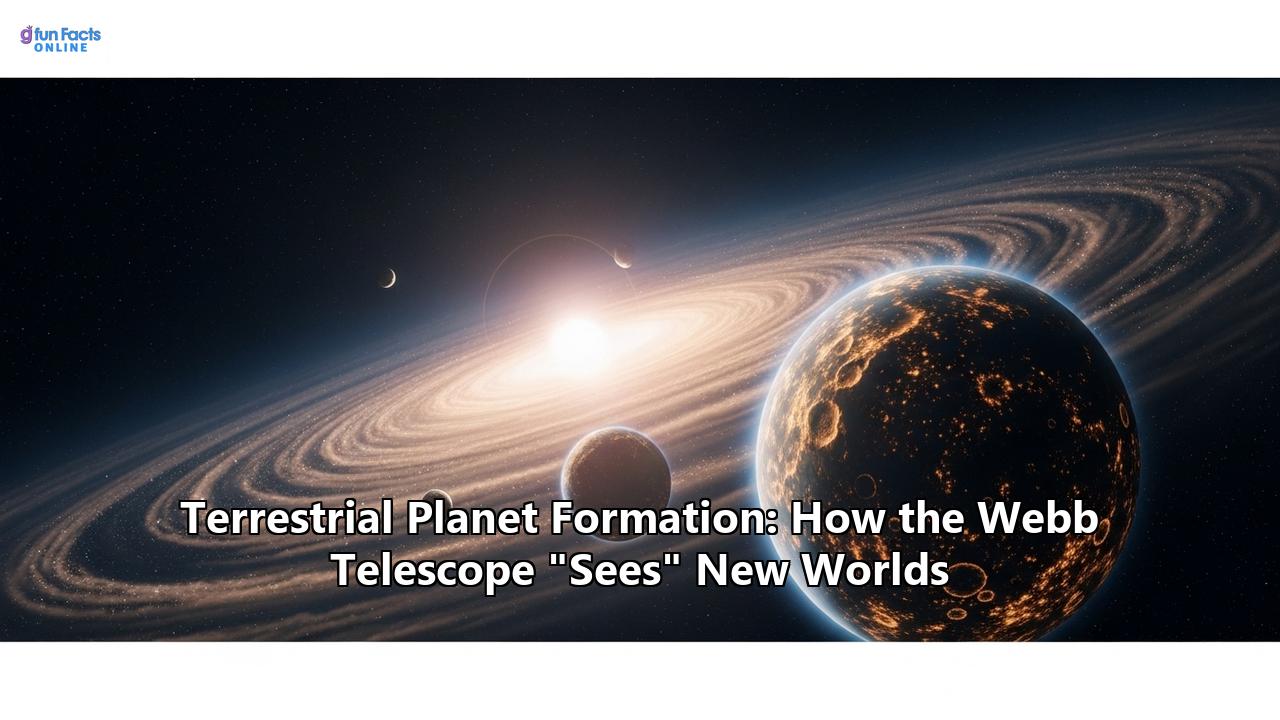
Terrestrial Planet Formation: How the Webb Telescope "Sees" New Worlds
For millennia, humanity has gazed at the night sky, wondering if we are alone in the universe. Are there other Earth-like planets orbiting distant suns? This question, once the realm of philosophy and science fiction, is now at the forefront of modern astronomy. The James Webb Space Telescope (JWST), with its unparalleled sensitivity and advanced instrumentation, is revolutionizing our understanding of how terrestrial, or rocky, planets like our own come into being. This article delves into the groundbreaking ways Webb is peeling back the cosmic curtains, allowing us to witness the very processes of world-building across the galaxy.
The Birthplace of Planets: Protoplanetary Disks
Planets are born from the remnants of star formation. As a young star ignites, it is surrounded by a vast, rotating disk of gas and dust known as a protoplanetary disk. These disks are the nurseries where planets are assembled over millions of years. For a long time, the inner regions of these disks—where rocky planets are expected to form—have been shrouded in mystery, obscured by the very material that builds them.
The JWST, however, is changing the game. Operating primarily in the infrared part of the spectrum, Webb can pierce through the obscuring dust and gas, providing an unprecedented view of these planet-forming regions. Its powerful instruments, the Near-Infrared Camera (NIRCam) and the Mid-Infrared Instrument (MIRI), work in tandem to capture stunningly detailed images and spectra of these distant nurseries.
NIRCam, Webb's primary imager, can detect the faint heat emitted by young, forming planets and the subtle structures they carve out in the disk. MIRI, on the other hand, is a "chemical machine," capable of analyzing the molecular composition of the disk's gas and dust. By combining the imaging capabilities of NIRCam with the spectroscopic prowess of MIRI, astronomers can create a comprehensive picture of the physical and chemical conditions within these planet-forming regions.
Unveiling the Architecture of a Forming System
One of the most exciting capabilities of the JWST is its ability to directly image the structures within protoplanetary disks that hint at the presence of forming planets. Gaps, rings, and spiral arms in these disks are all tell-tale signs that unseen worlds are gravitationally sculpting their surroundings.
In a groundbreaking observation, Webb captured a direct image of a previously unknown exoplanet, TWA 7 b, located within a debris disk. This was achieved using a coronagraph on the MIRI instrument, which blocks the overwhelming light from the central star, allowing the faint glow of the planet to be seen. The image revealed a heat source within one of the disk's rings, which, after careful analysis and computer simulations, was confirmed to be a planet.
This discovery is particularly significant because TWA 7 b is about ten times less massive than previously imaged exoplanets, with a mass comparable to Saturn. This demonstrates Webb's remarkable ability to detect smaller and lighter planets, bringing us closer to the goal of directly imaging Earth-sized worlds.
The Chemical Recipe for Rocky Worlds
A planet's composition is determined by the chemical makeup of the disk from which it forms. Understanding the distribution of elements and molecules in protoplanetary disks is therefore crucial to understanding the potential habitability of the planets that arise from them. The JWST's spectroscopic instruments are providing an unprecedented inventory of the chemical ingredients available for planet formation.
Water, Water, Everywhere?Water is considered a key ingredient for life as we know it, so its presence in protoplanetary disks is of paramount interest. The JWST has made significant breakthroughs in this area, detecting water vapor in the inner, terrestrial planet-forming zones of several disks.
In one study, Webb observed the protoplanetary disk around the star PDS 70 and detected water vapor at distances of less than 100 million miles from the star – the region where rocky planets are likely forming. This was the first detection of water in the terrestrial region of a disk already known to host protoplanets.
These observations are helping to confirm a long-held theory of planet formation known as "pebble drift." This theory proposes that icy pebbles, formed in the cold outer regions of the disk, drift inward toward the star, delivering both solid material and water to the inner disk. As these icy pebbles cross the "snowline" – the point where it's warm enough for ice to turn into vapor – they release large amounts of cold water vapor. The detection of this excess cool water vapor by Webb provides strong evidence for this dynamic process of water delivery.
A Diverse Cocktail of Organic MoleculesBeyond water, the JWST is uncovering a rich and diverse chemistry within protoplanetary disks, including a host of organic molecules that are the building blocks of life. In a survey of several disks, the MIRI instrument detected a variety of carbon-bearing molecules, including carbon dioxide, acetylene, and for the first time in a protoplanetary disk, benzene.
These findings reveal that the chemical composition of planet-forming disks can be quite diverse. Some disks are rich in water and carbon dioxide, while others show an abundance of hydrocarbons. For instance, the disk around the low-mass star J160532 was found to be unexpectedly rich in hot acetylene molecules, suggesting a carbon-rich environment. Such a high carbon-to-oxygen ratio could have a significant impact on the atmospheres of the planets that form there.
The detection of complex organic molecules in these disks is particularly exciting. The "Ice Age" program, a JWST Early Release Science Program, is dedicated to tracing the chemical evolution of ices from molecular clouds to protoplanetary disks. Recent findings from this program have led to the first unambiguous detections of complex organic molecules larger than methanol in ices, providing crucial insights into how these life-precursor molecules are delivered to forming planets.
Planet Formation in Extreme Environments
It was once thought that the harsh radiation from massive stars would make it impossible for planets, especially Earth-like ones, to form in their vicinity. The intense ultraviolet (UV) radiation was believed to quickly erode and disperse the material in protoplanetary disks.
However, the JWST is challenging these assumptions. In a landmark study, Webb peered into the inner region of a protoplanetary disk named XUE 1, which is located in one of the most extreme star-forming environments in our galaxy, bathed in intense UV radiation from nearby massive stars. To the surprise of astronomers, the observations revealed the presence of both water and simple organic molecules in the inner part of the disk.
Further modeling showed that the inner region of the disk, where rocky planets are expected to form, appears to be shielded from the most damaging UV radiation. While the outer parts of the disk are significantly affected, the inner regions remain a relatively protected haven for planet formation. This discovery dramatically expands the range of environments where habitable, Earth-like planets could potentially form.
The Synergy of Webb and ALMA
While the JWST is a powerful tool on its own, its capabilities are greatly enhanced when used in conjunction with other observatories. The Atacama Large Millimeter/submillimeter Array (ALMA) in Chile has been instrumental in studying the outer regions of protoplanetary disks, providing detailed maps of their dust and gas structures.
Webb and ALMA are a perfect scientific pairing. ALMA's observations of the cold, outer disk provide context for Webb's detailed studies of the warmer, inner disk where terrestrial planets form. For example, a joint study using both telescopes on a protoplanetary disk in the Orion Nebula revealed the profound impact that massive stars can have on shaping planetary systems. The intense radiation from these stars can either help or hinder planet formation, depending on the mass of the star at the center of the disk. By combining the data from both observatories, astronomers can get a more complete picture of the complex interplay of forces that govern planet formation.
Looking to the Future: The Search for Life
The ultimate goal of studying terrestrial planet formation is to understand the prevalence of habitable worlds and, ultimately, to search for signs of life beyond Earth. The JWST is a crucial first step in this grand endeavor.
By characterizing the atmospheres of young, newly formed planets, Webb can provide clues about their composition and potential for habitability. Its spectroscopic instruments can search for biosignature gases – molecules that could indicate the presence of biological activity.
However, the search for life is a complex challenge. Interpreting the spectra of exoplanet atmospheres is an intricate task, and it is unlikely that a single "silver bullet" biosignature will be found. Instead, scientists will need to build up a large sample of observations and use sophisticated models to interpret the data.
The James Webb Space Telescope is just beginning its mission, and it has already transformed our understanding of how terrestrial planets are born. Its ability to peer into the heart of dusty protoplanetary disks, to analyze their chemical composition, and to directly image forming worlds is providing us with an unprecedented glimpse into the cosmic processes of creation. As Webb continues to explore the universe, it will undoubtedly uncover even more secrets about the origins of planets like our own, bringing us ever closer to answering that age-old question: Are we alone? The journey has just begun, and the best is yet to come.
Reference:
- https://www.universite-paris-saclay.fr/en/news/protoplanetary-disks-eye-james-webb-space-telescope
- https://www.universetoday.com/articles/webb-examined-an-asteroid-belt-and-found-more-than-it-bargained-for
- https://www.spectroscopyonline.com/view/how-the-james-webb-telescope-s-miri-and-nircam-are-advancing-cosmic-exploration
- https://www.astronomy.com/science/jwst-discovers-exoplanet-direct-imaging/
- https://www.cnrs.fr/en/press/james-webb-space-telescope-discovers-its-first-exoplanet
- https://www.tcd.ie/physics/news-events/news/2025/james-webb-space-telescope-discovers-its-first-directly-imaged-exoplanet-/
- https://www.nasa.gov/universe/nasas-webb-to-explore-forming-planetary-systems/
- https://www.space.com/james-webb-space-telescope-chemistry-planet-forming-disks
- https://webbtelescope.org/contents/media/images/2021/052/01FF8FQG37AV8V7EJBW5D6TYBD
- https://timesofindia.indiatimes.com/science/frozen-world-beyond-our-solar-system-nasas-james-webb-space-telescope-discovers-water-in-distant-protoplanetary-disk/articleshow/116248278.cms
- https://www.nasa.gov/centers-and-facilities/goddard/webb-detects-water-vapor-in-rocky-planet-forming-zone/
- https://news.txst.edu/research-and-innovation/2023/telescope-planet-formation.html
- https://www.mpe.mpg.de/7941595/news20230413
- https://scitechdaily.com/jwst-unlocks-cosmic-mystery-lifes-precursors-found-in-extreme-stellar-environments/
- https://astrobiology.com/2023/04/jwst-looks-into-the-chemical-components-of-exoplanet-formation.html
- https://www.space.com/astronomy/exoplanets/james-webb-space-telescope-discovers-planets-forming-in-spaces-most-punishing-environments
- https://www.qmul.ac.uk/media/news/2023/se/new-james-webb-space-telescope-observations-reveal-potential-for-earth-like-planets-in-harsh-environments.html
- https://www.ukatc.stfc.ac.uk/Pages/New-research-using-JWST-and-ALMA-shows-massive-stars-shape-entire-planetary-systems.aspx
- https://www.almaobservatory.org/en/press-releases/jwst-and-alma-reveal-young-star-clusters-and-the-birth-of-the-universes-first-stars/
- https://www.alma-allegro.nl/science-day-jan2024-announcement/
- https://astrobiology.com/2025/04/prospects-for-detecting-signs-of-life-on-exoplanets-in-the-jwst-era.html
- https://join1440.com/topics/james-webb-telescope/a/james-webb-s-impact-on-exoplanetary-science
- https://arxiv.org/abs/2504.12946
- https://www.space.com/james-webb-space-telescope-3-years-exoplanet
- https://science.nasa.gov/mission/webb/