
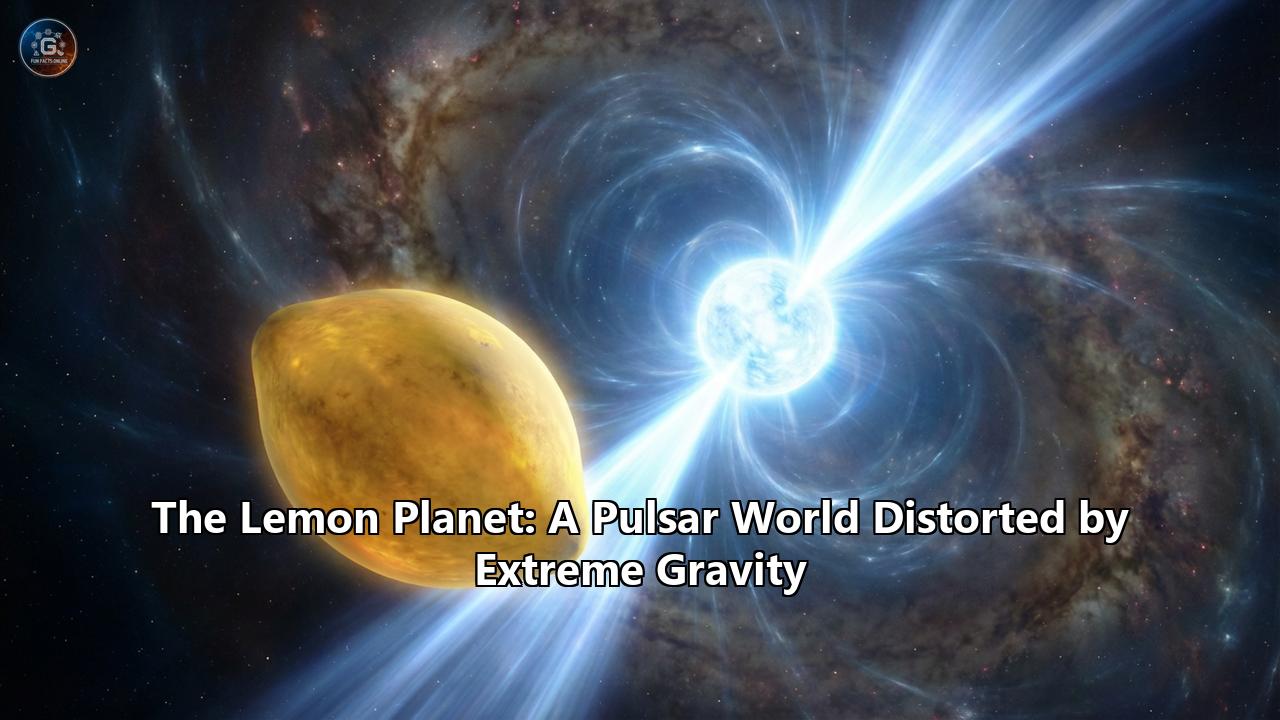
In the vast, silent theater of the cosmos, planets have long been assumed to be spherical—marbles of gas, rock, and ice rolling through the dark. But deep in the constellation Sculptor, roughly 2,000 light-years from Earth, the James Webb Space Telescope (JWST) has just revealed a world that shatters this geometric rule. Meet PSR J2322-2650b: a Jupiter-sized exoplanet that the universe has violently squeezed into the shape of a lemon.
This is not merely a quirky piece of space trivia; it is a "torture chamber" of astrophysics. Orbiting a dead, rapidly spinning star at a proximity that defies logic, this world is being stretched by gravitational tides so immense that they have deformed it into a prolate spheroid—a cosmic rugby ball tumbling through a bath of high-energy radiation.
Welcome to the Lemon Planet, a world where it rains diamonds, the year lasts less than a work shift, and gravity is a sculptor working with a heavy hand.
The Discovery: A Shape That Shouldn't Exist
For decades, astronomers have hunted for exoplanets using the "transit method"—watching for the tiny dip in light as a planet passes in front of its star. But PSR J2322-2650b was not found around a normal star. It orbits a pulsar—the ultra-dense, city-sized corpse of a massive star that exploded in a supernova.
Pulsars are nature’s most precise clocks, spinning hundreds of times per second and blasting beams of radiation that sweep across the galaxy. By timing these pulses with nanosecond precision, astronomers detected tiny irregularities. Something was tugging on the pulsar.
When the James Webb Space Telescope turned its gold-plated mirror toward the system in late 2025, it didn't just see a wobble; it resolved the thermal signature of a planet in distress.
Most planets are "oblate spheroids"—slightly wider at the equator due to their own spin (like Earth and Saturn). PSR J2322-2650b is different. It is being pulled outward at its poles, elongated toward its host star. If you could hold it in your hand, it wouldn't feel like a marble; it would feel like a lemon or an American football.
The Physics of Distortion: Dancing on the Edge of Doom
To understand why the Lemon Planet exists, you must understand the monster it orbits. The host pulsar packs the mass of our Sun into a sphere only about 12 miles (20 km) wide. The surface gravity on this star is billions of times stronger than Earth's.
PSR J2322-2650b orbits this object at a suicidal distance of just 1 million miles—roughly 1% of the distance between Earth and the Sun. At this range, the gravitational differential is extreme. The side of the planet facing the pulsar is pulled significantly harder than the side facing away.
This is the same "tidal force" that the Moon exerts on Earth to create ocean tides, but amplified to an apocalyptic scale. The pulsar’s gravity is literally trying to rip the planet apart. The planet’s own gravity is barely holding it together, resulting in that distinct, elongated "lemon" shape.
Astronomers call this the Roche potential. The planet is filling its "Roche lobe," the teardrop-shaped region of space where its own gravity dominates. If it gets any closer, the lemon shape will stretch into a stream, and the planet will be "spaghettified"—dissolved into a ring of gas that feeds the pulsar. For now, it balances on the knife's edge, a football-shaped survivor in a gravitational hurricane.
A World of Diamond Rain and Soot Clouds
If the shape of PSR J2322-2650b is bizarre, its atmosphere is the stuff of science fiction nightmares.
When JWST analyzed the light filtering through the planet's atmosphere (spectroscopy), the team expected to see the standard fingerprints of gas giants: hydrogen, perhaps some methane or water vapor. Instead, they found a chemical composition that has never been seen before.
The atmosphere is dominated by helium and carbon. There is almost no hydrogen, and absolutely no water.
"It’s a dry, scorched world," says Dr. Michael Zhang, one of the lead researchers on the discovery. "The chemistry suggests this isn't a normal planet at all."
The extreme temperatures—reaching nearly 3,700°F (2,000°C) on the day side—combined with the high pressure and carbon-rich atmosphere, suggest a terrifying weather system. High in the atmosphere, clouds of hot carbon soot float through helium skies. As this soot falls deeper into the planet’s crushing interior, the pressure becomes great enough to crystallize the carbon.
On the Lemon Planet, it doesn't rain water. It rains nanodiamonds.
These diamonds likely fall toward the core, accumulating in a glittering, super-dense slush that might make up a significant portion of the planet's mass. It is a treasure chest locked inside a radiation vault.
The "Black Widow" Scenario: A Star That Ate Its Spouse
How does a planet made of helium and diamond end up shaped like a lemon around a dead star? The leading theory is a story of cosmic cannibalism.
Astronomers believe PSR J2322-2650b was not born as a planet. Billions of years ago, it was likely a star—a white dwarf or a small, sun-like star orbiting the pulsar. Over eons, the pulsar acting like a "Black Widow" spider, began to devour its mate.
The pulsar's intense gravity stripped away the lighter hydrogen layers of the companion star, feeding on the material to spin itself up to incredible speeds (millisecond pulsars are often called "recycled pulsars" for this reason).
What we see today is the shriveled, husk of that former star. The hydrogen is gone, eaten by the pulsar. All that remains is the helium-rich, carbon-dense core, now whittled down to the mass of Jupiter. It has been demoted from a star to a planetary oddity, trapped in an eternal, distorted dance with its destroyer.
A Year in 7.8 Hours
Life on the Lemon Planet would be impossible, but the view would be spectacular. Because the orbit is so tight, a "year"—one full revolution around the star—takes only 7.8 hours.
The planet is tidally locked, meaning the "nose" of the lemon always points toward the pulsar. If you stood on that sub-stellar point (and didn't instantly vaporize), the pulsar would hang motionless in the sky, a blindingly bright point of blue-white light.
However, the light wouldn't just be visible. You would be bathed in X-rays and gamma rays. The magnetic field of the pulsar would be visible as auroras that don't just crown the poles but likely envelop the entire planet, glowing in electric purples and greens against the black soot clouds.
Every few milliseconds, a lighthouse beam of radio energy would sweep over the planet. The noise in the radio spectrum would be deafening—a constant, rhythmic screaming of the star that powers the system.
Why This Discovery Matters
The discovery of the Lemon Planet is a watershed moment for planetary science for several reasons:
- Material Limits: It tests the material physics of planetary bodies. How much can a planet stretch before it snaps? This system provides a real-world laboratory for tidal physics that we cannot simulate on Earth.
- Exotic Formation: It confirms that "planets" can be formed through the destruction of stars, creating a new category of celestial objects: ultra-low-mass white dwarf remnants masquerading as gas giants.
- Atmospheric Mysteries: The carbon-helium atmosphere challenges our models of opacity and heat transfer. How does a sky made of soot and helium distribute heat? The data from JWST will keep theorists busy for years.
The Ultimate Survivor
PSR J2322-2650b is a testament to the resilience of matter. It has survived the supernova that created its host. It has survived billions of years of radiation blasting. It has survived being stripped of its outer layers. And now, it survives a gravitational tug-of-war that has warped its very shape.
It is a lemon-shaped diamond in the rough, a distorted monument to the violence of the cosmos. As we continue to peer deeper into the universe, the Lemon Planet serves as a reminder: nature's imagination is far stranger, and far more geometry-defying, than our own.
Quick Facts: The Lemon Planet
- Official Name: PSR J2322-2650b
- Distance: ~2,000 light-years
- Mass: Approx. 1 Jupiter Mass
- Orbital Period: 7.8 Hours
- Shape: Prolate Spheroid (Lemon/Rugby Ball)
- Key Features: Helium/Carbon atmosphere, Diamond rain, "Black Widow" survivor.
Reference:
- https://www.jagranjosh.com/general-knowledge/what-is-an-exoplanet-1820005129-1
- https://www.astronomy.com/science/jwst-discovers-a-strange-exoplanet-that-orbits-a-pulsar/
- https://www.spacedaily.com/reports/Webb_maps_carbon_rich_atmosphere_on_distorted_pulsar_planet_999.html
- https://www.findarticles.com/webb-spies-lemon-shaped-planet-but-with-an-unseen-atmosphere/
- https://tribune.com.pk/story/2582872/astronomers-discover-lemon-shaped-exoplanet-with-bizarre-atmosphere
- https://www.smithsonianmag.com/smart-news/this-lemon-shaped-planet-has-an-atmosphere-unlike-anything-astronomers-have-ever-seen-180987902/
- https://futurism.com/space/james-webb-planet-lemon-shaped
- https://www.cbsnews.com/chicago/news/scientists-uchicago-discover-bizarre-lemon-shaped-planet-orbiting-neutron-star/
- https://www.vice.com/en/article/scientists-just-found-a-lemon-shaped-planet-that-breaks-the-rules-of-planet-formation/
- https://centralnews.co.za/scientists-discover-unusually-stretched-planet-orbiting-fast-spinning-star-cosmic-oddity-astronomers-find-planet-stretched-into-extreme-shape/
- https://news.uchicago.edu/story/nasas-webb-telescope-finds-bizarre-atmosphere-lemon-shaped-exoplanet
- https://www.nasa.gov/universe/extreme-telescopes-find-the-second-fastest-spinning-pulsar/
- https://en.wikipedia.org/wiki/Neutron_star