
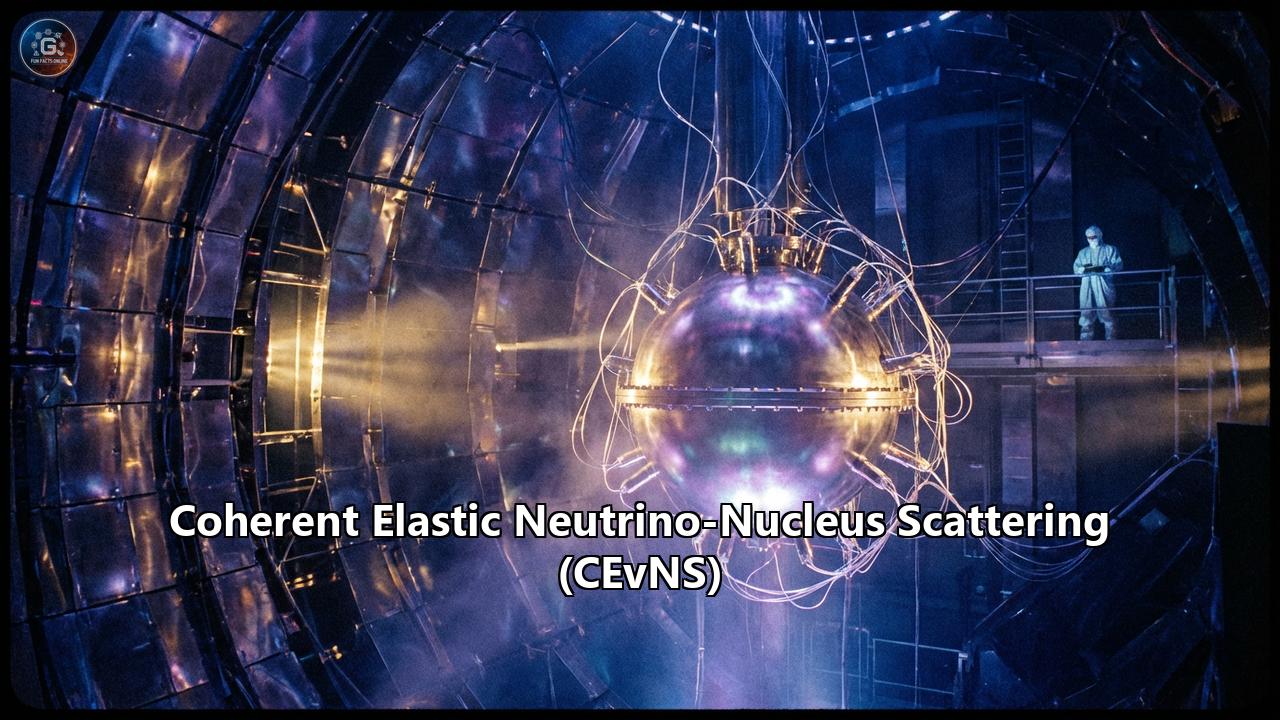
For decades, the neutrino was the ghost of the particle physics world—omnipresent yet nearly invisible, passing through light-years of lead without leaving a trace. We built cathedrals of science deep underground, filling massive tanks with thousands of tons of water or liquid argon just to catch a handful of these elusive particles. But in 2017, a small detector the size of a toaster, sitting in a basement hallway in Tennessee, changed everything. It detected a process that had been predicted forty-three years earlier but never seen: Coherent Elastic Neutrino-Nucleus Scattering (CEvNS).
This discovery was not just a triumph of experimental persistence; it was the opening of a new portal into the subatomic world. CEvNS (pronounced "sevens") is not merely another interaction; it is a unique mechanism where the neutrino strikes the atomic nucleus as a whole, causing it to recoil gently like a bell struck by a hammer. This "gentle bump" has unleashed a flood of physics potential, from probing the dense hearts of neutron stars to hunting for dark matter and monitoring nuclear reactors for non-proliferation.
This is the comprehensive story of CEvNS—from the theoretical "act of hubris" that predicted it, to the decades-long struggle to detect it, and the revolutionary future it is now enabling.
Part I: The Theoretical "Act of Hubris"
To understand why CEvNS is so special, we must retreat to the standard interactions of neutrinos. For most of history, we observed neutrinos interacting with individual particles inside an atom—striking a single proton or neutron and transforming it (Inverse Beta Decay). These interactions are incredibly rare because the weak nuclear force, which governs them, is exceedingly weak.
In 1974, a theorist named Daniel Z. Freedman proposed a radical idea. He realized that if a neutrino's energy is low enough, its quantum wavelength becomes large—larger than the size of the atomic nucleus itself. In quantum mechanics, waves determine how particles interact. If the neutrino's wave is long enough to cover the entire nucleus, it doesn't "see" individual protons and neutrons. Instead, it sees the nucleus as a single, solid sphere.
Freedman predicted that under these conditions, the neutrino would scatter off the entire nucleus coherently. The implications of "coherence" are profound. In a standard interaction, the probability of scattering (the cross-section) scales with the number of nucleons ($N$) linearly. But in a coherent interaction, the amplitudes of scattering off each neutron add up constructively. The probability doesn't just scale with $N$; it scales with the square of the number of neutrons ($N^2$).
For a heavy nucleus like Cesium or Xenon, which has tens of neutrons, this $N^2$ factor is massive. It boosts the interaction probability by factor of 100 or 1,000 compared to standard neutrino interactions. Freedman calculated that this should be, by far, the most frequent way low-energy neutrinos interact with matter.
However, in his seminal 1974 paper, Freedman concluded with a pessimistic note, calling his proposal an "act of hubris." He argued that while the interaction rate was high, the result was almost invisible. The neutrino hits the heavy nucleus and bounces off elastically. The nucleus, being heavy, barely moves. The recoil energy is tiny—in the range of kilo-electronvolts (keV) or even less. Detecting such a microscopic shudder in a detector was, at the time, technologically impossible. The "loudest" neutrino interaction was effectively silent.
Part II: The Long Silence and the Experimental Challenge
For 43 years, Freedman's prediction stood as a "Holy Grail" of neutrino physics—known to exist but impossible to touch. The challenge was twofold:
- The Energy Sweet Spot: To get coherent scattering, you need low-energy neutrinos (below ~50 MeV). If the energy is too high, the neutrino wavelength shrinks, it starts resolving individual nucleons, and the coherence is broken.
- The Whispering Signal: The signal is a nuclear recoil. Imagine throwing a ping-pong ball at a bowling ball. The ping-pong ball (neutrino) bounces off, but the bowling ball (nucleus) hardly moves. Detectors in the 1970s and 80s were designed to see high-energy flashes of light from charged particles, not the subtle heat or ionization from a barely-moving nucleus.
It wasn't until the 21st century that detector technology began to catch up, driven largely by a completely different field: the hunt for Dark Matter.
Dark Matter researchers were building detectors specifically designed to see Weakly Interacting Massive Particles (WIMPs) bumping into nuclei—the exact same signature as CEvNS. They developed ultra-sensitive Germanium crystals, liquid Xenon time-projection chambers, and scintillating crystals capable of detecting sub-keV energy depositions.
By the mid-2010s, the technology was ready. The race was on to find the perfect source of neutrinos.
Part III: The Breakthrough at Neutrino Alley
While nuclear reactors produce massive amounts of neutrinos, their energies are very low, making the nuclear recoil even harder to see (we will return to this challenge later). The ideal source for a first discovery was a "Stopped Pion Source."
Enter the Spallation Neutron Source (SNS) at Oak Ridge National Laboratory in Tennessee.
The SNS is designed to produce neutrons for materials science, not neutrinos. It fires a proton beam at a mercury target, smashing the mercury atoms and releasing neutrons. But as a byproduct, this violent collision produces pions, which stop inside the target and decay. This decay chain produces a flood of neutrinos with a very specific energy spectrum, peaking around 30-50 MeV—the perfect "Goldilocks" zone for CEvNS. High enough energy to create a detectable recoil, but low enough to maintain coherence.
Even better, the SNS beam is pulsed. It turns on and off 60 times a second. This was the key. Experimentalists could look for signals that appeared only when the beam was on and vanished when it was off. This allowed them to reject the constant background of cosmic rays that plagues surface experiments.
A collaboration formed, appropriately named COHERENT. Led by physicists from Duke University, Oak Ridge, and other institutions, they set up shop in a basement corridor shielded by concrete, a location that became affectionately known as "Neutrino Alley."
They didn't build a massive cathedral. They built a compact detector using 14.6 kilograms of Cesium Iodide (CsI) crystal doped with Sodium. The crystal would scintillate (flash with light) when a nucleus recoiled.
In August 2017, the COHERENT collaboration announced the result that shook the physics world. They had observed CEvNS with a statistical significance of 6.7 sigma—far beyond the threshold for discovery. The data points lined up perfectly with the Standard Model prediction. After four decades, the "act of hubris" had been vindicated.
Part IV: The Physics Implications
The observation of CEvNS was not just a box-ticking exercise. It unlocked a treasure chest of physics.
1. Probing the Standard Model and the Weak Mixing Angle
CEvNS provides a pristine test of the Standard Model. The cross-section depends heavily on the "Weak Mixing Angle" (or Weinberg angle), a fundamental parameter that dictates how the electromagnetic and weak forces unify. Most measurements of this angle had been done at high energies (in particle colliders). CEvNS allows us to measure it at very low energies. Any deviation from the predicted value here could be a "smoking gun" for new particles, like dark photons or Z-prime bosons, interfering with the interaction.
2. Measuring the "Neutron Skin"
One of the most profound applications of CEvNS is in nuclear physics. We know the distribution of protons in a nucleus very well because we can scatter electrons off them (since electrons interact with positive charge). But neutrons are neutral; they are invisible to electron scattering. Consequently, we don't know exactly where the neutrons sit.
Do they mix evenly with protons? Or do they form a "skin" on the outer surface of the nucleus?
CEvNS interacts with neutrons. By measuring the CEvNS rate precisely on different nuclei, physicists can map out the distribution of neutrons and measure the thickness of this "neutron skin." This might sound like arcane nuclear trivia, but it has cosmic consequences. The pressure that pushes neutrons apart in a nucleus is the same pressure that holds up a Neutron Star against the crushing force of gravity. By measuring the neutron skin of a tiny nucleus in a basement in Tennessee, we are effectively measuring the Equation of State of neutron stars, helping us understand how large these dead stars can grow before collapsing into black holes.
3. The Search for Non-Standard Interactions (NSI)
The Standard Model assumes neutrinos only interact via the weak force. But what if they have other, secret interactions? What if they "talk" to quarks via a new, unknown force carrier? Because the CEvNS rate is so precisely predicted, any excess or deficit in the observed event rate is a sign of "Non-Standard Interactions" (NSI). COHERENT and subsequent experiments are currently placing some of the world's tightest constraints on these hypothetical heavy mediators.
Part V: The Reactor Frontier and the "Neutrino Fog"
While COHERENT used a spallation source, another battlefront opened up at nuclear reactors. Reactors produce antineutrinos at lower energies (< 10 MeV). This makes the coherence condition ($N^2$ enhancement) even stronger, but the recoil energy becomes vanishingly small—often below 1 keV.
Detecting this requires the absolute bleeding edge of technology. Experiments like CONUS (in Germany) and MINER (in the US) have been deploying ultra-sensitive Germanium and Silicon detectors very close to reactor cores. In 2024 and 2025, we began seeing the first confirmed observations of Reactor CEvNS, opening the door to a sci-fi application: Neutrino Safeguards.
Because CEvNS cross-sections are large, we can theoretically build neutrino detectors that are small—perhaps the size of a suitcase—rather than the size of a house. Such a detector could be placed outside a nuclear reactor to monitor its power level and fuel composition in real-time. If a rogue nation tried to divert plutonium from a reactor for weapons, the change in the neutrino spectrum would be visible to a CEvNS monitor. The International Atomic Energy Agency (IAEA) is watching this technology closely as a future tool for global nuclear non-proliferation.
The Dark Matter Collision
There is one group of physicists who view CEvNS with a mix of excitement and dread: Dark Matter hunters.
For years, Dark Matter experiments have been pushing for higher sensitivity to find WIMPs. But as they get more sensitive, they are approaching a fundamental limit. Eventually, their detectors will be so sensitive that they will start seeing CEvNS events from solar neutrinos and atmospheric neutrinos.
To a Dark Matter detector, a CEvNS neutrino looks exactly like a WIMP. They both produce a single, low-energy nuclear recoil.
This limit was historically called the "Neutrino Floor." It was feared as a hard barrier where Dark Matter searches would end, swamped by an irreducible background of neutrinos. However, the community has rebranded it the "Neutrino Fog." It’s not a solid floor, but a fog you can push through if you are clever—using directional detection or combining data from different target nuclei (since CEvNS depends on $N^2$, but WIMP interactions might scale differently).
Remarkably, in 2024, the massive Dark Matter detectors XENONnT and PandaX-4T reported their first observation of CEvNS from solar neutrinos (Boron-8 neutrinos). This was a bittersweet milestone: it confirmed the incredible sensitivity of their detectors, but it also signaled that the "fog" has officially rolled in. The background that Freedman predicted is now a reality that all future Dark Matter searches must account for.
Part VI: The Future Landscape
We are now in the "Precision Era" of CEvNS. The initial discovery is done; now comes the detailed mapping.
- New Targets: COHERENT is deploying new detectors using different nuclei, like Argon and Germanium. Comparing the rate between Cesium, Argon, and Germanium allows physicists to cancel out systematic errors and isolate the NSI effects and nuclear structure details.
- Sterile Neutrinos: If "Sterile Neutrinos" (ghostly cousins of regular neutrinos that don't interact at all) exist, they could cause the CEvNS rate to oscillate at short distances. This is one of the few ways to test for these particles, which could explain the mass of the neutrino.
- Electromagnetic Properties: If neutrinos have a tiny "magnetic moment" (acting like little magnets), the CEvNS cross-section would skyrocket at very low recoil energies. Reactor experiments are currently hunting for this anomaly.
Conclusion
The story of CEvNS is a testament to the long arc of scientific inquiry. It began as a theoretical curiosity, dismissed as an "act of hubris" impossible to observe. It required four decades of patience and the convergence of technologies from disparate fields—spallation sources, dark matter detection, and low-background computing.
Today, CEvNS is no longer a ghost. It is a tool. It is a microscope for the nucleus, a telescope for neutron stars, a probe for new forces of nature, and a watchdog for nuclear safety. We have moved from the era of hunting the neutrino's gentle bump to the era of using that bump to shake the foundations of physics.
Deep Dive: The Science of the "Gentle Bump"
The following sections detail the specific physics mechanisms, experimental technologies, and data analysis techniques that make CEvNS possible.1. The Coherence Condition: Seeing the Forest, Not the Trees
In quantum mechanics, every particle behaves like a wave. The "wavelength" is inversely proportional to the particle's momentum.
- High Energy Neutrinos: Have short wavelengths. They strike a nucleus and "resolve" the individual protons and neutrons. The scattering is incoherent.
- Low Energy Neutrinos: Have long wavelengths (larger than the nuclear radius, approx 5-10 femtometers). The wave washes over the entire nucleus.
The scattering amplitude is the sum of the amplitudes from all nucleons. Because neutrons have a much larger weak charge than protons (in the Standard Model, the proton's weak charge is accidentally close to zero), the process is dominated by neutrons.
If the scattering is coherent, the total cross-section ($\sigma$) is approximately:
$$ \sigma \propto Q_w^2 \cdot E_\nu^2 \cdot F(q^2)^2 $$
Where:
- $Q_w \approx N$: The weak charge of the nucleus (roughly the number of neutrons).
- $E_\nu$: The neutrino energy.
- $F(q^2)$: The nuclear "Form Factor," which describes the loss of coherence as the momentum transfer ($q$) increases.
This $N^2$ dependency is the magic. For Cesium ($N=78$), $N^2 \approx 6000$. This huge multiplier compensates for the weakness of the weak force.
2. The Experimental Nightmare: Quenching Factors
If the cross-section is so huge, why is it hard to see? The problem is Kinematics.
When a light neutrino hits a heavy nucleus, it's like a ping-pong ball hitting a bowling ball. The neutrino bounces off with almost all its energy, leaving the nucleus with a tiny amount of kinetic energy (recoil).
$$ E_{recoil} \approx \frac{2 E_\nu^2}{M_{nucleus}} $$
For a 30 MeV neutrino hitting a Cesium nucleus, the maximum recoil is only about 15 keV.
But it gets worse. Detectors usually measure ionization (electrons liberated) or scintillation (light produced). When a heavy nucleus moves through a crystal, it dissipates most of its energy as heat (phonons), not light or ionization. This loss of signal is called the "Quenching Factor."
For a 15 keV recoil, the detector might only see 1 or 2 keV worth of light. Measuring the Quenching Factor is one of the biggest systematic uncertainties in CEvNS physics. The COHERENT team had to spend years shooting neutrons at their crystals to precisely map out how much light a recoiling nucleus actually produces.
3. The "Neutrino Alley" Advantage
Background radiation is the enemy. Cosmic rays (muons) constantly bombard the earth. If a muon hits a detector, it lights it up like a Christmas tree, blinding it to the tiny CEvNS signals.
Most neutrino experiments go deep underground (like Super-Kamiokande in Japan) to use the earth as a shield. COHERENT couldn't do that; the SNS is on the surface.
Their solution was Timing.
The SNS proton beam hits the target in short pulses, 600 nanoseconds wide, at 60 Hz.
This means the beam is "ON" for only a tiny fraction of the time. By ignoring everything the detector sees when the beam is "OFF," COHERENT reduced the cosmic ray background by factor of thousands. They effectively created a "virtual underground laboratory" using time instead of rock.
4. Reactor vs. Spallation: The Trade-off
- Spallation Sources (SNS):
Pros: Higher energy (30-50 MeV) = larger recoil signals. Pulsed beam = great background rejection.
Cons: Lower neutrino flux compared to reactors. Expensive to build.
- Nuclear Reactors:
Pros: Incredible flux ($10^{20}$ neutrinos per second). Available all over the world.
Cons: Lower energy (< 10 MeV) = tiny, sub-keV recoils. Constant stream (not pulsed) = hard to separate signal from background.
The current generation of experiments is moving toward reactors because the sheer number of neutrinos allows for precision statistics, if the detector threshold can be lowered enough. This has driven the development of Cryogenic Bolometers (detectors operating near absolute zero to measure heat) and CCD (Charge Coupled Device) sensors similar to those in digital cameras but optimized for particle physics (like the CONNIE experiment).
The Legacy of CEvNS
In the history of physics, there are moments where a wall is breached. For 40 years, the low-energy neutrino interaction was a wall—a theoretical certainty that was experimentally inaccessible. The breach of this wall in 2017 did not just confirm an old theory; it provided a new lens.
We are now using the smallest wisp of an interaction to weigh the hearts of dead stars and probe the validity of the Standard Model. As detectors shrink and sensitivity grows, we may soon see a day where neutrino detectors are standard industrial equipment, guarding the world's nuclear stockpile, while their larger cousins deep underground map the invisible fog of the universe. The "act of hubris" has become the act of discovery.
Reference:
- https://en.wikipedia.org/wiki/Coherent_elastic_neutrino-nucleus_scattering
- https://kaistcompass.kaist.ac.kr/?magazine=the-first-observation-of-coherent-elastic-neutrino-nucleus-scattering
- https://coherent.ornl.gov/what-is-cevns/
- https://www.emergentmind.com/topics/coherent-elastic-neutrino-nucleus-scattering-ce-ns
- https://www.ornl.gov/division/pd/coherent
- https://physics.stackexchange.com/questions/717434/dark-matter-searches-when-the-neutrino-floor-is-reached
- https://theory.fnal.gov/events/event/results-from-coherent/
- https://www.phys.vt.edu/content/dam/phys_vt_edu/reu/papers2020/goel_paper.pdf
- https://arxiv.org/html/2501.05206v1
- https://www.particlebites.com/?p=9655
- https://www.universetoday.com/articles/experiment-detects-mysterious-neutrino-nucleus-scattering-first-time
- https://pos.sissa.it/421/066/pdf
- https://iris.unica.it/handle/11584/391993
- https://sites.duke.edu/coherent/files/2020/06/S0804_Markoff.pdf
- https://arxiv.org/pdf/2304.09241