
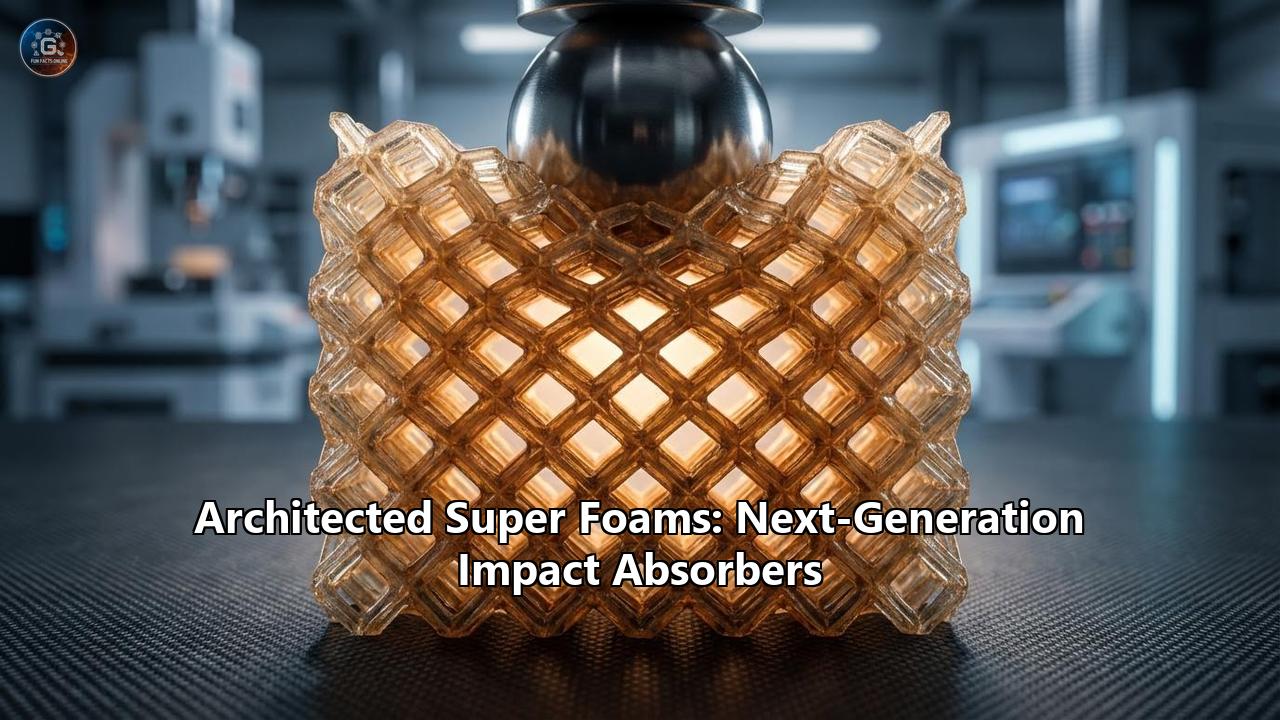
Imagine a helmet that can absorb the catastrophic force of a high-speed collision, flawlessly disperse the kinetic energy, and instantly snap back to its pristine shape, ready for the next blow. Picture a spacecraft shield, feather-light yet capable of absorbing immense orbital vibrations, or a shoe midsole custom-tailored to the exact biomechanics of your foot, returning unprecedented energy with every stride. For decades, engineers have relied on conventional bulk foams to protect our fragile bodies and delicate machinery. However, traditional shock absorbers—like expanded polystyrene (EPS) or standard polyurethane (PU) foams—have hit a technological and evolutionary dead end. They are inherently unpredictable at the microscopic level, often single-use, and notoriously bulky.
Today, materials science is undergoing a profound renaissance. We are entering the era of Architected Super Foams—a revolutionary class of mechanical metamaterials that derive their extraordinary impact-absorbing capabilities not merely from their chemical composition, but from highly precise, mathematically optimized internal geometries. By leveraging advanced 3D printing and structural hierarchy, engineers are creating foams that defy traditional physics, offering unprecedented strength-to-weight ratios, flawless shape recovery, and even built-in "smart" sensory capabilities.
The Metamaterial Paradigm Shift: From Randomness to Architecture
To understand the magnitude of this leap, we must first look at how traditional foams are made. Standard foams are "stochastic". This means their internal cellular structure is dictated by a random chemical foaming process, much like baking a loaf of bread. The resulting bubbles and voids vary wildly in size, shape, and distribution. Because of this unpredictability, engineers must over-design the material—making it thicker and heavier—to guarantee it meets minimum safety thresholds. Furthermore, stochastic foams suffer from an inefficient scaling power index, meaning their structural deformation is heavily bending-dominated and suboptimal for energy absorption.
Architected foams, on the other hand, are engineered at the micro- and macro-scale. They are considered "metamaterials" because their properties transcend the limitations of their base ingredients. Whether fabricated from polymers, metals, ceramics, or carbon nanotubes, architected foams rely on cellular lattices—such as body-centered cubic (BCC), simple-cubic (SC), or complex honeycomb topologies—that are deterministically designed. Because the internal architecture is entirely controlled, engineers can independently tune distinct mechanical properties, dictating exactly how the foam compresses, buckles, and recovers under extreme stress.
This shift from random chemical bubbling to deliberate geometric design means that architected foams demonstrate superior modulus, strength, and energy absorption at comparable or even lower densities than their stochastic predecessors. They can consist of more than 90% air, yet withstand immense crushing loads without catastrophic failure.
The Magic of "Structures Within Structures"
One of the most significant breakthroughs in the realm of architected impact absorbers is the development of hierarchical architectures—essentially creating "structures within structures".
Recent research spearheaded by engineers at the University of Wisconsin-Madison has demonstrated the astonishing potential of multilevel architectural design. By embedding microballoons (microscopic hollow spheres) into a base material, and then using additive manufacturing to structure that material into a lattice with millimeter-scale gaps, scientists have created a highly resilient "bounce-back" foam.
In a standard impact absorber, a violent collision forces the cellular walls to buckle and fracture, permanently deforming the foam. This is why a bicycle helmet must be replaced after a single crash. However, the hierarchical design of these new super foams allows the microscopic voids to absorb initial stress, while the larger macro-architecture intelligently folds and distributes the kinetic energy. This multi-level stress distribution prevents the base material from tearing. Once the kinetic energy is dissipated, the foam springs completely back to its original shape.
The implications of this reusability are massive. By simply adjusting the parameters of the 3D printer and altering the size and concentration of the embedded microballoons, engineers can precisely tune the stiffness and compressibility of the foam. These microscale tweaks ripple up to the macro level, allowing a single manufacturing technique to produce everything from a hyper-stiff military boot sole to an ultra-soft helmet liner designed to prevent athletic concussions.
Defying Common Physics: Auxetics and Negative Poisson’s Ratio
If hierarchical structures are the secret to reusability, geometric trickery is the secret to ultimate armor. Most traditional materials possess a positive Poisson's ratio: when you stretch them, they get thinner in the middle (like a rubber band), and when you compress them, they bulge outward.
Architected super foams can be designed as auxetic metamaterials, meaning they possess a Negative Poisson’s Ratio (NPR). Through rationally topologized designs—such as convex-concave lattices or re-entrant honeycomb shapes—auxetic foams do the exact opposite of natural materials. When you stretch an auxetic foam, it becomes thicker. More importantly for impact absorption, when you compress it, the material folds inward on itself.
Imagine a severe impact striking a layer of auxetic super foam. Instead of the material displacing outward and allowing the projectile to penetrate, the surrounding cellular structures dynamically rush toward the point of impact. The foam literally becomes denser and harder exactly where the force is applied, creating localized, instantaneous armor. This provides an extraordinary combination of high specific densification strength, ultra-high energy absorption capacity, and extreme fracture toughness. Studies on auxetic metamaterials manufactured via laser-sintering of carbon nanotube-reinforced nanocomposites have revealed specific energy absorption capabilities approaching those of heavy titanium alloy foams, but at a fraction of the weight.
Carbon Nanotubes and the Power of Non-Linear Dynamics
When scaling these principles to extreme limits, materials scientists are turning to Vertically Aligned Carbon Nanotube (VACNT) foams. Non-architected VACNTs inherently exhibit an exceptional modulus and energy absorption comparable to metallic foams, but with the compressibility and strain-recovery of soft polymers.
When researchers apply structural hierarchy to VACNTs—creating mesoscale cylindrical architectures within the foam—the results are paradigm-shifting. By exploiting size-effects and nanoscale inter-tube interactions, architected VACNT foams achieve synergistic improvements in specific elastic modulus and specific compressive strength. They fundamentally alter the known rules of thickness-to-diameter ratios in thin-walled structures, heavily outperforming commercial polymeric and metallic foams at ultra-lightweight scales.
Furthermore, these designs embrace the power of geometric nonlinearity. Traditional shock absorbers are bound by linear mechanics, requiring a bulky layer of foam to slow down an object gradually enough to prevent lethal G-forces. However, using dimensional analysis, researchers have mathematically proven that foams engineered with a plateau-like, sublinear stress-strain response can absorb equal amounts of energy at much lower stress levels. By fine-tuning the fractal architecture of VACNT foams, engineers have unlocked sublinear stress responses that allow for ultra-compact, paper-thin shock absorbers that provide the same protective qualities as massive blocks of conventional padding.
Snap-Through Instability: Reusable Energy Absorption
To create universal, omni-directional impact absorbers, scientists are exploring multi-stable cellular materials. A major hurdle in traditional foams is that energy dissipation usually requires destructive mechanisms—bonds breaking, cells crushing, and walls tearing.
Next-generation architected foams utilize "snap-through" instabilities. By aligning the rotation centers of lattice layers with opposite chiralities, the geometry incorporates local rotational degrees of freedom. When an impact occurs, the individual struts of the lattice don't bend and break; instead, they "snap" from one stable geometric configuration into another. This elastic snap-through event requires a massive amount of kinetic energy to trigger, effectively draining the energy from the impact.
Because the process relies entirely on geometry rather than chemical bonds breaking, the material can easily be snapped back into its original state. This elasto-magnetic or purely elastic hysteretic cycling provides omni-directional absorption for all loading modes—tension, compression, and shearing—making it a holy grail for re-usable impact mitigation platforms.
The Alchemy of Additive Manufacturing
The rise of architected super foams is inextricably linked to the rapid advancement of Additive Manufacturing (3D printing). Traditional subtractive manufacturing (milling, carving) or injection molding simply cannot produce the complex internal voids required for these metamaterials. Today, scientists utilize an array of cutting-edge fabrication methods:
- Selective Laser Sintering (SLS) and Stereolithography (SLA): These traditional 3D printing methods are being pushed to new limits by introducing advanced composite resins. By printing layers of polyurethane mixed with nanoparticles, engineers can achieve sub-millimeter precision on complex BCC and honeycomb lattices.
- Direct Ink Writing (DIW) and In-Situ Foaming: Researchers have revolutionized extrusion-based 3D printing by combining it with chemically blown polysiloxane foams. By using a two-component foaming ink and an active mixing printhead, the 3D printer can control the exact extent of foaming dynamically as it prints. Changing the mixing speed allows for in-situ control over the hierarchical tiers of porosity. Engineers can print a macro-scale open-cell lattice while simultaneously controlling the micro-scale porosity within the very struts of the lattice itself. This allows for the creation of gradient structures where different layers of the foam possess varying stiffnesses, entirely eliminating the need for complex post-processing.
- Direct Bubble Writing: Going a step further, scientists have developed "direct bubble writing" for polymer foams. By directly printing air- or nitrogen-filled bubbles using highly viscous inks (thiol-ene chemistries), they can create surfactant-free and solvent-free 3D foams. By simply adjusting the gas pressure on the fly, the printer transitions seamlessly between open-cell and closed-cell architectures, tailoring the density and cell size of the foam layer by layer.
- AI and Inverse Co-Design: Designing these intricate lattices by trial and error is computationally impossible given the vast parameter space. Today, researchers utilize Machine Learning and Fourier approximations to achieve "inverse co-design". An engineer inputs the desired mechanical response—for example, "I need a material that compresses by exactly 14% under a 500-newton load and absorbs 40 joules of energy"—and the AI algorithm works backward to generate the precise cellular topology required to achieve it.
Multi-Functional: The Dawn of "Smart" Foams
Perhaps the most fascinating evolution of architected super foams is their transition from passive structural components into active, multi-functional systems. Because additive manufacturing allows for the precise deposition of multiple materials simultaneously, engineers are now embedding sensory capabilities directly into the void spaces of the foam lattices.
By laminating varying layers of soft lattice foams (SLFs) with thin, stretchable fabrics interwoven with silver fibers, researchers have successfully converted these foams into capacitive sensors. These hybrid smart foams can actively sense deformation, strain, and compression. This has immediate applications in the biomedical and sports sectors; for instance, the development of a "smart knee pad" that not only provides superior, targeted impact protection through gradient lattice designs but also streams real-time data to a smartphone about the forces being absorbed by the user's joint.
Furthermore, by utilizing ultra-violet induced reduction of silver nitrate within the liquid resin ink during the printing process, scientists are generating conductive composite foams. These allow the architected structures to act as highly sensitive soft pressure sensors or thermal regulators, controlling the flow of electricity, heat, or even directing the flow of liquids and gases for advanced catalytic converters and desalination systems.
Revolutionizing Global Industries
The theoretical elegance of architected super foams is rapidly translating into paradigm-shifting commercial and industrial applications across several high-stakes sectors:
1. Automotive Safety and LightweightingIn the automotive industry, reducing vehicle weight to extend EV battery range is a top priority, but it cannot come at the expense of passenger safety. Architected foams are being explored for crash boxes and vehicle bumpers. Because these metamaterials can be designed with a highly specific sublinear stress-strain plateau, they can absorb the massive kinetic energy of a car crash in a fraction of the physical space required by traditional crumple zones. Moreover, the integration of multi-material 3D printing means automotive chassis components can be re-architected to be 90% air while maintaining the tensile strength of solid metal.
2. Aerospace and Extreme Energy EnvironmentsIn aerospace, every gram of weight matters, and materials must survive extreme thermal and mechanical trauma. Architected foams provide critical vibration dampening for delicate satellite payloads. More incredibly, they are being deployed in high-intensity energy applications. Recently, international energy agencies have demonstrated how 3D-printed micro-architected foams behave under high-intensity laser pulses, validating their use in inertial confinement fusion (ICF) targets. The ability to precisely predict and control how these micro-foams erode and absorb energy at the atomic scale is a crucial stepping stone toward achieving sustainable fusion energy.
3. Sports, Athletics, and Human ProtectionThe most immediate consumer impact of super foams is in athletics. The epidemic of Traumatic Brain Injuries (TBIs) and concussions in contact sports is largely due to the failure of single-use EPS foam helmets to adequately dissipate rotational and linear impact forces. Utilizing "structures within structures" and auxetic lattices, next-generation helmets can provide localized densification precisely where a player is struck, absorbing the blow dynamically and then bouncing back to full structural integrity in milliseconds. Similarly, running shoes utilizing custom-architected midsoles are fine-tuning the energy return for runners, minimizing joint degradation while maximizing athletic output.
The Horizon of Architected Materials
We are merely scratching the surface of what is possible. Historically, human engineering was constrained by the materials provided by nature—we built with the chemistry of wood, iron, and stone. As synthetic polymers and metallic alloys evolved, our capabilities expanded, but we were still bound by the inherent properties of bulk materials.
Architected super foams represent a fundamental decoupling of material from geometry. We are no longer designing products based on a material's existing chemistry; we are engineering the physical rules of the material itself. By manipulating voids, leveraging snap-through mechanics, and employing hierarchical lattices from the nanoscale to the macroscale, we are creating impact absorbers that are lighter, stronger, smarter, and infinitely more resilient.
As additive manufacturing scales in speed and volume, and machine learning further refines the inverse design of complex topologies, architected super foams will phase out stochastic materials entirely. They will line our protective gear, insulate our homes, secure our vehicles, and safeguard our spacecraft—ushering in a durable, lightweight, and resilient future built from the very geometry of the void.
Reference:
- https://www.designnews.com/3d-printing-materials/3d-printing-structural-foams-with-multiple-materials
- https://engineering.wisc.edu/news/new-structures-within-structures-foam-softens-a-blow-and-bounces-right-back/
- https://pmc.ncbi.nlm.nih.gov/articles/PMC12667523/
- https://journals.spiedigitallibrary.org/conference-proceedings-of-spie/12483/1248304/Isotropic-hybrid-architected-foams-with-enhanced-energy-absorption/10.1117/12.2657645.full
- https://frazier.ucsd.edu/documents/ART_Metamaterial%20design%20strategy%20for%20re-usable,%20universal%20energy%20absorption.pdf
- https://www.researchgate.net/publication/329406974_3D-Printed_Mechanical_Metamaterials_with_High_Energy_Absorption
- https://pmc.ncbi.nlm.nih.gov/articles/PMC12322130/
- https://www.mdpi.com/1996-1944/11/10/1869
- https://scispace.com/pdf/superior-mechanical-properties-by-exploiting-size-effects-2mpxl2bj.pdf
- https://www.osti.gov/servlets/purl/2212865
- https://www.researchgate.net/publication/335914731_Architected_Polymer_Foams_via_Direct_Bubble_Writing
- https://www.amfg.ai/post/latest-developments-in-additive-manufacturing-june-2025