
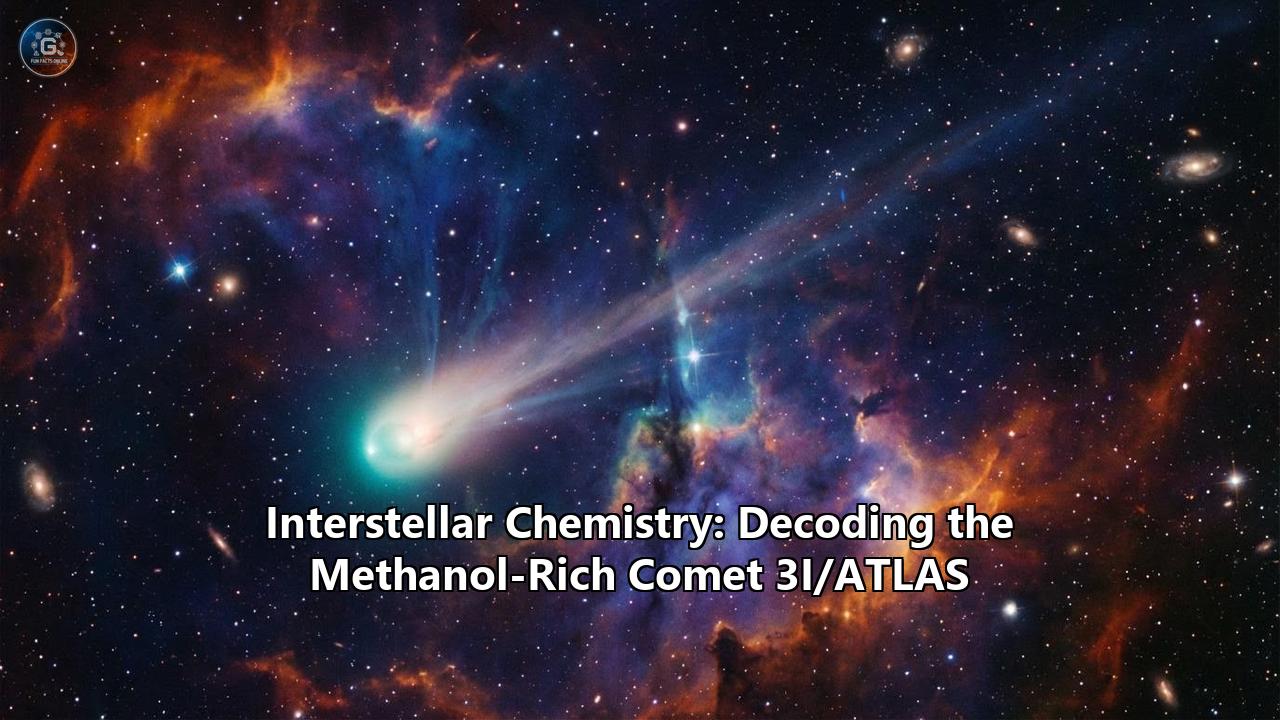
When an object from the space between the stars pierces the veil of our solar system, it carries with it the profound and pristine secrets of an alien genesis. In the summer of 2025, the global astronomical community was galvanized by the arrival of a true cosmic outsider—only the third of its kind ever confirmed to enter our celestial neighborhood. Designated 3I/ATLAS, this interstellar comet not only offered a fleeting, spectacular display in our skies, but it also presented a chemical fingerprint that has since challenged our fundamental understanding of planetary formation. Packed with an astonishingly high concentration of methanol, 3I/ATLAS is essentially a floating, frozen reservoir of alcohol that tells a vivid story of a distant, frigid protoplanetary disk located far beyond the reach of our own Sun.
The discovery and subsequent analysis of 3I/ATLAS represent a monumental leap in the field of astrochemistry. While we cannot yet send spacecraft to other star systems to study their formation, visitors like 3I/ATLAS deliver the building blocks of those alien worlds right to our doorstep. By unpacking the comet’s staggering velocity, its unprecedented observation by a fleet of interplanetary spacecraft, and the complex mechanics of its outgassing, scientists have begun to reverse-engineer the very stellar nursery from which it was violently ejected billions of years ago.
The Arrival of a Cosmic Outsider
Interstellar objects are the ultimate cosmic wanderers. For decades, astronomers theorized that the space between the stars must be littered with ejected planetary building blocks—comets and asteroids violently thrown out of their home systems by the gravitational bullying of giant planets. However, it was not until 2017 with the discovery of the cigar-shaped 1I/Oumuamua, followed by the rogue comet 2I/Borisov in 2019, that humanity finally laid eyes on these interstellar vagabonds [8].
The third confirmed visitor, 3I/ATLAS, was first spotted on July 1, 2025, by the Asteroid Terrestrial-impact Last Alert System (ATLAS) survey telescope located in Río Hurtado, Chile [2]. While ATLAS is primarily an automated system designed to monitor the skies for near-Earth asteroids that might pose an impact threat [1], its wide-field surveillance is uniquely suited for catching fast-moving anomalies. When astronomers analyzed the data, they quickly realized that this newly discovered comet, which was also given the non-periodic designation C/2025 N1 (ATLAS) [3], was moving on a strongly hyperbolic trajectory [2]. Its path could not be explained by a standard, closed elliptical orbit bound to our Sun; when its trajectory was traced backwards in time, it was mathematically undeniable that 3I/ATLAS originated from elsewhere in the Milky Way [2].
Following the initial July discovery, researchers scoured archival data and successfully identified pre-discovery observations of the comet dating back to June 14, 2025, captured by other ATLAS telescopes and the Zwicky Transient Facility in California [4]. These early data points allowed orbital dynamicists to precisely calculate its path. The comet’s trajectory possesses an extremely high orbital eccentricity of 6.141, making it the most eccentric orbit of the three known interstellar objects to date, far surpassing Oumuamua’s eccentricity of 1.2 and Borisov’s 3.4.
This high eccentricity meant that 3I/ATLAS was plunging through our solar system in a nearly straight line, traveling at a blistering speed of over 60 kilometers per second (about 216,000 kilometers per hour). Furthermore, it approached on a retrograde path, moving in the opposite direction to the standard orbital flow of the planets in our solar system. Because of this immense velocity and its deep trajectory, a rendezvous mission—such as the European Space Agency's historic Rosetta mission which matched speeds with comet 67P/Churyumov–Gerasimenko—was rendered physically impossible. By the time 3I/ATLAS was confirmed, the launch window for even a fleeting flyby probe had already closed. Instead, the astronomical community had to rely on the formidable armada of observatories already scattered throughout the solar system.
The Interplanetary Paparazzi
If interstellar objects are cosmic celebrities, 3I/ATLAS received the ultimate red-carpet treatment. Over the course of its passage, it had its snapshot taken by at least 16 different scientific spacecraft, making it one of the most widely observed astronomical events in recent history.
As the comet plunged toward its closest approach to the Sun (perihelion) on October 29, 2025, a vast array of instruments turned their mechanical eyes toward it. Ground-based observatories monitored it relentlessly, contributing to over 4,000 astrometric observations submitted to the Minor Planet Center by late November. But the space-based observations provided the most dramatic insights. NASA’s Hubble Space Telescope and the James Webb Space Telescope (JWST) both locked onto the comet, with JWST providing crucial early data on its chemical makeup while it was still far from the Sun. The newly launched SPHEREx observatory, which maps the sky in near-infrared, utilized the comet as a prime "target of opportunity," documenting the sudden awakening of the comet as it shed its ancient, cosmic-ray-battered crust.
The comet was tracked by an unprecedented interplanetary network. NASA's Lucy mission spotted it from 240 million miles away while en route to Jupiter's Trojan asteroids. Spacecraft tasked with observing the Sun, such as SOHO, STEREO, and PUNCH, observed its brilliant tail as it braved the intense solar radiation. Even from the surface and orbit of Mars, the comet was visible; the Mars Reconnaissance Orbiter (MRO), the MAVEN spacecraft, and the intrepid Perseverance rover all pointed their cameras to the night sky to watch the interstellar interloper pass by.
Perhaps the most remarkable images came from the European Space Agency’s Jupiter Icy Moons Explorer (Juice). En route to the outer solar system, Juice used its high-gain antenna as a heat shield against the Sun while operating its JANUS science camera. On November 6, 2025, just a week after the comet’s perihelion, Juice captured over 120 images of 3I/ATLAS from a distance of roughly 66 million kilometers. These images revealed a bright halo of gas known as a coma, complete with a long tail, dynamic rays, jet streams, and structural filaments emanating from the comet's nucleus.
Through this coordinated, solar-system-wide observation campaign, astronomers were prepared to dissect the chemical composition of 3I/ATLAS as it underwent intense solar heating for the first time in billions of years. What they found shattered existing paradigms of comet chemistry.
Unlocking the Chemical Fingerprint
Most comets native to our solar system are composed of a familiar mixture of water ice, carbon dioxide, carbon monoxide, and trace organic compounds. When they approach the Sun, the solar heat causes these ices to sublimate—transitioning directly from a solid to a gas—creating the bright coma and tail. 3I/ATLAS initially displayed somewhat delayed cometary activity, likely because its surface had been irradiated by galactic cosmic rays for eons, creating a hardened, volatile-depleted shell. However, as it closed in on the Sun, reaching a minimum distance of 1.36 astronomical units (just inside the orbit of Mars), the stellar heat finally cracked this ancient crust.
Early observations by the James Webb Space Telescope revealed that the comet's coma was heavily dominated by carbon dioxide, rather than the water vapor typically seen in local comets at similar distances. It also exhibited emissions of hydrogen cyanide (HCN) and atomic nickel. While these findings were already intriguing, indicating a body that had formed in a highly specific, freezing environment, the true shock came from the Atacama Large Millimeter/submillimeter Array (ALMA) in Chile.
Using ALMA’s Atacama Compact Array, a team of researchers led by Dr. Nathan Roth of American University observed the comet extensively between August and October 2025. ALMA is uniquely capable of detecting the faint submillimeter radio frequencies emitted by rotating molecules in a comet's coma. By acting as a highly sensitive chemical sniffer, ALMA effectively took a "fingerprint" of the star system where 3I/ATLAS was born.
The data revealed that 3I/ATLAS was packed with an extraordinarily high amount of methanol (CH₃OH)—an organic alcohol tied closely to prebiotic chemistry. While methanol is found in solar system comets, the sheer volume pouring out of 3I/ATLAS was virtually unprecedented. The researchers compared the production rate of methanol to that of hydrogen cyanide (HCN), a common nitrogen-bearing organic molecule used as a baseline for cometary chemistry.
On two specific observing dates in mid-September 2025, the team measured staggering methanol-to-hydrogen cyanide ratios of roughly 79 to 1 and 124 to 1. To put this in perspective, these values represent an enrichment of methanol that is nearly two orders of magnitude higher than what is typically observed in comets originating from our own Oort Cloud or Kuiper Belt. According to Dr. Roth, the comet was "bursting with methanol in a way we just don't usually see in comets in our own solar system". In the entirety of recorded astronomical history, these heavily enriched values are surpassed only by one highly anomalous native solar system comet, C/2016 R2 (PanSTARRS).
The Physics of Outgassing and "Mini-Comets"
Beyond simply identifying the chemical inventory of 3I/ATLAS, the high-resolution imaging capabilities of ALMA allowed astronomers to map exactly how these alien molecules were behaving as they escaped into the vacuum of space. The outgassing behaviors of hydrogen cyanide and methanol were distinctly different, providing a window into the physical structure of the interstellar nucleus.
The data showed that hydrogen cyanide was sublimating directly from the comet's central solid nucleus. Its production rate was steady and geometrically straightforward, concentrated primarily in the sunward hemisphere of the coma where solar heating was most intense. This is standard behavior for volatile organics locked deep within the primary ice matrix of a comet.
Methanol, on the other hand, displayed a far more complex and dynamic escape pattern. Instead of solely erupting from the main nucleus, the methanol was also being released from a vast cloud of icy dust grains suspended within the coma itself. As 3I/ATLAS approached the Sun, these tiny, ejected particles acted like miniature comets; as the microscopic grains absorbed sunlight, their internal ices rapidly turned into gas, saturating the surrounding space with methanol.
While this "distributed source" phenomenon has been witnessed in a select few comets within our solar system, witnessing the detailed physics of such outgassing in an interstellar object was a historic first. The fact that methanol could survive in these ejected icy grains long enough to sublimate in the coma suggests that the alcohol is intimately mixed with the comet's water and carbon dioxide ices at a microscopic level, pointing back to the specific thermodynamic conditions of its birth.
Reconstructing an Alien Protoplanetary Disk
Why does the methanol-to-HCN ratio of 3I/ATLAS matter so much? In astrochemistry, comets are considered the frozen time capsules of planetary formation. They are the pristine, unaltered leftovers from the spinning disk of gas and dust—the protoplanetary disk—that eventually coalesces into planets, moons, and asteroids. Because 3I/ATLAS formed around a completely different star, its chemical inventory allows us to reverse-engineer the thermal and radiation environment of an alien stellar nursery.
The extreme abundance of methanol strongly indicates that the icy material making up 3I/ATLAS formed, or was heavily processed, under conditions drastically different from those that shaped our own solar system. Methanol is predominantly formed in space on the surfaces of microscopic dust grains. In the deep freeze of a protoplanetary disk, carbon monoxide (CO) gas freezes onto these dust grains. If the environment is subjected to the right amount of cosmic radiation or stellar ultraviolet light, hydrogen atoms can sequentially attach to the frozen carbon monoxide, gradually hydrogenating it into formaldehyde, and eventually, methanol.
For 3I/ATLAS to contain such a massive reservoir of methanol, it likely aggregated in a specific region of its native disk known as the "carbon monoxide snowline"—the precise distance from the host star where temperatures drop low enough (around -250 degrees Celsius) for carbon monoxide to freeze solid. The extreme enrichment suggests an environment characterized by unique temperature gradients or significantly different radiation processing compared to the ancient solar nebula that birthed Earth.
Furthermore, the abundance of methanol has profound implications for the potential of prebiotic chemistry in other star systems. Methanol is a complex organic molecule that serves as a crucial chemical precursor for the synthesis of even more complex, life-essential compounds, including amino acids and sugars. The fact that a randomly intercepted chunk of interstellar ice is so deeply saturated with a prebiotic building block acts as a compelling indicator that the chemical prerequisites for life are abundantly manufactured in planetary systems far beyond our own.
A Fleeting Visitor, An Enduring Legacy
Following its closest approach to the Sun in late October 2025, 3I/ATLAS began its long, unyielding journey back into the frigid abyss of interstellar space. By December 2025, as it moved safely past Earth at a distance of roughly 170 million miles, it reemerged from the Sun's glare for a final round of observations before fading into the cosmic dark. Moving at its blistering hyperbolic velocity, it will eventually escape the gravitational pull of our Sun entirely, never to return.
We may never know the specific star that birthed 3I/ATLAS. It could be older than our own Sun, having wandered the lonely voids of the Milky Way for billions of years before its brief, fiery encounter with our solar system. Yet, the legacy of its visit is permanently etched into the annals of astronomy.
Before the discoveries of Oumuamua, Borisov, and ATLAS, the study of exoplanetary systems was limited to analyzing the dimming of distant starlight or the subtle gravitational wobbles of alien suns. Comet 3I/ATLAS shattered this barrier, offering a high-fidelity, physical sample of a distant world's building blocks [6]. It has proven that the universe is highly connected by these wandering envoys of ice and dust.
As we continue to build more advanced sky surveys like the Vera C. Rubin Observatory, astronomers anticipate finding these interstellar visitors with increasing frequency. But 3I/ATLAS will forever hold a unique place in history—the celestial wanderer bursting with alcohol, which generously allowed the telescopes of Earth to take a chemical fingerprint of the wider galaxy. Through the lenses of ALMA, JWST, and an armada of interplanetary spacecraft, we did not just look out into the cosmos; for a brief, shining moment, the cosmos brought a piece of itself directly to us.
Reference:
- https://www.almaobservatory.org/en/audiences/alma-detects-extremely-abundant-alcohol-in-interstellar-comet-3i-atlas/
- https://astrobiology.com/2025/12/ch3oh-and-hcn-in-interstellar-comet-3i-atlas-mapped-with-the-alma-atacama-compact-array-distinct-outgassing-behaviors-and-a-remarkably-high-ch3oh-hcn-production-rate-ratio.html
- https://starlust.org/interstellar-comet-3-i-atlas-is-full-of-alcohol-alma-observations-suggest/
- https://www.sci.news/astronomy/alma-3i-atlas-methanol-hydrogen-cyanide-14610.html
- https://www.discovermagazine.com/interstellar-comet-3i-atlas-is-packed-with-alcohol-indicating-that-it-formed-beyond-our-solar-system-48800
- https://aui.edu/alma-detects-extremely-abundant-alcohol-in-interstellar-comet-3i-atlas/
- https://www.rdworldonline.com/spectroscopic-mapping-of-3i-atlas-identifies-unique-chemical-fingerprints-from-another-solar-system/
- https://www.popsci.com/science/3i-atlas-comet-alcohol/