
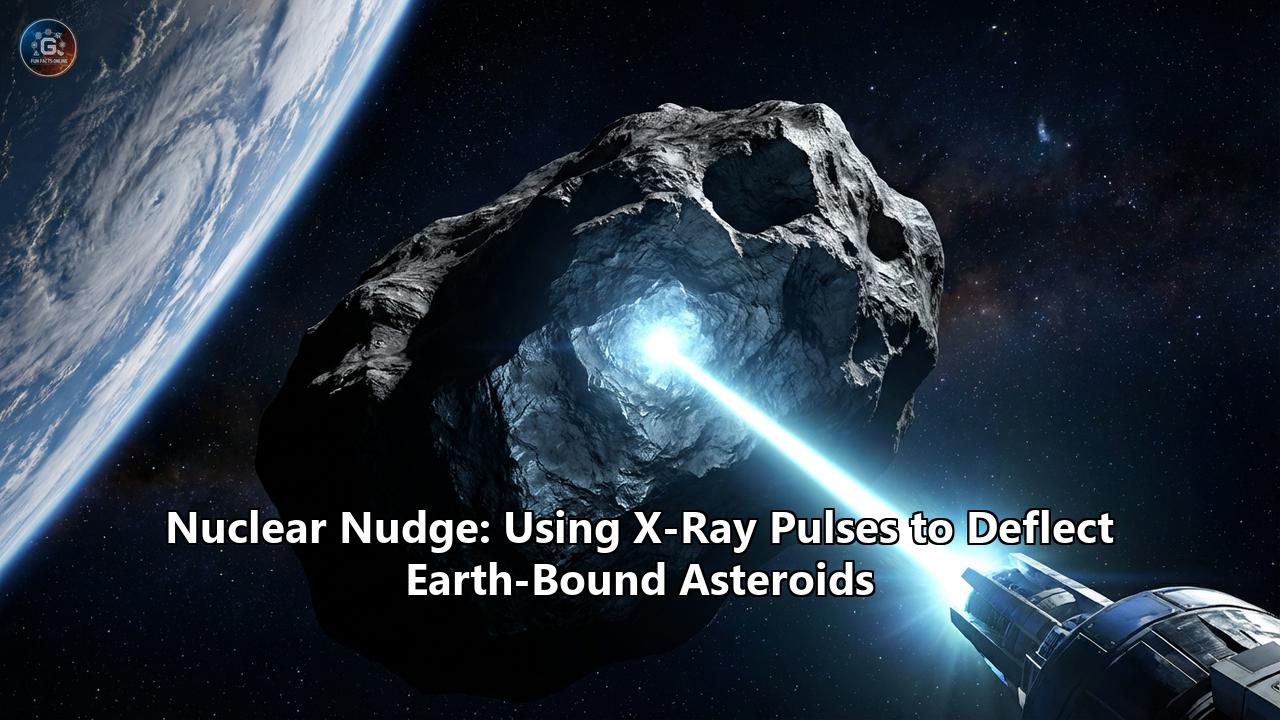
It is the ultimate cosmic nightmare: a mountain-sized rock hurtling through the void, destined to cross paths with Earth. For decades, this scenario has been the domain of Hollywood blockbusters, where grizzled oil drillers or steely-eyed astronauts fly on suicide missions to blow the threat into oblivion. But in the quiet, sterile halls of real-world science, the solution has always been less about brute force destruction and more about precise, high-stakes physics.
In late 2024, a team of physicists at Sandia National Laboratories fundamentally changed the playbook for saving humanity. They didn’t look to drills or kinetic battering rams. Instead, they looked to the raw, blinding power of X-rays.
Their breakthrough, published in Nature Physics, provides the first experimental evidence that the radiation from a nuclear explosion can be used to gently—but firmly—shove an asteroid off a collision course. This is the story of the "Nuclear Nudge," a technology that transforms our most destructive weapon into a shield for the entire planet.
Part I: The Invisible Threat and the Kinetic Limit
To understand why the "Nuclear Nudge" is such a critical development, we must first understand the enemy. Near-Earth Objects (NEOs) are remnants from the early solar system, ranging from pebbles that burn up as shooting stars to behemoths capable of ending civilizations.
The Kinetic Impactor: A Blunt Instrument
Until recently, humanity’s primary defense strategy was the "Kinetic Impactor." The concept is simple: slam a spacecraft into the asteroid at high speed to transfer momentum, slightly altering its orbit.
On September 26, 2022, NASA proved this could work. The DART (Double Asteroid Redirection Test) mission successfully crashed a vending-machine-sized spacecraft into the asteroid Dimorphos. The impact shortened Dimorphos’s orbit around its parent body by 32 minutes—a resounding success.
However, DART revealed the limitations of kinetic impactors:
- Mass Limits: A spacecraft is tiny compared to a city-killer asteroid. DART worked on a moonlet only 160 meters wide. For an asteroid 4 kilometers wide (like the one simulated in the Sandia study), you would need thousands of DARTs, or a spacecraft so massive it would be impossible to launch.
- Time Constraints: Kinetic deflection requires years, even decades, of lead time. The change in velocity is so small that it needs a long time to compound into a safe miss distance.
- Composition Unknowns: If an asteroid is a "rubble pile" (loosely held together rocks), a kinetic impactor might just be absorbed like a bullet into a sandbag, failing to impart enough push.
We needed a weapon with more energy density—something that could deliver a massive shove in a fraction of a second.
Part II: The Physics of the "Nuclear Nudge"
The popular image of nuclear asteroid defense involves drilling a hole and detonating a bomb inside, blowing the rock to smithereens. In reality, this is the last thing planetary defense experts want to do. Blowing up an asteroid turns a single cannonball into a shotgun blast of radioactive buckshot, all still heading toward Earth.
The goal is deflection, not disruption.
The Rocket Effect
The strategy validated by Sandia National Laboratories relies on a "standoff" detonation. A nuclear device is detonated a few kilometers away from the asteroid’s surface.
- The Flash: A nuclear explosion in space releases roughly 70-80% of its energy as high-intensity X-rays.
- The Heating: These X-rays travel at the speed of light and slam into the side of the asteroid facing the blast.
- The Vaporization: The outer layer of the asteroid’s rock (only a few microns to millimeters deep) is instantly heated to tens of thousands of degrees. It doesn't just melt; it sublimates, turning directly from solid rock into expanding gas (plasma).
- The Push: This rapidly expanding gas explodes outward into space. According to Newton's Third Law (for every action, there is an equal and opposite reaction), the force of this gas shooting away from the asteroid imparts a massive thrust into the asteroid.
Effectively, the X-rays turn the asteroid’s own surface into a rocket engine for a split second.
Part III: The Z Machine Experiment
Theory is one thing; proving it is another. You cannot simply launch a nuclear weapon into space to test a hypothesis—the 1967 Outer Space Treaty bans the placement and testing of nuclear weapons in orbit.
Enter Nathan Moore and his team at Sandia National Laboratories in Albuquerque, New Mexico. They realized they didn't need a nuke; they just needed the X-rays.
The Beast: The Z Pulsed Power Facility
The experiment took place inside the Z machine, the most powerful pulsed-power generator on Earth. The Z machine is a technological titan, capable of discharging electrical currents unmatched by any lightning bolt.
- How it works: The machine stores huge amounts of electricity in banks of capacitors. In a microsecond, it releases this energy into a target area the size of a spool of thread.
- The Result: The electrical current creates a magnetic field so intense it crushes argon gas atoms together (a Z-pinch), creating a superheated plasma that emits a burst of X-rays powerful enough to simulate a nuclear detonation.
The "X-Ray Scissors"
The challenge was gravity. In space, an asteroid floats freely. In the lab, any target you hang up is pulled down by Earth's gravity. If you hold it with clamps, the clamps absorb the shock. If you hang it by a string, the string interferes.
Moore’s team devised a brilliant solution they dubbed "X-ray Scissors."
- They suspended a mock asteroid (a 12-millimeter grain of silica or quartz) using a foil filament eight times thinner than a human hair.
- When the Z machine fired, the initial burst of radiation instantly vaporized the foil, cutting the target loose.
- For a few millionths of a second, the target was in true free-fall—floating as if it were in deep space.
- In that exact window, the main X-ray pulse hit the target.
The Results
The results were staggering. The X-ray pulse hit the silica target, vaporizing its surface. The resulting plume of gas accelerated the tiny rock to 69.5 meters per second (over 150 miles per hour).
"It was like a rocket engine," Moore explained. The experiment proved that the momentum transfer wasn't just a theoretical equation—it was a measurable, scalable physical reality. The synthetic asteroids weren't smashed; they were shoved.
Part IV: Scaling Up – Saving the Earth from a City-Killer
The data from the 12mm target allowed the team to scale their math up to real-world threats. The implications are profound.
The 4-Kilometer Monster
The scaling laws derived from the Z machine data suggest that this method could deflect an asteroid up to 4 kilometers (2.5 miles) wide.
To put that in perspective:
- The asteroid that wiped out the dinosaurs (Chicxulub) was about 10km wide.
- The asteroid responsible for the "standard" catastrophic movie scenario is usually 1-2km.
- A 4km asteroid is an "extinction-level" event for human civilization.
The study indicates that a nuclear standoff burst could impart enough velocity change (delta-v) to push such a monster off an Earth-intersecting trajectory, provided we intercept it with enough lead time.
The "Short Warning" Advantage
Perhaps the most critical advantage of the Nuclear Nudge is speed.
If we discover an asteroid is going to hit Earth in 6 months, a kinetic impactor (like DART) is useless; it simply cannot deliver enough energy to change the path in time. A nuclear device, however, packs millions of times more energy per kilogram of payload.
Moore’s research suggests that even with short warning times, the sheer force of X-ray ablation could provide the desperate, high-energy shove needed to clear the Earth.
Part V: The Materials Challenge
Not all asteroids are solid rocks. Some, like the asteroid Bennu (visited by the OSIRIS-REx mission), are "rubble piles"—loose conglomerations of gravel and boulders held together by weak gravity.
Critics of nuclear deflection previously worried that a nuke would simply scatter a rubble pile, turning it into a cloud of radioactive debris that would still rain down on Earth.
The Sandia experiment addresses this. Because the X-rays only interact with the surface (the top few millimeters), the shockwave doesn't necessarily have to travel through the whole body to move it. The "rocket effect" pushes against the surface, and gravity drags the rest of the rubble pile along with it.
- Quartz vs. Silica: The experiment tested different materials. Quartz (crystalline) and fused silica (glass-like) both responded predictably.
- Future Tests: The team plans to test more complex makeups, including iron-nickel composites and porous rocks, to simulate the wide variety of asteroid compositions found in our solar system.
Part VI: The Geopolitical and Legal Minefield
While the science is sound, the implementation is politically explosive.
The Outer Space Treaty of 1967
Article IV of the Outer Space Treaty explicitly forbids placing objects carrying nuclear weapons in orbit around the Earth or on celestial bodies.
- The Loophole? The treaty bans stationing weapons. It is legally ambiguous whether launching a weapon from Earth to intercept an asteroid constitutes "stationing."
- International Trust: If the US or China announces it is launching a massive nuclear warhead into space to "stop an asteroid," other nations might fear it is a disguised attack or a test of an orbital bombardment system.
For the "Nuclear Nudge" to be a viable planetary defense strategy, the world needs a new legal framework. We need rapid-response protocols, verified by international bodies, that allow for the launch of a nuclear interceptor only when a verified threat exists.
Planetary Defense Coordination
NASA currently has a Planetary Defense Coordination Office (PDCO). This office, along with international partners like ESA (European Space Agency), would be the command center.
The new Sandia findings likely push the "nuclear option" from a theoretical last resort to a primary strategy for large objects (over 1km) or late-detected threats.
Part VII: The Future of Planetary Defense
The success of the Z machine experiments marks the beginning of a new era in how we view our place in the cosmos. We are no longer passive victims of celestial mechanics.
Creating the "Library of Deflection"
Nathan Moore’s goal is not just to prove it works once, but to create a comprehensive database. He envisions a library where, if an asteroid is spotted, we can look up its:
- Composition (Iron, Silica, Carbonaceous)
- Size
- Porosity
And the library will tell us exactly:
- What yield of warhead is needed (kilotons vs. megatons).
- What standoff distance is optimal (1km vs 5km).
- Where to detonate to maximize the deflection vector.
A Layered Defense
The future of Earth’s defense will likely be a "layered" system:
- Layer 1 (Early Warning): Space telescopes (like the upcoming NEO Surveyor) spotting threats decades out.
- Layer 2 (Kinetic Impactors): For smaller rocks (<500m) with long lead times, we use DART-style battering rams. They are "clean" and politically safer.
- Layer 3 (Nuclear Nudge): For the "City Killers" and "Planet Killers," or any rock detected with less than 5 years to impact, we deploy the X-ray solution.
Conclusion: Prometheus Unbound
For nearly 80 years, nuclear technology has been the specter of humanity's self-destruction. It is poetic irony that the same physics used to build the ultimate weapon may be the only thing capable of ensuring our survival against the universe's most ancient violence.
The Sandia National Laboratories experiment has moved the "Nuclear Nudge" from science fiction to science fact. By harnessing the ghost-like power of X-rays to turn falling stars into rocket ships, we have proven that we can protect our pale blue dot.
The dinosaurs didn't have a space program. They didn't have the Z machine. We do. And because of the work of scientists like Nathan Moore, when the next great rock comes for us, we won't just watch the sky fall. We will push it back.
Reference:
- https://newatlas.com/space/x-rays-deflect-asteroids-nuclear/
- https://physicsworld.com/a/mock-asteroids-deflected-by-x-rays-in-study-that-could-help-us-protect-earth/
- https://www.smithsonianmag.com/smart-news/asteroid-deflecting-missions-need-to-hit-asteroids-in-a-specific-spot-to-avoid-pushing-them-into-another-collision-course-with-earth-new-research-reveals-180987342/
- https://www.youtube.com/watch?v=V2M0hq84tyg
- https://www.sciencenews.org/article/nuclear-x-rays-deflect-earth-asteroids
- https://www.space.com/asteroid-nuclear-bomb-deflection-x-rays
- https://www.newsweek.com/asteroid-collision-deflection-x-rays-nuclear-bomb-1958700
- https://www.researchgate.net/publication/384266006_Simulation_of_asteroid_deflection_with_a_megajoule-class_X-ray_pulse
- https://newsreleases.sandia.gov/asteroid_deflection/
- https://www.sandia.gov/labnews/2024/10/03/deflecting-doom-how-sandia-research-could-save-earth-from-asteroids/
- https://www.popsci.com/science/x-ray-scissors-asteroid/
- https://www.sci.news/physics/x-ray-asteroid-deflection-13281.html