
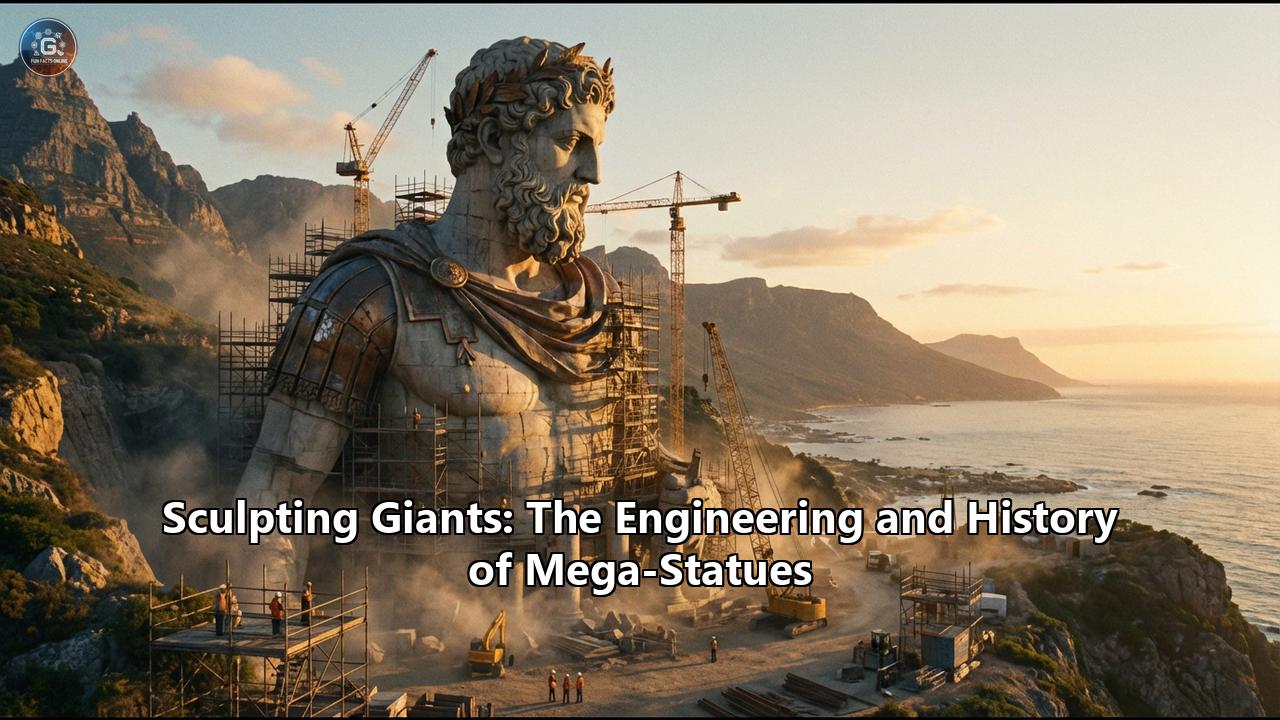
For as long as humanity has looked up at the stars, we have felt an inexplicable need to build things that reach for them. From the sun-baked sands of Giza to the riverbanks of modern India, our species has spent millennia crafting colossal human figures that defy gravity, logic, and often, the economy. These are not just statues; they are engineering miracles, political statements, and testaments to human ambition.
But how do you build a 600-foot human out of bronze and steel? How do you keep it standing when a typhoon hits? And why, after thousands of years, are we building them taller than ever before?
This is the story of sculpting giants—the physics, the failures, and the sheer audacity of the world’s mega-statues.
Part I: The Ancient Ambition (The Impossible Builders)
To understand the modern titans, we must first look at the ancestors who built giants without cranes, steel beams, or computer-aided design.
The Ghost of Rhodes
The most famous mega-statue of antiquity no longer exists, yet it haunts every engineer who attempts to build a colossus today. The Colossus of Rhodes, erected around 280 BC, was a bronze statue of the sun god Helios. Standing approximately 33 meters (108 feet) tall, it was roughly the height of the Statue of Liberty’s internal skeleton.
For centuries, medieval illustrations depicted the Colossus straddling the harbor entrance, ships passing between its legs. Modern engineering tells us this was impossible; the structural stress on the groin area would have caused it to snap under its own weight, not to mention the harbor would have been blocked during construction.
Instead, the Colossus likely stood on a pedestal near the harbor. Its construction was a feat of ingenuity born of war. The people of Rhodes melted down the bronze and iron from abandoned Macedonian siege engines—towers and weapons left behind after a failed invasion—to build their god. The engineer Chares of Lindos likely built it in horizontal sections, casting bronze plates and riveting them to an iron framework, filling the hollow interior with stone blocks for stability. It stood for only 54 years before an earthquake snapped it at the knees, a stark reminder that even gods are subject to the laws of physics.
The Eternal Sphinx
While Rhodes crumbled, the Great Sphinx of Giza endured. Carved directly from the limestone bedrock around 2500 BC, it is a "monolithic" statue—one solid piece of stone. This presented a different engineering challenge: subtraction rather than addition. If the sculptors made a mistake with the nose or the paw, there was no going back. The Sphinx’s survival is due less to structural engineering and more to geology; for thousands of years, it was buried up to its neck in sand, protected from the wind and erosion that would have otherwise erased it.
Part II: The Iron Skeleton (The Turning Point)
For thousands of years, height was limited by the weight of stone. If you built too tall, the stone at the bottom would crush under the weight of the stone at the top. The game changed forever in the late 19th century in a workshop in Paris.
Liberty’s Secret Weapon
When Frédéric Auguste Bartholdi designed the Statue of Liberty, he wanted a figure of copper. But copper is soft and heavy. A hollow copper statue of that size would collapse like a crushed soda can. He needed a skeleton.
Enter Gustave Eiffel. Before he built his famous tower, Eiffel designed the internal spine of Lady Liberty. He created a central iron pylon that acted as the statue's backbone. From this spine, a web of lighter iron bars reached out to hold the copper skin.
The genius was in the connection: the copper skin is not rigidly fixed to the iron frame. Instead, it "floats" on saddles that allow the skin to expand and contract with the heat of the New York sun without cracking. This technique, known as curtain wall construction, is the same principle used in modern skyscrapers. The Statue of Liberty wasn't just a gift; it was the prototype for the modern mega-statue.
Part III: The Modern Titans (A New Arms Race)
In the 21st century, the race for height has accelerated. We are no longer satisfied with 100 feet. We are pushing past 500.
1. The Statue of Unity (India): The Current King
Standing at a staggering 182 meters (597 feet)—nearly twice the height of the Statue of Liberty—the Statue of Unity is currently the tallest in the world. Located in Gujarat, it depicts Sardar Vallabhbhai Patel, the "Iron Man of India."
The Engineering Challenge:- The Shape: Unlike a tapering obelisk or a pyramid, a human figure is aerodynamically a nightmare. It has broad shoulders and narrow feet. The Statue of Unity is "slender" at the bottom and heavy at the top, defying the usual logic of stability.
- The Core: To keep it upright, engineers from Larsen & Toubro utilized two massive reinforced concrete cores that house high-speed elevators. These cores act as the spine.
- The Skin: A steel space frame hangs off these cores, supporting 6,500 bronze panels. These panels were cast in China (a point of local controversy) and designed to overlap slightly to allow for movement.
- The Wind: The statue is located in a river basin subject to high winds. It is designed to withstand wind speeds of 180 km/h. To manage this, the statue has two tuned mass dampers—massive 250-tonne weights suspended inside the chest area. When the wind pushes the statue one way, these weights swing the other way, canceling out the vibration.
2. Spring Temple Buddha (China): The Copper Lotus
Until 2018, this was the world record holder. Standing 128 meters tall (208 meters if you count the elaborate pedestals), the Spring Temple Buddha in Henan province is a masterclass in casting.
The Golden Touch:The statue is made of 1,100 pieces of copper cast, weighing 1,000 tonnes. The challenge here was surface area. The copper skin had to be treated to withstand the humid, industrial air of central China without corroding. The exterior is also coated in gold, making it a blindingly bright beacon. The project was expedited after the Taliban destroyed the Bamiyan Buddhas in Afghanistan, framed as a defiant preservation of Buddhist heritage.
3. Garuda Wisnu Kencana (Indonesia): The Puzzle in the Sky
Perhaps the most complex statue ever built is the GWK in Bali. Depicting the Hindu god Wisnu riding the mythical eagle Garuda, it is not a simple standing figure. It is a mass of wings, feathers, and flowing robes, standing 121 meters tall.
The 28-Year Struggle:Designed by Nyoman Nuarta, this statue took nearly three decades to finish.
- Wind Tunnel Testing: Because of its massive wingspan (64 meters), the statue acts like a giant sail. Engineers tested scale models in wind tunnels in Canada to ensure the tropical storms of Bali wouldn't tear it apart.
- The Skin: The statue is made of a copper and brass alloy. Unlike the smooth panels of the Statue of Unity, GWK is textured and complex. It was built in 754 separate modules. These modules were crafted in Java, cut into pieces, transported by truck and hanging ferry to Bali, and then welded back together like a giant 3D jigsaw puzzle in the sky.
4. The Motherland Calls (Russia): The Defiant Physics
Completed in 1967, this 85-meter statue in Volgograd is terrifyingly complex. It depicts a woman stepping forward with a sword raised high.
The Structural Nightmare:- The Sword: The original stainless steel sword was so heavy and caught so much wind that it caused the statue to sway dangerously. It had to be replaced with a perforated steel structure to let wind pass through, and later, wind dampers were added to the tip.
- The Foundation: Incredibly, the statue is not fixed to the bedrock. It stands on its base solely by its own weight (gravity), floating on a foundation of clay. However, rising groundwater has caused the clay to shift, leading to a "Leaning Tower of Pisa" situation. Millions of dollars have been spent recently to shore up the foundation and prevent the Motherland from toppling over.
Part IV: The Engineering of Awe
Building a mega-statue involves overcoming three primary enemies.
Enemy #1: The Square-Cube Law
As you scale an object up, its volume (and weight) grows much faster than its surface area. If you double the height of a statue, it doesn't become twice as heavy; it becomes eight times as heavy.
This is why you cannot simply "scale up" a statue of David. The ankles would shatter instantly. Modern mega-statues require high-strength reinforced concrete cores (Grade M60 or higher) and specialized steel trusses just to support their own crushing mass.
Enemy #2: The Wind (Vortex Shedding)
When wind hits a cylindrical object (like a statue's arm or torso), it flows around it and creates alternating swirls or "vortices" on the back side. This can create a rhythmic push-pull force called vortex shedding. If this rhythm matches the statue's natural sway frequency, the statue can resonate and shake itself apart (like a singer breaking a wine glass).
- Solution: Engineers use wind tunnel testing to shape the statue subtly to confuse the wind, or they install the previously mentioned Tuned Mass Dampers to absorb the energy.
Enemy #3: Thermal Expansion
A bronze statue standing in the sun heats up. Metal expands when hot. A 182-meter statue might grow by several centimeters on a hot day. If the skin were bolted tightly to the rigid concrete core, the statue would rip itself apart.
- Solution: The "Floating Skin." The outer panels are attached via sliding clips that allow the metal to breathe, expand, and contract without transferring that stress to the main skeleton.
Part V: The Economics of Giants
Why do we build them? The answer is a mix of piety, politics, and profit.
The Tourism Engine
The Statue of Unity attracted over 2.9 million visitors in its first year, generating roughly 82 crore INR (approx. $11 million) in revenue. It has transformed the sleepy town of Kevadia into a bustling tourist hub with hotels, a tent city, and river rafting. Similarly, the Statue of Liberty is a global icon that drives a significant portion of New York City's tourism economy.
However, the "Bilbao Effect"—the idea that a massive landmark will automatically regenerate a region's economy—is not guaranteed.
- The Ushiku Daibutsu in Japan, while impressive, sits in a quiet area of Ibaraki. It sees steady visitation but hasn't transformed the regional economy in the way the Statue of Unity has.
- The Motherland Calls is a site of solemn pilgrimage rather than commercial tourism, serving a different "economic" purpose: the maintenance of national identity and historical memory.
The Cost of Pride
These projects are enormously expensive.
- Statue of Unity: ~$400–420 million USD.
- Garuda Wisnu Kencana: Estimated $100 million+ over 28 years.
- Spring Temple Buddha: ~$55 million for the statue, but hundreds of millions for the surrounding park.
Critics often argue these funds could be better spent on hospitals or schools. In India, the Statue of Unity faced severe criticism for its cost and the displacement of local tribal communities. In Indonesia, the GWK project stalled for years due to the Asian Financial Crisis and public outcry over the budget. The economic argument is always a gamble: will the tourist dollars eventually outweigh the initial massive outlay?
Part VI: The Dark Side of the Giant
There is an environmental price to paying homage to the gods.
The Concrete Footprint:The construction of the Statue of Unity used 210,000 cubic meters of cement and concrete. Cement production is responsible for about 8% of global CO2 emissions. Building a mega-statue is a massive carbon bomb.
Displacement:To build the "Statue of Unity," irony struck when local tribal groups were displaced from their lands to make way for the tourism infrastructure. Similarly, the creation of the massive scenic areas around Chinese Buddhas often involves reshaping entire mountains and relocating villages.
Ecological Disruption:The GWK in Bali was built on a limestone quarry, but the sheer volume of water and electricity required to run the cultural park in a water-scarce region of Bali has raised concerns.
Part VII: The Future of Statues
Are we done? Is 182 meters the limit?
Probably not. But the race is slowing down.
The Shiv Smarak (Statue of Chhatrapati Shivaji) proposed for the Arabian Sea off the coast of Mumbai was planned to be 212 meters tall, surpassing the Statue of Unity. However, the project has been stalled by environmental litigation and concerns over the massive cost.
We are reaching the limits of what is economically sensible, if not engineered possible. As we move forward, the definition of a "monument" may shift. We might see:
- Dynamic Statues: Kinetic sculptures that move with the wind.
- Digital Colossi: Massive hologram projections or drone swarms that create 1000-foot figures in the sky without using a single drop of concrete.
- Sustainable Giants: Structures that double as vertical forests or air purifiers, justifying their existence by contributing to the environment rather than taking from it.
Conclusion
From the melted weapons of Rhodes to the computer-modeled bronze panels of Gujarat, the history of mega-statues is the history of human engineering. We build them because we are small, and the universe is large, and we desperately want to leave a mark that says, "We were here, and we could do great things."
They are vanity projects, yes. They are economic gambles, certainly. But standing at the foot of the Ushiku Daibutsu, looking up at a face the size of a tennis court, it is hard not to feel that primal sense of awe. And as long as humans can feel awe, we will keep building giants.
Reference:
- https://www.youtube.com/watch?v=9WDKW1_2S5A
- https://www.businesstoday.in/bt-newsflicks/photo/all-you-need-to-know-about-the-tallest-statues-of-the-world-5764-2018-10-31
- https://authentic-indonesia.com/blog/6-facts-about-garuda-wisnu-kencana-statue-bali/
- https://www.youtube.com/watch?v=hHuSN6uz8h8
- https://souticket.in/2023/10/06/statue-of-unity-the-economic-impact-on-surrounding-areas/
- https://www.youtube.com/watch?v=mvcGzORsrJo
- https://www.gwkbali.com/pages/the-story
- https://www.nowjakarta.co.id/welcoming-indonesia-s-latest-landmark-the-statue-of-garuda-wisnu-kencana/
- https://economictimes.indiatimes.com/news/politics-and-nation/gujarat-statue-of-unity-attracted-29-lakh-tourists-earned-rs-82-crore/articleshow/72461015.cms?from=mdr
- https://www.latrobe.edu.au/news/articles/2018/opinion/worlds-tallest-statue-costs-environment
- https://www.abacademies.org/articles/the-statue-of-unity-a-boost-for-tourism-a-case-study-from-india-10309.html