
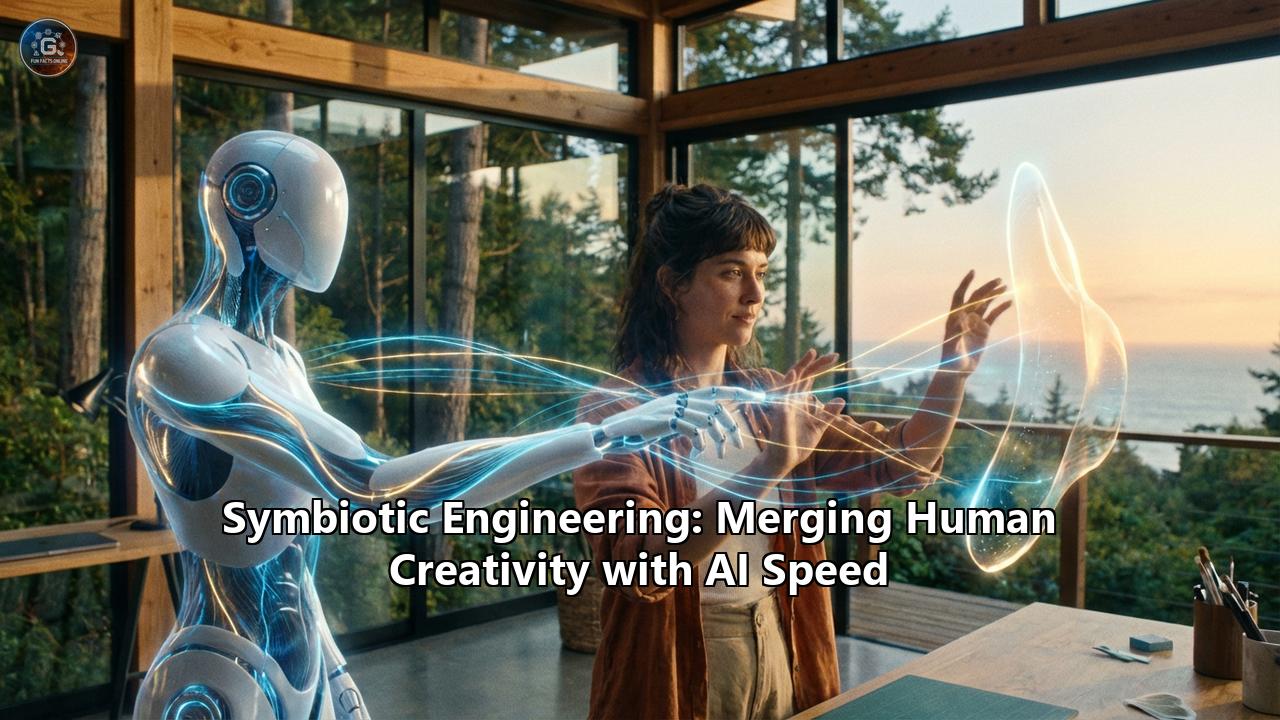
Symbiotic Engineering represents the most significant paradigm shift in how we build our world since the Industrial Revolution. For decades, technology has been a passive tool—a calculator, a drafting board, a compiler—waiting for human input to execute a command. Today, that dynamic has fundamentally inverted. We are entering an era where our tools talk back, offer alternatives, and independently solve problems we haven't yet identified. This is not automation, where a machine mindlessly repeats a task; this is symbiosis, where human creativity and AI speed merge to create a collective intelligence that exceeds the sum of its parts.
In 2026, the engineer is no longer just a builder but an orchestrator of synthetic intelligence. The "lone genius" sketching on a napkin is being replaced by the "centaur"—a human-AI hybrid team where the human provides the intent, ethics, and creative spark, while the AI provides the infinite scale, instant validation, and rapid iteration. This article explores the depths of this new discipline, examining how Symbiotic Engineering is reshaping industries from microchip design to bio-architecture, and why the future belongs not to those who can code the fastest, but to those who can best dance with machines.
The Anatomy of Symbiosis: From Tool to Teammate
To understand Symbiotic Engineering, we must first distinguish it from traditional automation. Automation is about removing the human from the loop to increase efficiency in repetitive tasks. Symbiosis is about keeping the human in the loop to increase complexity and quality in creative tasks.
The core mechanic of this relationship is often described as the "70/30 Protocol." In a symbiotic workflow, AI handles the "heavy lifting"—the 70% of engineering that involves data retrieval, compliance checking, basic code generation, and simulation. This liberates the human engineer to focus on the top 30%—the high-value tasks of conceptualization, ethical judgment, system architecture, and "edge case" problem-solving.
This shift allows for a phenomenon known as "Cognitive Symbiosis." In this state, the friction between having an idea and testing it disappears. An engineer can verbally describe a mechanical bracket, and within seconds, an AI agent generates fifty distinct 3D models, runs stress tests on all of them, filters out the ones that are impossible to manufacture, and presents the top three candidates for human review. The human didn't draw a single line but "engineered" the solution by defining the constraints and the goal.
The Digital Architect: Electronics and Software
Nowhere is this symbiosis more mature than in the realm of electrons and code. In the semiconductor industry, companies like NVIDIA are pioneering tools like "CircuitVAE," a variational autoencoder that collaborates with human designers to optimize chip layouts.
Designing a modern GPU involves placing billions of transistors—a task that exceeds unassisted human cognitive capacity. In the symbiotic model, the human designer sets the high-level goals: "Maximize performance per watt for this specific logic block." The AI then explores a continuous "latent space" of design possibilities, generating thousands of layouts that a human would never consider. It doesn't just place components; it trades off power consumption against signal integrity and thermal dissipation in real-time.
Crucially, the AI is not just a "black box." Platforms like CELUS are transforming circuit design by allowing engineers to describe a functional block—"I need a Bluetooth module that connects to this specific sensor suite"—and the AI automatically scouts the component supply chain, verifies stock availability, retrieves the datasheets, and generates the schematic connectivity. The engineer’s role shifts from reading hundreds of PDF datasheets to evaluating the system-level architecture proposed by the AI.
In software engineering, the concept of "pair programming" has evolved into "AI co-piloting." It is estimated that by late 2025, over 40% of new code is being generated by AI assistants. However, the most effective developers treat the AI not as a code generator, but as a relentless sparring partner. They use the AI to write unit tests before the code exists, to refactor legacy codebases into modern languages, and to simulate security attacks against their own software. The human provides the "why" and the "what"; the AI provides the "how."
The Physical Shaper: Manufacturing and Automotive
Moving from bits to atoms, Symbiotic Engineering is revolutionizing how we manufacture physical objects. The automotive industry, traditionally slow and risk-averse, has become a hotbed for this new discipline.
Consider the "wiring harness" of a modern electric vehicle—the nervous system of the car, containing miles of copper wire and thousands of connection points. Traditionally, this was a nightmare of manual routing. Today, tools like Siemens Capital allow for generative design where the human engineer defines the spatial constraints of the chassis and the electrical requirements. The AI then "grows" the wiring harness like a vine, finding the optimal path through the vehicle’s body to minimize weight and interference.
At BMW, this symbiosis extends to the factory floor. Quality control is no longer just about cameras looking for scratches. It involves "vision language models" that can reason about what they see. A human inspector works alongside an AI that doesn't just flag defects but suggests root causes. If the paint on a hood is too thin, the AI might cross-reference this with the humidity sensors in the spray booth from three hours ago and the specific batch of paint used, presenting the human with a hypothesis: "Viscosity likely too low due to humidity spike; recommend adjusting solvent ratio." The human validates the insight, and the process improves.
We are also seeing the rise of "Digital Twins" as the ultimate symbiotic interface. In Formula 1 racing and aerospace, engineers no longer just look at telemetry data. They converse with a digital replica of the car or plane. An engineer can ask the Digital Twin, "What happens to the front wing aerodynamics if we increase the track temperature by 10 degrees?" The AI runs a physics-accurate simulation and returns a visualization. This allows for "counterfactual engineering"—exploring paths not taken—at zero physical cost.
The Bio-Explorer: Science and Medicine
Perhaps the most profound application of Symbiotic Engineering is in biology, where the complexity of nature often overwhelms human intuition. Here, the AI acts as a "Cognitive Microscope," seeing patterns in data that are invisible to us.
A landmark example occurred at Imperial College London, where researchers partnered with a "Google Co-Scientist" AI to tackle antibiotic resistance. For a decade, human scientists struggled to understand how certain "superbugs" were sharing genetic material. The AI agent didn't run a single wet-lab experiment. Instead, it ingested decades of papers, data logs, and genetic sequences, eventually hallucinating a novel hypothesis involving viral shells as transport vectors. The human scientists, initially skeptical, designed a physical experiment to test this AI-generated hunch—and it worked.
This is the essence of Symbiotic Engineering: the AI proposes the hypothesis, and the human provides the empirical validation. We see similar breakthroughs in materials science. Researchers are using Large Language Models (LLMs) to mine millions of botanical papers to find "bio-inspired" engineering solutions. When a team needed a new type of reversible adhesive, their AI partner suggested looking at the microscopic structure of pollen grains—a connection no human specialist had made because the relevant papers were in completely different sub-fields.
The Methodology of Symbiosis
How does an organization actually implement Symbiotic Engineering? It requires more than just buying a ChatGPT subscription. It demands a restructuring of workflows around the "Human-in-the-Loop" (HITL) principle.
- The Prompt as Design Language: The ability to craft precise, context-rich prompts is now a core engineering skill. It is the new syntax. Engineers must learn to "speak machine," breaking down complex system requirements into logical steps that an AI agent can execute without hallucinating.
- Iterative Feedback Loops: The workflow is circular, not linear. It follows a "Generate-Evaluate-Refine" cycle.
Generate: The human sets parameters; the AI generates 100 variations.
Evaluate: The AI pre-filters these based on "hard" constraints (physics, cost); the human evaluates the survivors based on "soft" constraints (aesthetics, user experience, ethics).
Refine: The human selects the best candidate and tweaks the parameters; the AI regenerates a focused batch.
- The "Glass Box" Requirement: For symbiosis to work, trust is essential. Engineers cannot work with a "black box" that gives a magical answer without working. Symbiotic tools must be "explainable"—they must be able to show their work. "Why did you route the pipe this way?" The AI must be able to highlight the constraint (e.g., "Avoided heat source X by 50mm") that led to the decision.
The Challenges: The Ownership Gap and Deskilling
This brave new world is not without its perils. The most pressing technical challenge is the "Ownership Gap." When an AI agent generates 70% of the code or design, who owns the result? If the bridge fails, is the engineer liable for not catching an error in the AI's simulation? The consensus forming in 2026 is that the human is always the architect of record. The AI is a tool, however sophisticated. An engineer cannot blame the calculator for a wrong answer, and they cannot blame the AI for a structural failure. This increases, rather than decreases, the burden of responsibility on senior engineers to be master auditors of machine output.
There is also the fear of "deskilling." If an AI solves all the differential equations, will the next generation of engineers forget the first principles of physics? There is a risk that we produce "parameter tuners" rather than true engineers. To combat this, universities are shifting their focus from rote calculation to "systems thinking." The value of a human engineer is no longer in solving the equation, but in knowing which equation needs to be solved.
The Future: The Agentic Economy and Generative Reality
Looking ahead to 2027 and beyond, Symbiotic Engineering will evolve into the "Agentic Economy." We will move from chatting with a single AI bot to orchestrating swarms of specialized "AI Agents."
Imagine a civil engineer designing a bridge. She won't just use CAD software. She will summon a team of agents: a "Structural Agent" to calculate loads, a "Geotechnical Agent" to analyze the soil data, a "Cost Agent" to monitor the budget in real-time, and a "Compliance Agent" that has memorized every local building code. These agents will debate each other. The Cost Agent might argue that a certain steel grade is too expensive, while the Structural Agent argues it's necessary for safety. The human engineer becomes the judge, weighing the trade-offs and making the final call.
We are also moving toward "Generative Reality" in simulation. Engineers will soon walk through photorealistic, physics-accurate VR simulations of their designs that are generated in real-time. A car designer could sit in a virtual prototype, drive it, and say, "The visibility over the hood is poor." The AI would instantly lower the hood geometry, adjust the engine placement to fit, and re-calculate the aerodynamics—all while the designer is still driving.
Conclusion: The Human Element
In the end, Symbiotic Engineering is not about replacing the human; it is about amplifying the human. It is a recognition that while machines are faster, stronger, and more precise, they lack the one thing that defines true engineering: purpose.
A machine can design a bridge that stands up for a thousand years, but it cannot decide where* that bridge should go to best serve a community. It cannot weigh the beauty of a skyline against the efficiency of a grid. It cannot feel the frustration of a user struggling with a poorly designed handle.
The engineers of the future will not be measured by their ability to do what machines can do. They will be measured by their ability to dream what machines cannot. They will be the visionaries who harness the raw, chaotic speed of AI and channel it, through human wisdom and creativity, into a world that is not just more efficient, but more livable, more beautiful, and more human. This is the promise of Symbiotic Engineering: the merging of the silicon spark with the human soul to build a tomorrow that neither could achieve alone.
Reference:
- https://medium.com/@ieeewieuom/human-ai-symbiosis-exploring-how-humans-and-ai-collaboratively-innovate-in-engineering-and-881dab81f87a
- https://www.getstellar.ai/blog/revolutionizing-manufacturing-with-ai-real-world-case-studies-across-the-industry
- https://www.celus.io/news/how-ai-is-reshaping-electronics-design
- https://www.insights.onegiantleap.com/four-human-ai-collaborations-weve-loved-in-2025/
- https://aiasiapacific.org/2025/05/28/symbiotic-ai-the-future-of-human-ai-collaboration/
- https://mindtitan.com/resources/industry-use-cases/ai-in-manufacturing/
- https://www.fingent.com/blog/ai-applications-in-manufacturing-use-cases-examples/
- https://www.thesys.dev/blogs/designing-human-in-the-loop-ai-interfaces-that-empower-users
- https://humansintheloop.org/what-is-a-human-in-the-loop/
- https://www.youtube.com/watch?v=a8N5ck1IkqI
- https://www.uffmm.org/2025/06/04/human-ai-symbiosis-manifesto-and-example/
- https://hai.stanford.edu/news/humans-loop-design-interactive-ai-systems
- https://medium.com/artful-design/humans-in-the-loop-b83e3bffa65e