
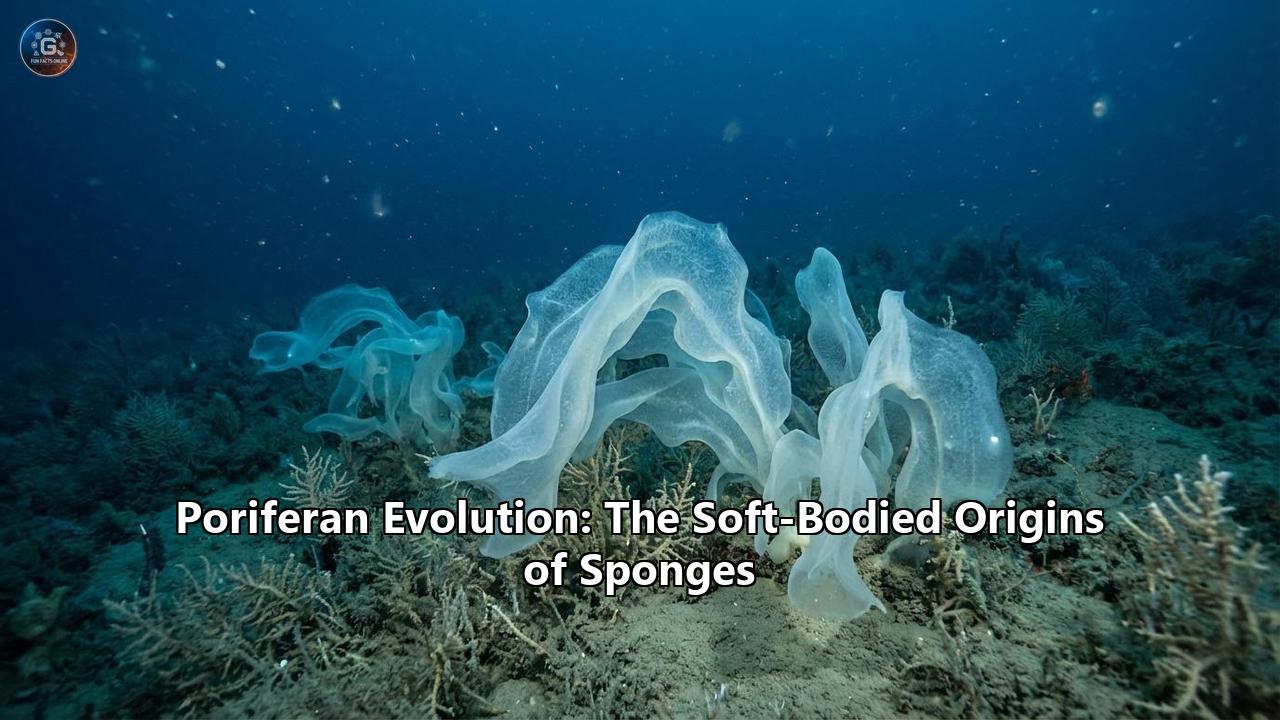
When we peer into the abyssal depths of Earth’s history, searching for the dawn of animal life, we are not greeted by the roar of fearsome predators or the swift movements of complex creatures. Instead, we find ourselves in the quiet, microscopic world of the Neoproterozoic oceans, looking at the unassuming ancestors of modern sponges. For decades, paleontologists have been captivated by the evolutionary origins of the Phylum Porifera—the sponges. As one of the most ancient branching lineages of the animal kingdom, sponges hold the key to understanding how life transitioned from solitary, single-celled organisms to complex, multicellular metazoans. Yet, tracing this lineage back to its roots presents one of the most formidable challenges in evolutionary biology. The earliest sponges were entirely soft-bodied, lacking the hard, biomineralized skeletons that typically survive the ravages of geological time. This missing fossil record has sparked intense scientific debate, driven the search for microscopic clues in ancient rocks, and led to the mapping of complex genomic architectures that reveal a hidden world of soft-bodied pioneers.
To understand the evolution of these soft-bodied ancestors, we must first understand what a sponge is. The Phylum Porifera consists of organisms characterized by their porous bodies, filter-feeding lifestyle, and a distinct lack of true tissues, organs, or nervous systems. Unlike most animals, which have distinct internal digestive tracts, sponges rely on a system of water canals. They use specialized flagellated cells called choanocytes—which bear a striking resemblance to single-celled protists known as choanoflagellates—to generate water currents. As water swooshes through their bodies, they capture bacteria, microalgae, and dissolved organic matter. Modern sponges maintain their structural integrity through a skeleton made of spongin (a collagen-like protein) and hard, needle-like structures called spicules, which are composed of silica or calcium carbonate. However, the ability to secrete these hard spicules is an evolutionary innovation that occurred relatively late in the history of the phylum. Before the advent of biomineralization, sponges were gelatinous, soft-bodied entities, leaving a ghostly and highly contested footprint in the Precambrian fossil record.
The quest to pinpoint the origin of sponges is deeply intertwined with the quest to identify the Last Universal Common Ancestor of all animals. In recent years, evolutionary biologists have been locked in a fascinating debate regarding the base of the animal family tree: the "Sponge-First" versus the "Ctenophore-First" hypothesis. Traditionally, the morphological simplicity of sponges—their lack of muscles, nerves, and a centralized gut—positioned them unequivocally as the sister group to all other animals. However, modern phylogenomic studies have occasionally suggested that ctenophores (comb jellies), which possess complex nervous systems and muscles, might have branched off first. If the "Ctenophore-First" hypothesis holds true, it implies either that the complex traits seen in comb jellies evolved entirely independently, or that the ancestors of sponges were far more complex and subsequently lost these traits in favor of a highly specialized, sessile, filter-feeding lifestyle. Regardless of which lineage diverged first, genetic molecular clocks unequivocally indicate that the earliest ancestors of sponges were present during the Cryogenian period, roughly 700 to 800 million years ago. This places their origin deep within the Precambrian, long before the famous Cambrian Explosion, during a time when the Earth was repeatedly encased in ice—a phenomenon known as "Snowball Earth".
If these soft-bodied sponges existed during the deep freeze of the Cryogenian, where is the physical evidence? For a long time, scientists relied on "chemical fossils" or biomarkers to track their presence. Researchers discovered distinct hydrocarbon molecules, specifically 24-isopropylcholestanes and other C30 steranes, in ancient Neoproterozoic sedimentary rocks dating back over 635 million years. Because these specific lipid biomarkers are produced in abundance by modern demosponges, their presence in ancient rocks was initially heralded as definitive proof that soft-bodied demosponges dominated the early oceans. However, the geochemical landscape is fraught with deceptive mimics. Recent rigorous analyses have demonstrated that these 24-isopropylcholestanes are not exclusively diagnostic for sponges. Instead, they likely formed through the geological alteration and methylation of common sterols produced by chlorophyte algae, which were the dominant eukaryotes at the time. This revelation reconciled the biomarker evidence with the geological record, shifting the focus away from chemical traces and back toward the arduous hunt for physical, microscopic fossils of soft-bodied sponges.
The search for Precambrian body fossils has yielded some of the most fascinating and fiercely debated discoveries in modern paleontology. Because soft tissues decay rapidly, preserving a soft-bodied sponge requires extraordinary geological conditions, typically involving rapid phosphatization, where calcium phosphate replaces the cellular structure before it can decompose. One of the most intriguing candidates for the earliest known animal is Otavia antiqua, discovered in the Otavi Group of Namibia. These submillimeter-sized fossils, recovered from rocks dating between 760 and 550 million years ago, predate the most extreme climatic changes of the Snowball Earth glaciations. Otavia specimens exhibit a quasi-ovoid form pierced by numerous small holes, with internal cavities that connect to larger excurrent openings, strongly mimicking the oscula and ostia of a poriferan body plan. The internal cavities are often filled with geopetal sediment, proving that these organisms were hollow during life. Proponents argue that Otavia represents a stem-group sponge that survived millions of years of global glaciation by quietly filtering bacteria and algae in calm, shallow lagoons. Furthermore, the burial of abundant Otavia organisms may have acted as a significant carbon sink, potentially contributing to the rise in atmospheric oxygen levels that paved the way for more complex life forms. While some skeptics argue that Otavia could represent complex amoebas or other protists, its discovery pushes the potential dawn of animal life back by over 100 million years.
A more anatomically convincing glimpse into the soft-bodied origins of sponges was unearthed in the phosphorus-rich Doushantuo Formation in Guizhou, China. Here, scientists discovered an exquisitely preserved, 600-million-year-old microfossil named Eocyathispongia qiania. Barely the size of a pinhead (about 1.2 millimeters wide), this fossil was frozen in time, preserved in astonishing three-dimensional cellular detail. Eocyathispongia consists of three adjacent hollow tubes sharing a common base. Two of the smaller tubes were likely used to draw water in, while the larger, twisted central tube acted as an exit valve. What makes this fossil truly unprecedented is the preservation of its cellular structure. Scanning electron microscopy and X-ray technology revealed that the organism was composed of hundreds of thousands of cells. The outer surface is covered with a thin layer of flattened, tile-like cells practically identical to the pinacocytes that form the epidermis of modern sponges. Even more remarkably, inside the tubes, researchers observed an array of regularly shaped pits encircled by raised collars. These structures bear a profound resemblance to choanocytes—the definitive collar cells that sponges use to generate water currents and trap food. Although Eocyathispongia does not fit neatly into any of the four modern classes of Porifera, its combination of advanced morphological features cements its position as a late Precambrian stem-group sponge. It proves that highly organized, soft-bodied, filter-feeding metazoans were successfully navigating the Ediacaran oceans up to 60 million years before the Cambrian Explosion.
As the Ediacaran period drew to a close and the Cambrian period dawned approximately 541 million years ago, the soft-bodied ancestors of sponges underwent a revolutionary biological innovation: biomineralization. The earliest undisputed, verifiable fossil sponge remains are siliceous spicules found in the basal Cambrian Soltanieh Formation in Iran, dating to roughly 535 million years ago. The transition from soft, gelatinous bodies to organisms armed with microscopic glass or calcareous spears was driven by sweeping environmental and ecological changes. During the early Cambrian, increased tectonic activity and weathering led to a surge in the availability of dissolved calcium and silica in seawater. Simultaneously, the emergence of the first mobile predators created immense selective pressure for defensive mechanisms. Spicules provided a brilliant evolutionary solution: they made the sponges unpalatable to predators and provided a rigid internal scaffolding. This structural support allowed sponges to grow larger, lift their feeding apparatus higher into the water column to access faster currents, and colonize new, high-energy marine environments.
The invention of the spicule triggered a dramatic radiation of the Porifera. The Cambrian period saw the rise of the Archaeocyatha, an extinct group of heavily calcified sponges that became the first metazoans to construct massive reef ecosystems. These double-walled, conical organisms aggressively competed for space on the shallow marine shelf, engineering the environment and creating complex habitats that fostered the explosive diversification of other early animals. By the time the Archaeocyathids went extinct in the late Cambrian, the three main modern lineages of sponges—Demospongiae, Hexactinellida (glass sponges), and Calcarea—were already firmly established.
Yet, the legacy of the soft-bodied sponge ancestors is not entirely locked away in the rocks; it is also written in the DNA of their living descendants. To look at a sponge is to see an organism of profound morphological simplicity. They lack a brain, a central nervous system, and a digestive tract. However, modern genomic sequencing has revealed a stunning paradox: sponges possess an incredibly complex genetic toolkit, heavily stocked with the same developmental and regulatory genes that govern the formation of complex organs in higher animals. The genome of the marine sponge Amphimedon queenslandica has shown that the vast regulatory landscape used by complex bilaterians was already firmly in place at the dawn of animal multicellularity. Researchers studying histone modifications in Amphimedon discovered distal enhancers, repressive chromatin, and transcriptional units marked by H3K4me3—a level of cis-regulatory complexity previously thought to belong only to advanced animals. These metazoan-specific genomic regions prove that the regulatory foundation for spatiotemporal gene expression evolved long before the divergence of sponges and eumetazoans.
Further evidence of this hidden complexity is found in the freshwater sponge model Ephydatia muelleri. Scientists have identified highly conserved gene regulatory networks (GRNs), such as the Pax/Six/Eya/Dac (PSED) network, actively operating within its cells. In vertebrates, the PSED network is responsible for the development of eyes and sensory organs. In the sponge, orthologs of these genes (like EmPaxB and EmSix1/2) are expressed in the endothelial cells lining the canal system and in the choanoderm. Knocking down these genes via RNA interference results in catastrophic defects in the sponge's water canal system. This demonstrates that the ancestral soft-bodied sponges utilized these regulatory networks to build their specialized filter-feeding architecture, and over hundreds of millions of years of evolution, evolution co-opted these exact same genetic pathways to build the eyes of vertebrates and the brains of insects. Similarly, genes involved in the formation of the eumetazoan endomesoderm, such as β-catenin, Brachyury, and Gata, are heavily expressed during the formation of the sponge's choanoderm. These profound molecular similarities provide strong contemporary support for Haeckel’s early hypothesis that the basic body plans of sponges and more complex animals are fundamentally homologous, derived from a shared, soft-bodied ancestral blueprint.
The evolutionary journey from solitary protozoans to soft-bodied colonial filter feeders, and eventually to the biomineralized reef-builders of the Cambrian, represents one of the most critical transitions in the history of the Earth. The early soft-bodied sponges were not merely passive inhabitants of the Precambrian oceans; they were active ecological engineers. Before their emergence, the oceans were murky suspensions of bacteria, microalgae, and dissolved organic matter. By evolving highly efficient, multicellular filter-feeding systems, the early sponges effectively cleared the water column. This benthic-pelagic coupling drastically increased water clarity, allowing sunlight to penetrate deeper into the ocean. The resulting expansion of the photic zone stimulated the growth of benthic algae, injecting higher levels of oxygen into the marine environment and establishing the ecological foundation required for the Cambrian Explosion of complex, energy-demanding animal life.
The story of poriferan evolution is a testament to the resilience and innovation of life. From the microscopic, hollow globs of Otavia surviving the Snowball Earth, to the intricately cellular Eocyathispongia quietly filtering the Ediacaran seas, these soft-bodied ancestors laid the genetic and ecological groundwork for the entire animal kingdom. They remind us that profound evolutionary leaps do not always announce themselves with bones and teeth. Sometimes, the most revolutionary events in biological history are driven by delicate, soft-bodied pioneers, silently sifting the waters of an ancient world, armed with a genetic code that would one day build the biosphere as we know it today.
Reference:
- https://prehistoricfossils.com/fossil-sponges-for-sale/
- https://theworld.org/stories/2017/05/13/namibia-fossils-otavia-antiqua-are-worlds-first-animals-scientists-say
- https://ideas.repec.org/a/nat/natcom/v5y2014i1d10.1038_ncomms4905.html
- https://www.researchgate.net/publication/261958141_Giving_the_early_fossil_record_of_sponges_a_squeeze
- https://www.researchgate.net/publication/255728283_The_first_animals_ca_760-million-year-old_sponge-like_fossils_from_Namibia
- https://elifesciences.org/articles/22194
- http://english.nigpas.cas.cn/ns/RelatedNews/201503/t20150311_145119.html
- https://www.sciencenews.org/article/possible-ancestor-sponges-found
- https://www.nationalgeographic.com/animals/article/120207-oldest-animals-sponges-earliest-science-evolution
- https://www.researchgate.net/publication/282791015_The_oldest_compelling_evidence_for_sponges_is_still_early_Cambrian_in_age_-_reply_to_Love_and_Summons_2015
- https://scitechdaily.com/researchers-discover-remains-of-possibly-earliest-known-ancestor/
- https://en.wikipedia.org/wiki/Otavia
- https://en.wikipedia.org/wiki/Eocyathispongia
- https://reefbuilders.com/2015/03/15/oldest-sponge-fossil-china/
- https://pubmed.ncbi.nlm.nih.gov/23607302/