
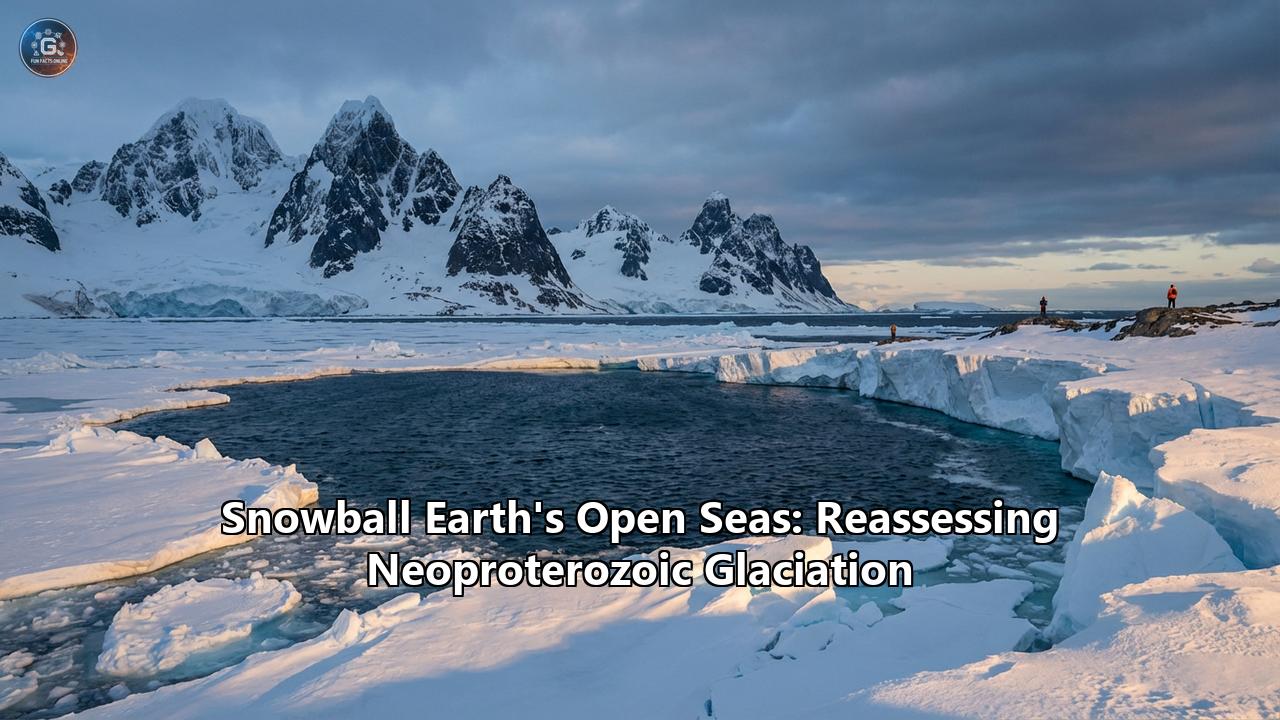
Picture an Earth completely alien to the one we inhabit today. From the vantage point of space, the familiar swirl of blue oceans and green landmasses is gone, replaced entirely by a blinding, glaring sphere of unbroken white. The continents are buried beneath glaciers kilometers thick, and the world’s oceans are sealed beneath a colossal shell of ice. The equator, usually a belt of sweltering tropical humidity, is a frozen wasteland with temperatures plunging to minus 50 degrees Celsius. This is the Cryogenian Period, an era lasting from roughly 720 to 635 million years ago, during which our planet experienced the most extreme climatic catastrophes in its 4.5-billion-year history.
For decades, the "Snowball Earth" hypothesis has captivated geologists, climatologists, and evolutionary biologists alike. It provides a dramatic and elegant explanation for the presence of glacial deposits left behind at what were once tropical latitudes. Yet, this apocalyptic scenario has always harbored a glaring, irreconcilable paradox: if the Earth was entirely sealed in ice for millions of years, cutting off the oceans from the sun and atmosphere, how did light-dependent, oxygen-breathing life survive?
Recent, groundbreaking discoveries have begun to crack the ice of the "hard" Snowball Earth theory. A sweeping reassessment of Neoproterozoic glaciation is currently underway, driven by high-resolution geochemical data, advanced climate modeling, and astonishing fossil discoveries. The emerging picture is not of a dead, frozen wasteland, but of a highly dynamic "Slushball" Earth—a world punctuated by vital oases of open seas, vigorous ocean circulation, and mid-latitude refugia that served as the crucibles for the evolution of complex life.
The Genesis of a Glacial Apocalypse
To understand the magnitude of the current reassessment, we must first look at how the Snowball Earth hypothesis was born. The geological breadcrumbs pointing to a frozen antiquity have been accumulating since the mid-20th century, when geologists began discovering "dropstones"—boulders carried by glaciers and dropped into marine sediments—in rock formations that magnetic data proved were located near the equator at the time of their deposition.
In 1992, Caltech geobiologist Joseph Kirschvink coined the term "Snowball Earth". He proposed a mechanism by which the Earth could actually freeze over: the runaway ice-albedo feedback. When continents clustered near the equator, they became subject to heavy rainfall, which accelerated the chemical weathering of silicate rocks. This process pulled massive amounts of carbon dioxide (a greenhouse gas) out of the atmosphere. As the Earth cooled, polar ice caps expanded. Because ice is highly reflective (high albedo), it bounced more of the sun’s energy back into space, cooling the planet even further. Once the ice sheets advanced past a critical threshold—around 30 degrees latitude—the feedback loop became unstoppable. The ice marched rapidly toward the equator, enveloping the globe.
Harvard geologist Paul Hoffman later championed and expanded this theory, finding compelling evidence in the cap carbonates of Namibia—thick layers of limestone that sit directly atop glacial deposits, recording the rapid, ultra-greenhouse aftermath of the Snowball's eventual thaw. Under the canonical "hard" Snowball model, this deep freeze occurred at least twice during the Neoproterozoic era: the Sturtian glaciation (approx. 717 to 660 million years ago) and the Marinoan glaciation (approx. 640 to 635 million years ago). During these events, the oceans were thought to be entombed under ice up to a kilometer thick, shutting down the hydrological cycle, halting air-sea gas exchange, and turning the global ocean into a dark, anoxic (oxygen-deprived) abyss.
The Biological Conundrum: Life in a Freezer
The elegance of the hard Snowball Earth theory clashed violently with the biological record. By the time the Sturtian glaciation began, Earth was already teeming with life. While animals had not yet evolved, the oceans were filled with diverse communities of bacteria, archaea, and, crucially, eukaryotic organisms. These included photosynthetic cyanobacteria and early forms of green and red algae.
Photosynthetic life requires sunlight, which cannot penetrate a kilometer of solid marine ice. Furthermore, aerobic eukaryotes require free oxygen to survive. If the oceans were entirely cut off from the atmosphere, the dissolved oxygen would have been rapidly depleted by the decay of organic matter, leaving the seas anoxic and rich in dissolved iron (ferruginous). Under a strict hard Snowball model, the planet should have experienced a mass extinction of catastrophic proportions, wiping out the ancestors of all modern plants and animals.
Yet, the fossil record shows no such mass extinction. In fact, life emerged from the Cryogenian Period seemingly invigorated, leading directly to the Ediacaran biota—the Earth's first flourishing of macroscopic, multicellular organisms. How did these organisms survive tens of millions of years in a planetary freezer?
Early attempts to solve this puzzle invoked extreme extremophile behavior. Some scientists suggested that life clung to the margins of volcanic hydrothermal vents in the deep ocean, though this could not explain the survival of light-dependent algae. Others proposed that meltwater pools on the surface of the ice (cryoconite holes), darkened by wind-blown dust, could have hosted microbial communities. However, these tiny, nutrient-poor puddles were unlikely to sustain the sheer diversity of eukaryotic life that successfully navigated the glacial bottleneck.
The Slushball and Waterbelt Alternatives
The biological paradox forced climate modelers back to their supercomputers. Could the Earth have remained partially unfrozen? Thus emerged the "Slushball Earth" or "Waterbelt" hypothesis.
Using complex thermodynamic sea-ice models, atmospheric scientists demonstrated that a completely frozen Earth is incredibly difficult to achieve and, once achieved, even harder to escape. Some models suggested that as ice advanced toward the equator, the extreme cold and lack of evaporation would drastically reduce snowfall. Without snow to cover it, the equatorial sea ice would remain thin, bare "sea-glacier" ice, which allows some sunlight to penetrate.
More intriguingly, several models revealed a "Jormungand" climate state—named after the World Serpent of Norse mythology that encircled the Earth. In this scenario, the runaway ice-albedo feedback is halted just short of total planetary encasement, leaving a continuous belt of open, liquid water churning around the equator. This waterbelt would be sustained by ocean currents transporting heat from the equator to the ice margins. A Slushball Earth would provide the perfect refugium: a sunlit, oxygenated strip of ocean where marine life could wait out the millions of years of glaciation.
For years, the debate raged between the Hard Snowball and the Slushball camps. What was missing was physical, geological proof from the rocks themselves that open water existed during the darkest days of the Marinoan and Sturtian glaciations.
The Nantuo Formation Revelation
The turning point in the reassessment of Neoproterozoic glaciation came from the rugged, mountainous terrain of the Shennongjia Forestry District in Hubei Province, South China. Here, the Nantuo Formation holds an immaculate, continuous sedimentary record of the Marinoan glaciation, dating back roughly 654 to 635 million years.
In 2023, a team of researchers from the China University of Geosciences, the University of Cincinnati, and the UK published a landmark study in Nature Communications that effectively shattered the Hard Snowball paradigm. Buried within the dark, carbon-rich black shales of the Nantuo Formation, they discovered something that theoretically should not have existed: the fossilized remains of complex, benthic phototrophic macroalgae. In simpler terms: seaweed.
The discovery of the Songluo Biota, as these fossils are known, carried profound implications. Benthic macroalgae live attached to the seafloor in shallow coastal waters. They are completely dependent on sunlight for photosynthesis. The fact that they were growing and thriving during the height of the Marinoan glaciation proved unequivocally that their environment was not covered by thick, opaque ice.
But the most shocking revelation was not just that open water existed; it was where it existed. Paleomagnetic reconstructions of the Earth's continents during the Marinoan glaciation place the South China block not at the balmy equator, but at mid-latitudes—between 30 and 40 degrees north.
If the equator-only "Waterbelt" hypothesis were strictly true, mid-latitudes should have been locked under solid ice. The survival of macroalgae in South China implies that Snowball Earth was not a monolithic block of ice with a single equatorial puddle, but rather a dynamic, shifting, and patchy landscape. As lead researcher Huyue Song noted, the Marinoan glaciation was not a static deep-freeze, but an active climate system featuring multiple intervals of melting and freezing, creating widespread, ice-free "oases" or islands of open water far from the equator.
The Geochemical Symphony of Survival
Fossils are rare, but the chemical signatures left behind in the rocks—geochemical proxies—provide a continuous broadcast of what the Snowball Earth oceans were doing. Recent high-resolution isotopic analyses have painted a vivid picture of these open-sea refugia.
The Breathing Ocean: Nitrogen and Carbon Cycling
Under a hard Snowball, the ocean's nutrient cycles would grind to a halt. Without wind to stir the waters and without runoff from the continents, the seas would stagnate. However, a seminal 2017 study by Johnson, Goldblatt, and colleagues analyzed nitrogen isotopes from Marinoan glacial deposits. Nitrogen is a critical building block for DNA and proteins. In a healthy ocean, the nitrogen cycle is driven by bacteria that fix atmospheric nitrogen, nitrify it in oxygenated waters, and denitrify it in deeper, anoxic zones.
The researchers found robust isotopic evidence of an active, complex nitrogen cycle during the Marinoan glaciation. This proves two monumental facts. First, there must have been significant air-sea gas exchange, which is impossible if the ocean is entirely sealed by ice. Second, the surface waters must have been oxygenated to support nitrification. The Snowball ocean was breathing. It was producing marine oxygen, hosting an active biosphere, and maintaining nutrient inputs from exposed, weathering continental margins.
Subglacial Meltwater and the Iron Seas
While the surface waters in these oases were oxygenated, the deep ocean was a different story. Without the global ocean circulation patterns we have today, the deep seas became highly stratified, anoxic, and ferruginous (choked with dissolved iron).
This stratification presented a unique survival mechanism, as outlined in a 2019 study published in PNAS by Maxwell Lechte and his team. They examined iron-rich chemical sediments (iron formations) deposited in glacial environments. They discovered that as the massive continental ice sheets ground against the land, they produced immense volumes of subglacial meltwater. Because this meltwater was derived from glacial ice that had trapped air bubbles, it was rich in dissolved oxygen.
When this dense, highly oxygenated, freezing meltwater discharged into the ocean at the glacier's grounding line, it violently collided with the warm, anoxic, iron-rich seawater. The dissolved iron instantly oxidized and precipitated out as rust, sinking to the seafloor and leaving behind the iron formations we study today. More importantly for biology, this continuous injection of oxygenated meltwater created localized, highly stable "oxygen oases" right at the edges of the ice sheets. Even if the open ocean froze over temporarily, these coastal subglacial meltwater plumes provided a reliable, oxygen-rich sanctuary for aerobic marine habitats.
Rare Earth Elements and Ocean Stratification
Further corroboration comes from the dolostones of the Nantuo Formation. An analysis of Rare Earth Elements (REEs) and trace metals in these rocks reveals a distinct chemical signature. The patterns show that while the deep waters were deeply ferruginous and toxic to complex life, there existed a persistent, thin oxic or suboxic layer restricted to shallow coastal waters. These geochemical fingerprints definitively rule out the idea that the world’s oceans were entirely poisoned or frozen. Instead, life was squeezed into a narrow, two-dimensional sliver of habitability—clinging to the shallow, sunlit, oxygenated coasts of mid-latitude continents, surrounded by an encroaching ice sheet on one side and a toxic, iron-rich abyss on the other.
Refugia as Evolutionary Crucibles
Reassessing Neoproterozoic glaciation not only solves the paradox of how life survived; it illuminates why life suddenly became so complex immediately afterward. The traditional view of Snowball Earth treats it as an evolutionary pause button. The modern, dynamic "Open Seas" view frames it as an evolutionary pressure cooker.
By confining all eukaryotic life into isolated, disconnected refugia—mid-latitude open-water oases and subglacial meltwater plumes—the Marinoan and Sturtian glaciations created the perfect conditions for allopatric speciation. Populations of algae and early single-celled organisms were cut off from one another for millions of years. In these harsh, highly competitive, and resource-limited micro-environments, the selective pressures were immense. Organisms that could cooperate, form multicellular colonies, or adapt to wildly fluctuating oxygen levels had a distinct survival advantage.
When the Snowball finally began to crack, it did so with unimaginable violence. Millions of years of volcanic outgassing had pumped atmospheric CO2 levels to extreme heights (perhaps 10 to 100 times modern levels), as there was no liquid ocean or exposed rock to absorb it. Once the ice-albedo feedback reversed, the Earth transitioned from a deep freeze to a sweltering hothouse in a geologic blink of an eye.
The melting glaciers unleashed a planetary-scale flash flood, scraping the continents bare and dumping millions of years' worth of pulverized rock, phosphorus, and other vital nutrients into the oceans. The isolated, highly adapted lifeforms in their coastal refugia were suddenly unleashed into a vast, nutrient-rich, rapidly warming, and increasingly oxygenated global ocean. This is the very environmental whiplash that scientists believe triggered the Ediacaran explosion and the subsequent Cambrian explosion, giving rise to the first animals, sponges, and eventually, us. Without the agonizing bottleneck of the open-sea refugia, complex life as we know it might never have evolved.
Redefining the Neoproterozoic and Beyond
The shift from a "Hard Snowball" to a dynamic "Slushball" or "Waterbelt" model fundamentally changes our understanding of Earth's climate system. It demonstrates that our planet has an astonishingly resilient thermostat. Even when pushed to the absolute limits of cold, the Earth's internal heat, combined with the nuances of sea-ice thermodynamics and oceanic heat transport, fights back to maintain pockets of habitability.
This realization stretches far beyond our own paleontology; it has profound implications for astrobiology. When astronomers search the cosmos for exoplanets, they often look for "Earth-like" worlds within the narrow Goldilocks Zone. But the reassessment of the Cryogenian Period suggests that the parameters for life are much broader. If Earth could maintain open seas and support complex eukaryotic ecosystems while predominantly covered in ice, then exoplanets previously dismissed as "too cold" or "iceballs" might actually be harboring vibrant, complex life in localized waterbelts or grounding-line refugia. It also lends tantalizing hope to the search for life within our own solar system, on ice-encrusted moons like Europa and Enceladus, where subglacial oceans interface with tidal heating.
Conclusion
The story of Snowball Earth is no longer just a tale of a frozen, dormant rock drifting through space. Through the tireless work of geologists reading the chemical signatures of dolostones, paleontologists uncovering ancient seaweeds in the mountains of South China, and climatologists modeling the thermodynamics of sea ice, a new narrative has emerged.
The Neoproterozoic glaciations were indeed the most severe climate crises life on Earth has ever faced. But the Earth was never completely defeated. Amidst the towering ice sheets and the roaring, frigid winds, the oceans kept breathing. In mid-latitude oases and equatorial waterbelts, beneath the glaring sun, patches of blue water rippled against the ice. Here, in these isolated open seas, the ancestors of all modern plants and animals fought for survival, transforming a planetary catastrophe into the ultimate crucible of evolution. The ice did not conquer life; it forged it.
Reference:
- https://www.quora.com/Can-you-explain-what-a-snowball-earth-event-is-and-how-long-it-typically-lasts
- https://www.science.gov/topicpages/s/snowball+earth+hypothesis.html
- https://www.sciencealert.com/snowball-earth-may-not-have-been-an-endless-frozen-wasteland-after-all
- https://www.researchgate.net/figure/Three-models-of-refugia-during-Cryogenian-Snowball-Earth-glaciation-left-and-simplified_fig3_369791845
- https://astrobiology.com/2023/04/snowball-earth-might-have-been-slushball-earth.html
- https://egusphere.copernicus.org/preprints/2023/egusphere-2023-2073/
- https://www.sciencenews.org/article/warm-band-may-have-girdled-snowball-earth
- https://www.pnas.org/doi/10.1073/pnas.1909165116
- https://www.mdpi.com/2076-3263/2/2/90
- https://www.mdpi.com/2075-163X/9/6/348
- https://pmc.ncbi.nlm.nih.gov/articles/PMC5673069/
- https://pubs.geoscienceworld.org/gsa/gsabulletin/article/136/9-10/4050/636057/Synglacial-carbonate-records-of-snowball-Earth
- https://nome.unak.is/wordpress/tag/snowball-earth/
- https://journal.hep.com.cn/fesci/EN/10.1007/s11707-011-0179-9