
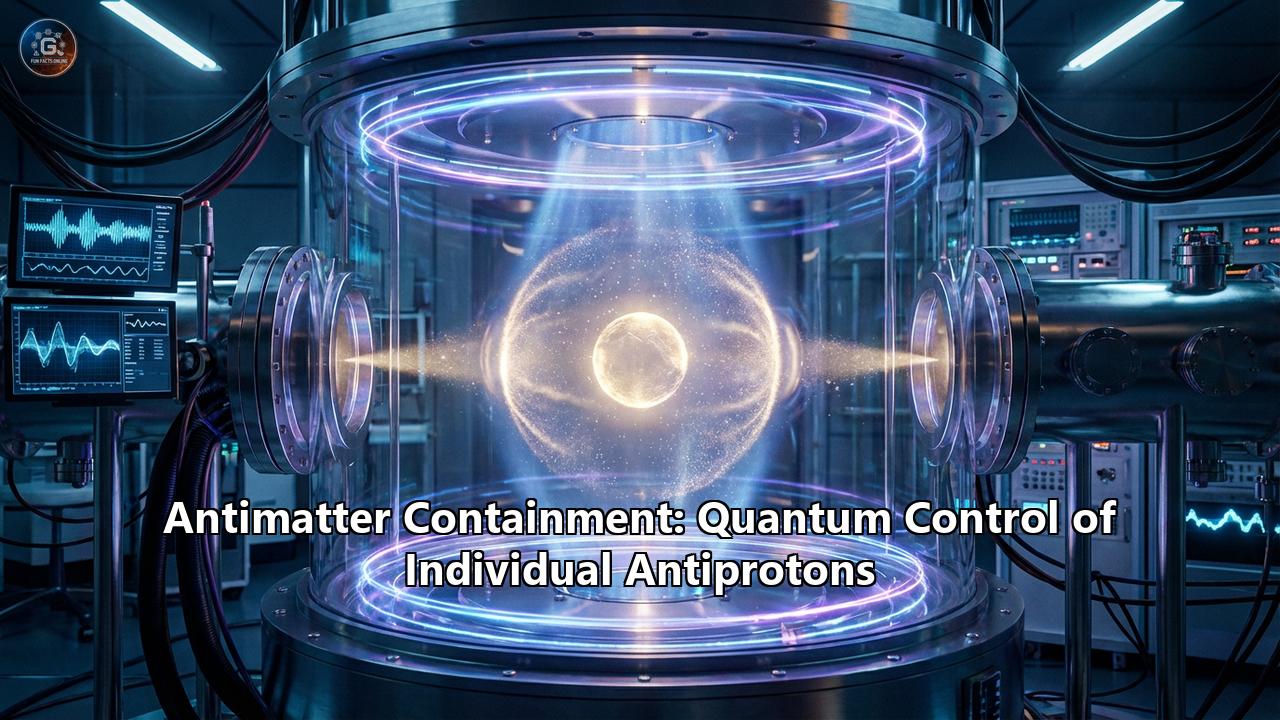
For nearly a century, antimatter has been the "enfant terrible" of physics—volatile, elusive, and prone to violent annihilation upon the slightest contact with our material world. It is the substance of starship dreams and cosmic paradoxes. But in the quiet, supercooled vacuum of a laboratory at CERN, the narrative has shifted from explosive containment to delicate, absolute mastery. We have moved beyond merely caging the beast; we are now teaching it to dance.
As of early 2026, the frontier of high-energy physics is no longer just about smashing particles together at near-light speeds to see what debris flies out. It is about stillness. It is about the "Quantum Control of Individual Antiprotons"—a feat that represents the pinnacle of precision measurement. The recent breakthroughs by the BASE (Baryon Antibaryon Symmetry Experiment) collaboration have achieved what was once thought impossible: the isolation, cooling, and coherent quantum manipulation of a single antiproton.
This is not just a technical triumph; it is a confrontation with the universe’s deepest secret. The Big Bang should have created equal parts matter and antimatter, yet we live in a universe made of matter. Where did the antimatter go? To answer this, physicists are interrogating individual antiprotons with a precision that rivals the ticking of the most accurate atomic clocks, searching for the tiniest flaw in the symmetry of reality.
II. The Vessel of the Void: The Advanced Penning TrapTo control an antiproton, you must first create a prison from which there is no escape and within which there is no touch. This vessel is the Penning Trap.
Imagine a microscopic can, no larger than a stack of coins, situated inside the bore of a massive superconducting magnet. Inside this can, the air is pumped out to a vacuum so extreme that it rivals interstellar space—pressures lower than $3 \times 10^{-18}$ mbar. In this void, a combination of strong magnetic fields and static electric fields creates a "potential well," a gravitational-like valley where charged particles are forced to orbit endlessly.
For years, the gold standard was simply keeping them alive. The BASE collaboration shattered records by keeping a cloud of antiprotons trapped for over 405 days. But "quantum control" requires more than a cloud; it requires a soloist.
The modern trap architecture is a "multi-trap" system. It consists of a Reservoir Trap, where a cloud of antiprotons (harvested from CERN’s Antiproton Decelerator) is stored, and a Precision Trap, where the magic happens. Using sophisticated voltage ramps, physicists can pinch off a small segment of the cloud, shuttle it between zones, and filter the particles until exactly one antiproton remains.
This single particle, isolated in the dark cold of 4 Kelvin (-269°C), becomes the subject of the most precise interrogation in history. It orbits the trap like a tiny planet, its motion defined by three specific frequencies: the cyclotron motion (orbiting the magnetic field lines), the axial motion (bouncing up and down), and the magnetron motion (a slow drift around the center).
III. The Quantum Waltz: Sympathetic Cooling and Logic SpectroscopyThe challenge of the single antiproton is its "temperature." Even when trapped, the particle is "hot" in the quantum sense—it jitters with thermal noise that obscures precise measurements. You cannot touch it to cool it, and traditional laser cooling (used for normal atoms) doesn't work because we lack the "anti-lasers" or simple energy level structures required for antiprotons.
The solution, perfected in recent years, is Sympathetic Cooling. It is a quantum waltz between a beauty and a beast.
Physicists trap a single "logic ion"—typically a Beryllium ion ($^9Be^+$)—in a separate but adjacent trap. This Beryllium ion can be laser-cooled to near absolute zero, entering its quantum ground state where it is virtually perfectly still. Through the electrostatic force (the repulsion between charges), the "hot" antiproton is coupled to the "cold" Beryllium ion. They "feel" each other across the gap. The antiproton transfers its thermal energy to the Beryllium ion, which then radiates it away via laser fluorescence.
This technique allows the antiproton to be cooled to the ground state, the lowest possible energy level allowed by quantum mechanics.
Once cold, the team employs Quantum Logic Spectroscopy. Since we cannot easily "read" the state of the antiproton without destroying its quantum coherence, we use the Beryllium ion as a messenger. By coupling their motions, the quantum state of the antiproton (specifically its spin direction, "up" or "down") is mapped onto the Beryllium ion. The Beryllium ion is then probed with a laser; if it lights up, the antiproton was in one state; if it stays dark, it was in the other. This allows for the non-destructive readout of the antimatter's secret life.
IV. The 2025 Breakthrough: Coherent Spin ControlIn July 2025, the physics world was rocked by a publication from the BASE collaboration. For the first time, they demonstrated coherent spin spectroscopy on a single antiproton.
Previously, measurements were "incoherent"—like flipping a coin and seeing where it lands. The 2025 experiment was different. They managed to place the antiproton into a "superposition" of spin states—simultaneously spin-up and spin-down—and maintain this delicate quantum phase for nearly 50 seconds.
This is a lifetime in the quantum realm. For those 50 seconds, the antiproton acted as a qubit (quantum bit), the fundamental unit of quantum computing.
By applying precise microwave pulses, the researchers induced "Rabi oscillations," causing the antiproton's spin to flip back and forth in a predictable, coherent rhythm. This level of control reduced the width of the resonance resonance peak by a factor of 16 compared to previous methods.
Why does this matter? Precision. The frequency at which the spin flips (the Larmor frequency) is directly tied to the particle's magnetic moment. By measuring this frequency with unprecedented accuracy, and comparing it to the proton, we are testing the fundamental symmetry of the universe (CPT symmetry) to a precision of parts per trillion.
V. Portable Antimatter: The BASE-STEP ProjectPerhaps the most sci-fi application of this technology is the BASE-STEP (Symmetry Test with Portable Antiprotons) initiative.
Historically, if you wanted to study antimatter, you had to go to CERN in Geneva, the only place on Earth with an Antiproton Decelerator. But the magnetic environment at a particle accelerator is "noisy," vibrating with the hum of massive machinery, which limits the precision of sensitive quantum measurements.
The solution? Take the antimatter "to go."
BASE-STEP is a transportable Penning trap system—essentially a antimatter thermos truck. It is designed to load a cloud of antiprotons at CERN, lock them in a portable superconducting magnet, and then be driven by truck to a quiet, dedicated precision laboratory (like the one at Heinrich Heine University in Düsseldorf).
This project relies on the extreme vacuum and stability developed for the single-particle control. If you can control a single antiproton for years, you can certainly take a billion of them on a road trip. This opens the door to a new era where antimatter is a resource distributed to high-precision laboratories worldwide, allowing for experiments that are currently impossible in the noise of an accelerator hall.
VI. Beyond the Trap: The Search for New PhysicsThe ultimate goal of this quantum control is not just stewardship; it is interrogation. The Standard Model of particle physics is incredibly successful, but it is incomplete. It cannot explain dark matter, dark energy, or the matter-antimatter asymmetry.
By comparing the charge-to-mass ratio and the g-factor (magnetic moment) of the proton and antiproton, scientists are looking for a crack in the mirror.
- CPT Symmetry Tests: If the antiproton's magnetic moment differs from the proton's by even the tiniest fraction, CPT symmetry is broken. This would imply that the laws of physics are not the same for matter and antimatter, potentially explaining why our universe exists at all.
- Dark Matter Searches: These traps are so sensitive that they can act as detectors for Dark Matter. If "axion-like particles" (a candidate for dark matter) permeate the universe, they might interact faintly with the spinning antiproton, causing a tiny wobble in its precession frequency.
While the current focus is on fundamental physics, the mastery of individual antiprotons lays the groundwork for the distant future. The energy density of antimatter is unparalleled—$9 \times 10^{16}$ Joules per kilogram. A few grams could power a city; a few kilograms could send a starship to Proxima Centauri.
We are centuries away from the "warp cores" of Star Trek. However, the techniques of high-density non-neutral plasma confinement (stuffing billions of antiprotons into a small space) are being refined alongside these single-particle experiments. Projects investigating the interactions of antimatter with gravity (like the ALPHA-g and GBAR experiments) rely on similar trapping and cooling technologies.
ConclusionWe have entered the "Golden Age" of antimatter physics. We are no longer merely observing the destructive flashes of annihilation. We are holding a single mirrored shard of reality in a magnetic bottle, cooling it to the stillness of deep space, and asking it to whisper its secrets. In the quantum control of the individual antiproton, we find not just a triumph of engineering, but a doorway to understanding the very origins of existence. The mirror is no longer just reflecting; it is speaking.
Reference:
- https://physicsworld.com/a/quantum-control-of-individual-antiprotons-puts-the-standard-model-to-the-test/
- https://home.cern/news/news/physics/quantum-leap-antimatter-measurements
- https://www.riken.jp/en/news_pubs/research_news/rr/20190329_FY20180065/index.html
- https://physicsworld.com/a/sympathetic-cooling-gives-antihydrogen-experiment-a-boost/
- https://arxiv.org/pdf/2107.08433
- https://en.wikipedia.org/wiki/Penning_trap
- https://base.web.cern.ch/content/base-experiment
- https://www.youtube.com/watch?v=YsUKgV3bzc8
- https://antimatter.physik.uni-mainz.de/transportable-antiproton-traps/
- https://base.web.cern.ch/
- https://www.youtube.com/watch?v=Z3kO6ev7kng
- https://www.researchgate.net/publication/386584994_Future_of_Antimatter_Production_Storage_Control_and_Annihilation_Applications_in_Propulsion_Technologies