
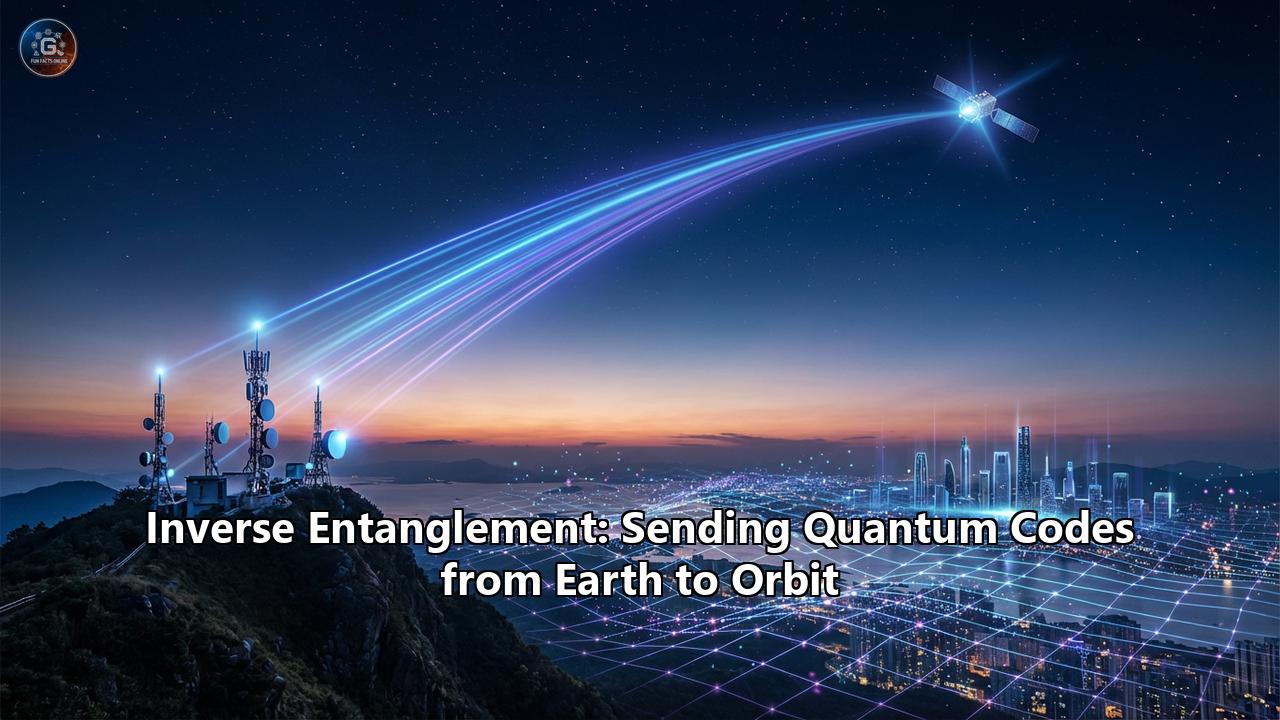
For nearly a decade, the dream of a global quantum internet has hung suspended in low Earth orbit, raining down upon us from above. Since the launch of China’s Micius satellite in 2016, the standard model for quantum communication has been a one-way street: a highly complex satellite generates fragile pairs of entangled photons in the vacuum of space and fires them down to ground stations on Earth. It was a brilliant solution to a difficult problem, but it was also a technological dead end for scalability. It required putting the most expensive, sensitive, and power-hungry equipment in the most inaccessible place imaginable.
Now, that model has been inverted.
In late 2025, researchers from the University of Technology Sydney (UTS) and international collaborators shattered the "glass ceiling" of quantum physics. They demonstrated that the "impossible" link—sending entangled quantum codes from Earth up to orbit—is not only possible but is the key to unlocking a commercially viable quantum internet. This paradigm shift, which we might call "Inverse Entanglement," changes everything. It moves the heart of the quantum network from the sky to the ground, turning satellites into simple mirrors and putting the power of the quantum revolution back in human hands.
This is the comprehensive story of that reversal—why it was thought impossible, how it was achieved, and why it ensures that the future of the internet will be written in the language of quantum mechanics.
Part I: The Downlink Era and the Atmospheric Wall
To understand the magnitude of the "Inverse Entanglement" breakthrough, we must first understand the physics of the problem. Quantum communication relies on entanglement—the spooky phenomenon where two particles (usually photons) become inextricably linked. Change the state of one, and the other changes instantly, no matter the distance. This allows for Quantum Key Distribution (QKD), a method of encryption that is theoretically unbreakable because any attempt to eavesdrop on the key destroys the entanglement, alerting the users.
The Problem of Loss
Photons are incredibly fragile. In a fiber optic cable, a photon traveling a few hundred kilometers has a high probability of being absorbed or scattered. To build a global network, you need to send them thousands of kilometers. Traditional amplifiers used in today's internet cannot copy quantum states (due to the No-Cloning Theorem), so you cannot simply boost the signal.
Space offered a solution. By sending photons through the vacuum of space, where there is no air to scatter them, they can travel vast distances. But they eventually have to hit Earth.
Why Downlink Was King
In the "Downlink" model (Space-to-Earth), the satellite generates the entangled pairs. It fires them down toward telescopes on the ground.
- The Physics: The atmosphere is thickest near the ground and thins out as you go up. When a photon comes down from space, it travels through 480km of vacuum (perfect clarity) and only hits the "mud" of the atmosphere in the last 10-20km.
- The Benefit: By the time the atmosphere distorts the beam, the photon is already nearly at the receiver. The beam has spread out, but the turbulence happens at the very end of the journey, making it manageable.
This is why Micius and subsequent missions were designed as downlinks. It was the path of least resistance. But it came with a massive cost.
The Satellite Bottleneck
The Downlink model forces you to put your quantum source—a complex lab bench of lasers, crystals, and detectors—on a satellite.
- Power: Satellites run on solar panels. Quantum lasers need juice. This limits how bright and fast your source can be.
- Maintenance: If a component fails, you can't send a technician to fix it.
- Cost: Launching heavy, complex scientific payloads is exorbitantly expensive.
- Obsolescence: Quantum technology advances monthly. A satellite launched today is obsolete in three years, but it stays in orbit for a decade.
The Downlink model proved the physics worked, but it proved the economics were broken. To build a quantum internet, we needed to keep the expensive, heavy, power-hungry gear on the ground and just use the satellites as relays. We needed to go Up.
Part II: The "Impossible" Uplink
For years, physicists stated that an Uplink (Earth-to-Space) for quantum entanglement was effectively impossible with current technology.
The Atmospheric Lens
When you fire a laser from the ground up into space, you are firing it through the thickest, most turbulent air immediately.
- Beam Wander: Turbulent air pockets act like shifting lenses. They bend the beam left and right. If you aim a laser at a satellite 500km away, a tiny wiggle at the source (the ground) translates to missing the satellite by kilometers once the beam arrives.
- Beam Broadening: The atmosphere scatters the light, causing the laser spot to spread out. By the time it reaches the satellite, the "spot" of light might be huge, and the tiny telescope on the satellite will only catch a microscopic fraction of the photons.
In the Downlink, the beam spreads in the vacuum where it's safe. In the Uplink, the beam gets mangled at the start, and that mangled trajectory gets amplified over 500km of travel. The loss rates were calculated to be insurmountable. It was estimated that to get one entangled photon pair to survive the journey, you would need to fire trillions, requiring power levels that would melt the equipment or blind pilots.
This was the consensus: Gravity is easy; Uplink is hard.
Part III: The UTS Breakthrough
In late 2025, the narrative flipped. A team led by Professor Simon Devitt and Professor Alexander Solntsev from the University of Technology Sydney (UTS) published a landmark paper in Physical Review Research.
They didn't invent a new type of laser or a magic lack of atmosphere. Instead, they used advanced modeling to prove that the "impossible" was actually just a rigorous engineering challenge. They introduced a new protocol—the "Inverse" approach—that utilized the full power of ground stations to brute-force through the atmospheric wall.
The "Inverse" Mechanics
The core realization of the UTS team was that while the atmosphere is an obstacle, the ground offers infinite resources.
- Infinite Power: Unlike a satellite limited by battery life, a ground station can plug directly into the national power grid. You can crank up the laser intensity to levels impossible in orbit.
- Adaptive Optics: We can use the same technology astronomers use to untwinkle stars. By firing a "guide star" laser up, measuring how the atmosphere distorts it, and then warping a deformable mirror in real-time to cancel out that distortion, we can "pre-correct" the quantum beam. When the pre-mangled beam hits the mangled air, they cancel out, creating a straight shot.
- The "dumb" Satellite: The most crucial part of the Inverse Entanglement model is that the satellite becomes "dumb." It doesn't need to generate quantum states. It only needs a small receiver to catch the photons and perform a simple measurement (Bell state measurement).
Entanglement Swapping
The specific protocol modeled by the team involves Entanglement Swapping.
- Ground Station A (Alice) generates an entangled pair. She keeps one and fires the other up to the satellite.
- Ground Station B (Bob), hundreds of kilometers away, does the same.
- The Meeting: The satellite receives one photon from Alice and one from Bob.
- The Swap: The satellite performs a joint measurement on the two photons. Because of the magic of quantum mechanics, this measurement "swaps" the entanglement. Suddenly, the photon Alice kept on the ground and the photon Bob kept on the ground become entangled with each other, even though they never met.
- The Result: You have created a secure quantum link between two ground stations using the satellite only as a middleman.
The UTS study showed that even with the atmospheric scattering, the higher power available on the ground, combined with precise synchronization and adaptive optics, yields a secure "key rate" (the speed of data transfer) that is commercially viable.
Part IV: Why "Inverse Entanglement" Changes the World
This shift from Downlink to Uplink (Inverse) is not just a scientific curiosity; it is the industrial revolution of quantum technology.
1. The Democratization of Access
In the Downlink era, if a country or company wanted a quantum network, they had to build and launch a billion-dollar quantum satellite. In the Inverse era, the satellite infrastructure becomes shared, generic, and cheap.
- CubeSats: Because the satellite only needs a receiver and not a laser lab, the payload can fit on tiny, inexpensive "CubeSats" (shoebox-sized satellites).
- The "Cell Tower" Model: A telecommunications company could launch a constellation of cheap, "dumb" quantum receiver satellites. Then, anyone on Earth—banks, universities, governments—can buy a ground terminal and point it at the sky. The expensive complexity stays with the user, where it is accessible and upgradeable.
2. Quantum "Electricity"
Professor Devitt compared this transition to the electricity grid. We don't generate electricity inside our laptops; we generate it at massive power plants and transmit it to the device.
"Inverse Entanglement" turns entanglement into a utility. The ground station is the power plant. It generates the "quantum fuel" (entangled photons) and pumps it into the network. The user just plugs in. This allows for massive scaling. If you need more bandwidth, you don't launch a new satellite; you just upgrade the laser on your roof.
3. Connecting Quantum Computers
The ultimate goal isn't just secure email (QKD); it's the Quantum Internet. This requires linking quantum computers to create a "distributed quantum cluster."
- To link quantum computers, you need incredibly high bandwidth—millions of entangled pairs per second.
- Downlink satellites simply cannot generate pairs fast enough. They are too small and power-constrained.
- Uplink stations, powered by the grid and utilizing massive banks of lasers, can generate the necessary bandwidth.
The Inverse model is the only path to connecting a quantum computer in New York to one in London to create a super-machine.
Part V: The Technological Roadmap
So, how do we build it? The transition to Inverse Entanglement requires mastering three specific technologies.
1. Synchronization (The Time Problem)
For the satellite to swap entanglement between Alice and Bob, their photons must arrive at the satellite detector at exactly the same instant.
- The Challenge: The satellite is moving at 27,000 km/h. The distance to Alice and Bob is changing by microseconds every moment.
- The Solution: The ground stations must fire their photons with "predictive timing." They must calculate exactly where the satellite will be and fire the photon early or late so it arrives in perfect sync with the other photon. This requires atomic-clock precision, but again, atomic clocks are easier to keep on the ground than in space.
2. Adaptive Optics (The Turbulence Problem)
As mentioned, correcting for the "soup" of the atmosphere is critical.
- Laser Guide Stars: Ground stations will fire bright orange sodium lasers into the upper atmosphere. These lasers excite sodium atoms, creating a fake "star."
- Deformable Mirrors: Sensors track how this fake star wiggles. A computer calculates the inverse wiggle and applies it to a rubber-like mirror 2,000 times a second. The quantum laser bounces off this mirror and enters the atmosphere "pre-corrected," slicing through the turbulence like a needle.
3. The "Quantum Memory" Buffer
In the future, we won't just rely on lucky timing. Satellites will carry Quantum Memories.
- Instead of needing Alice's and Bob's photons to hit the detector at the same nanosecond, the satellite could catch Alice's photon, store it in a crystal (quantum memory) for a millisecond, wait for Bob's photon, and then perform the swap.
- This relaxes the timing requirements and drastically increases the success rate.
Part VI: Real-World Applications
What does a world with Inverse Entanglement look like?
Blind Quantum Computing
Imagine a hospital that wants to use a quantum computer to simulate a new drug molecule. They can't afford a quantum computer (which costs millions and requires near-absolute zero cooling). They want to rent time on a cloud quantum computer (like those from Google or IBM).
- The Problem: The hospital cannot send their data to the cloud computer because the data (patient DNA, proprietary formula) is sensitive. If they send it, the cloud provider could see it.
- The Solution: Using the Uplink, the hospital entangles their laptop with the cloud quantum computer. They can then use a protocol called Blind Quantum Computing. They send instructions to the server that are encrypted by the laws of physics. The server performs the calculation without ever knowing what the calculation is. It returns the result, which only the hospital can decrypt.
This is only possible with the high-bandwidth links provided by the Inverse/Uplink model.
Global Voting and Governance
Secure voting systems are the holy grail of democracy. A quantum internet allows for "unforgeable" digital ballots. Because quantum states cannot be copied (No-Cloning), a digital vote sent via quantum uplink cannot be duplicated or spoofed.
Deep Space Communication
While the UTS study focused on Earth-to-Orbit, the Inverse model opens the solar system.
If we want to communicate securely with a base on Mars, we cannot put a massive transmitter on the Mars rover. But we can put a massive transmitter on Earth (Uplink). We fire the signal up to Mars. The Mars base only needs a receiver. The heavy lifting is done by Terra.
Part VII: The Future Horizon
The late 2025 announcement by UTS is comparable to the moment we switched from dial-up to broadband. It didn't change what the internet was, but it changed what the internet could do.
We are now moving toward a "Hybrid Quantum Network."
- Layer 1 (The Backbone): Fiber optic cables for short distances (within cities).
- Layer 2 (The Inverse Link): Ground-to-Space Uplinks connecting cities to the orbital network.
- Layer 3 (The Orbital Mesh): Satellites talking to satellites via laser, routing traffic around the globe.
The "Quantum Sky"
In the near future, look up. You won't see them, but crossing the sky will be invisible beams of entangled light, fired from rooftops in Tokyo, New York, and Sydney. These beams will be carrying the encryption keys for the world's financial systems, the calculations for new life-saving medicines, and the private conversations of a new digital age.
The "Inverse Entanglement" revolution teaches us a profound lesson about innovation: sometimes, when you hit a wall (or a thick atmosphere), the solution isn't to push harder—it's to flip the script. By reversing the direction of the stream, we have turned the sky from a barrier into a bridge. The quantum age is no longer falling from the stars; it is rising from the Earth.
Reference:
- https://www.sciencedaily.com/releases/2025/12/251217082515.htm
- https://thequantuminsider.com/2025/11/05/in-step-toward-quantum-communication-networks-new-research-shows-feasibility-of-sending-quantum-signals-to-a-satellite/
- https://thedebrief.org/satellite-communications-breakthrough-could-pave-the-way-toward-quantum-energy/
- https://www.thebrighterside.news/post/ground-based-satellite-uplink-revolutionizes-quantum-communication/
- https://www.sciencealert.com/scientists-thought-a-quantum-satellite-uplink-was-impossible-until-now
- https://app.futurwise.com/article/08e17864-1467-4e04-9ce2-af237d906b8a?ref=thedigitalspeaker.com
- https://www.innovationnewsnetwork.com/innovating-satellite-communication-with-quantum-entangled-photons/4548/